This compound belongs to the class of organic compounds known as benzonitriles. These are organic compounds containing a benzene bearing a nitrile substituent.
External Descriptors
Not available
1. Djoumbou Feunang Y, Eisner R, Knox C, Chepelev L, Hastings J, Owen G, Fahy E, Steinbeck C, Subramanian S, Bolton E, Greiner R, and Wishart DS. ClassyFire: Automated Chemical Classification With A Comprehensive, Computable Taxonomy. Journal of Cheminformatics, 2016, 8:61.
Determine the necessary mass, volume, or concentration for preparing a solution.
Dilution Calculator
Determine the dilution needed to prepare a stock solution.
Reconstitution Calculator
Bewertungen
Kundenbewertungen
Application Protocols
Not applicable. This listing is a synthetic organic reagent and does not have immunoassay or staining protocols (e.g., WB, IHC, IF, FC). For practical use, see Reaction Conditions and Application sections for synthetic procedures.
Biological Roles
This product is a small synthetic aromatic nitrile not known to have endogenous biological function. The notes below are general background (literature/general) and do not imply suitability for biological systems.
Endogenous role: None known in primary metabolism. Aromatic nitriles are rare in native biochemistry but occur in some plant-derived natural products and can be formed by specialized enzymes (e.g., cyanogenic pathways).
Physicochemical properties relevant to biology: Hydrophobic–moderately lipophilic (logP ~2.5–2.7), low water solubility, neutral at physiological pH. Likely to partition into lipid phases rather than aqueous compartments.
Reactivity in biological media: The aryl nitrile is generally metabolically stable; potential biotransformations include oxidative metabolism on the ring and, less commonly, nitrile hydrolysis to amide by nitrilases/nitrile hydratases (microbial systems).
Safety note: Handling and disposal should follow chemical safety protocols; this product is for research use only and is not intended for food, drug, cosmetic, or household use.
Buffer Applications
Not typically applicable. 2-Chlorobenzonitrile is a neutral, water-insoluble organic building block and is not used to formulate aqueous buffers or electrophoresis media. For practical use, see the Reaction & Applications and Solvent Selection sections.
Green Alternatives
Greener strategy focuses on solvent/catalyst choices and step economy rather than replacing the substrate itself (literature/general):
Solvent selection
Replace 1,4-dioxane/DMF with 2-MeTHF, CPME, toluene/ethanol mixtures, or water/MeOH micellar media where catalytic systems permit.
Catalyst/ligand choices
Nickel catalysis or heterogeneous Pd on reusable supports can reduce precious-metal loading. Use air-stable precatalysts to simplify handling and minimize waste.
Process intensification
Micellar catalysis (e.g., surfactant-enabled aqueous couplings) or flow chemistry can reduce solvent volumes and improve heat/mass transfer for aryl chloride activation.
Step economy
Starting from 2-chlorobenzonitrile avoids separate cyanation steps (which can involve toxic cyanide reagents), reducing risk and waste.
Comparison snapshot (literature-general):
1,4-Dioxane vs CPME/2-MeTHF
Efficiency: Comparable for many Pd couplings with modern ligands.
Safety/Environment: CPME/2-MeTHF have better environmental profiles and lower peroxide concerns than ethers like THF; dioxane is a hazardous air pollutant.
Pd vs Ni catalysts
Cost/abundance: Ni more abundant/cheaper; may require stricter air/moisture control.
Substrate scope: Pd often broader/tolerant; Ni excels with certain challenging electrophiles.
Note: Choice should be validated at lab scale; observe institutional green-chemistry guidelines and waste minimization practices.
Pharmaceutical Uses
No excipient or formulation role is indicated for this item. Not specified for this item; refer to CoA/Spec Sheet.
General context (literature/industry):
2-Chlorobenzonitrile is employed as a synthetic intermediate in process chemistry for small-molecule APIs and agrochemicals, where the aryl chloride enables cross-coupling/amination and the nitrile can be diversified (hydrolysis, reduction, hydration).
In pharmaceutical manufacturing settings, control of halogenated/isomeric impurities and residual metals (from catalytic steps) is important; these are process-specific and governed by ICH guidelines, not a property of the starting material itself.
No therapeutic or clinical claims are made; this product is for research and laboratory synthesis only.
Physical Properties
Item-specific numerical specifications are not provided in the Product Data. Values below are literature data for 2-chlorobenzonitrile and are for reference only (not product specifications).
Phase/appearance at ambient conditions: Not specified for this item; refer to CoA/Spec Sheet. (Note: literature indicates a low-melting solid/liquid near room temperature.)
Molecular formula: C7H4ClN (literature)
Molecular weight: 141.57 g/mol (literature)
Melting point: ~26–28 °C (literature)
Boiling point: ~227–229 °C at 1 atm (literature)
Density: ~1.23–1.25 g/mL at 25 °C (literature)
Refractive index: n20/D ≈ 1.54 (literature, if measured in liquid state above mp)
Vapor pressure: Low at ambient temperature (literature qualitative)
Solubility: Sparingly soluble in water; miscible/soluble in common organics (acetone, acetonitrile, dichloromethane, ethyl acetate, toluene, alcohols) (literature)
LogP (octanol/water): ~2.5–2.7 (literature)
pKa: Not applicable (no ionizable protic site; nitrile is weakly basic only under superacid conditions) (literature)
Practical note: With a melting point close to room temperature, the material may be partially solidified in cool labs; gentle warming (ambient to ~35 °C) may be required for homogeneous handling (general guidance). Always verify item-specific handling on the CoA/Spec Sheet.
Quality and Grades
Grade/purity for this specific catalog item: Not specified for this item; refer to CoA/Spec Sheet.
Appearance for this specific item: Not specified for this item; refer to CoA/Spec Sheet.
General guidance for interpreting common grades of 2-chlorobenzonitrile (literature/industry conventions):
Technical grade: Suitable for bulk synthesis where trace UV-absorbers or minor impurities are acceptable. May contain higher levels of halogenated byproducts.
Reagent/ACS grade: Meets general reagent specifications; typically controlled for assay and select impurities.
High-purity (≥99%) or “for synthesis” grade: Lower levels of halogenated isomers and benzonitrile; preferred for catalytic cross-couplings and when downstream purification is limited.
Low-water/low-acid variants: Beneficial for base-sensitive reactions (e.g., strong-base metalations) and for moisture-sensitive catalysts; check COA for water/acid number if critical.
Stabilizers/inhibitors: Not typically required for aryl nitriles; none are specified for this item. If a stabilizer is present in a particular lot, it will be listed on the CoA.
QC considerations for this substrate (practical):
Key impurities to monitor include chlorobenzene, benzonitrile, positional chlorobenzonitrile isomers (3-, 4-), and hydrolysis products (2-chlorobenzamide/acid). GC/HPLC and 1H/13C NMR are routinely used. For cross-couplings, trace metal content can influence catalyst performance; consult CoA if relevant.
Reaction and Applications
2-Chlorobenzonitrile is a versatile aryl electrophile bearing a synthetically rich nitrile handle. Key application families (literature/general):
Cross-coupling of the aryl chloride
Suzuki–Miyaura: Formation of 2-cyanobiaryl motifs; requires catalysts/ligands competent for aryl chlorides (e.g., Pd/XPhos, SPhos, RuPhos; or Ni/bipyridyl). Bases: K3PO4, Cs2CO3. Solvents: toluene, dioxane, CPME, or aqueous mixtures. Typical 60–120 °C.
Buchwald–Hartwig amination: Converts C–Cl to anilines; BrettPhos/XPhos/BippyPhos ligands with Pd(0/II), or Ni systems. Strong bases (NaOtBu, Cs2CO3) and 80–110 °C are common.
Kumada/Negishi/Stille: Possible with appropriate activation; Ni or Pd catalysts can address aryl chlorides effectively.
Nucleophilic aromatic substitution (SNAr)
The ortho nitrile increases ring deactivation and can facilitate SNAr with strong nucleophiles (e.g., alkoxides, amines) under forcing conditions, though aryl chlorides generally remain less reactive than aryl fluorides.
Directed metalation/functionalization
The –C≡N group is a strong ortho-directing, metal-coordinating group. Lithiation (e.g., s-BuLi/TMEDA) can enable further substitution adjacent to CN; quench with electrophiles (D2O, CO2, electrophilic halogens).
Transformations of the nitrile
Hydrolysis: To 2-chlorobenzamide (partial) or 2-chlorobenzoic acid (complete) under acidic or basic reflux.
Reductions: To 2-chlorobenzylamine (full hydrogenation, e.g., Pd/C, Raney Ni) or to 2-chlorobenzaldehyde via controlled DIBAL-H or Schwartz reagent at low temperature.
Nitrile hydration: Catalytic hydration to the amide using metal catalysts or solid acids.
Use as precursor/intermediate
Common in the synthesis of agrochemical scaffolds, dyes, and functional materials where the nitrile participates in further diversification. No medical/clinical claims are implied.
Reaction Conditions
The following conditions are general literature guidance for 2-chlorobenzonitrile; they are not specifications for this product.
Catalyst: Pd2(dba)3 (0.5–1 mol% Pd) with XPhos/SPhos (1–2 mol%) or Pd-PEPPSI (NHC).
Base: K3PO4 (2–3 equiv) or Cs2CO3; water or t-BuOH/H2O as co-solvent beneficial.
Solvent/Temp: Toluene, dioxane, CPME, or Me-THF; 80–110 °C; 2–16 h.
Typical outcomes: Moderate to high yields for many boronic acids; aryl chlorides may require higher temp or more active ligand.
Buchwald–Hartwig amination (Ar–Cl + amine)
Catalyst: Pd(OAc)2 or Pd2(dba)3 with BrettPhos/XPhos/BippyPhos (1–3 mol% Pd).
Base: NaOtBu, K3PO4, or Cs2CO3 (2–3 equiv).
Solvent/Temp: Toluene, dioxane, or CPME; 80–110 °C; 4–18 h.
Nitrile reduction to aldehyde (chemoselective)
Reagent: DIBAL-H (1.2–1.5 equiv) in toluene or THF at −78 to −20 °C; careful quench to avoid over-reduction.
Alternative: Schwartz reagent (Cp2Zr(H)Cl) in THF, −78 to 0 °C.
Nitrile reduction to amine
Catalytic hydrogenation: Pd/C or Raney Ni, H2 (10–50 bar), MeOH/EtOH, 25–80 °C.
Hydride routes: BH3·THF, followed by hydrolysis; note safety controls for boranes.
Hydrolysis to amide/acid
Acidic: 6 M HCl, reflux (amides) or longer to acids; mixed solvents (dioxane/water) improve solubility.
Basic: Aqueous NaOH/KOH, reflux to acids; amide isolation by controlled conditions.
Directed ortho-metalation
Base: s-BuLi (1.1–1.5 equiv) with TMEDA in THF/Et2O at −78 to −40 °C; quench with electrophiles.
Note: Actual conditions depend on substrate/partner scope and scale. Screen ligands/bases and monitor for potential catalyst inhibition by the nitrile.
Safety and Handling
Item-specific GHS details are not provided in the Product Data; consult the product SDS for authoritative information. The guidance below reflects general hazards of aryl nitriles and aryl chlorides (literature/general).
GHS classification and pictograms: Not specified for this item; refer to SDS.
Signal word/H-statements: Not specified for this item; refer to SDS. (Aryl nitriles often carry warnings for acute toxicity if swallowed/inhaled and for eye/skin irritation.)
Key hazards (general chemistry knowledge)
Combustible organic liquid/low-melting solid; vapors may form flammable mixtures at elevated temperatures.
Harmful if swallowed or inhaled; may cause irritation to skin, eyes, and respiratory tract.
Not a cyanide salt; does not readily liberate HCN under normal handling, but strong acidic/basic hydrolysis can generate amide/acid and ammonia under forcing conditions.
Handling recommendations (general best practices)
Use in a fume hood; avoid inhalation of vapors/aerosols and skin contact.
Wear appropriate PPE: lab coat, safety glasses, and chemical-resistant gloves (e.g., nitrile). Consider double-gloving for prolonged handling.
Prevent release to the environment; collect waste as halogenated organic waste.
Incompatibilities (general)
Strong oxidizers; strong bases/acids under heating (can promote hydrolysis or side reactions); reactive metals when combined with strong bases (metalation chemistry).
First-aid overview (general)
Inhalation: Move to fresh air; seek medical attention if symptoms persist.
Skin/eye contact: Rinse with water for at least 15 minutes; remove contaminated clothing; seek medical advice if irritation continues.
Ingestion: Rinse mouth; do not induce vomiting; seek medical attention.
Always defer to the SDS and institutional protocols for spill response, fire-fighting measures, and exposure controls.
Solvent Selection
As a halogenated aromatic nitrile, 2-chlorobenzonitrile is a substrate rather than a solvent. Solvent choice pertains to its use in reactions and processing.
Polarity and miscibility (literature/general)
Moderately polar, non-protic aromatic compound; water solubility is low; miscible with many organic solvents (DCM, THF, acetone, MeCN, EtOAc, toluene, alcohols).
Dielectric properties similar to benzonitrile derivatives; favorable dissolution in polar aprotic media.
Typical solvent choices by application
Pd/Ni cross-coupling (Suzuki, Buchwald–Hartwig): Toluene, dioxane, CPME, or Me-THF with alcohol/water co-solvents; polar options like DMAc, NMP, or MeCN for challenging aryl chlorides.
Nucleophilic substitutions/metalation: THF, MTBE, or Et2O under strong base at low temperature.
Hydrolysis (to amide/acid): Aqueous ethanol, dioxane/water, or acetic acid/water under reflux.
Reductions: Alcoholic solvents (MeOH/EtOH) for catalytic hydrogenation; THF/toluene for DIBAL or Schwartz reagent to control chemoselectivity.
Selection tips
For aryl chloride activation, more polar, high-boiling solvents can enhance catalyst activity; consider ligand-enabled systems to use greener ethers (CPME/2-MeTHF) in place of dioxane.
Avoid highly basic aqueous media when nitrile hydrolysis is undesirable.
Brief comparison (literature-general)
Toluene: Low polarity, good for Pd-couplings with bulky ligands; easy workup.
1,4-Dioxane: Effective but less green; consider CPME/2-MeTHF as alternatives.
MeCN/DMAc: Boosts rate/solubility for tough aryl chlorides; use with appropriate PPE and waste management.
Storage and Reconstitution
Storage (from Product Data): Room temperature.
Shipping (from Product Data): Normal conditions.
Additional general guidance (literature/practice; verify with CoA/SDS):
Keep container tightly closed in a cool, well-ventilated place. Protect from heat sources above its melting point if solid form causes container blockage; gentle warming may be needed before dispensing.
Store away from strong oxidizers, strong acids/bases, and reactive metals. Maintain dryness to prevent hydrolytic impurities during prolonged storage.
If partial solidification occurs near room temperature (mp ~26–28 °C, literature), warm to ~30–35 °C and mix to homogenize before aliquoting or analytical sampling.
Reconstitution: Not applicable; the product is supplied neat. If preparing stock solutions, use dry, compatible organic solvents (e.g., toluene, THF, MeCN, DCM) and store solutions in airtight containers; minimize exposure to moisture and air for base- or catalyst-sensitive applications.
Shelf life: Not specified for this item; refer to CoA/Spec Sheet. Inspect periodically by GC/HPLC/NMR if used as a coupling electrophile where trace hydrolysis or isomeric impurities may impact performance.
Research Use Note: For research use only.
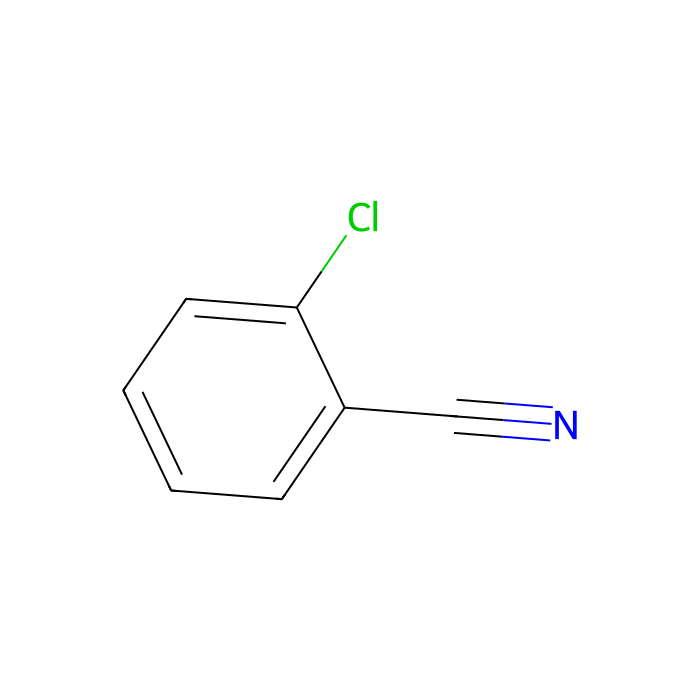
Structure and Identity
A halogenated aromatic nitrile useful as an electrophilic aryl building block and as a cyano-bearing handle for further transformations.
Item-specific identifiers (from Product Data)
SKU: C105958
Product name: 2-Chlorobenzonitrile
CAS: 873-32-5
CID: 13391
InChIKey (per product data): 238939 (note: not a standard-format InChIKey; see literature key below)
Storage conditions: Room temperature
Shipped in: Normal
Literature structure identifiers (for reference; not item-specific specs)
Molecular formula (literature): C7H4ClN
Molecular weight (literature): 141.57 g/mol
SMILES (literature): N#Cc1ccccc1Cl
Standard InChIKey (literature): TWLHWQDLPUHDBC-UHFFFAOYSA-N
Structural features (general description)
Core: Monosubstituted benzene ring bearing an ortho chloro substituent relative to the nitrile (–C≡N) group.
Functional groups: Aryl chloride (C–Cl on sp2 carbon) and aryl nitrile (sp hybridized carbon of –C≡N conjugated to the ring).
Regiochemistry: The chloro substituent is adjacent (ortho) to the nitrile, enabling directing effects and potential intramolecular interactions in metalation chemistry.
2D structure (in words): A benzene ring with a nitrile at position 1 and chlorine at position 2; remaining ring positions are unsubstituted hydrogens.
Functional group perspective (literature/general):
Aryl chloride (C–Cl): Platform for C–C, C–N, C–O, and C–S bond formation via Pd/Ni catalysis; can undergo directed metalation enabled by the adjacent nitrile.
Aryl nitrile (–C≡N): Convertible into amides, acids, aldehydes, amines; serves as a strong electron-withdrawing and directing group, modulating reactivity and regioselectivity.
Retrosynthetic/value considerations:
Starting from 2-chlorobenzonitrile avoids hazardous cyanation steps on later-stage scaffolds and sets the stage for late diversification at the C–Cl site.
Ortho relationship between Cl and CN allows strategic intramolecular coordination (e.g., chelation-assisted catalysis) and selective ortho metalation.
Representative transformations:
Suzuki–Miyaura coupling to install (hetero)aryl partners, giving 2-cyanobiaryls.
Buchwald–Hartwig amination to furnish 2-cyanoanilines.
Nitrile reduction to 2-chlorobenzylamine or controlled partial reduction to 2-chlorobenzaldehyde (DIBAL-H, Schwartz reagent).
Hydrolysis to 2-chlorobenzamide/2-chlorobenzoic acid; subsequent derivatizations (esterification, Curtius/Schmidt from acid derivatives).
Directed ortho-metalation followed by electrophile trapping (formylation, halogenation, deuteration).
Selectivity notes:
Aryl chloride activation often requires stronger catalysts/ligands than bromides/iodides; modern Pd–biaryl phosphine or Pd–NHC systems enable efficient couplings at moderate temperatures.
The nitrile can coordinate to metals; catalyst/ligand choice should account for potential inhibition or beneficial chelation depending on the transformation.
Target Specificity
Not applicable. This product is a small-molecule chemical reagent, not a biological targeting reagent or antibody. No antigen/epitope, species reactivity, clone, or isotype information applies.
Wir verwenden Cookies, um die ordnungsgemäße Funktion der Website sicherzustellen und, soweit zulässig, Ihr Nutzererlebnis zu verbessern. Sie können Ihre Einstellungen jederzeit unter „Einstellungen“ verwalten. Weitere Informationen finden Sie in unserer Cookie-Richtlinie.
Shall we send you a message when we have discounts available?
Remind me later
Thank you! Please check your email inbox to confirm.
Products are supplied to verified businesses, institutions, and qualified professionals for research and development use only. Not for use in humans, animals, diagnosis, or therapy.

 C2324417