2-Ethyl-4-methylimidazole can be used as a: cross-linker for epoxy resins to synthesize network polymers with improved thermal resistance and physical properties. curing agent for polysiloxane episulfide resin (PSER). catalyst to promote curing of blends of hyperbranched aromatic epoxy polymer and bisphenol F diglycidyl ether.
This compound belongs to the class of organic compounds known as imidazoles. These are compounds containing an imidazole ring, which is an aromatic five-member ring with two nitrogen atoms at positions 1 and 3, and three carbon atoms.
External Descriptors
Not available
1. Djoumbou Feunang Y, Eisner R, Knox C, Chepelev L, Hastings J, Owen G, Fahy E, Steinbeck C, Subramanian S, Bolton E, Greiner R, and Wishart DS. ClassyFire: Automated Chemical Classification With A Comprehensive, Computable Taxonomy. Journal of Cheminformatics, 2016, 8:61.
Determine the necessary mass, volume, or concentration for preparing a solution.
Dilution Calculator
Determine the dilution needed to prepare a stock solution.
Reconstitution Calculator
Bewertungen
Kundenbewertungen
Application Protocols
No manufacturer protocols were provided in the Product Data. Below are general, literature-style workflow outlines (for research use only):
Epoxy cure screening (general):
Pre-dissolve 0.5–2.0 wt% 2-ethyl-4-methylimidazole in a portion of epoxy resin (e.g., DGEBA) at 50–60 °C under dry N2/Ar.
Combine with hardener (anhydride or phenolic) per stoichiometry. Degas under vacuum.
Cure schedule example: 80 °C (1 h) → 120 °C (1–2 h) → optional post-cure 150 °C (1 h). Record gel time/DSC exotherm.
N-acylimidazole intermediate (general):
Cool anhydrous DCM to 0–5 °C; add carboxylic acid chloride (1.0 eq) dropwise to a solution of 2-ethyl-4-methylimidazole (1.05–1.2 eq) and Et3N (1.0–1.2 eq).
Stir at 0–25 °C until completion (TLC/LC–MS). Quench with saturated NaHCO3, separate layers, wash, dry, and isolate N-acylimidazole or proceed in situ.
Transesterification test (general):
Combine ester (1.0 eq) and alcohol (1.5–3.0 eq) with 5 mol% catalyst in toluene or 2-MeTHF; heat 80–110 °C with Dean–Stark or sweep gas to remove alcohol byproduct; monitor by GC.
These are illustrative starting points only; optimize conditions for your substrates and equipment.
Biological Roles
Item is intended for research and industrial chemistry; no biological role is assigned to the product.
General context (literature/general):
Imidazole as a motif: The imidazole ring is the side chain of histidine and frequently coordinates transition metals in enzymes (e.g., in hemoproteins and zinc-binding domains). It participates in acid–base catalysis around physiological pH due to a pKaH near neutrality.
Substituted imidazoles: Adding alkyl groups (ethyl, methyl) modulates pKa, hydrophobicity, and binding interactions. Such derivatives can serve as model ligands in bioinorganic studies or as probes for H-bonding networks.
Buffering: While imidazole itself is used in buffers (e.g., His-tag purification), 2-ethyl-4-methyl substitution alters solubility/basicity and is not commonly used as a biological buffer.
Important note:
No medical, diagnostic, or therapeutic uses are claimed. For any work involving biological systems, evaluate cytotoxicity/biocompatibility independently and consult institutional safety protocols.
Buffer Applications
This compound is not typically employed as a laboratory buffer component. If a buffer near neutral pH with imidazole functionality is desired, researchers commonly use imidazole or histidine-based buffers (literature/general) rather than 2-ethyl-4-methylimidazole.
Guidance:
For immobilized metal affinity chromatography (IMAC) or Ni-NTA elution, standard imidazole (not this substituted derivative) is typically used at 10–500 mM, pH 7.5–8.0.
If you need imidazole-like buffering around pH ~6–7, select compounds with well-characterized pKa and buffering ranges; verify UV transparency and metal-binding effects for your application.
For this item: No buffer recipes or pKa specifications are provided. Refer to CoA/Spec Sheet and consider conventional buffering agents for routine biochemical workflows.
Green Alternatives
Context: 2-Ethyl-4-methylimidazole (2E4MZ) is already a low-volatility, high-efficiency catalyst. Green chemistry considerations focus on solvent choice, energy input, and toxicity/volatility trade-offs.
Comparison of catalyst options (literature/general):
2E4MZ: Low vapor pressure (reduced VOC), effective at low loadings, good latency in epoxy systems. Toxicity manageable with standard PPE; not strongly corrosive.
Tertiary amines (e.g., DMP-30, TEA): Often higher volatility and odor; effective but increase VOCs; can cause more pronounced amine blush in epoxies.
DBU/TBD (guanidine/amidines): Very strong bases; high activity at room temperature but poorer latency and potential for runaway exotherms; sometimes more hazardous to handle.
Imidazole (parent) or 1-methylimidazole: Lower molar mass and sometimes higher volatility; activity differs; selection depends on cure schedule and storage stability.
Greener process levers:
Use bio-based or lower-toxicity solvents (e.g., 2-MeTHF, CPME, propylene carbonate) where compatible.
Minimize catalyst loading via kinetic optimization; employ staged temperature ramps for energy efficiency.
Choose solvent-free (neat) or high-solids epoxy formulations where possible.
Implement closed mixing/dispensing to limit operator exposure and emissions.
Trade-offs:
Very strong bases can reduce energy use (lower cure temperature) but compromise pot life and safety margins. 2E4MZ often offers a practical balance between cure speed, latency, and EHS profile.
Pharmaceutical Uses
No pharmacopeial or excipient status is specified for this item; refer to CoA/Spec Sheet. This product is sold for research use only.
General context (literature/general):
Substituted imidazoles are common intermediates in medicinal chemistry campaigns due to their metal-binding and H-bonding capabilities. 2-Ethyl-4-methylimidazole could be used as a building block or catalyst in process development.
As a processing aid, imidazole derivatives may catalyze acylation, carbamate, or carbonate formation in synthetic steps, but they are typically removed during workup and are not intended as formulation excipients.
Formulation notes:
If used in process R&D, ensure removal to below specification limits via extraction, crystallization, or chromatography. Analytical methods often include HPLC-UV or LC–MS monitoring for residual azoles.
Compliance:
No clinical or therapeutic claims are made. For any cGMP context, establish internal specifications (identity, purity, residuals) and follow ICH guidelines for impurities and elemental analysis as applicable.
Physical Properties
Item-specific specifications: Not specified for this item; refer to CoA/Spec Sheet.
Literature/general reference values (typical ranges; not item-specific):
Molecular formula: C6H10N2
Molecular weight: ~110.16 g/mol
Physical state at ambient: reported as a low-melting solid or viscous liquid depending on purity and temperature; some sources list mp in the ~40–60 °C range (literature). If solid at room temperature, it softens near warm ambient conditions.
Boiling point: commonly reported in the ~240–260 °C range at 1 atm (literature).
Density: reports around ~1.00–1.05 g/mL at 20–25 °C (literature).
Refractive index (nD): values around ~1.49–1.51 (literature).
pKa (conjugate acid): imidazole derivatives typically ~7.0–7.5; alkyl substitution often shifts basicity modestly upward from imidazole (pKaH 6.95) (literature trend).
LogP (octanol/water): expected small positive value due to two ring nitrogens and two small alkyls; reported values generally ~0.2–0.7 for comparable alkylimidazoles (literature).
Solubility: miscible with polar organics (alcohols, ketones, ethers); appreciable solubility in water due to the imidazole ring; excellent solubility in DMF/DMSO (literature).
Practical notes for users (general):
Hygroscopicity: imidazoles can absorb moisture/CO2; water uptake can affect viscosity and catalytic performance in epoxy systems.
Viscosity increases upon cooling and upon water loss; gentle warming often restores flow (general handling observation).
Quality and Grades
Item-specific quality details (grade, purity, appearance): Not specified for this item; refer to CoA/Spec Sheet.
Guidance on typical grades for this compound class (general information):
Technical/industrial grade: Common for epoxy curing catalysts and resin modifiers. Emphasis on low water content and controlled color (Gardner) to minimize impact on resin appearance and cure profile.
Laboratory/reagent grade: Suitable for synthetic transformations (e.g., acyl transfer catalysis, N-acylimidazole formation). Often accompanied by NMR/GC purity and water content by Karl Fischer.
Electronic/low-halide grade: In electronics encapsulation, halide and metal ion limits may be specified to protect device reliability (not specified for this item).
Stabilizers/additives:
Imidazoles typically do not require stabilizers. Performance can depend on residual water and acidity; some suppliers dry and package under inert gas to maintain consistency.
What is specific to this item:
Storage condition is explicitly specified: Room temperature, Argon charged. This suggests moisture/oxygen-sensitive performance aspects are considered; maintain the inert headspace when re-closing.
Documentation:
For exact assay, residual solvents, water content, color, and metals: Not specified for this item; refer to CoA/Spec Sheet.
Reaction and Applications
This substituted imidazole is valued as a nucleophilic/base catalyst and latent curing accelerator.
Key application families (literature/general):
Epoxy curing: Accelerates anionic ring-opening polymerization of epoxides and co-cure with anhydrides or phenolic hardeners. Often used at 0.1–5 wt% relative to resin. Balances latency (storage stability) with fast gel/cure on heating.
Urethane chemistry: Catalyzes isocyanate–alcohol reactions and related side reactions (alcohol/isocyanate trimerization control). Lower odor and volatility than tertiary amines.
Transesterification and acyl transfer: Forms reactive N-acylimidazoles from anhydrides/acid chlorides; these intermediates acylate alcohols/amines smoothly.
Carbonate/epoxide coupling and ROCOP: As a co-catalyst/base component with organometallic or organocatalyst systems.
Ionic liquid precursors: Quaternization to imidazolium salts affords task-specific ionic liquids (e.g., for electrochemistry or separations).
Ligand/organocatalyst: The imidazole ring coordinates metals and mediates H-bonding catalysis; substituents tune basicity and solubility.
Practical tips:
Maintain dryness/inert conditions during epoxy formulation to ensure consistent latency and cure. Moisture and acids can alter pot life and exotherm.
For acylations, conduct reactions in polar aprotic solvents (THF, DCM, MeCN) at 0–25 °C to control exotherm; isolate N-acylimidazole intermediates if needed.
In urethanes, start with small catalyst loadings and titrate; elevated temperature markedly increases rate.
Manufacturer Applications: Not provided in the Product Data; the above reflects common literature uses for this compound class.
Reaction Conditions
General guidance from literature (not item-specific specifications):
Epoxy curing/acceleration:
Loading: 0.1–5 wt% relative to epoxy resin (optimize experimentally).
Temperature profile: Latent at ambient; rapid cure on heating (e.g., 80–150 °C depending on resin/hardener). Gel time decreases sharply above ~100 °C.
Atmosphere: Dry/inert recommended to control latency and avoid amine blush; use moisture-controlled environment.
Formation of N-acylimidazoles (acyl transfer):
Solvents: DCM, THF, MeCN, or DMF.
Temperature: 0–25 °C for acid chloride routes; 20–60 °C for anhydride routes.
Bases: Often none required beyond the imidazole; for acid chloride, employ auxiliary base (e.g., Et3N) if HCl scavenging is needed.
Workup: Aqueous wash to remove imidazole salts; extract product into organic phase.
Transesterification/esterification catalysis:
Catalyst loadings: 1–10 mol% typical.
Temperature: 50–120 °C depending on substrate volatility; remove alcohol byproduct to drive conversion.
Quaternization (to imidazolium):
Electrophiles: Alkyl halides, sulfate esters.
Solvents: Polar aprotics (MeCN, acetone) or neat.
Temperature: 50–100 °C; monitor exotherm.
Notes:
Always confirm thermal stability/DSC in your specific matrix.
For scale-up, implement calorimetry (RC1/DSC) to define safe temperature and dosing windows.
Safety and Handling
Item-specific hazard data: Not specified for this item; refer to the product SDS for authoritative safety information. No GHS signal word, H-statements, or pictograms were provided in the Product Data.
General safety information for substituted imidazoles (literature/analog-based; not product-specific):
Hazards: May cause skin/eye irritation; prolonged contact can lead to dermatitis. Vapor pressure is low, but aerosols or mists should be avoided. Amino/azole bases can be harmful if swallowed and may cause respiratory irritation if dust/fumes are generated.
Sensitization: Some imidazoles can act as skin sensitizers; avoid repeated unprotected contact.
Corrosivity: Not strongly corrosive, but basicity can cause irritation to mucous membranes.
PPE and handling:
Wear lab coat, safety goggles, and appropriate chemical-resistant gloves (e.g., nitrile). Use in a chemical fume hood when heating, charging reactors, or weighing fine powders.
Avoid contact with acids (can form imidazolium salts), strong oxidizers (combustion/oxidation risk), and acylating/alkylating agents without proper controls (exothermic reactions).
First-aid (overview; consult SDS):
Skin/eyes: Rinse with water for ≥15 minutes; remove contaminated clothing; seek medical attention if irritation persists.
Inhalation: Move to fresh air; monitor for respiratory symptoms.
Ingestion: Rinse mouth; do not induce vomiting; seek medical advice.
Stability-related risks:
Not an ether—peroxide formation is not a concern. Hygroscopic uptake of moisture/CO2 can affect product performance; keep containers tightly closed under inert gas as specified.
Solvent Selection
2-Ethyl-4-methylimidazole is a polar, basic, heteroaromatic compound used as a catalyst/reactant rather than a bulk solvent.
General solvent compatibility (literature/general):
Highly soluble in polar aprotic solvents (DMF, DMSO, NMP, acetonitrile) and polar protics (alcohols).
Miscible/compatible with common epoxy monomers (e.g., DGEBA), ketones (MEK, MIBK), esters (EtOAc, PGMEA), and ethers (THF, CPME). Water solubility is moderate to high due to the imidazole ring.
When choosing a solvent matrix:
Epoxy formulations: Often used neat or pre-dissolved in epoxy resin, reactive diluents, or in low-volatility solvents (e.g., propylene carbonate) to aid dosing and wetting.
Organic synthesis: Select polar aprotic media (DCM, THF, MeCN, DMF) for acyl-transfer, transesterification, or N-acylimidazole formation. Alcohols can be used when proton shuttling is beneficial, noting possible rate changes.
Avoid strongly acidic media if free-base catalysis is required; protonation suppresses nucleophilicity.
Small comparison (general):
2-Ethyl-4-methylimidazole vs imidazole: Greater lipophilicity and often higher activity/latency balance in epoxy cures; improved solubility in organics.
vs 1-methylimidazole: Retains N–H for H-bonding/metal binding; different catalytic profile (less steric hindrance at ring nitrogens than some 1-alkylimidazoles).
Drying/quality:
Where water-sensitive outcomes matter (epoxies, acylations), use dry solvents and maintain inert atmosphere to match the product’s argon-charged handling.
General handling guidance (literature/practice; align with item’s inert packaging):
Keep container tightly closed under inert gas (Ar/N2) to limit moisture and CO2 uptake. Hygroscopic uptake can alter viscosity and catalytic performance.
Store in a dry place away from acids and strong oxidizers.
If the material solidifies or becomes highly viscous at lower temperatures, warm gently (e.g., 40–60 °C water/oil bath) with container vented/inerted and mix to restore homogeneity. Avoid overheating and open flames.
For solution preparation, use dry, oxygen-free solvents when performance in moisture-sensitive systems (e.g., epoxy) is critical. Filter solutions through PTFE if particulate is observed.
Specifications not provided for this item:
Appearance, assay/purity, water content, stabilizers, and solution stability: Not specified for this item; refer to CoA/Spec Sheet.
Disposal:
Dispose of contents/container in accordance with institutional and local regulations for organic bases/heterocycles.
Structure and Identity
2-Ethyl-4-methylimidazole is a substituted imidazole used widely as a nucleophilic/base catalyst and epoxy curing accelerator.
Item-specific (from Product Data):
SKU: E104846
Product name: 2-Ethyl-4-methylimidazole
CAS: 931-36-2
PubChem CID: 70262
InChIKey (as provided): 362883
Storage: Room temperature, Argon charged
Shipped in: Normal
Research use: For research use only
Computed/Literature identity (for reference; not item-specific specs):
Molecular formula (literature): C6H10N2
Molecular weight (literature): ~110.16 g/mol
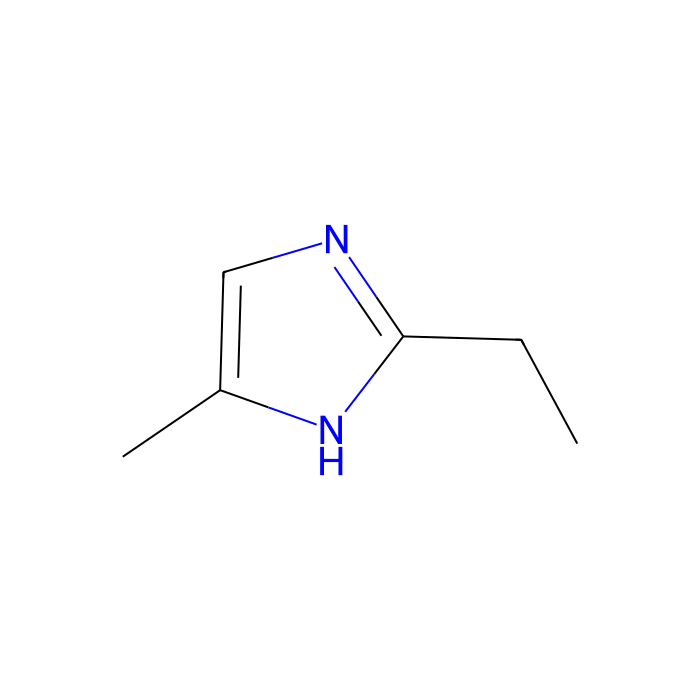
Core scaffold: 1H-imidazole ring bearing an ethyl group at C2 and a methyl group at C4.
Functional groups: aromatic diazole (imidazole), weakly basic sp2 nitrogen (pyridine-like) and an N–H (pyrrole-like) site enabling H-bonding and metal coordination.
2D description: a five-membered aromatic ring with adjacent nitrogens (N1 and N3). The C2 position carries an ethyl substituent (–CH2–CH3); the C4 position carries a methyl (–CH3). The ring N–H can tautomerize, but the 1H-tautomer generally dominates in neutral media.
SMILES/InChI: Not specified for this item; refer to CoA/Spec Sheet or authoritative databases (e.g., PubChem CID 70262) for canonical representations.
Notes:
Substitution pattern modulates basicity and nucleophilicity versus imidazole, improving catalytic activity in epoxy/urethane systems (literature).
Synthetic Utility
Reactivity profile (literature/general):
Nucleophilic/basic catalyst: The sp2 ring nitrogen (pyridine-like) acts as a Lewis base/nucleophile; the N–H participates in H-bonding and proton shuttling, enabling bifunctional catalysis.
Formation of N-acylimidazoles: With acid chlorides or anhydrides, generates activated acyl donors that acylate alcohols/amines under mild conditions. Useful in peptide coupling alternatives and esterifications.
Epoxide activation: Catalyzes anionic ring-opening polymerization and crosslinking of epoxies; can co-catalyze with anhydrides or phenols, often providing latency until moderate heating.
Quaternization/IL synthesis: Alkylation at ring nitrogen yields imidazolium salts—precursors to ionic liquids and organocatalysts.
Metal coordination: Serves as a neutral ligand in coordination complexes; substituents tune sterics/solubility.
Retrosynthetic value:
As a chiral-agnostic, small heteroaromatic, it is a convenient platform for late-stage quaternization or for temporary activation of carboxylic acids.
Practical insights:
Compared to imidazole, the 2-ethyl/4-methyl substitution improves solubility in organic media and modulates basicity, often enhancing rates in nonpolar formulations (e.g., epoxy resins) while maintaining manageable latency.
Water content influences catalytic performance; dry reagents and inert handling improve reproducibility, aligning with the argon-charged storage of this item.
Target Specificity
Not applicable to this product type. This is a small-molecule heterocycle, not a biological targeting reagent or antibody. No antigen/epitope, clone, isotype, or species reactivity information is relevant.
Häufig gestellte Fragen
What is the purity of this product?
This product is supplied at ≥96% purity (chemical assay). Lot-specific values are stated on the Certificate of Analysis.
How should this product be stored?
Store at room temperature under argon. It is supplied under an argon blanket; reseal under inert gas after each use.
How is this product shipped?
This product ships under standard ambient conditions. No temperature-controlled packaging is required.
What are the CAS number, molecular formula and molecular weight?
The CAS Number is 931-36-2, the molecular formula is C6H10N2, and the molecular weight is 110.16 g/mol. InChIKey ULKLGIFJWFIQFF-UHFFFAOYSA-N.
What documentation is provided?
Available product documentation, including Certificates of Analysis (COA), Safety Data Sheets (SDS), and specification sheets, is shown in the product document area. Document availability and access follow the current site policy.
Wir verwenden Cookies, um die ordnungsgemäße Funktion der Website sicherzustellen und, soweit zulässig, Ihr Nutzererlebnis zu verbessern. Sie können Ihre Einstellungen jederzeit unter „Einstellungen“ verwalten. Weitere Informationen finden Sie in unserer Cookie-Richtlinie.
Dürfen wir Sie über Rabattaktionen informieren?
Später erinnern
Vielen Dank! Bitte überprüfen Sie Ihren E-Mail-Posteingang, um zu bestätigen.
Products are supplied to verified businesses, institutions, and qualified professionals for research and development use only. Not for use in humans, animals, diagnosis, or therapy.

 A2305318