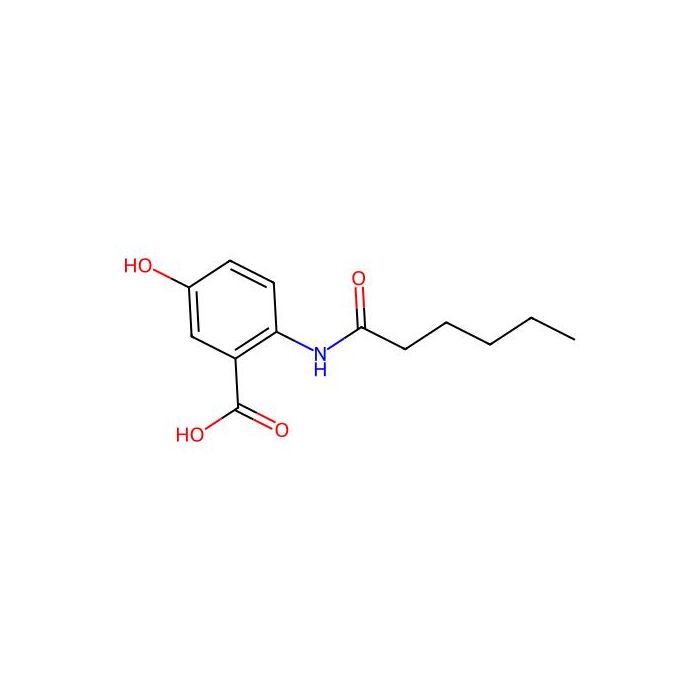
This compound belongs to the class of organic compounds known as acylaminobenzoic acid and derivatives. These are derivatives of amino benzoic acid derivatives where the amine group is N-acylated.
External Descriptors
Not available
1. Djoumbou Feunang Y, Eisner R, Knox C, Chepelev L, Hastings J, Owen G, Fahy E, Steinbeck C, Subramanian S, Bolton E, Greiner R, and Wishart DS. ClassyFire: Automated Chemical Classification With A Comprehensive, Computable Taxonomy. Journal of Cheminformatics, 2016, 8:61.
Zertifikate (CoA, COO, BSE/TSE und Analyse-Diagramm)
C of A & Other Certificates(BSE/TSE, COO):
Analytical Chart:
Chemische und physikalische Eigenschaften
Molekulargewicht
251.280 g/mol
XLogP3
2.700
Hydrogen Bond Donor Count
3
Hydrogen Bond Acceptor Count
4
Rotatable Bond Count
6
Exact Mass
251.116 Da
Monoisotopic Mass
251.116 Da
Topological Polar Surface Area
86.600 Ų
Heavy Atom Count
18
Formal Charge
0
Complexity
293.000
Isotope Atom Count
0
Defined Atom Stereocenter Count
0
Undefined Atom Stereocenter Count
0
Defined Bond Stereocenter Count
0
Undefined Bond Stereocenter Count
0
The total count of all stereochemical bonds
0
Covalently-Bonded Unit Count
1
Lösungsrechner
Molarity Calculator
Determine the necessary mass, volume, or concentration for preparing a solution.
Dilution Calculator
Determine the dilution needed to prepare a stock solution.
Reconstitution Calculator
Bewertungen
Kundenbewertungen
Application Protocols
No tested biological assay protocols are provided in the Product Data for this small-molecule reagent. Typical laboratory use involves:
Preparing concentrated stock solutions (e.g., 10–100 mM) in DMSO/DMF for screening or synthetic steps.
Carrying out organic transformations as outlined under Reaction Conditions and Synthetic Utility.
For any specialized application, validate conditions (solvent, concentration, pH) on small scale and consult relevant literature.
Biological Roles
No specific biological role is assigned to this catalog item in the Product Data. The following are general considerations relevant to research use of small aromatic acids/anilides (no medical or clinical claims):
Interaction motifs: The molecule presents both hydrogen-bond donors (phenol, amide N–H) and acceptors (carboxylate when deprotonated, amide carbonyl, phenolic oxygen), enabling multipoint binding in biochemical assays aimed at probing H-bond networks.
Ionization behavior: At physiological pH, the carboxyl group tends to be deprotonated, while the phenol generally remains unionized; this modulates membrane permeability and target engagement in in vitro systems.
Scaffold utility: Aromatic carboxamides/phenols are common fragments in chemical biology libraries exploring enzyme active sites or protein–protein interaction surfaces via covalent and noncovalent modifications.
Any biological use should be confined to controlled laboratory experiments. For research use only.
Buffer Applications
This compound is not a conventional buffering agent. While it contains acidic functionalities (carboxylic acid and phenol), its pKa values and limited aqueous solubility make it unsuitable as a primary buffer component.
Practical notes:
Aqueous handling is typically accomplished by dissolving in an organic co-solvent (e.g., DMSO) and diluting into assay buffer, or by transient basification to form the carboxylate salt prior to dilution.
If a buffered system is needed, select a standard buffer (e.g., phosphate, HEPES, TRIS) appropriate to your target pH and ensure the compound is introduced via a compatible stock solution.
Green Alternatives
Greener solvent choices and coupling strategies can reduce environmental footprint without sacrificing performance.
Solvent alternatives (general guidance):
Replace DMF/NMP with safer polar aprotics: Cyrene (dihydrolevoglucosenone) or propylene carbonate for certain couplings and O-alkylations; 2-MeTHF or CPME for acid chloride esterifications or when biphasic workups are beneficial.
Favor ethanol or isopropanol for recrystallizations over chlorinated solvents when feasible.
Coupling reagent considerations:
Minimize carbodiimide waste by using catalytic peptide-coupling systems (e.g., COMU) or green coupling aids (oxyma derivatives) with careful quench protocols.
Explore enzymatic esterifications/amidations in green solvents for compatible substrates (literature precedent), though rate/selectivity must be validated.
Comparison snapshot (general):
DMF vs Cyrene: Cyrene offers lower toxicity and biodegradability; viscosity is higher and base compatibility differs—reaction rates may require temperature adjustment.
THF vs 2-MeTHF: 2-MeTHF is bio-derived and less miscible with water, easing separations; it may stabilize some reactive intermediates differently and has higher boiling point.
Trade-offs:
Some green solvents can alter solubility and coupling kinetics for multifunctional aromatics like this compound. Pilot small-scale screenings (0.05–0.2 mmol) are recommended to confirm conversion and selectivity before scale-up.
Pharmaceutical Uses
No pharmacopeial status or excipient role is specified for this item. It is supplied for research use only.
General context for professionals (non-clinical):
As a multifunctional aromatic building block, 2-hexanamido-5-hydroxybenzoic acid may serve as an intermediate in the synthesis of discovery-stage compounds, pro-moieties, or conjugation handles (via its carboxyl and phenolic groups).
Formulation screening in vitro often employs DMSO stock solutions due to solubility constraints; co-solvent systems (e.g., PEG 400/propylene glycol) can be evaluated for preclinical enabling studies in research settings only.
No therapeutic claims are made or implied. For manufacturing or regulatory applications, obtain full quality documentation and assess per internal SOPs.
Physical Properties
Item-specific specifications (from Product Data):
Appearance: Not specified for this item; refer to CoA/Spec Sheet.
Molecular Formula: Not specified for this item; refer to CoA/Spec Sheet.
Molecular Weight: Not specified for this item; refer to CoA/Spec Sheet.
Literature/computed expectations (non-specification, for planning only):
Formula (computed from name): C13H17NO4; MW ~251.29 g/mol
Physical state: Expected solid (aromatic carboxylic acid/anilide; literature analogy)
Melting point: Not located in primary literature for this exact compound; likely moderate mp typical of salicylamide-like benzoic acids. Use differential scanning or a small test melt on receipt if critical.
Boiling point: Not applicable (decomposes before boiling under ambient pressure; literature generality for similar polyfunctional aromatics)
Density: Not specified for this item; refer to CoA/Spec Sheet.
pKa (qualitative, literature expectations):
Carboxylic acid pKa typically ~2–4 in water
Phenolic OH pKa typically ~9–11 (deprotonation facilitated in polar aprotic media)
Amide N is nonbasic; conjugate acid pKaH often <0 (not appreciably protonated in neutral water)
LogP/LogD: Not specified; analogous salicylamide derivatives often show moderate lipophilicity (qualitative).
Low: water (unionized form); improves in basic aqueous media via carboxylate formation
Poor: alkanes, cycloalkanes, nonpolar ethers
UV-Vis: Aromatic π–π* absorption expected near 200–280 nm (literature generality). Exact ε/λmax not specified for this item.
Refractive index: Not applicable for solids; not specified for this item.
Quality and Grades
Item-specific grade/purity information: Not specified for this item; refer to CoA/Spec Sheet.
Guidance on interpreting grades (general):
Research/biochemical grade typically indicates rigorous control of organic and inorganic impurities suitable for synthetic or biochemical assays.
HPLC grade (when specified for solvents) focuses on low UV background and particulate content; for solids used in chromatography development, low nonvolatile residues and well-defined purity are relevant.
Assay reporting: Organic building blocks are commonly specified by HPLC/GC area % or qNMR. Metal content or residual solvent levels may be provided when relevant to catalytic applications. If such specs are critical, request the current CoA.
Stabilizers/additives:
No stabilizer is indicated in the Product Data. If stabilization (e.g., as a salt or with antioxidant) is required for your application, verify with the CoA or inquire for a stabilized lot.
Batch-to-batch assurance (general best practices):
Confirm identity by NMR/HRMS/IR on receipt for sensitive syntheses.
Drying: Some benzoic acids/phenols retain trace solvents or water; brief vacuum drying at ambient or mild heat (≤40–50 °C) can improve consistency (ensure compatibility before heating).
Reaction and Applications
This polyfunctional aromatic building block offers orthogonal handles for derivatization and library synthesis.
Key transformation families (general literature guidance):
Carboxyl group transformations:
Amide/ester formation via carbodiimides (EDC/HOBt, DIC/DMAP) or uronium reagents (HATU/HBTU). Mixed anhydrides or acid chlorides (SOCl2/Oxalyl chloride) where compatible.
Decarboxylative functionalization after activation (e.g., Barton ester pathways) is conceptually possible but substrate-dependent.
Phenolic OH chemistry:
O-alkylation/acylation under basic conditions (K2CO3/Cs2CO3/NaH) in polar aprotics. Protect as benzyl or silyl ethers to direct selectivity.
Conversion to aryl triflate (Tf2O/pyridine) enabling cross-coupling (e.g., Suzuki–Miyaura, Buchwald–Hartwig after subsequent amination strategies).
Anilide (hexanamido) role:
The amide N–H can be acylated/alkylated for N-protection or diversification; note that N-alkylation competes with phenolic O-alkylation—use differential bases/solvents for selectivity.
The amide carbonyl serves as a directing group for certain C–H activations (e.g., ortho metallation of anilides; requires careful condition development due to additional substituents).
Applications (typical in discovery/medchem workflows):
Fragment-to-lead expansion exploring salicylic/anilide pharmacophore space (no clinical claims; research chemistry context only).
Prodrug/bioconjugate linkers: leverage the carboxyl to couple onto amines/alcohols; phenol can be masked as a triggerable group.
Practical tips:
Control chemoselectivity by temporary protection (e.g., methyl/benzyl ester for the acid; silyl/benzyl ether for phenol; Boc on the amide N if needed).
Employ mild bases to favor O- over N-alkylation depending on target; monitor by LC–MS.
Dry, oxygen-free conditions are generally not mandatory, but anhydrous solvents improve coupling efficiency.
Reaction Conditions
General, literature-informed conditions for each functional handle (guidance only; optimize per substrate):
Amide/Ester formation at the carboxyl:
Solvent: DMF, DCM, or 2-MeTHF
Activators: HATU/HBTU (1.1–1.5 equiv) or EDC·HCl (1.2–1.5 equiv) with HOAt/Oxyma; base DIPEA or NMM (2–3 equiv)
Temperature: 0–25 °C (amine-sensitive); up to 50 °C for sluggish alcohol couplings
Time: 1–16 h; monitor by LC–MS/HPLC
Acid chloride route:
Reagents: SOCl2 (3–5 equiv) or (COCl)2 (2–3 equiv) with catalytic DMF
Solvent: DCM/2-MeTHF; 0–25 °C, 0.5–2 h to form acid chloride, then quench into nucleophile at 0 °C to rt
Phenol O-alkylation/acylation:
Base: K2CO3/Cs2CO3 (1.5–2.5 equiv) or NaH (1.1–1.5 equiv for hindered substrates)
Electrophiles: Alkyl halides, sulfonates; acyl chlorides/anhydrides for esters
Solvent: DMF/MeCN/acetone; 25–60 °C; 1–12 h
Tip: Protect the carboxyl as a methyl/benzyl ester to prevent competing acylation or salt formation
Phenol to aryl triflate then cross-coupling:
Triflation: Tf2O (1.2–1.5 equiv), pyridine or 2,6-lutidine, DCM, −20 to 0 °C
Suzuki–Miyaura: Pd(PPh3)4 (1–3 mol%), base K3PO4 or Cs2CO3, dioxane/H2O or 2-MeTHF/H2O, 60–90 °C, 2–12 h
N-Modification of the anilide:
N-acylation: Acyl chloride/anhydride, base (Et3N), DCM, 0–25 °C
N-alkylation: Alkyl halide, mild base (K2CO3) in DMF; monitor for competing O-alkylation—use phase-transfer or solvent tuning for selectivity
Expected outcomes: Many such transformations afford 60–90% isolated yields under optimized conditions (literature ranges). Always confirm compatibility of all functional groups and consider protection as needed.
Safety and Handling
Item-specific hazard data (from Product Data):
Signal Word: Not specified for this item; refer to SDS.
H-Statements: Not specified for this item; refer to SDS.
GHS Classification/Pictograms: Not specified for this item; refer to SDS.
General safety guidance (literature/analog-based; defer to SDS as authoritative):
Likely hazards: Irritation to skin, eyes, and respiratory tract typical of aromatic acids/phenols and amides. Avoid dust generation and inhalation.
PPE: Laboratory coat, safety glasses or goggles, appropriate chemical-resistant gloves (e.g., nitrile). Use in a fume hood to avoid dust exposure.
Handling tips:
Avoid contact with strong oxidizers and strong bases/acids unless intended for reaction.
Phenolic and carboxylic acidity may etch some metals; use glass/PTFE equipment.
Hygroscopicity is not expected to be severe, but keep container tightly closed to prevent moisture uptake and contamination.
First aid overview (consult SDS):
Inhalation: Move to fresh air; seek medical attention if symptoms persist.
Skin/eye contact: Rinse with water for at least 15 minutes; remove contaminated clothing; obtain medical advice if irritation continues.
Ingestion: Rinse mouth; do not induce vomiting; seek medical attention.
Fire & reactivity:
Combustible organic solid; use CO2, dry chemical, or foam extinguishers.
Thermal decomposition may release CO/CO2 and nitrogen oxides.
Spill response: Avoid dust; collect mechanically or with inert absorbent; place in suitable waste container per institutional and local regulations.
Always consult the product’s SDS before use. For research use only.
Preferred dissolution solvents: DMSO, DMF, NMP; solubility often improves with gentle warming and sonication.
Secondary options: Methanol, ethanol, acetone, acetonitrile; may require base (e.g., a drop of triethylamine) to increase solubility via carboxylate formation.
Poor solvents: Aliphatic hydrocarbons, MTBE/diethyl ether (limited), water (neutral pH).
When to choose which solvent (practical guidance):
Stock solutions for screening/biochemistry: DMSO (stable, high solubility). Filter through 0.2 µm if needed.
Coupling at the carboxyl group: DMF, NMP, or DCM with in situ base; consider co-solvents (THF/MeCN) to adjust viscosity.
O-alkylation/acylation of phenol: Polar aprotic solvents (DMF, acetone, MeCN). Use mild base (K2CO3/Cs2CO3) for selective O-functionalization.
Aqueous work: Use basic aqueous media (pH > 7) to solubilize as the carboxylate; re-acidify to precipitate.
Small comparison (general):
DMSO vs DMF: DMSO offers higher solubility and thermal stability; DMF can facilitate homogeneous carbodiimide couplings but may require tighter control of residual dimethylamine.
MeCN vs alcohols: MeCN supports cleaner base-mediated alkylations; alcohols may participate or lead to ester formation under activating conditions.
Storage and Reconstitution
Item-specific (Product Data):
Storage Conditions: Room temperature
Shipped In: Not specified for this item; refer to CoA/Spec Sheet.
General guidance for this compound class:
Storage: Keep tightly closed in a dry, inert atmosphere at ambient temperature away from light and oxidizers. If long-term storage is planned, consider desiccation and an inert headspace.
Stability: Aromatic carboxylic acids/anilides are typically stable at room temperature. Avoid prolonged exposure to strong bases/acids unless intended for reaction, as phenolic/acyl functionalities can undergo transesterification or hydrolysis under harsh conditions.
Reconstitution:
Prepare stock solutions in dry DMSO (common), DMF, or other suitable solvent. Typical concentrations: 10–100 mM depending on solubility.
For aqueous assays, dilute DMSO stocks into buffer with vigorous mixing; keep final DMSO ≤1–2% v/v where assay-compatible.
Filter sterilize (0.2 µm PTFE) if sterility is required for cell-free biochemical assays.
Freeze–thaw: If storing solutions, aliquot to avoid repeated freeze–thaw cycles. DMSO solutions are generally stable at −20 °C for weeks to months; verify by LC–MS before critical use.
Always consult the current CoA/SDS for lot-specific guidance. For research use only.
Structure and Identity
Brief description: 2-Hexanamido-5-hydroxybenzoic acid is an ortho-acylated anilide bearing a benzoic acid core with a phenolic OH at the 5-position and a hexanamido (–NH–CO–C5H11) substituent at the 2-position.
Item-specific (Product Data):
SKU: H976209
Product Name: 2-Hexanamido-5-hydroxybenzoic acid
CAS: 1015856-35-5
PubChem CID: 45926047
InChIKey: 164701 (as provided)
SMILES: Not specified for this item; refer to CoA/Spec Sheet.
Aromatic ring: monosubstituted benzoic acid core (–CO2H at position 1)
Substituents: –NH–CO–(CH2)4–CH3 at C-2 (anilide/secondary amide); –OH at C-5 (phenol)
Functional groups: carboxylic acid, phenol, secondary amide, aromatic ring
Hydrogen-bonding: intramolecular and intermolecular H-bonding possible (CO2H/phenol donors; amide carbonyl/phenolic oxygen acceptors)
2D structure in words: a benzoic acid ring with the carboxyl at C-1, an –NH–CO–hexyl chain attached to the adjacent carbon (C-2), and a phenolic –OH meta to the amide (C-5). No stereocenters; achiral.
Note: Structural identifiers not explicitly supplied in the Product Data (e.g., canonical SMILES) are not claimed here as item specifications.
Synthetic Utility
Functional group set and reactivity (professional guidance):
Carboxylic acid (para to phenol relative to amide): amenable to classical coupling (amide/ester formation), activation to acyl chlorides/mixed anhydrides, and late-stage diversification under mild conditions. Temporary protection as methyl/benzyl esters allows orthogonal manipulations elsewhere on the ring.
Phenolic OH (meta to amide): enables O-alkylation/acylation; convertible to aryl triflate for cross-coupling (Suzuki–Miyaura, Negishi, Stille) to introduce C(sp2)–C(sp2/sp3) bonds while retaining the amide/acid handles (with appropriate protection).
Secondary anilide (hexanamido): N-acylation or N-alkylation to access tertiary amides; serves as a directing group for certain metalations or oxidative couplings in advanced routes.
Retrosynthetic value:
The scaffold allows bidirectional growth: outward from the acid to append linkers/polar groups and from the phenol through O-based leaving groups to install diverse aryl substituents.
Orthogonal protection strategies facilitate selective transformations: e.g., convert phenol to silyl ether (TBS) and acid to methyl ester to channel reactivity to the anilide.
Named/typical tactics (literature):
HATU/DIPEA-mediated amidations or Steglich esterification (DCC/DMAP) at the carboxyl group.
Tf2O-mediated phenol triflation followed by Pd-catalyzed cross-coupling.
Mitsunobu reactions are generally disfavored with phenols lacking suitable acidity tuning; prefer base-mediated O-alkylation.
Workup/purification:
Acid/base partitioning exploits the carboxylate toggle (pH control). Final polishing by flash chromatography on silica; add 0.1–1% acetic acid or triethylamine to mitigate tailing as needed.
Target Specificity
Not applicable. This product is a small-molecule chemical reagent, not a biological targeting reagent (e.g., antibody, enzyme, or ligand with defined target specificity) in the Product Data. No antigen/epitope/isotype information is provided.
Wir verwenden Cookies, um die ordnungsgemäße Funktion der Website sicherzustellen und, soweit zulässig, Ihr Nutzererlebnis zu verbessern. Sie können Ihre Einstellungen jederzeit unter „Einstellungen“ verwalten. Weitere Informationen finden Sie in unserer Cookie-Richtlinie.
Shall we send you a message when we have discounts available?
Remind me later
Thank you! Please check your email inbox to confirm.
Products are supplied to verified businesses, institutions, and qualified professionals for research and development use only. Not for use in humans, animals, diagnosis, or therapy.