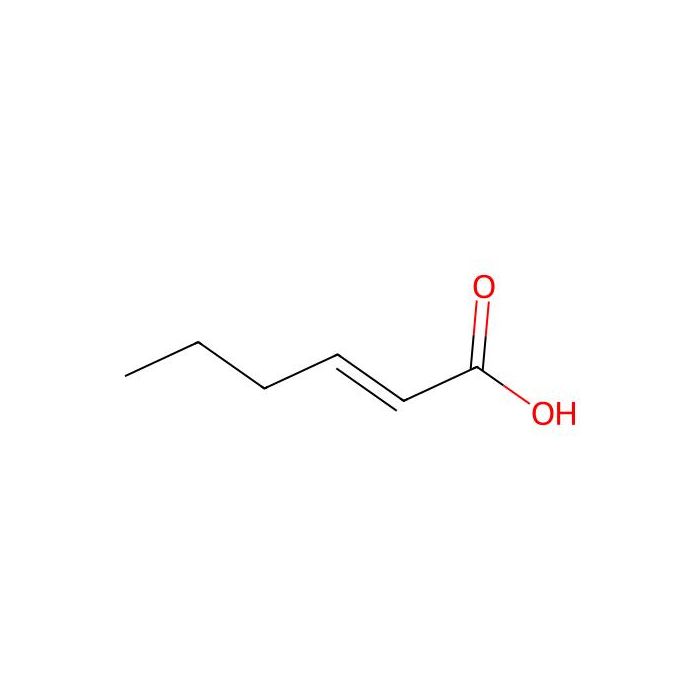
This compound belongs to the class of organic compounds known as medium-chain fatty acids. These are fatty acids with an aliphatic tail that contains between 4 and 12 carbon atoms.
External Descriptors
hexenoic acid
1. Djoumbou Feunang Y, Eisner R, Knox C, Chepelev L, Hastings J, Owen G, Fahy E, Steinbeck C, Subramanian S, Bolton E, Greiner R, and Wishart DS. ClassyFire: Automated Chemical Classification With A Comprehensive, Computable Taxonomy. Journal of Cheminformatics, 2016, 8:61.
Zertifikate (CoA, COO, BSE/TSE und Analyse-Diagramm)
C of A & Other Certificates(BSE/TSE, COO):
Analytical Chart:
Chemische und physikalische Eigenschaften
Molekulargewicht
114.140 g/mol
XLogP3
1.600
Hydrogen Bond Donor Count
1
Hydrogen Bond Acceptor Count
2
Rotatable Bond Count
3
Exact Mass
114.068 Da
Monoisotopic Mass
114.068 Da
Topological Polar Surface Area
37.300 Ų
Heavy Atom Count
8
Formal Charge
0
Complexity
94.700
Isotope Atom Count
0
Defined Atom Stereocenter Count
0
Undefined Atom Stereocenter Count
0
Defined Bond Stereocenter Count
0
Undefined Bond Stereocenter Count
1
The total count of all stereochemical bonds
1
Covalently-Bonded Unit Count
1
Lösungsrechner
Molarity Calculator
Determine the necessary mass, volume, or concentration for preparing a solution.
Dilution Calculator
Determine the dilution needed to prepare a stock solution.
Reconstitution Calculator
Bewertungen
Kundenbewertungen
Application Protocols
No specific tested application protocols are provided for this item. Typical small-molecule handling guidance includes:
Reaction setup: Use oven-dried glassware for moisture-sensitive transformations (e.g., couplings, acyl chloride formation). Purge with inert gas when required.
Analytical monitoring: Track reactions by TLC (UV 214 nm/anisaldehyde), GC-FID, or HPLC (UV ~210–220 nm). Calibrate with authentic standards when quantitation is required.
For validated, application-specific protocols, consult the literature relevant to your transformation or contact Aladdin Scientific technical support with your use case.
Biological Roles
No biological testing is provided for this catalog item. The following information describes general biochemical context of α,β-unsaturated C6 fatty acid analogs (literature):
Structural class: short-chain unsaturated fatty acid analogue; carboxylate form can participate in cellular transport and β-oxidation pathways after activation to acyl-CoA derivatives.
Metabolism (general): carboxylate activation by acyl-CoA synthetases, potential β-oxidation in mitochondria/peroxisomes; the C2=C3 double bond may require isomerase/reductase steps prior to full β-oxidation.
Reactivity in biological milieu: as a conjugated Michael acceptor, the unionized acid can react with soft nucleophiles in vitro; however, at physiological pH the carboxylate is largely deprotonated, reducing electrophilicity.
Sensory chemistry: C6 unsaturated acids/esters are noted odor-active compounds in food/flavor research; this is provided for chemical context only and not as a product claim.
Note: Aladdin Scientific supplies this product strictly for research and laboratory use. No biological efficacy, toxicity, or clinical performance is claimed or implied.
Buffer Applications
2-Hexenoic acid is not a standard laboratory buffering agent. While carboxylic acids can in principle form buffer systems near their pKa, this compound is rarely used for buffering due to odor, limited water solubility, and availability of superior alternatives.
Acid dissociation (literature): pKa ~4.2–4.4. A buffer could, in theory, operate in the ~3.2–5.2 pH range using its sodium/potassium salts.
Practical guidance: prefer conventional buffer systems (acetate, citrate, MES) for robust, nontoxic, and well-characterized buffering capacity.
If your application uniquely requires this specific conjugate base (hex-2-enoate), prepare by neutralizing the acid with equimolar NaOH/KOH in water or aqueous alcohol, then adjust ionic strength as needed. Verify compatibility with your biological/analytical system.
Green Alternatives
While 2-hexenoic acid itself is the target reagent, greener choices pertain to solvent and reagent selection for its transformations.
Replace chlorinated solvents (DCM, CHCl3) with EtOAc, 2-MeTHF, CPME, or MeCN when compatible.
For hydrogenations, use EtOH/iPrOH instead of DMF/THF if solubility permits.
Oxidations/epoxidations:
Use in situ peracetic acid from AcOH/H2O2 or Oxone®/acetonitrile–water rather than mCPBA where feasible; consider catalytic Shi epoxidation (fructose-derived ketone catalyst) for asymmetric variants.
Couplings and activations:
Minimize carbodiimide waste by using catalytic DMAP with acid anhydrides or deploy uronium reagents (HATU) at reduced stoichiometry; aqueous amide couplings (Amidation by activated esters) can reduce solvent load.
Workup/waste:
Opt for bicarbonate extractions and phase-splitting techniques to limit halogenated waste.
Comparison snapshot (general):
DCM vs EtOAc: similar polarity for many reactions; EtOAc is biodegradable and has lower toxicity.
THF vs 2-MeTHF/CPME: bio-based 2-MeTHF offers better phase separation and lower peroxide risk than THF, with higher boiling point.
mCPBA vs Oxone®: Oxone is safer/cheaper with benign by-products (sulfate) but may require biphasic conditions and phase-transfer catalysts.
Pharmaceutical Uses
No pharmacopeial status or excipient role is provided in the Product Data for this item.
General (non-clinical) context:
2-Hexenoic acid and its esters/amides may serve as synthetic intermediates in the preparation of active ingredient candidates or pro-moieties in medicinal chemistry campaigns.
As an α,β-unsaturated acid, it is occasionally used to introduce β-substitution or to generate ω-functionalized fragments via selective transformations.
Regulatory note: This product is offered strictly for research and development use. It is not approved for human or veterinary use, drug substance/excipient applications, or diagnostic procedures.
If a cGMP or pharmacopeial grade is required, contact Aladdin Scientific to discuss custom sourcing or qualification. Current Grade/Purity: Not specified for this item; refer to CoA/Spec Sheet.
Physical Properties
Item-specific specifications are not provided in the current Product Data. The following values are typical literature data for 2-hexenoic acid (hex-2-enoic acid); consult the CoA/SDS for item-specific specifications and acceptance ranges.
State/appearance: Not specified for this item; refer to CoA/Spec Sheet. (General: low-viscosity liquid at ambient temperature.)
Boiling point: typically ~205–212 °C at 1 atm (literature; varies with isomer/purity)
Melting point: often below 0 °C (literature; many samples are liquid at room temperature)
Density (20–25 °C): ~0.93–0.97 g/mL (literature)
Refractive index (n20 D): ~1.44–1.46 (literature)
pKa (aqueous, 25 °C): ~4.2–4.4 for the –CO2H group (literature)
Water: low to moderate; increases with pH due to carboxylate formation
Miscible with many polar organic solvents (alcohols, ethers, ketones) and soluble in most common organics (e.g., DCM, EtOAc)
UV cutoff: Not specified for this item; refer to CoA/Spec Sheet.
Residual water/metals/peroxides: Not specified for this item; refer to CoA/Spec Sheet.
Quality and Grades
Grade/Purity: Not specified for this item; refer to CoA/Spec Sheet.
UV/LC suitability: Not specified for this item; refer to CoA/Spec Sheet (important if using for analytical calibration or photochemical studies).
Isomeric composition:
2-Hexenoic acid exists as E/Z isomers. If stereochemistry matters for your synthesis or analysis, confirm the isomeric ratio and assignment on the item’s CoA or NMR data. Some applications (e.g., asymmetric synthesis, odorant standards) may require defined (E) or (Z) content.
Stabilizers/inhibitors: Not specified for this item; refer to CoA/Spec Sheet. In general, this acid is not commonly sold with polymerization inhibitors, but verify if trace antioxidants or acid value specs are provided.
Typical quality controls (general):
Identity by 1H/13C NMR and GC/MS; acid value; water by Karl Fischer; GC purity and E/Z ratio; residual solvents/metals as applicable.
If you require enhanced trace specs (water ppm, metals, residual solvents), contact Aladdin Scientific for custom QC or a tailored CoA.
Reaction and Applications
2-Hexenoic acid is a versatile α,β-unsaturated carboxylic acid useful for building conjugated derivatives and exploring addition chemistry.
Transformations (literature examples):
Conjugate (Michael) addition of soft nucleophiles (e.g., thiols, malonates, enolates) to the C2=C3 bond, often Cu- or organocatalyst-mediated.
Electrophilic additions: halogenation (Br2), hydrohalogenation (with care to avoid over-addition), and hydration under acid catalysis leading to β-substituted acids.
Dihydroxylation (OsO4 or catalytic Os/Ru with oxidants) to vicinal diols on the side chain.
Hydrogenation (Pd/C, H2) to hexanoic acid; selective hydrogenation can preserve acid while saturating the C=C.
Cross-metathesis (with terminal alkenes) or isomerization (Ru, Ir catalysts) to access other unsaturated acid isomers.
Esterification and transesterification to hex-2-enoates (acid catalysis or DCC/EDC for mild conditions); these esters are common intermediates.
Amide coupling to give α,β-unsaturated amides using EDC·HCl/HOBt, HATU, or CDI in DMF/DCM (with base such as DIPEA).
Practical notes:
Control E/Z stereochemistry where relevant; strong acids/bases and heat can isomerize the C=C.
Dry solvents and exclude water for coupling, epoxidation, or acyl chloride formation (SOCl2, oxalyl chloride with catalytic DMF).
For conjugate additions, monitor by TLC/GC; β-addition products often display characteristic downfield β-CH signals in 1H NMR.
Use areas (general, non-clinical): flavor/fragrance research standards, polymer and surface-functional monomers (after derivatization), and organic synthesis building block for β-functionalized carboxyl derivatives.
Reaction Conditions
The following are representative literature-style conditions for 2-hexenoic acid transformations; optimize for your substrate set and scale.
Esterification (Fischer):
Reagents: catalytic H2SO4 or p-TsOH in the corresponding ROH (solvent), 0.05–0.2 equiv acid catalyst.
Conditions: reflux (MeOH: 65 °C; EtOH: 78 °C; iPrOH: 82 °C), 2–16 h; remove water azeotropically or with 3Å sieves for higher conversions.
Amide coupling:
Reagents: EDC·HCl (1.1–1.5 equiv) + HOBt/HOAt or HATU (1.1–1.2 equiv) with amine (1.1–1.5 equiv), base (DIPEA 2–3 equiv).
Solvent: DMF, DCM, or MeCN; 0–25 °C, 2–12 h. Typical isolated yields: 70–90% (literature ranges).
Acyl chloride formation:
SOCl2 (2–4 equiv) with catalytic DMF, DCM or toluene, 0–25 °C to reflux, 1–3 h; distill/purge excess SOCl2; use immediately.
Hydrogenation to hexanoic acid:
Catalyst: 5–10 wt% Pd/C (5–10 mol% Pd relative to substrate).
mCPBA (1.1–1.2 equiv, 70–77%) in DCM (0–25 °C, 1–4 h) with NaHCO3 buffer; or Oxone®/MeCN–H2O with phase-transfer catalyst, 0–25 °C.
Michael additions:
Soft nucleophile (e.g., thiol or malonate), base (Et3N or DBU catalytic), solvent (MeCN, THF, or toluene), 0–25 °C, 2–24 h; Cu or organocatalysts can enhance rate/selectivity.
Notes:
Control E/Z integrity by avoiding prolonged strong acid/base/heat if stereochemistry matters.
Dry, oxygen-limited conditions improve outcomes for epoxidation and coupling steps.
Safety and Handling
GHS classification, signal word, pictograms, and H-statements: Not specified for this item; refer to the SDS for authoritative hazard communication.
General hazards (literature/analogous substances):
Causes skin and eye irritation; may cause respiratory irritation via vapors/aerosols.
Organic acid; can be corrosive to some metals in the presence of moisture via salt formation.
Precautions/PPE:
Handle in a fume hood or well-ventilated area; avoid inhalation of vapors.
Avoid contact with bases, strong oxidizers, and strong reducing agents.
Handling notes:
The α,β-unsaturated system can undergo polymerization or addition under strong basic/nucleophilic conditions—use clean glassware and avoid unnecessary exposure to strong bases unless intended.
Prevent prolonged exposure to air and heat to minimize oxidative degradation or isomerization (especially if isomerically enriched material is required).
First aid (overview; defer to SDS):
Skin/eye contact: Rinse immediately with water for ≥15 minutes; remove contaminated clothing; seek medical evaluation if irritation persists.
Inhalation: Move to fresh air; support breathing as needed; seek medical attention if symptoms develop.
Ingestion: Rinse mouth; do not induce vomiting; seek medical advice.
Fire safety:
Combustible organic liquid. Use CO2, dry chemical, or alcohol-resistant foam. Cool containers with water spray.
Spill response:
Absorb with inert material (vermiculite, sand), collect for disposal; wash area with detergent/water while preventing environmental release.
Solvent Selection
This product is a reagent/substrate rather than a routine chromatography solvent. Solvent selection pertains to its dissolution and reactivity control.
Polarity and solubility (literature):
Sparingly soluble in water at neutral pH; highly soluble in polar organics (MeOH, EtOH, iPrOH, acetone, MeCN, EtOAc) and in moderately polar aprotic solvents (THF, DCM). Solubility in nonpolar alkanes is moderate.
As pH increases above its pKa (~4.2), the carboxylate salt becomes water-soluble; use aqueous base (e.g., NaHCO3/Na2CO3) to transfer into water during workups.
Choosing solvents by task:
Esterification (Fischer): use the corresponding alcohol as solvent; remove water (Dean–Stark for higher alcohols or molecular sieves for lower alcohols).
Amide coupling: anhydrous DMF, DCM, or MeCN with carbodiimide/uronium reagents.
Conjugate additions/epoxidation: DCM, CHCl3, or EtOAc for peracid epoxidations; protic solvents can accelerate undesired polymerization.
Hydrogenation: alcoholic solvents (EtOH, iPrOH) or AcOEt under H2 with Pd/C.
Comparison notes:
Versus saturated hexanoic acid, 2-hexenoic acid is less polar and slightly less water-soluble due to conjugation; solvent choices are otherwise similar.
If UV monitoring is needed, consider low-background solvents (HPLC grade acetonitrile or methanol) and confirm the compound’s UV response near 210–220 nm.
Store tightly closed in an inert container; minimize headspace oxygen for long-term storage to limit oxidative changes.
Amber glass is recommended to reduce potential light-promoted isomerization or oxidation of the C=C.
Stability considerations (general):
Stable under recommended conditions. Avoid prolonged exposure to heat, strong bases/acids (if E/Z integrity is critical), and strong oxidizers.
If freezing for extended storage, allow to warm to ambient and mix thoroughly before use to ensure homogeneity.
Reconstitution: Not applicable—supplied as a neat liquid/acid reagent. If preparing solutions, use dry, oxygen-free solvents for moisture/air-sensitive steps.
Shipping: Not specified for this item; refer to CoA/Spec Sheet. Typically ships at ambient conditions unless otherwise required by your organization’s safety policies.
Research Use: For research use only (per Product Data).
Structure and Identity
2-Hexenoic acid is an α,β-unsaturated monocarboxylic acid (hex-2-enoic acid) bearing a carbon–carbon double bond adjacent to the carboxyl group. It occurs as E/Z geometric isomers.
Item-specific identifiers (Product Data):
CAS: 1191-04-4
SKU: H1022709
Category: Life Sciences (研究/实验用)
InChIKey: Not specified for this item; refer to CoA/Spec Sheet.
SMILES: Not specified for this item; refer to CoA/Spec Sheet.
Composition (literature/computed):
Molecular formula: C6H10O2 (literature)
Molecular weight: ~114.14 g/mol (literature)
Structural features (general description):
Functional groups: carboxylic acid (–CO2H); α,β-alkenyl unit (C=C directly conjugated to C=O)
Geometry/stereochemistry: possible E/Z configuration about C2=C3; many catalogs specify the (E)-isomer for this CAS, but confirm on the CoA.
2D description: a six‑carbon chain terminated by a carboxyl group at C1; a C2=C3 double bond; saturated C4–C6 tail.
Key functional elements of 2-hexenoic acid drive rich reactivity in synthesis:
Carboxylic acid handle:
Activation to acyl chlorides (SOCl2, oxalyl chloride) enables acylation of alcohols/amines;
Formation of mixed anhydrides or N-acylimidazoles (CDI) for mild couplings.
Direct esterification/transesterification under acid catalysis for hex-2-enoates.
Conjugated C=C electrophilicity:
Michael acceptor for C-, N-, S-nucleophiles to furnish β-substituted acids with defined regiocontrol.
Epoxidation/dihydroxylation allow downstream diversification to β-hydroxy/β-diol motifs.
Selective halogenation/hydration across the double bond provides handles for further substitution or elimination.
Manipulation of geometry and chain length:
E/Z isomer management under photochemical or acid/base catalysis (with caution to avoid overisomerization).
Cross-metathesis with terminal alkenes to tailor side-chain length/functionalization while retaining the acid terminus.
Retrosynthetic value:
Serves as a linchpin for assembling β-functionalized carboxylic acids, unsaturated amides/esters, and as a surrogate for vinyl acyl fragments in convergent routes.
Protection strategies:
Temporary masking as tert-butyl or benzyl esters for base/oxidation-sensitive sequences; deprotection via TFA (tBu) or hydrogenolysis (Bn).
Target Specificity
Not applicable. This product is a small-molecule chemical (2-hexenoic acid), not a biological macromolecule or antibody. No target, antigen, or isotype information is relevant or provided in the Product Data.
Wir verwenden Cookies, um die ordnungsgemäße Funktion der Website sicherzustellen und, soweit zulässig, Ihr Nutzererlebnis zu verbessern. Sie können Ihre Einstellungen jederzeit unter „Einstellungen“ verwalten. Weitere Informationen finden Sie in unserer Cookie-Richtlinie.
Shall we send you a message when we have discounts available?
Remind me later
Thank you! Please check your email inbox to confirm.
Products are supplied to verified businesses, institutions, and qualified professionals for research and development use only. Not for use in humans, animals, diagnosis, or therapy.