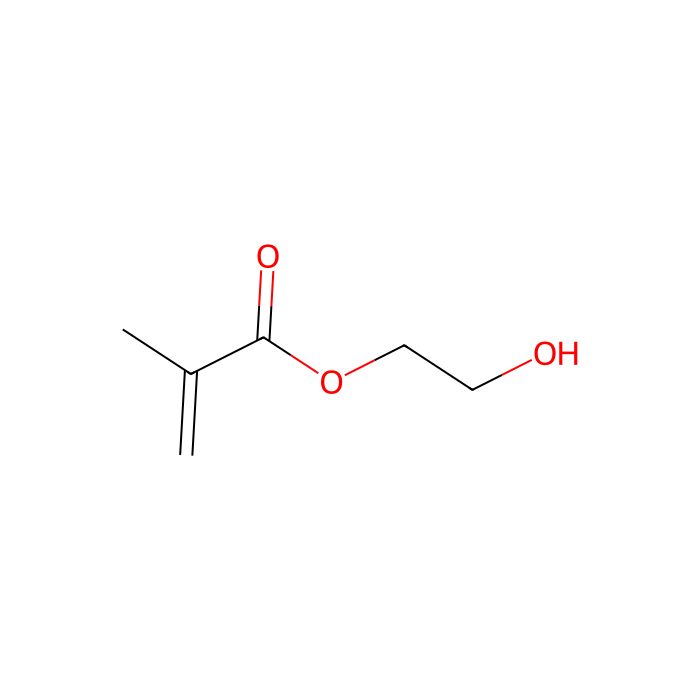
2-Hydroxyethylmethacrylat - wasserfrei, ≥99%, enthält Molekularsiebe, mit Molekularsieben, stabilisiert mit 200ppm MEHQ, Wasser≤50 ppm , CAS No.868-77-9

CAS: 868-77-9 Cat. No.: H140644 Summenformel: C6H10O3 Molekulargewicht: 130.14 Beilstein Registry Number: 1071580 EG-Nummer: 212-782-2
Zu bestellen verfügbar
GRADE & PURITY Anhydrous Grade ? Anhydrous grade — water removed and packaged dry for moisture-sensitive chemistry. Use in reactions where even trace water would interfere or quench. ≥99% Containing molecular sieves,with molecular sieves, stabilized with 200ppm MEHQ,Water≤50 ppm
Synonyms
2-Hydroxyethyl 2-methylacrylate # | EN300-98188 | InChI=1/C6H10O3/c1-5(2)6(8)9-4-3-7/h7H,1,3-4H2,2H | beta-Hydroxyethyl methacrylate | Methacrylic acid, 2-hydroxyethyl ester | 1,2-Ethanediol mono(2-methylpropenoate) | 2-Hydroxyethyl methacrylate (HEMA) |
Storage
Lagerung bei 2-8°C
Shipped In
Nasses Eis
★
Size
Deutschland (EU)
USA*
Price
Qty
100ml
H140644-100ml
—
3 Auf Lager
102,31€
500ml
H140644-500ml
—
Auf Lager ≥10
260,23€
Enter a quantity for the sizes you want to add.
🧪
Why this grade

wasserfrei, ≥99%, enthält Molekularsiebe, mit Molekularsieben, stabilisiert mit 200ppm MEHQ, Wasser≤50 ppm Anhydrous Grade for sensitive chromatographic and analytical workflows requiring minimal baseline interference.

🌡

Storage & shipping

Lagerung bei 2-8°C Ships Nasses Eis Check lot-specific COA for exact specifications.

📋

Quality documents

SDS, COA, datasheet, and spec sheet available for download. Lot-specific COA accessible via lot number lookup.

📚

Literature proof

Cited in 383 peer-reviewed publications across chromatography, organic synthesis, and cross-coupling reactions.

Übersicht

2-Hydroxyethylmethacrylat (HEMA) war das erste Monomer, das zur Synthese von Hydrogelen für biomedizinische Anwendungen verwendet wurde. Die wasserquellenden Eigenschaften von HEMA werden durch Copolymerisation mit hydrophileren Monomeren verbessert.
HEMA wird für die Synthese von biologisch funktionalen Poly(2-hydroxyethylmethacrylat)-Copolymeren (PHEMA) verwendet und zur Herstellung von lichtempfindlichen PHEMA-Membranen, HEMA/Acrylamid-Hydrogelen mit spezifischer Wirkstofffreisetzung und wasserlöslichen HEMA/Methacrylsäure-Hydrogelen für die Verabreichung von Arzneimitteln eingesetzt.Die Auswirkungen von HEMA auf die Migration von Zahnmarkstammzellen (in vitro) können untersucht werden.

Specifications

Synonyme
2-Hydroxyethyl 2-methylacrylate # | EN300-98188 | InChI=1/C6H10O3/c1-5(2)6(8)9-4-3-7/h7H,1,3-4H2,2H | beta-Hydroxyethyl methacrylate | Methacrylic acid, 2-hydroxyethyl ester | 1,2-Ethanediol mono(2-methylpropenoate) | 2-Hydroxyethyl methacrylate (HEMA) |
Spezifikationen & Reinheit
wasserfrei, ≥99%, enthält Molekularsiebe, mit Molekularsieben, stabilisiert mit 200ppm MEHQ, Wasser≤50 ppm
Storage
Lagerung bei 2-8°C
Verschickt in
Nasses Eis
Note
Anhydrous Grade
Reinheit
≥99%
Namen und Kennungen
Pubchem Sid
Kanonisches Lächeln
CC(=C)C(=O)OCCO
IUPAC Name
2-hydroxyethyl 2-methylprop-2-enoate
InChIKey
WOBHKFSMXKNTIM-UHFFFAOYSA-N
INCHI
1S/C6H10O3/c1-5(2)6(8)9-4-3-7/h7H,1,3-4H2,2H3
Isomere SMILES
CC(=C)C(=O)OCCO
WGK Deutschland
NWG
RTECS
OZ4725000
Molekulargewicht
130.14
Beilstein
1071580
Reaxy-Rn
1071583
Reaxys-RN_link_address
https://www.reaxys.com/reaxys/secured/hopinto.do?context=S&query=IDE.XRN=1071583&ln=

Documentation

📋 Safety Data Sheet (SDS)

Comprehensive hazard, handling, storage, and regulatory compliance document.

Download SDS →

✅ Certificate of Analysis (COA)

Lot-specific quality data. Enter your lot number to retrieve the exact COA.

Look up COA →

📊 Datasheet

Quick-reference summary of product specifications and applications.

View datasheet →

🔬 Specification Sheet

Full quality attributes and acceptance criteria for this grade.

View spec sheet →

Advanced Data

Taxonomic Classification

Taxonomy Tree

KingdomOrganic compounds
SuperclassOrganic acids and derivatives
KlasseCarboxylic acids and derivatives
SubclassCarboxylic acid derivatives
Intermediate Tree Nodes Carboxylic acid esters - Alpha,beta-unsaturated carboxylic esters
Direct ParentEnoate esters
Alternative Parents Monocarboxylic acids and derivatives  Primary alcohols  Organic oxides  Hydrocarbon derivatives  Carbonyl compounds  
Molecular FrameworkAliphatic acyclic compounds
Substituents Enoate ester - Monocarboxylic acid or derivatives - Organic oxygen compound - Organic oxide - Hydrocarbon derivative - Primary alcohol - Organooxygen compound - Carbonyl group - Alcohol - Aliphatic acyclic compound
BeschreibungThis compound belongs to the class of organic compounds known as enoate esters. These are an alpha,beta-unsaturated carboxylic ester of general formula R1C(R2)=C(R3)C(=O)OR4 (R4= organyl compound) in which the ester C=O function is conjugated to a C=C double bond at the alpha,beta position.
External Descriptors enoate ester
3D-Struktur
Interaktives chemisches Strukturmodell


Wirkungsmechanismen
Zertifikate (CoA, COO, BSE/TSE und Analyse-Diagramm)
C of A & Other Certificates(BSE/TSE, COO):
Analytical Chart:

Find and download the COA for your product by matching the lot number on the packaging.

22 results found

Lot NumberCertificate TypeDatumArtikel
I2611618Certificate of AnalysisSep 03, 2026 H140644
I2611617Certificate of AnalysisSep 03, 2026 H140644
I2611616Certificate of AnalysisSep 03, 2026 H140644
I2504424Certificate of AnalysisAug 28, 2025 H140644
I2504449Certificate of AnalysisAug 28, 2025 H140644
B2521052Certificate of AnalysisJul 29, 2024 H140644
H2421539Certificate of AnalysisJul 29, 2024 H140644
H2421540Certificate of AnalysisJul 29, 2024 H140644
A2411581Certificate of AnalysisNov 13, 2023 H140644
A2411582Certificate of AnalysisNov 13, 2023 H140644
A2411597Certificate of AnalysisNov 13, 2023 H140644
A2411598Certificate of AnalysisNov 13, 2023 H140644
A2411566Certificate of AnalysisNov 13, 2023 H140644
J2327554Certificate of AnalysisOct 18, 2023 H140644
J2327550Certificate of AnalysisOct 18, 2023 H140644
J2327549Certificate of AnalysisOct 18, 2023 H140644
G2328111Certificate of AnalysisJul 12, 2023 H140644
G2328110Certificate of AnalysisJul 12, 2023 H140644
G2328099Certificate of AnalysisJul 12, 2023 H140644
G2227908Certificate of AnalysisJun 29, 2022 H140644
G2227907Certificate of AnalysisJun 29, 2022 H140644
G2227906Certificate of AnalysisJun 29, 2022 H140644
Chemische und physikalische Eigenschaften
EmpfindlichkeitLight&Air Sensitive
Brechungsindex1.451-1.453
Flammpunkt (°F)222.8 °F
Flammpunkt (°C)101℃
Siedepunkt (°C)85°C/5mmHg
Schmelzpunkt (°C)-12℃
Molekulargewicht130.139 g/mol
XLogP30.500
Hydrogen Bond Donor Count1
Hydrogen Bond Acceptor Count3
Rotatable Bond Count4
Exact Mass130.063 Da
Monoisotopic Mass130.063 Da
Topological Polar Surface Area46.500 Ų
Heavy Atom Count9
Formal Charge0
Complexity117.000
Isotope Atom Count0
Defined Atom Stereocenter Count0
Undefined Atom Stereocenter Count0
Defined Bond Stereocenter Count0
Undefined Bond Stereocenter Count0
The total count of all stereochemical bonds0
Covalently-Bonded Unit Count1
FAQs und Artikel
The Guide to Anhydrous Grade for Reagents
Key Judgments in Medical Hydrogel R&D: From Polymer Source and Crosslinking Strategy to Sterilization Planning, Scale-Up Feasibility, and Quality Control
Structural and Performance Design of Acrylic Resins for Coatings: Monomer Composition, Key Parameters, and Film Formation/Curing Mechanisms
Guide to Selecting Polyurethane Coating Systems: Application Analysis for Wood, Flooring, Plastics, Automotive, and Industrial Protection
How Do Isocyanates and Polyols Affect the Performance of Polyurethane Coating Films: Structure, Raw Material Selection, and Performance Design Essentials
When Should You Choose Silicone Resin? Selection Comparison with Epoxy, Acrylic, Polyurethane, Fluororesin, and Other Coating Resins
Polyurethane Coating Resins: Not a Single Resin, but a Designable High-Performance System
Vinyl Acetate-Acrylic Emulsion (Vinyl Acrylic Emulsion): A Cost-Performance Balance Solution for Architectural Coatings
VC/VAc Resins and Their Modification: An Analysis of VC/VAc Vinyl Resins for Coatings and Inks
Guide to Common Waterborne Resin Types and Application-Based Selection: How to Choose Acrylics, PUD, Waterborne Epoxy, Waterborne Alkyd, VAE, and Related Chemicals
From Water to Film: Film-Formation Mechanisms and Performance Development of Waterborne Emulsions and Dispersions
Diagnosis of Coating Performance Issues and Selection of Resin Modification Routes
Mechanisms and Control of Coating Yellowing: From Chromophoric Structure Formation to Source Diagnosis and Formulation Optimization
Structural Design Logic of Common Resin Modification Technologies: Molecular Chain Structure, Functional Groups, Phase Structure, Crosslinked Networks, and Hybrid/Functional Design
Resin Polarity in Coating Formulations: From Molecular Structure to Dissolution, Compatibility, Interfacial Interactions, and Formulation Design
Application of Conductive Carbon Black in Coatings: Selection Criteria, Dispersion Control, and Conductive Network Construction
Key Variable in the Long-Term Stability of Waterborne Pigment Concentrates: How Dispersant Molecular Weight Distribution (MWD) Affects Pigment Dispersion, Surface Adsorption-Layer Formation, and Storage Stability
Structure, Degradation Behavior, and Applications of Poly(trimethylene carbonate) (PTMC) in Flexible Absorbable Materials
Citations of This Product
Lösungsrechner
Bewertungen

Kundenbewertungen

Dürfen wir Sie über Rabattaktionen informieren?

Später erinnern

Vielen Dank! Bitte überprüfen Sie Ihren E-Mail-Posteingang, um zu bestätigen.

Hoppla! Benachrichtigungen sind deaktiviert.