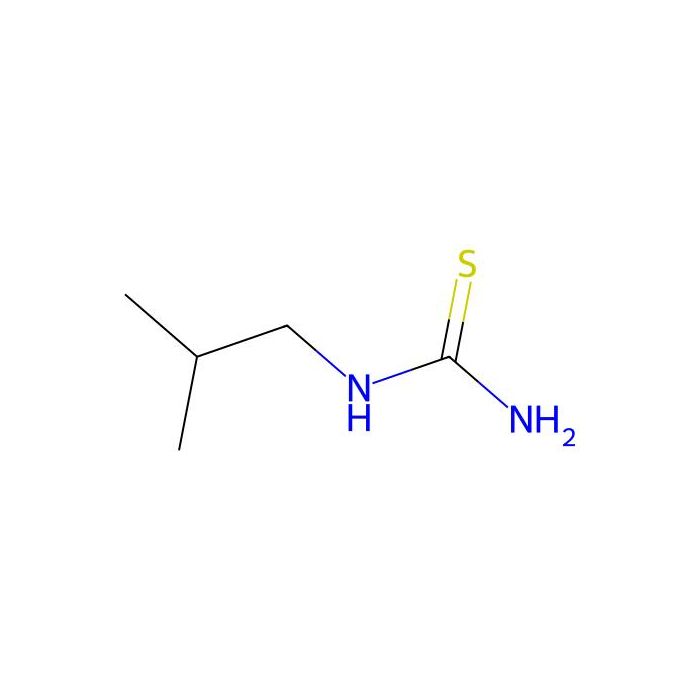
This compound belongs to the class of organic compounds known as thioureas. These are organic compounds containing the thiourea functional group, a derivative of urea with the general structure (R1(N)R2C(=S)(R3)R4, R1-R4=H, alkyl, aryl), obtained by replacing the carbonyl group of urea with a thiocarbonyl group.
External Descriptors
Not available
1. Djoumbou Feunang Y, Eisner R, Knox C, Chepelev L, Hastings J, Owen G, Fahy E, Steinbeck C, Subramanian S, Bolton E, Greiner R, and Wishart DS. ClassyFire: Automated Chemical Classification With A Comprehensive, Computable Taxonomy. Journal of Cheminformatics, 2016, 8:61.
Zertifikate (CoA, COO, BSE/TSE und Analyse-Diagramm)
C of A & Other Certificates(BSE/TSE, COO):
Analytical Chart:
Chemische und physikalische Eigenschaften
Molekulargewicht
132.230 g/mol
XLogP3
0.900
Hydrogen Bond Donor Count
2
Hydrogen Bond Acceptor Count
1
Rotatable Bond Count
2
Exact Mass
132.072 Da
Monoisotopic Mass
132.072 Da
Topological Polar Surface Area
70.100 Ų
Heavy Atom Count
8
Formal Charge
0
Complexity
80.500
Isotope Atom Count
0
Defined Atom Stereocenter Count
0
Undefined Atom Stereocenter Count
0
Defined Bond Stereocenter Count
0
Undefined Bond Stereocenter Count
0
The total count of all stereochemical bonds
0
Covalently-Bonded Unit Count
1
Lösungsrechner
Molarity Calculator
Determine the necessary mass, volume, or concentration for preparing a solution.
Dilution Calculator
Determine the dilution needed to prepare a stock solution.
Reconstitution Calculator
Bewertungen
Kundenbewertungen
Application Protocols
No application protocols are specified for this SKU in the Product Data.
General laboratory usage suggestions (literature-based; adapt to your needs)
Preparation of isothiocyanate intermediate
Dissolve the thiourea (0.5–1.0 M) in dry CH2Cl2 under N2 at 0 °C. Add oxalyl chloride (1.5–2.0 equiv) dropwise with base (2–3 equiv NEt3). Stir 1–2 h, warming to rt. Quench carefully and isolate R–N=C=S for immediate use.
S-alkylation to isothiouronium salt
Stir the thiourea with alkyl bromide (1.2 equiv) in MeCN (0.2–0.5 M) at 40 °C for 4–8 h. Filter the precipitated salt, wash with ether, and dry under vacuum.
Desulfurization to urea
Suspend in EtOH (0.1–0.3 M), add Raney Ni (wet, 0.2–0.5 g per mmol), heat to reflux 2–4 h. Filter hot through celite, concentrate, and recrystallize.
Important
The above are generic, literature-style procedures intended for experienced chemists. They are not item-specific validated protocols. Always perform risk assessment, consult the SDS, and run pilot trials before scale-up.
Biological Roles
Item-specific biological data: Not specified for this item; refer to CoA/Spec Sheet. The product is supplied for research use only.
General/literature context
Endogenous role: N-(2-methylpropyl)thiourea is a synthetic small molecule; it has no known endogenous biological role.
Interaction motifs: Thioureas are strong hydrogen-bond donors and weak acceptors, enabling interactions with proteins, nucleophiles, and polar binding pockets in biochemical assays. The sulfur is a soft base capable of coordinating to soft metal centers.
Use in biochemical research: Thiourea derivatives are widely employed as ligands or modifiers in metalloprotein model studies, as additives in enzymatic or chemical labeling workflows (e.g., modulation of cysteine reactivity), and as organocatalyst motifs in small-molecule screening.
Redox and reactivity: The C=S group can undergo oxidation (to thiourea S-oxide/dioxide) under strong oxidants, potentially altering assay outcomes; appropriate negative controls are advisable when testing in oxidative environments.
ADME considerations (general): Alkyl substitution increases hydrophobicity relative to thiourea, which could affect passive membrane association in model systems; however, such properties are highly context-dependent and should be measured experimentally.
Caveat
No claims are made regarding biological efficacy or therapeutic relevance. For any in vitro/in vivo experiments, establish purity, stability, and absence of interfering impurities using the batch-specific CoA and appropriate QC analytics.
Buffer Applications
This compound is not a buffering agent and is not typically used to prepare pH buffer systems.
Practical note: If employed in aqueous assays, dissolve using a compatible co-solvent (e.g., DMSO or ethanol, then dilute) and maintain an independent buffer system (e.g., phosphate, HEPES, MOPS) suited to your target pH.
Caution: Adjusting pH to force dissolution (e.g., strong base) can alter thiourea integrity via deprotonation or decomposition; verify stability under your buffer conditions.
For buffer formulation guidance, refer to dedicated buffering reagents rather than this thiourea derivative.
Green Alternatives
Strategic substitution and process choices can reduce environmental impact when working with N-alkylthioureas:
Safer activation chemistries (literature)
Isothiocyanate generation: Consider triphosgene alternatives (e.g., CDI with sulfur transfer, or SO2Cl2/NMI systems) that reduce phosgene handling. Reagent selection should balance atom economy, hazards, and waste.
Desulfurization: Favor catalytic hydrogenation or transfer-hydrogenation over stoichiometric heavy-metal desulfurants. Raney Ni in ethanol under reflux is a commonly cited, lower-waste option compared with Hg- or Pb-based methods.
Solvent choices
Prefer low-toxicity, biorenewable or EHS-favored solvents where feasible: ethanol, 2-MeTHF, ethyl acetate, propylene carbonate, or water/ethanol mixtures for workup and crystallization.
Replace DMF/NMP where possible with acetonitrile, MeOH/EtOH, or green dipolar aprotics (e.g., Cyrene, dimethyl isosorbide) if reaction performance permits.
Energy and workup
Use solvent minimization, telescoped steps (e.g., in situ isothiouronium formation and subsequent displacement), and crystallization-driven purifications to limit chromatographic waste.
Thiourea vs urea H-bond donors: Ureas are typically less hazardous and more oxidatively robust but may be less active as donors; consider urea analogs when catalytic activity allows.
Solid-supported thioureas can simplify separation and reduce solvent usage, at the cost of reagent preparation or loading efficiency.
Note: Always confirm that greener substitutions meet your reaction’s selectivity and yield requirements via small-scale trials.
Pharmaceutical Uses
Item-specific pharmacopeial status/uses: Not specified for this item; refer to CoA/Spec Sheet.
General formulation/manufacturing context (no therapeutic claims)
Role in discovery chemistry: N-alkylthioureas are common intermediates and scaffolds in medicinal chemistry campaigns, used to explore H-bond donor interactions or as precursors to isothiocyanates and ureas for SAR diversification.
Excipients: Thioureas are not typical pharmaceutical excipients due to reactivity (C=S) and potential safety concerns; where used in process development, they are usually intermediates removed prior to final API isolation.
Impurity control: In API manufacturing that employs thioureas, process development generally includes robust purge strategies for residual thiourea and related sulfur-containing impurities (oxidized thioureas, isothiouronium salts). Analytical methods may include HPLC-UV, LC–MS, and sulfur-specific detectors.
Salt formation: While thioureas can form salts (e.g., protonated at nitrogen), stable pharmaceutical salts are uncommon relative to amines or carboxylates; attention to polymorphism and solvate formation is still warranted during solid-form screening.
Recommendation
If considering use in any cGMP-relevant synthesis, obtain detailed specifications (assay, impurity profile, residual solvents, metals) and evaluate against ICH Q3A/B expectations.
Physical Properties
Item-specific specifications (this SKU)
Appearance: Not specified for this item; refer to CoA/Spec Sheet.
Molecular Formula: Not specified for this item; refer to CoA/Spec Sheet.
Molecular Weight: Not specified for this item; refer to CoA/Spec Sheet.
Other specs (bp/mp, density, refractive index, UV cutoff, residuals): Not specified for this item; refer to CoA/Spec Sheet.
Literature/general reference values for N-(2-methylpropyl)thiourea (for planning only; not product specs)
Phase at ambient conditions: typically a crystalline solid (literature, analogous N-alkylthioureas).
Approximate molar mass: ~132.23 g/mol (C5H12N2S; literature calculation).
Polarity/functional character: polar, hydrogen-bond donor (two N–H) and weak acceptor (thioamide sulfur and carbonyl carbon analogue); often exhibits moderate melting points typical of thioureas.
Solubility profile (qualitative, literature): generally soluble in polar aprotic solvents (DMSO, DMF, NMP) and polar protic solvents (alcohols); water solubility can be modest to moderate depending on substitution. Limited solubility in nonpolar hydrocarbons.
LogP and pKa: thioureas typically display low to moderate logP depending on alkylation; the thioamide N–H is weakly acidic (pKa often ~10–12 for related systems; literature, compound-dependent).
Spectral cues (literature): ν(C=S) typically ~1200–1500 cm⁻¹ in IR; strong N–H stretches ~3200–3400 cm⁻¹; 13C NMR shows deshielded thiocarbonyl carbon >175 ppm; 1H NMR shows two N–H resonances (exchangeable) and characteristic isobutyl pattern.
Practical note
Use the above only for preliminary lab planning. Always rely on the item’s CoA/SDS for exact specifications and acceptance criteria.
Quality and Grades
Item-specific grade/purity and stabilizers
Grade/Purity: Not specified for this item; refer to CoA/Spec Sheet.
Stabilizers/Inhibitors: Not specified for this item; refer to CoA/Spec Sheet.
Context for professional users (general guidance)
Analytical/Reagent grades: When specified, these indicate impurity controls suited to synthesis or analytical work (e.g., lower metals, defined assay). For organosulfur building blocks, trace metals and residual solvents can impact catalysis, odor, and shelf stability.
HPLC/UV grade (if applicable): Ensures low UV background and minimal fluorescent impurities—relevant if the compound is used as a standard or in detection-limited assays, though such grades are uncommon for solid amide-type building blocks like thioureas.
Water/peroxide/residuals: For reactive nucleophiles such as thioureas, water content can influence reaction rates and selectivity in S-alkylation or acylation. Always check Karl Fischer and residual solvent data on the CoA when moisture-sensitive steps are planned.
Batch qualification: For reproducible catalysis or medicinal chemistry, verify identity (1H/13C NMR, IR ν(C=S), HRMS) and purity (HPLC/GC, melting range). If chiral derivatives are involved, confirm enantiopurity/diast. purity (not typically relevant here).
Recommendation
If no grade is specified, treat as research-grade material. For critical applications, request the latest CoA/Spec Sheet for assay value, key impurity limits, and any stabilizer or drying history.
Reaction and Applications
This compound serves as a versatile N-alkylthiourea building block. Common literature applications (expand based on your synthesis goals):
Precursor to isothiocyanates (R–N=C=S)
Dehydrative/halogenative routes convert N-alkylthioureas to the corresponding isothiocyanates using agents such as oxalyl chloride, phosgene surrogates (triphosgene), or halogenating systems (e.g., NCS/POCl3), often in CH2Cl2, acetonitrile, or toluene at 0–25 °C. These isothiocyanates then undergo thiourea-forming or thiocarbamoylation reactions downstream.
S-Alkylation to isothiouronium salts
Reaction with alkyl halides or sulfonates in polar aprotic solvents affords S-alkyl isothiouronium salts, which can be intermediates toward thioethers (via base or Ag+ mediated fragmentation) or guanidine derivatives.
Desulfurization to ureas
Raney Ni or catalytic hydrogenation, or oxidative desulfurization (e.g., with H2O2/Na2WO4 or other reagents), can convert the thiocarbonyl (C=S) to a carbonyl (C=O), yielding the corresponding urea (N-isobutylurea). Useful for late-stage modulation of H-bonding and polarity.
H-Bond donor organocatalyst scaffold
Alkylthioureas can act as bifurcated H-bond donors to activate electrophiles (e.g., nitroolefins, imines) in Michael additions, Strecker-type reactions, and related transformations. The isobutyl substituent modulates solubility and steric environment around the donor site.
Metal binding/extraction and analytical utility
Thioureas coordinate soft metals via sulfur and can assist in phase-transfer separations or serve as ligating additives in coinage/late transition-metal chemistry (Cu, Ag, Au), influencing reduction and deposition processes.
Practical notes: Control moisture for halogenative dehydrations; avoid over-alkylation on nitrogen in S-alkylation by using mild bases and temperature control. Verify identity/purity before catalytic applications.
Reaction Conditions
Representative literature conditions (guidance only; optimize per substrate)
Isothiocyanate generation (R–N=C=S)
Reagents: oxalyl chloride (1.5–2.0 equiv) or triphosgene (0.4–0.7 equiv phosgene units) with base (NEt3 or pyridine).
Solvent: CH2Cl2, toluene, or MeCN, 0–25 °C.
Time: 0.5–4 h; monitor by IR (loss of ν(C=S) ~1200–1500 cm⁻¹; appearance of N=C=S ~2100–2150 cm⁻¹) or TLC.
S-Alkylation to isothiouronium salts
Reagents: alkyl bromides/iodides (1.1–1.5 equiv), mild base (K2CO3) or no base if substrate is sufficiently nucleophilic.
Solvent: DMF or MeCN; 20–60 °C.
Time: 1–12 h; precipitation of salts often observed; isolate by filtration and wash with ether.
Desulfurization to ureas
Catalytic: Raney Ni (W-2), EtOH or iPrOH, reflux (2–6 h). Alternative: H2 (1–3 bar) over Pd/C in EtOH at rt–40 °C.
Oxidative: H2O2 (30%, 2–3 equiv) with catalytic tungstate or Mo catalysts in MeOH/H2O, 0–25 °C, then workup to urea.
Thiazole-forming condensations
With α-haloketones: base (NaHCO3–K2CO3), polar solvent (EtOH/MeCN), 25–80 °C, 2–16 h.
Yields (typical literature ranges)
Isothiocyanate formation: 60–90% depending on substrate and reagent.
S-alkylation: 70–95% for primary alkyl halides.
Desulfurization to urea: 60–85% after optimization.
Notes
Control moisture and temperature to minimize N-alkylation or overreaction. Perform small-scale screens to select the cleanest protocol for your substrate set.
Safety and Handling
Item-specific hazard information
Signal Word: Not specified for this item; refer to SDS.
H-Statements: Not specified for this item; refer to SDS.
GHS Classification/Pictograms: Not specified for this item; refer to SDS.
General safety considerations for N-alkylthioureas (literature/typical guidance)
Hazards: Thiourea derivatives can cause skin/eye irritation and may be harmful if swallowed or inhaled. Some thioureas are skin sensitizers; parent thiourea has specific hazard classifications. Handle with caution and consult the SDS for this exact compound.
PPE: Use lab coat, nitrile gloves, and splash-resistant safety goggles. Employ a fume hood to minimize inhalation exposure, especially during weighing and transfers that can release dust.
Incompatibilities: Strong oxidizers (risk of exothermic reactions/oxidation), strong acids or acid chlorides (formation of reactive thiocarbamoyl halides), and strong bases (possible decomposition or thiolate formation in harsh conditions). Avoid reactive halogenating agents unless intended.
First aid (overview; defer to SDS):
Inhalation: Move to fresh air; seek medical attention if symptoms persist.
Skin/eye contact: Rinse with water for ≥15 min; remove contaminated clothing; get medical advice if irritation continues.
Ingestion: Rinse mouth; do not induce vomiting unless directed; seek medical attention.
Fire safety: Organic solid; use dry chemical, CO2, or foam. Combustion may release nitrogen/sulfur oxides. Avoid dust accumulation; standard Class A/B practices apply.
Waste: Collect as hazardous organic waste. Do not discharge to drains. Follow institutional and local regulations.
Always consult the product SDS for authoritative hazard, exposure limits, and emergency guidance.
Solvent Selection
Chemical class and polarity
N-(2-methylpropyl)thiourea is a polar, hydrogen-bonding organic solid with a thioamide core. It is both an H-bond donor (two N–H) and a weak acceptor (C=S/S lone pair), favoring polar solvents.
Good solvents: DMSO, DMF, NMP, acetonitrile, methanol, ethanol, isopropanol.
Moderate: Acetone, ethyl acetate.
Poor: Nonpolar hydrocarbons (hexanes, heptane, toluene) unless heated or with co-solvent.
Aqueous media: Solubility varies with substitution; N-alkylthioureas often show modest water solubility. Use co-solvents or pH adjustment (basic solutions can increase solubility via deprotonation but may induce side reactions).
Selection tips
For S-alkylation to form isothiouronium salts: polar aprotic solvents (DMF, MeCN) often enhance rates and control; ensure anhydrous conditions if competing hydrolysis is a concern.
For desulfurization (e.g., to the corresponding urea): alcohols (MeOH/EtOH) or ethereal solvents under hydrogenation/Raney Ni are commonly used.
For organocatalysis (H-bond donor applications): choose low-basicity solvents (DCM, toluene, EtOAc) to preserve H-bonding efficacy; add a polar co-solvent only as needed.
Comparison (literature tendencies)
Versus ureas: thioureas are generally more acidic (N–H) and stronger H-bond donors; they prefer slightly less basic, less strongly coordinating solvents to maintain catalyst activity.
Versus diarylthioureas: N-alkyl derivatives are typically more soluble in alcohols and aliphatic polar media, aiding higher-concentration operations.
Storage and Reconstitution
Item-specific storage/shipping
Storage Conditions: Room temperature (per Product Data).
Shipped In: Not specified for this item; refer to CoA/Spec Sheet.
General handling and reconstitution guidance (literature-based)
Container: Store tightly closed in a clean, dry, chemically compatible container. Protect from strong oxidizers and moisture ingress to preserve integrity.
Atmosphere: Ambient storage is typically acceptable; for long-term stability, consider a desiccator to limit humidity.
Reconstitution/solution preparation: For stock solutions, dissolve at the desired concentration in a compatible solvent such as DMSO, DMF, MeOH, EtOH, or MeCN (choose based on your application). Warm gently and sonicate if needed. Filter (0.2 µm PTFE) for assay-critical solutions.
Working solutions: Prepare fresh when possible. If storage is needed, aliquot and keep tightly capped; minimize freeze–thaw and light exposure. For DMSO stocks, −20 °C storage can extend shelf life (general practice), but confirm solubility/crystallization behavior upon thawing.
Stability considerations: Avoid prolonged exposure to strong acids/bases or oxidants, which can induce decomposition (e.g., S-oxidation or cleavage). Monitor by NMR/LC–MS for critical applications.
Always defer to the product’s CoA and SDS for definitive storage and handling instructions for this SKU.
Structure and Identity
Overview: (2-Methylpropyl)thiourea is the N-alkyl (isobutyl) derivative of thiourea, featuring a thiocarbonyl (C=S) flanked by two nitrogens, one of which bears a 2-methylpropyl substituent.
Item-specific identifiers (from Product Data)
CAS: 1516-33-2
CID: 853362
InChIKey: 315960 (format appears atypical; refer to CoA/SDS for confirmation)
SMILES: Not specified for this item; refer to CoA/Spec Sheet.
Literature/structure description (for context; not item specifications)
2D structural features: one thiocarbonyl C=S double bond; two endocyclic amide-like N atoms (thiourea motif). One N is primary (–NH2), the other is secondary (–NH–) bearing an isobutyl substituent (–CH2–CH(CH3)2).
Functional groups: thiocarbonyl (thioamide), two amino nitrogens (one secondary, one primary), alkyl (branched C4).
Typical (literature) line notation: SMILES CC(C)CH2NC(=S)N; InChI layers encode a single, neutral molecule with no stereocenters.
Computed/literature elemental formula and mass (for the N-isobutyl isomer)
Molecular formula (literature): C5H12N2S
Molecular weight (literature): ~132.23 g/mol
Notes
The above “literature” identifiers describe the commonly referenced N-isobutylthiourea isomer that matches the name “(2-methylpropyl)thiourea.” Verify exact registry details (including definitive InChIKey) against the product CoA/SDS for this SKU.
Synthetic Utility
Key functional elements and reactivity (literature)
Thioamide (C=S): electrophilic carbon enables acylation-type reactions; sulfur is nucleophilic/soft base, enabling S-alkylation and metal coordination.
Two N–H donors: allow formation of isothiouronium salts (upon S-alkylation), carbamothioyl halides (with acid chlorides), and serve as H-bond donors in organocatalysis.
Typical transformations
Isothiocyanate synthesis: Convert RNH–C(=S)–NH2 to R–N=C=S using dehydrating/halogenating systems (e.g., oxalyl chloride, triphosgene, or NCS + base), then capture with amines/thiols/alcohols.
Urea formation: Desulfurize (Raney Ni, catalytic hydrogenation, or peroxides with suitable catalysts) to access RNH–C(=O)–NH2. Useful for late-stage polarity tuning.
S-Alkylation: Alkyl halides (R′–X) give [RNH–C(=S)–NHR″]S–R′ isothiouronium salts; base or silver-mediated cleavage can yield thioethers (R′–S–R).
Guanidine access: Through S-alkylation followed by amine capture and sulfur removal (e.g., Hg-free protocols), furnishing guanidines from thiourea frameworks.
Cyclizations: With α-halo carbonyls to thiazolines/thiazoles (via intramolecular S/N capture) under basic conditions; scope depends on substitution and leaving group quality.
Retrosynthetic value
Readily prepared from isothiocyanates and amines or via thiocarbonylation of amines, making it a convenient node for bidirectional diversification: forward to isothiocyanates/ureas/guanidines, backward to the parent amine (2-methylpropylamine) via stepwise transformations.
Practical tips
Maintain moderate dryness; excessive base can lead to competitive N-alkylation or decomposition. Characteristic IR ν(C=S) and 13C signals enable rapid tracking of conversions.
Target Specificity
Not applicable to this product type.
This SKU is a small-molecule chemical reagent (thiourea derivative), not a biological targeting reagent (e.g., antibody, ligand with validated target profile).
No antigen, epitope, clone, isotype, or species reactivity data are provided for this item.
Wir verwenden Cookies, um die ordnungsgemäße Funktion der Website sicherzustellen und, soweit zulässig, Ihr Nutzererlebnis zu verbessern. Sie können Ihre Einstellungen jederzeit unter „Einstellungen“ verwalten. Weitere Informationen finden Sie in unserer Cookie-Richtlinie.
Dürfen wir Sie über Rabattaktionen informieren?
Später erinnern
Vielen Dank! Bitte überprüfen Sie Ihren E-Mail-Posteingang, um zu bestätigen.
Products are supplied to verified businesses, institutions, and qualified professionals for research and development use only. Not for use in humans, animals, diagnosis, or therapy.