This compound belongs to the class of organic compounds known as long-chain fatty acids. These are fatty acids with an aliphatic tail that contains between 13 and 21 carbon atoms.
External Descriptors
Unsaturated fatty acids
1. Djoumbou Feunang Y, Eisner R, Knox C, Chepelev L, Hastings J, Owen G, Fahy E, Steinbeck C, Subramanian S, Bolton E, Greiner R, and Wishart DS. ClassyFire: Automated Chemical Classification With A Comprehensive, Computable Taxonomy. Journal of Cheminformatics, 2016, 8:61.
Determine the necessary mass, volume, or concentration for preparing a solution.
Dilution Calculator
Determine the dilution needed to prepare a stock solution.
Reconstitution Calculator
Bewertungen
Kundenbewertungen
Application Protocols
Not applicable as standardized immunoassay protocols (WB, IHC, IF, FC) do not pertain to a small-molecule fatty acid.
Practical usage suggestions (general chemistry):
To prepare stock solutions, dissolve in a suitable dry organic solvent (e.g., EtOAc, THF, or DMSO for screening) at a known concentration; record the E/Z ratio if relevant.
For aqueous work, generate its sodium/potassium salt in situ for phase transfer or micellar media, then re-acidify to isolate the free acid.
Always consult your specific experimental method or literature precedent for exact conditions.
Biological Roles
Context (general biochemistry; not product-specific claims):
Structural class: 2-Tridecenoic acid is a monounsaturated, α,β-unsaturated C13 fatty acid analog. Naturally occurring fatty acids commonly enter β-oxidation pathways as CoA thioesters; α,β-unsaturation adjacent to the carboxyl can modulate enzymatic processing compared with internal cis/trans double bonds.
Membrane/lipid relevance: Long-chain fatty acids form micelles or incorporate into lipid bilayers after derivatization (e.g., esterification to glycerol backbones). The α,β-unsaturated motif can serve as a reactive handle for covalent conjugation to biomolecules under controlled conditions in research settings (e.g., Michael addition to thiols), though compatibility with biological matrices must be established empirically.
Protein/lipidation chemistry: Carboxylates are routinely activated (e.g., as NHS esters) for conjugation to amines on peptides/proteins in vitro. For unsaturated acids, care is taken to preserve double-bond geometry and prevent side reactions.
Important limitations:
This product is labeled For research use only (Product Data). It is not intended for diagnostic, therapeutic, or clinical use. Any biological handling should follow appropriate biosafety and chemical safety protocols.
Buffer Applications
Not typically applicable. 2-Tridecenoic acid is a hydrophobic monocarboxylic acid with poor water solubility and does not serve as a standard buffering component in aqueous systems.
Practical notes for labs (general):
If an aqueous phase is required, transient solubilization can be achieved by forming its sodium/potassium carboxylate with mild base (e.g., NaHCO3/Na2CO3), but this is for phase-transfer or extraction purposes rather than buffering.
For pH control, use conventional buffers (e.g., phosphate, Tris, HEPES) and treat the fatty acid as a hydrophobic additive/substrate rather than a buffer component.
Green Alternatives
Perspective: The molecule itself is a hydrophobic, bio-based class of chemical (fatty acids can be sourced from renewable lipids), but sustainability is typically driven by solvent and reagent choices in transformations.
Greener selections (literature guidance):
Solvents:
Prefer EtOAc, MeTHF/2-MeTHF, CPME, or alcohols (EtOH, i-PrOH) over chlorinated solvents when feasible.
Replace toluene/hexane with heptane or cyclopentyl methyl ether where azeotrope/water-removal needs allow.
Coupling chemistry:
Use EDC·HCl with catalytic DMAP in EtOAc or 2-MeTHF instead of DCC in DCM; minimize urea waste and facilitate filtrations.
Enzymatic esterification (lipase-catalyzed) in solvent-free or green solvents at 30–60 °C can deliver high selectivity and low E-factors.
Workup/waste:
Opt for aqueous bicarbonate washes rather than strong bases; recover and recycle organic phases; consider solid-supported catalysts.
Performance: Comparable conversions for fatty acid esterifications with optimized stoichiometry.
Trade-offs:
Greener solvents may change solubility and rates; modest warming or higher catalyst loading can compensate.
Avoid peroxidizable ethers for long storage; CPME or 2-MeTHF are more stable than THF/diethyl ether.
Pharmaceutical Uses
No therapeutic or clinical claims are made for this product. For research use only (Product Data).
General formulation roles of long-chain fatty acids (literature; not product-specific):
Excipients and intermediates: Fatty acids and their esters may serve as hydrophobic excipients, penetration enhancers, or components of lipid-based delivery systems (e.g., emulsions, self-emulsifying drug delivery) when appropriately qualified.
Prodrug chemistry: Carboxylic acids can be converted to esters or amides to adjust lipophilicity and permeability in exploratory medicinal chemistry.
Standards and controls: Unsaturated fatty acids may be used as analytical references in lipidomics or method development after proper characterization of isomer ratio and purity.
Regulatory/quality note:
Pharmacopeial monographs typically exist for common saturated/unsaturated fatty acids; 2-tridecenoic acid is a specialty isomer without a common monograph. If use in regulated contexts is contemplated, define specifications (assay, E/Z ratio, residuals, peroxides) and qualify per relevant pharmacopeial/ICH guidance.
Physical Properties
Item-specific specifications for this lot:
Appearance: Not specified for this item; refer to CoA/Spec Sheet.
Grade/Purity: Not specified for this item; refer to CoA/Spec Sheet.
Literature/general properties for α,β-unsaturated C13 fatty acids (for planning only; not product specifications):
Molecular formula: C13H24O2 (literature)
Molecular weight: 212.33 g/mol (literature)
Acid pKa: typically ~4.5–5.0 for long-chain monocarboxylic acids (literature, aqueous, ionic strength-dependent)
Physical state: often oily liquid or low-melting solid near ambient temperature depending on E/Z ratio and purity (literature)
Solubility profile: sparingly soluble in water; soluble in common organic solvents (e.g., alcohols, acetone, ethyl acetate, chlorinated solvents, ethers, hydrocarbons) (literature)
LogP: expected high hydrophobicity typical of C13 fatty acids (literature; exact value not specified here)
Boiling/melting points, density, refractive index: Not specified for this item; consult primary literature or measure as needed for your process.
Notes for users:
The double bond position next to the carboxyl group lowers melting point vs. the saturated analog; E/Z composition can further influence phase behavior. Verify phase and handling temperature empirically for your application.
Quality and Grades
Item-specific grade/purity: Not specified for this item; refer to CoA/Spec Sheet for assay, isomer ratio (E/Z), residual solvents, and impurity profile.
Guidance on quality considerations for 2-tridecenoic acid (general):
Isomeric composition: The E/Z ratio at C2–C3 can influence physical properties and reactivity. If stereochemical purity matters (e.g., in structure–activity studies or materials performance), request E/Z data on the CoA or by NMR/GC.
Acid value and neutralization equivalent: Useful for titrimetric confirmation of content and for stoichiometric dosing in esterifications/amidations.
Peroxide/acidic impurities: Unsaturated fatty acids can autoxidize, generating peroxides and aldehydes. If relevant to your process (e.g., polymerization or biological assays), test for peroxides and consider adding antioxidants or using argon-purged storage (this item is argon charged per Product Data).
UV background: Conjugation imparts weak UV absorbance; for chromatography, baseline impacts are usually minor but method-dependent.
What our listing specifies vs. general expectations:
All other specification limits (water, metal content, UV cutoff, stabilizers): Not specified for this item; refer to CoA/Spec Sheet.
Reaction and Applications
This α,β-unsaturated fatty acid serves as both a carboxylic acid handle and a Michael acceptor. Representative research applications (literature/general):
Functionalization at the carboxyl group:
Esterification (Fischer, Steglich): Alcohol coupling to yield allylic esters; useful as surfactant or polymer intermediates. For Steglich, use DCC/EDC with catalytic DMAP in DCM/THF at 0–25 °C.
Amidation: Coupling to amines via carbodiimides or mixed anhydrides; HOBt/HOAt or Oxyma improves acylation efficiency and suppresses double-bond isomerization.
Acid chloride formation (SOCl2, (COCl)2, 0–25 °C) followed by nucleophilic acyl substitution; maintain mild conditions to preserve C=C configuration.
Conjugate (Michael) additions to the C2–C3 double bond:
Thiol–ene/Michael additions forming β-thio acids (base-catalyzed in MeOH/THF); phase-transfer catalysis can enhance rates.
Secondary amines/azoles as nucleophiles to form β-amino or β-heteroaryl acids; control over 1,2- vs 1,4-addition via base and solvent selection.
Organometallic conjugate additions (e.g., cuprates) to install β-alkyl substituents; protect carboxyl as ester when using moisture-sensitive reagents.
Polymer/materials contexts:
Fatty-acid-derived monomers: Allylic esters enable further crosslinking; hydrophobic tails impart flexibility and low Tg.
Surface modification: Conversion to acyl chlorides/esters for hydrophobization of inorganic/organic surfaces.
Practical tips:
Keep oxygen exposure low (argon blanket as provided) to limit autoxidation/polymerization.
Monitor E/Z ratio if stereochemistry affects downstream behavior; avoid strong acids/bases at elevated temperature that can isomerize the double bond.
Reaction Conditions
General conditions commonly reported for related substrates (literature guidance; adjust experimentally):
Base: Tertiary amine (e.g., Et3N, DBU) or NaOMe (catalytic to 1.0 eq depending on nucleophile).
Solvent: MeOH, THF, or MeCN.
Temperature/time: 0–40 °C, 1–12 h.
Notes: Monitor for 1,2-addition side products with strong nucleophiles; carboxylate salts can alter selectivity.
Hydrogenation (C=C to saturated acid):
Catalyst: Pd/C (5–10 wt% relative to substrate) or PtO2.
Solvent: EtOH, EtOAc, or AcOEt/hexane mixtures.
Conditions: H2 (1–3 bar), rt to 40 °C, 1–6 h.
Notes: Protect acid as ester if catalyst poisons are present; avoid over-reduction of other functional groups if installed.
Expected yields: Many of these transformations give good to excellent isolated yields (60–95%) under optimized conditions in the literature; actual results depend on isomer ratio, purity, and workup.
Safety and Handling
Authoritative safety information must be taken from the product SDS.
Item-specific hazard data provided: Not specified (Signal Word, H-Statements, GHS class, and pictograms not supplied in Product Data). Always consult the SDS.
General laboratory guidance for long-chain, α,β-unsaturated carboxylic acids (literature/background; not product-specific):
Hazards: Carboxylic acids can be skin/eye irritants; α,β-unsaturated systems are Michael acceptors and may cause sensitization in some cases. Avoid inhalation of aerosols/vapors and prolonged skin contact.
PPE: Use lab coat, nitrile gloves, splash goggles; handle in a fume hood when heating, transferring bulk, or when aerosol/mist could form.
Incompatibilities: Strong oxidizers; strong bases (forms soaps; exothermic neutralization); strong reducing agents; avoid contact with reactive metals if water is present (corrosion). Unsaturated acids can undergo autoxidation; minimize exposure to air/heat/light.
First aid (overview):
Skin/eye contact: Rinse with copious water; remove contaminated clothing; seek medical attention if irritation persists.
Inhalation: Move to fresh air; obtain medical attention if symptoms occur.
Ingestion: Rinse mouth; do not induce vomiting unless directed by medical personnel.
Fire: Use CO2, dry chemical, or foam. Combustible organic; decomposition may produce acrid fumes.
Storage per Product Data: Store at room temperature under an argon blanket. Reseal tightly; purge headspace after each use. Protect from light to limit autoxidation. Ship: Normal.
Solvent Selection
Applicability: As a hydrophobic, long-chain carboxylic acid, 2-tridecenoic acid dissolves readily in many organic solvents and is poorly soluble in water (literature). Selecting solvent depends on transformation (esterification, amidation, conjugate addition) and downstream isolation.
Polarity/miscibility (literature):
Poorly water-soluble; forms soaps/salts in aqueous base which increase apparent solubility.
Good solubility in alcohols (MeOH–tBuOH), acetone/MEK, esters (EtOAc), chlorinated solvents (DCM, CHCl3), ethers (THF, CPME), and hydrocarbons (toluene, heptane) when warmed.
Typical choices by use-case (literature guidance):
Esterification (Fischer): Toluene, heptane, or cyclohexane with Dean–Stark to remove water; catalytic mineral acid or p-TsOH.
Carbodiimide-mediated couplings: DCM, DMF, THF, or MeCN with DCC/EDC and catalytic DMAP.
Conjugate (Michael) additions: Polar aprotic solvents (THF, MeCN) or alcohols; base or nucleophile-dependent.
Salt formation/extractions: Partitioning with aqueous NaHCO3/Na2CO3 to form soluble carboxylate, then re-acidify to recover the free acid into an organic phase.
Small comparison (literature):
THF vs. CPME: CPME offers lower peroxide tendency and higher hydrophobicity; THF dissolves bases/nucleophiles better but forms peroxides.
DCM vs. EtOAc: DCM provides fast kinetics and easy phase separation; EtOAc is a greener, biodegradable alternative suitable for many couplings.
Best practices (general guidance for unsaturated fatty acids):
Headspace: Maintain an inert atmosphere (argon or nitrogen) in the container to limit autoxidation. Re-purge after each opening.
Light/heat: Store in the dark or amber containers; avoid prolonged exposure to elevated temperatures.
Containers: Use airtight glass with PTFE-lined caps. Minimize headspace volume for long-term storage.
Stabilizers: Not specified for this item; refer to CoA/Spec Sheet. If peroxide formation is a concern in your application, consider periodic peroxide testing.
Reconstitution/stock solutions (general):
For immediate use, dissolve in dry organic solvents (e.g., EtOAc, THF, 2-MeTHF, i-PrOH) or DMSO as needed for assays. Prepare fresh solutions to minimize oxidation; if storing solutions, keep under inert gas at 2–8 °C, protected from light, and use within days.
To isolate from basic aqueous media, acidify the carboxylate solution to pH ~2–3 and extract with an appropriate organic solvent; dry and concentrate under reduced pressure at ≤40 °C.
Structure and Identity
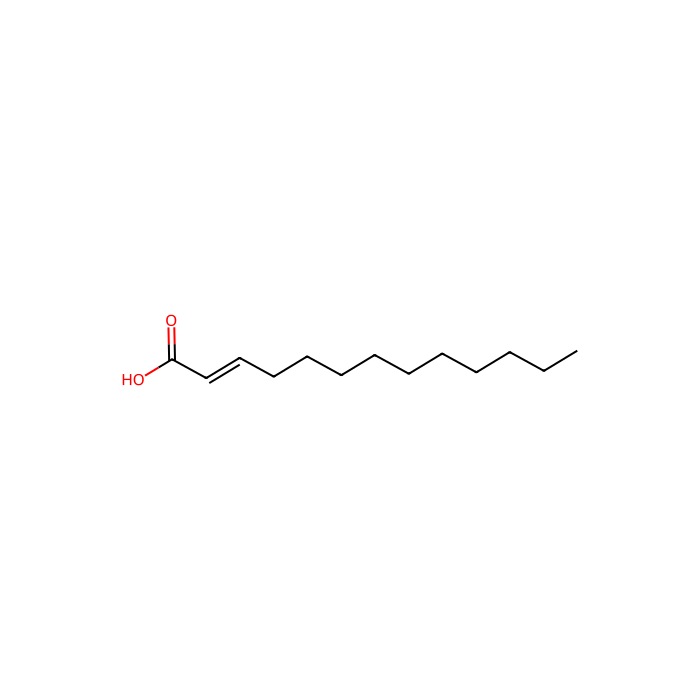
Brief description: 2-Tridecenoic acid is an α,β-unsaturated C13 fatty acid (double bond between C2–C3 relative to the carboxyl group), typically obtained or used as an E/Z mixture unless stereochemistry is specified.
Product Data identifiers (item-specific):
SKU: T352366
CAS: 6969-16-0
CID: 5282735
InChIKey (as provided): 109167
Category Path: 全部 / 可售 / 生命科学
Literature/computed identifiers (general reference values, not item-specific):
Molecular formula (theoretical): C13H24O2 (α,β-unsaturated C13 carboxylic acid)
Structural features: one carboxylic acid (–CO2H), one C=C (α,β to the acid), linear aliphatic tail (total 13 C atoms including carboxyl carbon), no heteroatoms beyond the acid oxygens.
2D structure in words (general):
Terminal carboxyl group (C1) conjugated to an internal C=C between C2–C3, followed by a linear saturated chain of ten methylene units terminating in a methyl group. Unless specified, the configuration about the C=C may be E and/or Z (mixture).
Synthetic Utility
Key functional elements and reactivity (literature/general):
Carboxylic acid handle: amenable to esterification, amidation, acyl chloride/anhydride formation, and coupling chemistry (DCC/EDC, mixed anhydrides, acid chlorides). The long hydrophobic tail imparts surfactant/lipid character to derivatives.
Conjugated alkene (α,β-unsaturated): serves as a Michael acceptor for O-, N-, S-, and C-nucleophiles; can undergo selective hydrogenation (1,4- or full) or epoxidation at the β,γ-position after activation/protection.
Orthogonality: You can functionalize the acid selectively (e.g., make methyl/benzyl esters) to protect it while exploiting the C=C for conjugation/cycloaddition; or conversely, modify the double bond (e.g., hydroboration–oxidation, halogenation) with the acid masked.
Named/standard transformations:
Steglich esterification (DCC/DMAP) to make allylic esters.
Mitsunobu esterification (with alcohol partners) if inversion at an alcohol substrate is beneficial; mindful of double-bond stability.
Conjugate addition with thiols/amines under base catalysis to produce β-functionalized acids.
Selective hydrogenation: Pd/C for C=C saturation; Lindlar or carefully tuned catalysts for partial hydrogenation if other unsaturation present in substrates.
Retrosynthetic value:
Serves as a modular intermediate connecting petro-/bio-based C13 feedstocks to functionalized lipids, surfactants, and polymer precursors. The α,β-unsaturation enables further diversification not accessible from fully saturated tridecanoic acid.
Target Specificity
Not applicable. This product is a small-molecule reagent (fatty acid), not an affinity reagent or biologic. No antigen/epitope, species reactivity, clone, or isotype information applies.
Wir verwenden Cookies, um die ordnungsgemäße Funktion der Website sicherzustellen und, soweit zulässig, Ihr Nutzererlebnis zu verbessern. Sie können Ihre Einstellungen jederzeit unter „Einstellungen“ verwalten. Weitere Informationen finden Sie in unserer Cookie-Richtlinie.
Shall we send you a message when we have discounts available?
Remind me later
Thank you! Please check your email inbox to confirm.
Products are supplied to verified businesses, institutions, and qualified professionals for research and development use only. Not for use in humans, animals, diagnosis, or therapy.

 E2615047