This compound belongs to the class of organic compounds known as organooxygen compounds. These are organic compounds containing a bond between a carbon atom and an oxygen atom.
External Descriptors
Not available
1. Djoumbou Feunang Y, Eisner R, Knox C, Chepelev L, Hastings J, Owen G, Fahy E, Steinbeck C, Subramanian S, Bolton E, Greiner R, and Wishart DS. ClassyFire: Automated Chemical Classification With A Comprehensive, Computable Taxonomy. Journal of Cheminformatics, 2016, 8:61.
Zertifikate (CoA, COO, BSE/TSE und Analyse-Diagramm)
C of A & Other Certificates(BSE/TSE, COO):
Analytical Chart:
Lösungsrechner
Molarity Calculator
Determine the necessary mass, volume, or concentration for preparing a solution.
Dilution Calculator
Determine the dilution needed to prepare a stock solution.
Reconstitution Calculator
Bewertungen
Kundenbewertungen
Application Protocols
No application protocols are specified for this item; refer to CoA/Spec Sheet. For general laboratory use with vinyl ethers:
Establish a dry, acid-free environment (freshly baked glassware, inert gas purge).
If conducting photopolymerization, prepare formulations in amber glass, add photoinitiator under low light, and record curing profiles (photo-DSC or RT-FTIR).
For thiol–ene reactions, verify radical initiator concentration and degas solutions to minimize oxygen inhibition.
Document pre- and post-reaction GC and NMR to confirm absence of unintended polymerization or hydrolysis.
These are general research practices and not product-specific validated protocols.
Biological Roles
This compound is a synthetic, small-molecule vinyl ether with a cycloaliphatic tail. There are no established endogenous biological roles.
Biogenic relevance: None known; not a natural metabolite.
Biochemical reactivity (general): The terminal vinyl ether is electron-rich and can undergo electrophilic addition under acidic conditions, but such chemistry is not associated with physiological function.
Use in bio-related research: Materials researchers may incorporate vinyl ether monomers into polymeric matrices, surface coatings, or hydrophobic modifiers for in vitro device prototypes. Any biological testing should be conducted under appropriate laboratory guidelines.
Important note: Per product labeling, this material is for research use only and is not intended for diagnostic, therapeutic, or other clinical uses.
Buffer Applications
Not typically applicable. This hydrophobic vinyl ether is not used to formulate aqueous biological buffers. For experiments involving this reagent, focus on the organic reaction media and handling recommendations described in Solvent Selection and Reaction & Applications.
Green Alternatives
Because this product is a reactive vinyl ether monomer/reagent, “green alternatives” focus on process choices and alternative monomer classes rather than drop-in solvent swaps.
Process considerations (greener practice):
Use photocatalytic/cationic photopolymerization at ambient temperature to reduce thermal energy input.
Select solvent-free or high-solids formulations when polymerizing to minimize VOC emissions.
Where solvent is necessary, prefer greener media (e.g., 2-MeTHF, CPME, dimethyl carbonate) provided they are neutral/dry and do not initiate cationic polymerization.
Monomer alternatives (contextual):
For UV-curable systems, consider bio-based acrylates or alkene-functional polysaccharides if cationic curing is not required; trade-offs include odor, shrinkage, and oxygen inhibition profiles.
Allyl ethers may be less acid-sensitive but typically polymerize more slowly under cationic mechanisms; performance and cure speed will differ.
Comparison snapshot (literature/general):
Vinyl ether (this product): fast cationic cure; acid-sensitive; low odor; possible hydrolysis to acetaldehyde.
Allyl ethers: slower cure; often better storage stability; may require more energetic initiation.
Select the platform that balances cure speed, emissions, and safety for the intended research application.
Pharmaceutical Uses
No pharmacopeial or formulation excipient status is specified for this item; refer to CoA/Spec Sheet. In pharmaceutical R&D contexts, vinyl ether monomers like this are sometimes explored in materials research (e.g., UV-curable coatings, device prototypes, or surface modification), but they are not typical drug substances or approved excipients.
Regulatory status: Not specified. Any use would require internal compatibility, extractables/leachables evaluation, and toxicological assessment.
Formulation role (research-only, general): Potential reactive diluent or crosslinkable monomer in radiation/UV-curable systems for nonbiological components.
This product is supplied strictly for research use only and is not intended for human or animal administration.
Physical Properties
Appearance: Not specified for this item; refer to CoA/Spec Sheet.
Boiling point / Melting point: Not specified for this item; refer to CoA/Spec Sheet. (Vinyl ethers of similar carbon number typically distill as liquids in the mid-to-high temperature range; literature-only generalization.)
Density, refractive index, UV cutoff, water/peroxide/metal specifications: Not specified for this item; refer to CoA/Spec Sheet.
Vinyl ethers are acid-sensitive; physical property measurements (e.g., RI) can drift if material partially polymerizes or hydrolyzes. Handle under dry, neutral to basic conditions.
If distillation is attempted (laboratory purification), employ reduced pressure, inert atmosphere, and acid-free glassware to minimize cationic polymerization. Always consult the item’s CoA/SDS for definitive specifications prior to process design.
Quality and Grades
Grade/Purity: Not specified for this item; refer to CoA/Spec Sheet.
Without an explicit grade, users should consult the CoA/SDS for assay method (e.g., GC), residual solvent content, inhibitor/stabilizer presence (if any), and limits on acidic impurities that could trigger polymerization.
For vinyl ethers, trace acidic or Lewis acidic impurities are particularly consequential. High-purity material often exhibits improved shelf-life and predictable reactivity in cationic or radical additions.
If an inhibitor/stabilizer is present (e.g., traces of base or phenolic inhibitors), this will be listed on the CoA; such additives can influence photopolymerization kinetics. If ultra-low inhibitor content is required, consider gentle removal strategies immediately before use (e.g., basic alumina if compatible), validating by analytical QC.
Recommended incoming QC (general):
GC-FID/GC–MS for purity and volatile impurities (including acetaldehyde).
Karl Fischer for water (vinyl ethers are moisture-sensitive under acidic conditions). Specific water limits are not specified for this item.
Acid number or pH of a non-aqueous solution to screen for acidic contaminants.
Record RI and NMR profiles to benchmark lot-to-lot consistency.
For applications in polymer R&D or surface coatings, tighter control over trace acids and peroxides improves reproducibility; however, item-specific thresholds are not provided here and must be confirmed on the CoA.
Reaction and Applications
Cationic polymerization (literature): Vinyl ethers are classic monomers for cationic and photo-cationic polymerizations (e.g., iodonium salt photoinitiators under UV). The cyclohexyl–ethylene spacer can impart flexibility and hydrophobicity to resulting polymers/coatings.
Thiol–ene additions (literature): Efficient anti-Markovnikov radical additions across the terminal C=C under AIBN/thermal or photoinitiated conditions. Useful for step-growth network formation and surface functionalization.
Hydroboration–oxidation (literature): BH3·THF or 9-BBN adds across the C=C to give primarily the anti-Markovnikov alcohol after oxidation (H2O2/NaOH). Careful workup avoids acid exposure.
Hydrosilylation (literature): Pt-catalyzed addition of hydrosilanes across the vinyl ether; basis for silicone modification.
Acid-catalyzed transformations (literature):
Controlled acetalization-type chemistry; vinyl ethers readily hydrolyze to give acetaldehyde and the corresponding alcohol (here, 2-hydroxyethylcyclohexane) under aqueous acid.
Participate in Prins-type and related electrophilic additions under strong acid, though polymerization competes.
Cross-coupling/metathesis (literature notes): Vinyl ethers are often challenging substrates for olefin metathesis due to strong coordination/electron donation; specialized conditions are required if attempted.
Practical tips:
Exclude acids rigorously unless they are the intended catalysts.
Work under dry, inert gas. For photoprocesses, use UV-transparent glassware and control oxygen if radical inhibition is an issue.
For polymerizations, monitor conversion by FTIR (vinyl C=C ~1640 cm−1 decrease) or 1H NMR (vinylic signals).
Reaction Conditions
General literature guidance for vinyl ethers (optimize per your system; these are not product specifications):
Cationic photopolymerization:
Initiators: diaryliodonium or triarylsulfonium salts (0.5–3 wt%).
Solvent: neat or low-acid, low-moisture media (toluene, MeCN).
Conditions: UV exposure (e.g., 365–405 nm depending on initiator sensitization), ambient temperature, inert atmosphere recommended. Rapid gelation and high conversion are typical.
Thiol–ene coupling:
Initiation: AIBN (0.5–2 mol%) at 60–80 °C or UV photoinitiators (e.g., DMPA) at ambient.
Solvent: toluene, DCM, MeCN, or bulk. Oxygen can inhibit radicals; degas if needed.
Stoichiometry: near-equimolar alkene:thiol for step-growth networks; monitor by 1H NMR.
Hydroboration–oxidation:
Reagents: BH3·THF or 9-BBN (1.0–1.2 equiv), 0–25 °C, 1–3 h; oxidize with H2O2/NaOH at 0–25 °C.
Solvent: THF or toluene (dry, acid-free). Gives primarily anti-Markovnikov alcohols.
Hydrosilylation:
Catalyst: Karstedt’s Pt or Speier’s Pt; 0.1–1 mol%.
Solvent: toluene/xylene or neat; 25–80 °C. Monitor by FTIR or GC.
Acidic hydrolysis (unmasking):
Dilute mineral acid (e.g., 0.1–1 M HCl, aqueous/organic biphasic), 0–25 °C. Generates acetaldehyde; ensure adequate venting and scrubbing.
Always exclude strong acids unless intentionally used, and work under dry, inert conditions to suppress unintended polymerization.
Safety and Handling
GHS classification, signal word, pictograms, H-statements: Not specified for this item; refer to SDS for authoritative safety information.
Primary hazards (general for vinyl ethers):
May be flammable as an organic liquid; keep away from ignition sources.
Acid-sensitive; can undergo rapid cationic polymerization upon contact with strong acids, Lewis acids, or acidic surfaces.
Can hydrolyze under acidic aqueous conditions, potentially releasing acetaldehyde (irritant, flammable) and the corresponding alcohol.
PPE: Safety glasses, chemically resistant gloves (e.g., nitrile), lab coat. Use in a fume hood to avoid inhalation of vapors and to control flammability risks.
Incompatibilities (general): Strong acids/Lewis acids, strong oxidizers, peroxides/initiators, and moisture under acidic conditions. Avoid clay-based acidic drying agents.
First aid (general guidance; defer to SDS):
Inhalation: Move to fresh air; seek medical attention if symptoms persist.
Skin/eye contact: Rinse with water for at least 15 minutes; remove contaminated clothing; seek medical advice for persistent irritation.
Ingestion: Rinse mouth; do not induce vomiting; seek medical attention.
Fire-fighting (general): Use alcohol-resistant foam, CO2, or dry chemical. Cool containers with water spray. Vapors may travel to ignition sources.
Safe handling tips: Maintain dry, inert atmosphere; avoid acidic contaminants; use amber glass if prolonged storage to limit radical initiation by light. Always consult the SDS before scale-up.
Solvent Selection
This material is itself a reactive, hydrophobic vinyl ether rather than a routine solvent. It is typically handled as a reagent or monomer.
Polarity class (qualitative): Low polarity, hydrocarbon-like behavior with an electron-rich C=C adjacent to oxygen.
Miscibility (literature/general): Expected miscibility with nonpolar and moderately polar organic solvents (e.g., hexanes, toluene, diethyl ether, MTBE, DCM, EtOAc). Poor water miscibility.
When choosing a solvent for this reagent:
Prefer aprotic, non-acidic media; avoid protic acids and Lewis acids unless intentionally catalyzing a reaction.
For radical additions (thiol–ene) or photopolymerization, use low-absorbing solvents such as toluene, MeCN, or DCM, chosen to match initiator solubility and optical window.
For hydroboration or hydrosilylation, THF or toluene are common; ensure absence of acid.
Comparison notes (general):
Versus allyl ethers, vinyl ethers are more electron-rich and more sensitive to acid; solvent must be drier/cleaner.
Versus styrenics, vinyl ethers can polymerize cationically; thus, avoid solvents or additives with acidic impurities.
If using this compound as a co-solvent is contemplated, verify compatibility with catalysts and confirm that the vinyl ether does not participate in unintended side reactions.
Storage and Reconstitution
Storage Conditions (from Product Data): Store at 2–8 °C. Shipped on wet ice.
Container/atmosphere (general best practice for vinyl ethers): Store in amber glass under inert gas (e.g., nitrogen or argon) to minimize light-initiated or oxygen-mediated side reactions. Keep tightly sealed to limit moisture ingress.
Stability considerations: Avoid contact with acids/Lewis acids and acidic surfaces. Prolonged exposure to moisture and acid can lead to hydrolysis (liberating acetaldehyde) and/or polymerization.
Freeze–thaw: Not applicable; product is typically supplied neat as a liquid. Do not freeze unless validated for your process; some vinyl ethers can become unstable upon repeated freeze–thaw.
Reconstitution: Not applicable; use as supplied. If dilution is required, choose a dry, neutral, aprotic solvent and use promptly.
Before use: Allow to warm to ambient in a sealed container to prevent condensation; inspect for turbidity, precipitate, or viscosity changes that could indicate polymerization or contamination.
Always consult the CoA/SDS for lot-specific stability and any inhibitor/stabilizer information.
Structure and Identity
A cycloaliphatic vinyl ether intended for research and synthetic applications.
Product Name (SKU): 2-vinyloxyethylcyclohexane (V681359)
CAS: 103983-46-6
PubChem CID (literature): 21363356
InChIKey: Not specified for this item; refer to CoA/Spec Sheet.
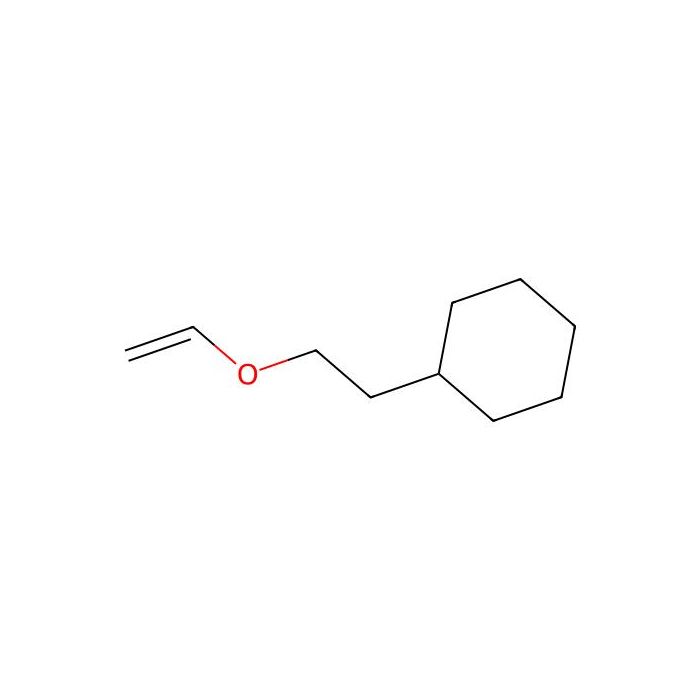
SMILES (literature): C=COCC1CCCCC1
Molecular Formula (literature): C10H18O
Molecular Weight (literature): ~154.25 g/mol
Structural features (descriptive):
Functional groups: A terminal vinyl ether motif (–O–CH=CH2) connected via an ethylene linker (–CH2–CH2–) to a cyclohexyl ring.
Ring system: Single saturated six-membered carbocycle (cyclohexane) tethered to the vinyl ether oxygen through a two-carbon spacer.
Unsaturation: One C=C double bond (vinyl) and one ring; overall an electron-rich enol ether.
Stereochemistry: No stereocenters; the vinyl group is terminal (no E/Z isomerism at the terminal alkene).
2D structure (in words): a cyclohexane ring bearing a two-carbon chain that terminates at an ether oxygen, which in turn is bound to a terminal vinyl group (CH2=CH–O–CH2–CH2–cyclohexyl). The electron-rich vinyl ether is prone to acid-catalyzed reactions and cationic polymerization, while the cyclohexyl segment imparts hydrophobicity and reduced volatility compared with lower vinyl ethers.
Synthetic Utility
Key functional handle is the vinyl ether (–O–CH=CH2), an electron-rich alkene that undergoes selective transformations:
Electrophilic/acid-catalyzed chemistry (literature): Rapid protonation at the β-carbon enables addition reactions; controlled hydrolysis yields acetaldehyde and 2-hydroxyethylcyclohexane, providing a route to the corresponding alcohol.
Radical additions (literature): Efficient thiol–ene coupling for installing thioether functionality at the terminal carbon; useful for modular ligation and polymer network formation.
Hydrofunctionalizations (literature):
Hydroboration–oxidation to primary alcohols (anti-Markovnikov).
Hydrosilylation (Pt-catalyzed) for silyl-functional materials.
Hydroamination under suitable catalysts, though less common due to competing pathways.
Polymer chemistry (literature): Cationic chain growth yields poly(vinyl ether)s with tunable Tg and hydrophobicity; the cyclohexyl–ethylene segment imparts flexibility and low polarity.
Retrosynthetic value: The vinyl ether can act as a masked acetaldehyde equivalent; acid-triggered unmasking releases acetaldehyde in situ while delivering the tethered alcohol. Conversely, O-vinylation strategies can install the vinyl ether from the alcohol precursor using vinylating agents (e.g., acetylene derivatives, vinyl esters) under neutral/basic conditions to avoid rearrangement.
The cyclohexyl moiety offers steric bulk and nonpolar character, aiding phase separation and simplifying certain extractions.
Target Specificity
Not applicable. This product is a small-molecule vinyl ether, not a biological macromolecule or affinity reagent. No antigen/epitope or species reactivity information applies.
Wir verwenden Cookies, um die ordnungsgemäße Funktion der Website sicherzustellen und, soweit zulässig, Ihr Nutzererlebnis zu verbessern. Sie können Ihre Einstellungen jederzeit unter „Einstellungen“ verwalten. Weitere Informationen finden Sie in unserer Cookie-Richtlinie.
Shall we send you a message when we have discounts available?
Remind me later
Thank you! Please check your email inbox to confirm.
Products are supplied to verified businesses, institutions, and qualified professionals for research and development use only. Not for use in humans, animals, diagnosis, or therapy.