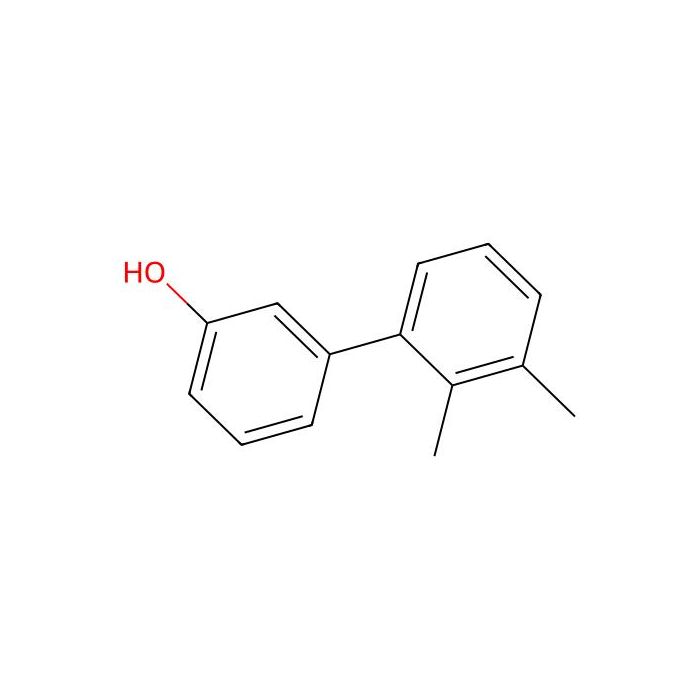
This compound belongs to the class of organic compounds known as biphenyls and derivatives. These are organic compounds containing to benzene rings linked together by a C-C bond.
External Descriptors
Not available
1. Djoumbou Feunang Y, Eisner R, Knox C, Chepelev L, Hastings J, Owen G, Fahy E, Steinbeck C, Subramanian S, Bolton E, Greiner R, and Wishart DS. ClassyFire: Automated Chemical Classification With A Comprehensive, Computable Taxonomy. Journal of Cheminformatics, 2016, 8:61.
Zertifikate (CoA, COO, BSE/TSE und Analyse-Diagramm)
C of A & Other Certificates(BSE/TSE, COO):
Analytical Chart:
Chemische und physikalische Eigenschaften
Molekulargewicht
198.260 g/mol
XLogP3
4.000
Hydrogen Bond Donor Count
1
Hydrogen Bond Acceptor Count
1
Rotatable Bond Count
1
Exact Mass
198.104 Da
Monoisotopic Mass
198.104 Da
Topological Polar Surface Area
20.200 Ų
Heavy Atom Count
15
Formal Charge
0
Complexity
202.000
Isotope Atom Count
0
Defined Atom Stereocenter Count
0
Undefined Atom Stereocenter Count
0
Defined Bond Stereocenter Count
0
Undefined Bond Stereocenter Count
0
The total count of all stereochemical bonds
0
Covalently-Bonded Unit Count
1
Lösungsrechner
Molarity Calculator
Determine the necessary mass, volume, or concentration for preparing a solution.
Dilution Calculator
Determine the dilution needed to prepare a stock solution.
Reconstitution Calculator
Bewertungen
Kundenbewertungen
Application Protocols
No item-specific validated application protocols are provided for this small-molecule reagent.
General guidance for solution preparation in research contexts:
Prepare concentrated stock solutions in DMSO, acetonitrile, ethanol, or THF as appropriate to your assay or reaction; typical ranges 10–100 mM for screening or 0.1–1.0 M for synthesis (general practice). Filter if required.
For biological assays, limit water-miscible co-solvent (e.g., DMSO) to ≤0.5–1% v/v in final media and include vehicle controls. Assess solubility and stability prior to use.
For synthetic procedures, see the Reaction Conditions and Synthetic Utility sections for literature-based starting points.
Biological Roles
Item-specific biological/biochemical roles are not provided. This product is for research use only.
General context (literature):
Phenolic aromatics can participate in hydrogen bonding and π–π interactions with proteins and membranes. The phenolic OH is weakly acidic and can exist as a phenoxide under physiological/basic conditions, altering polarity and binding.
Alkylphenols have been studied for hydrophobic interactions and, in some cases, endocrine-related activities in model systems; such effects are highly structure-dependent and are not implied for this specific compound.
Metabolism (generic): Phenols often undergo phase I oxidation on the aromatic ring or alkyl substituents followed by phase II conjugation (glucuronidation/sulfation) to enhance excretion (organism-dependent, literature).
No specific biological targets, pathways, or activities are assigned to 3-(2,3-dimethylphenyl)phenol in this listing. Any use in biological experiments should include appropriate controls and concentration–response assessments.
Buffer Applications
This compound is not typically used as a laboratory buffer. Although phenols are weak acids (typical pKa ≈ 10 for simple phenol; literature), 3-(2,3-dimethylphenyl)phenol is hydrophobic and not formulated as a buffering agent.
For pH control, choose established buffer systems (e.g., phosphate, Tris, HEPES, acetate) suited to your pH range and ionic strength requirements.
Green Alternatives
Greener strategies center on solvent choice, coupling technology, and reagent economy. While the molecule itself is fixed, its use in synthesis can be made more sustainable (general/literature guidance):
Solvent substitution: Prefer 2-MeTHF or CPME over THF/MTBE; ethyl acetate over dichloromethane where feasible; toluene over chlorinated solvents for nonpolar operations. For polar processes, consider propylene carbonate or MeCN (with proper recovery) over DMF/DMSO when compatible.
Base choice: Use inorganic carbonates (K2CO3, Cs2CO3) or KOAc in alcohols rather than strong, pyrophoric bases where possible.
Catalysis: Employ Pd-catalyzed couplings from aryl triflates using low catalyst loadings and aqueous micellar media (e.g., TPGS-750-M) when compatible.
Process intensification: Flow chemistry for hazardous reagents (triflation, acylations) can reduce solvent and improve safety.
Comparison snapshot (general):
Greener option: 2-MeTHF — biomass-derived, good solubility for ethers/esters; higher bp facilitates reactions; may form peroxides over long storage (monitor)
Traditional: THF — excellent solvating ability; lower bp simplifies removal; petroleum-derived; stabilizer may be required
Traditional: DCM — powerful, volatile chlorinated solvent; good for acylations; environmental and health concerns
Trade-offs should be evaluated case-by-case (solubility, rates, workup, safety).
Pharmaceutical Uses
No item-specific pharmacopeial status or excipient role is provided for this product. It is sold for research use only.
General considerations (literature/practice):
Medicinal chemistry intermediate: Phenolic biaryls are frequently employed as scaffolds or late-stage diversification handles (O-alkylation/acylation, aryl triflation then cross-coupling) during hit-to-lead or lead optimization.
Formulation relevance: As a hydrophobic phenol, it is not commonly used as an excipient. If used in in vitro studies, it may be dissolved in DMSO/EtOH to prepare stock solutions; ensure appropriate vehicle controls.
Regulatory: No USP/Ph. Eur. monograph is implied. Purity, residual solvents, and elemental impurities should be qualified per internal research specifications if used to prepare intermediates in API research routes.
Avoid any clinical or diagnostic use. Consult institutional guidelines for handling non-GMP research reagents.
Physical Properties
Item-specific physicochemical specifications are not provided for this catalog entry.
Appearance (item-specific): Not specified for this item; refer to CoA/Spec Sheet.
Melting point / Boiling point (item-specific): Not specified for this item; refer to CoA/Spec Sheet.
Density, refractive index (item-specific): Not specified for this item; refer to CoA/Spec Sheet.
Solubility (item-specific): Not specified for this item; refer to CoA/Spec Sheet.
General/literature expectations for this class of compound (non-specification):
Aromatic phenols of similar size (biaryl with two methyl groups) are typically sparingly soluble in water but readily soluble in organic solvents such as ethanol, methanol, acetone, acetonitrile, ethyl acetate, dichloromethane, toluene, and THF (literature).
The phenolic –OH confers weak acidity (typical phenol pKa ca. 10; literature value for simple phenol ~9.9), enabling formation of water- or alcohol-soluble phenoxide salts in basic media.
The two methyl groups generally increase lipophilicity and boiling point compared to unsubstituted phenylphenols (qualitative, literature).
Note: For exact values (mp, bp, density, UV cutoff, water/peroxide/metal limits), consult the product’s CoA/Spec Sheet; those data are not specified here.
Quality and Grades
Grade/Purity (item-specific): Not specified for this item; refer to CoA/Spec Sheet.
Interpretation and guidance (general):
If supplied as analytical/reagent grade, material typically meets purity suitable for synthetic and analytical workflows; trace contaminant limits and UV absorbance profiles vary by vendor specification.
If supplied as >95–99% purity, the material is typically appropriate for medicinal chemistry and materials synthesis; confirm by NMR/GC/LC and review impurity profile on the CoA.
Stabilizers: None are indicated for this item. If stabilizers were present (e.g., BHT for peroxidizable solvents), they would be listed on the CoA; absence here should not be interpreted as confirmation—verify on CoA/Spec Sheet.
What to check on receipt:
Identity: 1H/13C NMR consistent with a phenolic proton (downfield ~9–11 ppm, literature), aromatic resonances for a biaryl, and methyl singlets/doublets near ~2.1–2.4 ppm.
Purity: HPLC/GC (>95% for most research uses; verify your requirement). If performing photochemical or radical chemistry, assess inhibitor content if any.
Residual solvents/water/metals: Not specified for this item; refer to CoA/Spec Sheet if such limits are critical for your application (e.g., catalysis or materials).
Reaction and Applications
This compound is a versatile phenolic biaryl building block. The phenolic OH and the dimethyl-substituted aryl ring enable several synthetic avenues (general/literature guidance):
O-Alkylation (Williamson ether synthesis): Deprotonation (e.g., K2CO3, Cs2CO3, NaH) followed by reaction with primary alkyl halides or activated sulfates to access aryl alkyl ethers. Secondary halides often require stronger bases or phase-transfer catalysis.
O-Acylation/Ester formation: Acid chlorides/anhydrides with base (pyridine, triethylamine) or DCC/EDC coupling with a catalytic nucleophilic acylation catalyst (e.g., DMAP) to give aryl esters and carbonates.
Aryl triflate formation and cross-coupling: Conversion of the phenol to an aryl triflate (Tf2O, pyridine) provides a pseudohalide suitable for Suzuki–Miyaura, Stille, Negishi, or Buchwald–Hartwig couplings (literature), enabling rapid diversification at the phenolic carbon.
Mitsunobu etherification: Phenol as nucleophile with DEAD/DIAD and PPh3 to invert secondary alcohol partners; useful for constructing hindered ethers.
Directed metalation (remote): The 2,3-dimethyl pattern on the distal ring increases steric bulk and electron density, useful when probing regiochemical outcomes in electrophilic aromatic substitution or in designing ligands/materials where steric profile matters (qualitative, literature).
Materials/ligand precursor: Phenolic biaryls can be elaborated into phenoxide metal complexes, polymerizable monomers (via etherification/esterification), or incorporated into rigid, hydrophobic scaffolds for advanced materials (general application).
Use cases in research:
Scaffold for SAR campaigns (phenolic handle for rapid analog generation).
Intermediate toward diarylethers, aryl carbonates/urethanes, and biaryl triflates.
Reaction Conditions
General, literature-based conditions for common transformations of 3-(2,3-dimethylphenyl)phenol (non-item-specific guidance):
O-Alkylation (Williamson): 1.0 equiv substrate, 1.2–2.0 equiv base (K2CO3 or Cs2CO3) in DMF/MeCN/acetone, 0.5–1.5 equiv alkyl halide; 25–80 °C, 2–18 h. For hindered electrophiles: NaH (1.1 equiv) in THF/DMF at 0–25 °C then add electrophile; monitor by TLC/HPLC.
Esterification (Acyl chloride/anhydride): Base (Et3N or pyridine, 1.5–2.0 equiv) in DCM/MeCN, 0 °C to rt, 1–4 h. With coupling reagents: DCC or EDC (1.1–1.5 equiv) and catalytic DMAP (5–10 mol%) in DCM or THF, 0–25 °C, 2–16 h.
Triflation: Tf2O (1.2–1.5 equiv), pyridine/2,6-lutidine in DCM or toluene at −20 to 0 °C then warm to rt; strictly anhydrous. Quench with aqueous NaHCO3.
Suzuki–Miyaura (from aryl triflate): Pd(dppf)Cl2 (1–3 mol%), boronic acid/ester (1.2–1.5 equiv), base (K3PO4 or K2CO3, 2–3 equiv) in dioxane/H2O or toluene/MeOH/H2O, 50–90 °C, 2–12 h.
Mitsunobu etherification: Alcohol (1.2–1.5 equiv), DIAD/DEAD (1.2–1.5 equiv), PPh3 (1.2–1.5 equiv) in THF/CH2Cl2 at 0–25 °C, 2–6 h.
Notes:
Ensure anhydrous conditions for base-sensitive or activation steps. The 2,3-dimethyl substituents add steric hindrance; choose conditions favoring SN2 over E2 for O-alkylation (polar aprotic solvents, excess nucleophile, lower temperature) and consider more reactive electrophiles (e.g., alkyl iodides, mesylates).
Safety and Handling
Item-specific hazard classifications are not provided. Always consult the product-specific SDS before use.
GHS classification (item-specific): Not specified for this item; refer to SDS.
Signal word / H-statements / Pictograms (item-specific): Not specified for this item; refer to SDS.
General safety guidance for aromatic phenols (literature/industry practice):
Hazards: Phenolic compounds can be irritating to skin, eyes, and respiratory tract; some phenols may cause burns upon prolonged contact. Avoid aerosol formation.
PPE: Wear lab coat, safety glasses or goggles, and suitable chemical-resistant gloves (e.g., nitrile). Use in a fume hood to avoid inhalation.
Handling: Avoid contact with strong oxidizers. Phenoxides are strong nucleophiles/bases—exercise caution with acids and acylating agents.
First aid (overview): In case of skin or eye contact, rinse with plenty of water for at least 15 minutes; remove contaminated clothing. If inhaled, move to fresh air. If swallowed, rinse mouth; do not induce vomiting; seek medical attention. Follow SDS instructions.
Spill response: Absorb with inert material (vermiculite/sand), collect for disposal as hazardous waste.
Storage incompatibilities: Strong oxidizers and strong bases/acyl halides (which can react with phenols/phenoxides). Keep away from ignition sources as with typical organic solids/liquids.
Storage conditions (item-specific): Room temperature (per Product Data). Maintain container tightly closed in a dry, well-ventilated place.
Solvent Selection
As a hydrophobic biaryl with one phenolic OH, 3-(2,3-dimethylphenyl)phenol is generally:
Water solubility: Very low (qualitative, literature for substituted phenols of similar size). Solubility increases upon deprotonation to the corresponding phenoxide in basic aqueous media.
Organic solubility: High in common polar aprotic and moderately polar solvents (e.g., acetonitrile, DMF, DMSO, acetone, ethyl acetate) and in nonpolar aromatics (toluene, xylene). Alcohols (MeOH/EtOH) typically dissolve phenols moderately to well (literature).
Practical selection tips (general):
Spectroscopy/stock solutions: DMSO, acetone, acetonitrile, or ethanol provide good solubility and stability for short- to mid-term storage; add base only immediately before reactions if phenoxide is needed.
O-alkylation/esterification: Use polar aprotic solvents (DMF, DMSO, MeCN) or THF/2-MeTHF; ensure base compatibility (e.g., K2CO3, Cs2CO3, NaH).
Aryl triflation/sulfonylation: Dichloromethane, toluene, or MeCN under anhydrous conditions.
Suzuki from aryl triflate (derived in situ): Toluene/MeOH/H2O or dioxane/H2O biphasic with Pd catalysts.
Brief comparison (general):
Toluene/xylene: Excellent for high-T steps; poor polarity limits some bases/salts.
Acetonitrile/DMF/DMSO: Enhance rate of SN and coupling steps; consider workup challenges (DMF/DMSO removal).
2-MeTHF/EtOAc: Greener options with good handling and extraction profiles; confirm solubility.
Storage and Reconstitution
Storage conditions (item-specific): Store at room temperature (per Product Data). Keep the container tightly closed in a dry, well-ventilated place.
Best practices (general):
Protect from moisture and prolonged light. Although phenols are generally stable, slow oxidation/discoloration can occur over time; minimize air exposure (use desiccant, consider inert gas backfill for long-term storage).
If supplied as a solid, break up any caking under dry conditions. If supplied as a liquid/oil, ensure cap integrity and consider secondary containment.
Reconstitution/solution preparation (general):
Dissolve in suitable organic solvents (e.g., DMSO, acetonitrile, ethanol, THF, ethyl acetate, toluene), selecting based on downstream use. Gently warm (≤40 °C) or sonicate if needed; avoid strong base unless immediate use is intended.
For analytical stocks, record concentration by gravimetry or quantitative NMR where appropriate. Store solutions refrigerated or frozen to prolong stability, and avoid repeated freeze–thaw by preparing aliquots.
Research Use Note: For research use only. Not for human or veterinary use.
For any item-specific stability data (shelf life, solution stability, impurity limits), please refer to the product CoA/Spec Sheet.
Structure and Identity
A biaryl phenolic building block featuring a phenol ring para/meta-linked to a 2,3-dimethyl-substituted phenyl. The hydroxyl group resides on one ring; the second ring bears adjacent methyl groups at the 2- and 3-positions, imparting steric bulk and hydrophobicity.
Product Name (SKU D942489): 3-(2,3-Dimethylphenyl)phenol
CAS: 365427-18-5 (item-specific)
PubChem CID: 20556561 (item-specific)
InChIKey (item-specific): 403045
SMILES (item-specific): Not specified for this item; refer to CoA/Spec Sheet.
Molecular Formula (item-specific): Not specified for this item; refer to CoA/Spec Sheet.
Molecular Weight (item-specific): Not specified for this item; refer to CoA/Spec Sheet.
Structural features (general/literature description):
Functional groups: phenolic –OH on an aromatic ring (weakly acidic); two ring methyl substituents (electron-donating, ortho/meta-directing on their ring).
Ring system: unsymmetrical biphenyl (two fused-by-bond benzene rings, no heteroatoms in rings).
2D description: One benzene ring carries –OH; at its 3-position the rings are linked (3-phenylphenol motif). The distal ring is 2,3-dimethyl-substituted, creating proximal steric hindrance near the biaryl bond.
A reasonable literature formula for 3-(2,3-dimethylphenyl)phenol is commonly reported as C14H14O (literature). Corresponding formula mass ≈ 198.26 g/mol (calculated, literature).
Synthetic Utility
Key functional elements and reactivity (general/literature):
Phenolic OH: Convertible to ethers, esters, carbonates, carbamates; can be activated to aryl triflate for cross-coupling (Suzuki, Stille, Negishi, Buchwald–Hartwig). Phenoxide is a competent nucleophile for SNAr onto activated aryl halides.
Biaryl core: Provides rigidity and π-surface; useful for tuning lipophilicity and steric profile in targets. The 2,3-dimethyl substitution increases steric hindrance on the distal ring, influencing conformational bias and potentially suppressing undesired over-substitution.
Protecting group strategies: Phenol can be protected as silyl ethers (TBS/TBDPS), benzyl ethers, or carbonates to mask reactivity during multistep sequences, then unveiled under orthogonal conditions.
Downstream elaboration: Formation of sulfonates (mesylate/tosylate) is feasible but triflation is preferred for robust cross-coupling reactivity. Carbonate linkages enable installation of linkers or pro-moieties in probe development.
Late-stage diversification: Rapid library assembly via alkylation/acylation sets, followed by parallel purification, capitalizing on the single reactive OH handle.
Retrosynthetic value:
Serves as a convergent point to append diverse fragments through O-linkages or transform into a coupling handle (triflate) to replace the phenolic carbon-oxygen bond with C–C, C–N, or C–S bonds under Pd catalysis.
Target Specificity
Not applicable. This product is a small-molecule reagent, not a biological macromolecule or affinity reagent. No antigen, epitope, clone, isotype, or species reactivity is associated with this item.
Häufig gestellte Fragen
What is the purity of this product?
This product is supplied at ≥97% purity (chemical assay). Lot-specific values are stated on the Certificate of Analysis.
How should this product be stored?
Store at room temperature.
What are the CAS number, molecular formula and molecular weight?
The CAS Number is 365427-18-5, the molecular formula is C14H14O, and the molecular weight is 198.260 g/mol. InChIKey WNMUMXBEMBZWGJ-UHFFFAOYSA-N.
What documentation is provided?
Available product documentation, including Certificates of Analysis (COA), Safety Data Sheets (SDS), and specification sheets, is shown in the product document area. Document availability and access follow the current site policy.
Wir verwenden Cookies, um die ordnungsgemäße Funktion der Website sicherzustellen und, soweit zulässig, Ihr Nutzererlebnis zu verbessern. Sie können Ihre Einstellungen jederzeit unter „Einstellungen“ verwalten. Weitere Informationen finden Sie in unserer Cookie-Richtlinie.
Dürfen wir Sie über Rabattaktionen informieren?
Später erinnern
Vielen Dank! Bitte überprüfen Sie Ihren E-Mail-Posteingang, um zu bestätigen.
Products are supplied to verified businesses, institutions, and qualified professionals for research and development use only. Not for use in humans, animals, diagnosis, or therapy.