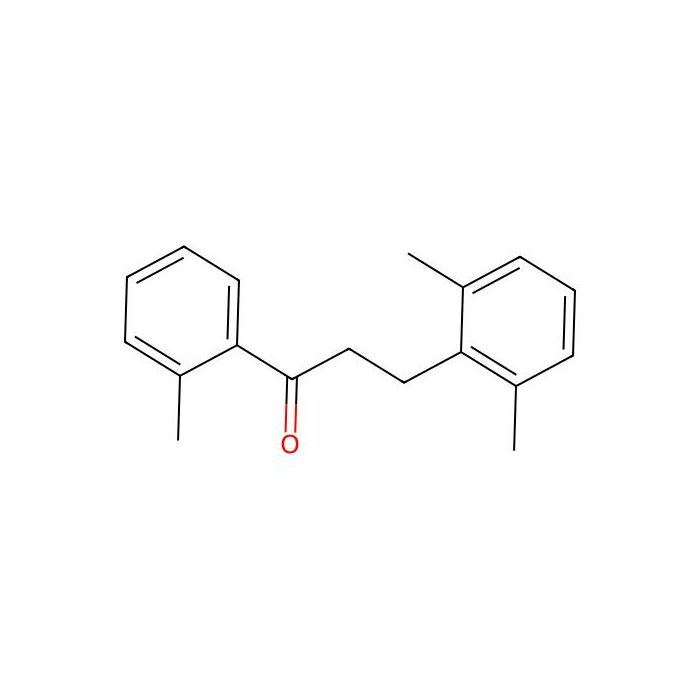
This compound belongs to the class of organic compounds known as retro-dihydrochalcones. These are a form of normal dihydrochalcones that are structurally distinguished by the lack of oxygen functionalities at the C2'- and C6'-positions.
External Descriptors
Not available
1. Djoumbou Feunang Y, Eisner R, Knox C, Chepelev L, Hastings J, Owen G, Fahy E, Steinbeck C, Subramanian S, Bolton E, Greiner R, and Wishart DS. ClassyFire: Automated Chemical Classification With A Comprehensive, Computable Taxonomy. Journal of Cheminformatics, 2016, 8:61.
Zertifikate (CoA, COO, BSE/TSE und Analyse-Diagramm)
C of A & Other Certificates(BSE/TSE, COO):
Analytical Chart:
Chemische und physikalische Eigenschaften
Molekulargewicht
252.300 g/mol
XLogP3
4.600
Hydrogen Bond Donor Count
0
Hydrogen Bond Acceptor Count
1
Rotatable Bond Count
4
Exact Mass
252.151 Da
Monoisotopic Mass
252.151 Da
Topological Polar Surface Area
17.100 Ų
Heavy Atom Count
19
Formal Charge
0
Complexity
286.000
Isotope Atom Count
0
Defined Atom Stereocenter Count
0
Undefined Atom Stereocenter Count
0
Defined Bond Stereocenter Count
0
Undefined Bond Stereocenter Count
0
The total count of all stereochemical bonds
0
Covalently-Bonded Unit Count
1
Lösungsrechner
Molarity Calculator
Determine the necessary mass, volume, or concentration for preparing a solution.
Dilution Calculator
Determine the dilution needed to prepare a stock solution.
Reconstitution Calculator
Bewertungen
Kundenbewertungen
Application Protocols
Not applicable.
No immunoassay or bioassay protocols (WB, IHC, IF, FC) are associated with this small-molecule reagent. For synthetic applications, refer to the Reaction Conditions and Synthetic Utility sections for general guidance.
Biological Roles
Applicability
This compound is a synthetic organic intermediate. It is not a known endogenous metabolite or biopolymer component.
General discussion (literature/general)
Aryl–alkyl ketones can interact with biological membranes due to lipophilicity; however, specific biological roles or targets for this highly substituted propiophenone are not established.
In chemical biology, aryl ketones are occasionally used as photo-crosslinkers (e.g., benzophenone motifs). The current item is a different scaffold and any such use would require empirical validation.
Note
No item-specific biological function is provided. Use is restricted to research applications per the Research Use Only note.
Buffer Applications
Not typically applicable.
This product is a hydrophobic aryl ketone, not a buffering agent. It does not form defined buffer systems in water. For aqueous work, select an appropriate buffer (e.g., phosphate, HEPES) independently, and dissolve this compound in a miscible cosolvent (e.g., DMSO, ethanol) before dilution if needed.
Green Alternatives
Context
This product is not a solvent but may require solvents and reagents of environmental concern during synthesis and use. Greener choices can reduce hazard and waste.
Greener solvent options (literature/general)
Replace chlorinated solvents (e.g., DCM) with:
2-Methyltetrahydrofuran (2-MeTHF): bio-based, wider liquid range; good for enolate and hydride reductions.
Cyclopentyl methyl ether (CPME): low peroxide formation, hydrophobic; effective for reductions and extractions.
Ethyl acetate or propylene carbonate: for workups and some reactions where higher polarity is acceptable.
Greener reagent strategies
Reductions: use catalytic hydrogenation (H2/Pd or Ru) or transfer hydrogenation (isopropanol/Ru, Mn) instead of stoichiometric hydrides when feasible.
Enolate chemistry: employ carbonate bases (Cs2CO3) with phase-transfer catalysis where suitable to avoid cryogenic organolithiums.
Photochemistry: LEDs in place of mercury lamps; organic photocatalysts (e.g., acridinium) over heavy-metal catalysts where applicable.
Trade-offs
2-MeTHF/CPME may alter selectivity and rates vs THF/DCM; solvent recovery is recommended. Catalytic reductions may require pressure equipment but greatly reduce waste.
Pharmaceutical Uses
Scope
No pharmacopeial status or excipient role is provided for this item.
General context (literature/general)
Substituted propiophenones and related aryl ketones primarily serve as synthetic intermediates in discovery chemistry and process development. They may be advanced to alcohols, amines, or further elaborated scaffolds during lead optimization.
Any use in drug product manufacture would require extensive qualification (impurities, residual solvents, elemental impurities) and compliance with cGMP—a context not implied here.
Research Use Only
As stated in the Product Data, this item is for research use only and is not intended for human or veterinary applications.
Physical Properties
Item-specific facts (from Product Data)
Appearance: Not specified for this item; refer to CoA/Spec Sheet.
Storage conditions: Room temperature.
Other specifications (bp, mp, density, refractive index, solubility, logP, pKa): Not specified for this item; refer to CoA/Spec Sheet.
General/literature expectations for aryl–alkyl ketones of this type
Physical state: typically colorless to pale yellow oily liquid or low-melting solid, depending on substitution.
Solubility: low in water; readily soluble in common organic solvents (e.g., dichloromethane, ethyl acetate, toluene, THF, acetonitrile, alcohols).
Volatility: moderate; higher boiling than the corresponding alkyl aryls due to the polarizable carbonyl and aryl mass.
UV/Vis: strong π→π* absorption in the near-UV (approx. 240–280 nm for aryl ketones; literature, compound-specific values not established here).
Acidity/basicity: carbonyl is non-basic; α-CH2 next to carbonyl is mildly acidic (enolizable; typical pKa for aryl–alkyl ketones ~19–21 in DMSO; literature).
Note: For exact numeric properties for this specific item, consult the Aladdin CoA/SDS.
Quality and Grades
Item-specific facts (from Product Data)
Grade/Purity: Not specified for this item; refer to CoA/Spec Sheet.
General guidance on grades (for context)
Research grade reagents are intended for laboratory R&D use and may not have pharmacopeial certification. Analytical grades (AR) and HPLC grades control impurities that influence analytical UV background and metal content.
For aryl ketones used as intermediates, relevant quality attributes often include: identity (1H/13C NMR), purity by GC/LC, residual solvents, water content (Karl Fischer), and stabilizers (if any). No stabilizer is indicated for this item.
If using in photo- or radical-sensitive workflows, low peroxide content and low UV background are desirable; verify on the CoA for this lot.
Aladdin provides a Research Use Only designation per Product Data; not for human or veterinary use.
Reaction and Applications
Manufacturer applications
The catalog entry lists no specific application text. Research Use Only.
General/literature applications for substituted propiophenones and aryl ketones
Synthetic intermediates: serve as precursors to secondary alcohols by 1,2-reduction (NaBH4, catalytic hydrogenation) and to amines via reductive amination (NaBH3CN/NaBH(OAc)3, hydrogenation with NH3 or amines).
Enolate chemistry: α-alkylation/acylation via LDA, LiHMDS, or NaH to give β-substituted products; α-halogenation (NBS/NCS) provides handles for further elaboration.
Cross-coupling after α-halogenation: α-bromo ketones undergo Suzuki/Negishi at aryl partners after further transformation when a halide is present; or used in Pdcatalyzed α-arylation of ketones (Buchwald–Hartwig-type protocols with aryl halides; literature).
Photochemistry: aryl ketones can engage in Norrish Type I/II processes under UV; the 2,6-dimethyl substitution can modulate triplet lifetimes and cleavage pathways.
Friedel–Crafts chemistry: the corresponding acyl chloride (from the ketone via oxidation/functional group interconversion) is used for arylation; conversely, the ketone motif is accessible via acylation of an arene.
Materials/ligand platforms: bulky ortho-methyl groups can impart steric bias in ligands or small-molecule probes; diaryl ketones often show interesting fluorescence/room-temperature phosphorescence when constrained (literature observations).
Reaction Conditions
General literature guidance (illustrative; not item-specific specifications)
Enolate formation/alkylation: LDA (1.1–1.5 equiv) in dry THF at −78 to −40 C, 0.5–2 h, then add alkyl halide (1.2–2.0 equiv); typical isolated yields 50–85% depending on electrophile and sterics.
α-Halogenation: NBS (1.05 equiv) with catalytic acid (e.g., p-TsOH) in acetonitrile or CCl4 at 0–25 C; 1–3 h; monitor by TLC/GC.
Reduction to alcohol: NaBH4 (1.2–2 equiv) in MeOH or EtOH at 0–25 C, 0.5–2 h; or H2 (1–5 bar) with Pd/C in EtOH/EtOAc at 25–50 C for 2–6 h.
Reductive amination: carbonyl + amine (1.2–1.5 equiv) + NaBH(OAc)3 (2–3 equiv) in DCE or MeCN with AcOH (1–2 equiv), 25 C, 2–16 h.
Formation of silyl enol ether: TMSCl (1.5 equiv) with Et3N or imidazole in DCM or toluene; for Saegusa–Ito oxidation use Pd(OAc)2 in DMSO under O2.
Photochemistry: UV-A/B irradiation (e.g., 300–365 nm) in MeCN or isooctane with inert atmosphere; intensities and times vary (minutes to hours) and require actinometry for scale-up.
Operational controls
Rigorous dryness and inert atmosphere (N2/Ar) recommended for strong-base steps.
Quench enolates at low temperature and allow controlled warming to minimize side reactions.
Purification commonly by silica gel chromatography (hexanes/EtOAc gradient); protect from strong light if photoreactivity is a concern.
Safety and Handling
Item-specific facts (from Product Data)
GHS signal word: Not specified for this item; refer to SDS.
H-statements/pictograms/classification: Not specified for this item; refer to SDS.
Shipping: Not specified for this item; refer to SDS/logistics documents.
General safety guidance for aryl–alkyl ketones (literature/general)
Hazards: Many aryl ketones are combustible liquids and can cause skin/eye irritation and CNS effects upon high vapor exposure. Avoid inhalation, ingestion, and skin contact.
PPE: laboratory coat, safety glasses or goggles, and suitable chemical-resistant gloves (e.g., nitrile). Work in a fume hood.
First aid: If on skin, wash with soap and water. If in eyes, rinse cautiously with water for several minutes and remove contact lenses if present. If inhaled, move to fresh air. If ingested, rinse mouth—do not induce vomiting; seek medical attention. Follow SDS-specific measures.
Incompatibilities: strong oxidizers; strong bases/acids can promote aldol/self-condensation or cleavage; reactive metals.
Stability: generally stable under ambient conditions; protect from strong UV if photoactivity is a concern for aryl ketones.
Waste: collect as halogen-free organic waste unless mixed; follow institutional regulations.
Always defer to the product-specific SDS for authoritative hazard and response information.
Solvent Selection
Applicability
As a hydrophobic aryl–alkyl ketone, solvent choice affects solubility, reaction rate (via enolate formation), and workup.
General solvent guidance (literature/general)
Polarity: moderately polar functionality embedded in a largely nonpolar scaffold; favors mid-polar aprotic solvents.
Highly suitable solvents: dichloromethane, toluene, ethyl acetate, THF, MTBE, acetonitrile, DMF/DMSO (for high polarity needs). Alcohols can be used for recrystallization if solid.
Water miscibility: poor; biphasic systems with aqueous base or acid are common in extractions.
Choosing among options:
For enolate chemistry: THF, toluene, or DME under anhydrous conditions.
For photochemical studies: acetonitrile or isooctane (depending on quenching behavior) with UV-transparent solvents.
For chromatographic purification: hexanes/EtOAc gradients or toluene/EtOAc for more aromatic retention.
Comparison (general)
THF: excellent for base-promoted α-functionalization; peroxide monitoring required over time.
Toluene: high boiling, inert, good for Friedel–Crafts or reductions with hydride donors insoluble in ethers.
MeCN: UV-transparent, good for photochemistry; higher polarity assists certain catalytic reactions.
Storage and Reconstitution
Item-specific facts (from Product Data)
Storage conditions: Room temperature.
Shipped in: Not specified for this item; refer to CoA/Spec Sheet.
Physical form/appearance: Not specified for this item; refer to CoA/Spec Sheet.
General handling guidance (literature/general)
Store tightly closed in an inert atmosphere if possible, away from oxidizers and strong acids/bases. Protect from prolonged strong light if conducting photochemical work with aryl ketones.
For weighing and transfers, minimize exposure to ambient moisture to avoid complications in strong-base chemistry planned downstream.
Reconstitution/solubilization: dissolve in suitable organic solvent (e.g., DCM, THF, toluene, EtOAc, MeCN, ethanol). For biological assays requiring aqueous media, prepare a concentrated stock in DMSO or ethanol, then dilute into buffer with vigorous mixing to avoid precipitation.
Stability: Generally stable at ambient temperature when dry and sealed. For long-term storage, consider cool, dark conditions in amber glass.
Research Use Only
As noted, this product is for research use only; not for human or veterinary use.
Key features: one acetyl–ethyl ketone moiety (–CO–CH2–CH3) conjugated to an aromatic ring; additional aromatic ring substituted with two ortho methyl groups (2,6-dimethylphenyl) appended meta to the carbonyl-bearing ring per the name.
2D description: a benzene ring bearing a propiophenone side chain is further substituted by a 2,6-dimethylphenyl group; overall, a highly lipophilic diaryl aliphatic ketone with no heteroatoms beyond the carbonyl oxygen.
Stereochemistry: none (acyclic carbonyl, no chiral centers implied by the name).
Synthetic Utility
Key functional element
A benzylic/α-methylene next to a ketone enables enolate formation and diverse α-functionalizations. The aryl rings (including a 2,6-dimethylphenyl substituent) provide steric/electronic tuning.
1,2-Reduction: NaBH4 or catalytic hydrogenation to give the corresponding secondary alcohol (benzylic carbinol); stereochemical control possible if a new stereocenter is formed.
Reductive amination: with aldehydes/amines or ammonia equivalents to access β-alkylated anilines/diarylmethylamines.
α-Functionalization: LDA or LiHMDS at −78 to −40 C in THF affords the kinetic enolate; trapping with alkyl halides, Michael acceptors, or acyl donors.
α-Halogenation: NBS/NCS or Br2/Cl2 under acid catalysis provides α-halo ketones as versatile electrophiles.
Oxidation/Olefination: conversion to enones via Saegusa–Ito (via silyl enol ether) or via bromination–elimination; Wittig/HWE on the corresponding aldehyde after reduction–oxidation sequence.
Photochemical diversification: Norrish reactions or Paternò–Büchi with alkenes under UV (requires optimization to control side reactions).
Practical notes
Steric hindrance from 2,6-dimethyl groups can influence regioselectivity and suppress undesired electrophilic substitution on that ring, aiding chemoselective elaboration elsewhere.
Target Specificity
Not applicable.
This product is a small-molecule ketone, not a biological targeting reagent or antibody. No antigen/epitope or species specificity applies.
Häufig gestellte Fragen
How should this product be stored?
Store at room temperature.
What are the CAS number, molecular formula and molecular weight?
The CAS Number is 898754-26-2, the molecular formula is C18H20O, and the molecular weight is 252.357 g/mol. InChIKey SSNMYNDNVJONTF-UHFFFAOYSA-N.
What documentation is provided?
Available product documentation, including Certificates of Analysis (COA), Safety Data Sheets (SDS), and specification sheets, is shown in the product document area. Document availability and access follow the current site policy.
Wir verwenden Cookies, um die ordnungsgemäße Funktion der Website sicherzustellen und, soweit zulässig, Ihr Nutzererlebnis zu verbessern. Sie können Ihre Einstellungen jederzeit unter „Einstellungen“ verwalten. Weitere Informationen finden Sie in unserer Cookie-Richtlinie.
Dürfen wir Sie über Rabattaktionen informieren?
Später erinnern
Vielen Dank! Bitte überprüfen Sie Ihren E-Mail-Posteingang, um zu bestätigen.
Products are supplied to verified businesses, institutions, and qualified professionals for research and development use only. Not for use in humans, animals, diagnosis, or therapy.