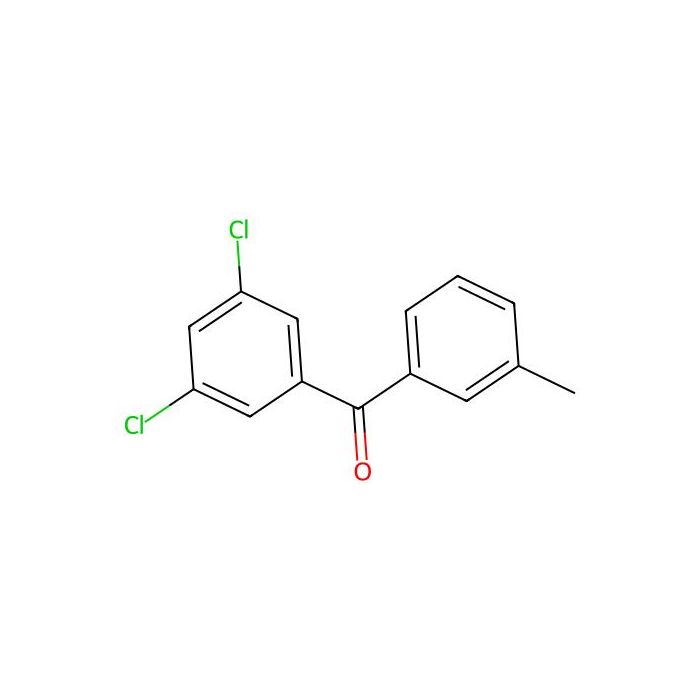
This compound belongs to the class of organic compounds known as benzophenones. These are organic compounds containing a ketone attached to two phenyl groups.
External Descriptors
Not available
1. Djoumbou Feunang Y, Eisner R, Knox C, Chepelev L, Hastings J, Owen G, Fahy E, Steinbeck C, Subramanian S, Bolton E, Greiner R, and Wishart DS. ClassyFire: Automated Chemical Classification With A Comprehensive, Computable Taxonomy. Journal of Cheminformatics, 2016, 8:61.
Zertifikate (CoA, COO, BSE/TSE und Analyse-Diagramm)
C of A & Other Certificates(BSE/TSE, COO):
Analytical Chart:
Chemische und physikalische Eigenschaften
Molekulargewicht
265.100 g/mol
XLogP3
4.900
Hydrogen Bond Donor Count
0
Hydrogen Bond Acceptor Count
1
Rotatable Bond Count
2
Exact Mass
264.011 Da
Monoisotopic Mass
264.011 Da
Topological Polar Surface Area
17.100 Ų
Heavy Atom Count
17
Formal Charge
0
Complexity
269.000
Isotope Atom Count
0
Defined Atom Stereocenter Count
0
Undefined Atom Stereocenter Count
0
Defined Bond Stereocenter Count
0
Undefined Bond Stereocenter Count
0
The total count of all stereochemical bonds
0
Covalently-Bonded Unit Count
1
Lösungsrechner
Molarity Calculator
Determine the necessary mass, volume, or concentration for preparing a solution.
Dilution Calculator
Determine the dilution needed to prepare a stock solution.
Reconstitution Calculator
Bewertungen
Kundenbewertungen
Application Protocols
Not applicable. No bioassay, immunoassay, or analytical kit protocols are defined for this small-molecule building block. For synthetic applications, see the “Reaction Conditions,” “Synthetic Utility,” and “Reaction & Applications” sections for general laboratory guidance.
Biological Roles
This product is intended for research use in chemical synthesis and materials/photochemical studies. It does not have a defined endogenous biological role.
General context (not item-specific biological activity claims)
Benzophenone scaffolds are widely used as photoprobes due to efficient triplet-state formation and hydrogen abstraction, enabling covalent capture in photoaffinity labeling studies after tethering to biomolecules. Any such application requires derivatization; the free ketone here is a starting scaffold rather than a bioactive agent.
Aromatic ketones can intercalate or bind non-specifically to hydrophobic sites; however, this compound is not intended or certified for biological or clinical use.
If introduced into biological systems (not recommended; for research only), aryl ketones may undergo phase I reduction to alcohols or oxidation at benzylic positions, followed by phase II conjugation (glucuronidation/sulfation). The dichloro substituents may reduce metabolic clearance and increase lipophilicity.
No pharmacological, toxicological, or clinical claims are made for this catalog item. For any work involving cells or biomolecules, ensure appropriate purity, endotoxin control, and approvals; these parameters are not specified for this item.
Buffer Applications
Not typically applicable. 3,5-Dichloro-3′-methylbenzophenone is a neutral, water-insoluble organic building block and does not function as a buffering agent. For aqueous work, dissolve in a suitable organic cosolvent (e.g., DMSO, MeCN) before dilution if compatibility allows, or perform biphasic/solid-supported reactions. See “Solvent Selection” and “Reaction & Applications” for more relevant information.
Green Alternatives
Greener practice considerations focus on solvent/catalyst selection and energy input rather than replacing the substrate itself (a specific, functionalized benzophenone).
Solvent choices (general guidance)
Prefer EtOAc or 2-MeTHF over DCM/THF when feasible for workups and reductions.
Use MeOH/EtOH as protic media for NaBH4 reductions of the ketone when compatible.
For cross-coupling, consider 2-MeTHF or CPME under Pd catalysis as alternatives to dioxane/DMF.
Catalysts and conditions
Employ ligand-efficient Pd or Ni systems that operate at lower loadings/temperatures; explore micellar catalysis (TPGS-750-M) to reduce organic solvent use.
Photochemical steps can leverage LED sources to minimize energy and heat; flow photochemistry can improve efficiency and safety.
Waste and protection
Minimize halogenated solvent waste; segregate for proper disposal.
Given photoreactivity of benzophenones, use minimal UV exposure to avoid byproduct formation and rework.
Comparison snapshot (general)
DCM vs EtOAc: EtOAc is biodegradable, lower toxicity; evaporation may be slower and solubility lower for highly chlorinated aromatics.
THF vs 2-MeTHF: 2-MeTHF from renewable feedstocks, forms fewer peroxides and allows phase-splitting workups; may slightly alter reaction rates/selectivities.
DMF/dioxane vs water/micellar media: significant EHS benefits; may require optimization of ligands/bases and attention to substrate solubility.
Pharmaceutical Uses
Item-specific status
No pharmacopeial grade or excipient designation is provided for this item; Not specified for this item—refer to CoA/Spec Sheet.
General context (no therapeutic claims)
Substituted benzophenones can serve as intermediates in the synthesis of drug candidates and performance materials due to their modular aryl ketone core and handles for diversification (aryl chlorides, benzylic methyl).
The benzophenone chromophore is also used in photo-crosslinking probes for target identification in medicinal chemistry workflows after derivatization.
Formulation/excipient remarks
This compound is not indicated as an excipient. For any use in GMP or clinical manufacturing, dedicated qualification, impurity profiling, and regulatory review would be required.
For this catalog item, usage is restricted to research and laboratory synthesis.
Physical Properties
Item-specific specs
Appearance: Not specified for this item; refer to CoA/Spec Sheet.
Grade/Purity: Not specified for this item; refer to CoA/Spec Sheet.
Literature/general reference values for substituted benzophenones (not item specifications)
Physical state: typically crystalline solids for dihalogenated benzophenones
Solubility: generally insoluble in water; soluble in common organic solvents (e.g., dichloromethane, chloroform, THF, acetone, ethyl acetate, toluene)
Partitioning: aryl ketones with di-chloro substituents are moderately lipophilic; expected logP > 2 (qualitative)
UV behavior: benzophenone chromophore typically shows strong absorption in near-UV; useful for photochemistry and as a photosensitizer (qualitative)
Unavailable for this item (consult CoA/Spec Sheet)
Melting point, boiling point, density, refractive index, pKa, logP (numerical), UV cut-off, trace impurities, residual solvents.
Practical notes (general)
The benzophenone carbonyl confers polarity relative to hydrocarbons, aiding solubility in polar aprotic media.
Halogenation increases crystallinity and thermal stability in many analogs, but exact values vary with substitution pattern.
If precise physical constants are critical (e.g., for DSC calibration or crystallization design), obtain the lot-specific CoA.
Quality and Grades
Item-specific status
Grade/Purity: Not specified for this item; refer to CoA/Spec Sheet.
Stabilizers/Inhibitors: Not specified for this item; refer to CoA/Spec Sheet.
Guidance on grades (general, for context)
Research grade: suitable for most synthetic and analytical tasks; impurity limits vary by supplier/lot.
Purified/recrystallized material: often exhibits sharp melting behavior and lower residual solvent; useful for photochemical or catalytic studies sensitive to impurities.
HPLC grade/low-UV grade (when applicable): controlled UV absorbance profile suitable for chromatographic reference use; not typically designated for solid building blocks unless used as standards.
Practical advice
Verify lot-specific purity by NMR/GC/LC as required for sensitive transformations (e.g., photochemistry, organometallic catalysis) where trace halides, acids, or peroxides could affect outcomes.
If trace metals or halide content are critical (e.g., for polymerizations or cross-couplings), request a detailed Specification Sheet.
For reproducibility, record the lot number and any pre-use conditioning (e.g., drying, recrystallization) performed in-house.
Reaction and Applications
As a substituted benzophenone, 3,5-dichloro-3′-methylbenzophenone is a versatile synthon combining a photochemically active ketone with cross-coupling-capable aryl chlorides and a benzylic methyl handle.
Transformations at the carbonyl
Reductions to secondary alcohols: NaBH4 (protic solvents) or LiAlH4 (ethers) to give the corresponding diaryl carbinol.
Nucleophilic additions: Grignard/organolithium reagents afford tertiary alcohols; cyanation yields cyanohydrins; formation of imines/oximes/hydrazones for derivatization or purification.
Carbonyl removal: Wolff–Kishner or Clemmensen reductions to substituted diphenylmethane frameworks.
Aryl chloride chemistry
Cross-coupling (literature): Suzuki–Miyaura, Buchwald–Hartwig, and Negishi couplings of aryl chlorides using Pd catalysts (e.g., Pd2(dba)3/XPhos, Pd-PEPPSI) at elevated temperature (80–120 °C) in polar aprotic solvents (DMF/DMAc/dioxane) with bases (K3PO4, Cs2CO3).
Directed metalation is less favored on chloro-deactivated rings but benzylic positions on the methyl-bearing ring can be functionalized.
Benzylic methyl as a handle
Radical bromination (NBS/AIBN, light) to afford benzyl bromide derivatives for SN2 couplings.
Oxidation to benzyl alcohol or carboxylic acid (e.g., KMnO4 or catalytic oxidations) to introduce polar handles.
Photochemical utility
Benzophenone chromophore enables hydrogen abstraction and triplet sensitization; applicable in Paternò–Büchi cycloadditions with alkenes or as a photosensitizer in polymerizations and photoredox contexts.
Applications span medicinal chemistry intermediate synthesis, materials photochemistry, and late-stage diversification via selective coupling at chloro sites.
Reaction Conditions
General literature-guided conditions for transformations on substituted benzophenones and aryl chlorides (guidance only; optimize per substrate):
Reduction of the ketone to alcohol
NaBH4 (MeOH/EtOH, 0–25 °C, 1–3 h) gives the secondary alcohol; quench with aqueous NH4Cl.
LiAlH4 (THF/Et2O, 0–25 °C, 1–4 h) for more forcing reductions; careful quench (ice, then aqueous workup).
Grignard/organolithium addition to carbonyl
RMgX in THF or 2-MeTHF (0 to reflux, 1–6 h). Typical 1.2–2.0 equiv nucleophile; aqueous NH4Cl workup.
Oxime/hydrazone formation
Hydroxylamine·HCl, pyridine/EtOH (rt–60 °C, 2–6 h). Hydrazine or substituted hydrazines similarly, often with acid catalysis.
Cross-coupling on aryl chloride positions
Suzuki–Miyaura: aryl boronate (1.2–1.5 equiv), Pd2(dba)3 (1–2 mol%) with XPhos/SPhos (2–4 mol%), K3PO4 or Cs2CO3 (2–3 equiv), dioxane/H2O or 2-MeTHF/H2O, 80–110 °C, 4–16 h.
Buchwald–Hartwig amination: Pd(OAc)2 (1–3 mol%), BrettPhos/XPhos (2–6 mol%), NaOtBu or Cs2CO3, toluene/dioxane, 90–120 °C, 6–18 h.
Sonogashira (Cu-free): Pd(PPh3)2Cl2 (1–2 mol%), amine base (iPr2NH), DMF/THF, 50–80 °C, 4–12 h.
Benzylic bromination (methyl handle)
NBS (1.1–1.3 equiv), AIBN or hv, CCl4, PhH, or greener: PhMe/MeCN, 0–25 °C to reflux, monitor by TLC.
Photochemistry (sensitization/Paternò–Büchi)
UV-A/near-UV LEDs, degassed solvent (MeCN/benzene), 0–25 °C, minutes to hours; inert atmosphere recommended.
Yields and selectivities depend on substitution and conditions; run small-scale screens to optimize catalyst/ligand/base and solvent.
Safety and Handling
Item-specific hazard data
GHS classification, signal word, H/P statements, and pictograms: Not specified for this item; refer to SDS.
General safety guidance for substituted benzophenones (not item-specific; consult SDS for authoritative instructions)
Likely hazards: may cause skin/eye irritation; harmful if swallowed or inhaled; aryl chlorides and aromatic ketones can be hazardous to aquatic life. Handle as a potentially harmful organic solid.
PPE: lab coat, safety glasses or chemical splash goggles, and appropriate chemically resistant gloves (e.g., nitrile). Use in a fume hood to avoid dust/vapor exposure.
Incompatibilities: strong reducing agents (exothermic reactions possible with the carbonyl), strong oxidizing agents, strong bases under heating (may induce side reactions such as aldol-type condensations or halide displacement in extreme conditions).
Photoreactivity: benzophenone chromophore can undergo photochemical reactions (e.g., hydrogen abstraction). Minimize exposure to intense UV light; store and handle under ambient light conditions or protect from UV sources.
First-aid overview (general)
Inhalation: move to fresh air; seek medical attention if symptoms persist.
Skin contact: wash with soap and water; remove contaminated clothing.
Eye contact: rinse cautiously with water for several minutes; remove contact lenses if present and easy; seek medical attention if irritation continues.
Ingestion: rinse mouth; do not induce vomiting; seek medical advice.
Always defer to the product’s SDS for definitive hazard, exposure limits, and spill/firefighting procedures.
Solvent Selection
This item is a moderately lipophilic aryl ketone with two chloro substituents; it behaves as a neutral, polarizable organic solid.
General solubility/miscibility profile (literature/general; not item specifications)
Hot alcohols: limited to moderate solubility; may recrystallize well from ethanol/isopropanol blends
Polarity considerations
The carbonyl group enables dissolution in polar aprotic solvents; aromatic chlorides increase hydrophobicity, favoring halogenated solvents or toluene for processing and crystallization.
When to choose which solvent
Reaction medium: THF, dioxane, MeCN for polar pathways (e.g., oxime formation, reductions with NaBH4); toluene or DMF/DMAc for cross-coupling on the aryl chloride positions; DCM for extractions and workups.
Purification: gradient normal-phase chromatography (hexanes/EtOAc or toluene/EtOAc). Recrystallization often succeeds from toluene/hexanes or EtOH/Water mixtures depending on solubility.
Small comparison (general)
DCM vs EtOAc: DCM dissolves more readily and evaporates faster; EtOAc is greener but may require warming.
THF vs 2-MeTHF: 2-MeTHF offers improved sustainability and water tolerance with similar solvating power; consider for reductions or Grignard additions to the carbonyl where applicable.
Shipped In: Not specified for this item; refer to CoA/Spec Sheet.
General handling guidance
Store tightly closed in a dry place, preferably under inert gas if long-term storage is anticipated, to avoid moisture uptake or slow oxidative changes.
Protect from prolonged or intense UV exposure because benzophenone chromophores can be photoreactive; amber glass recommended for long-term storage.
If solid cakes form, gentle warming or sonication in a suitable organic solvent (e.g., DCM, THF, EtOAc) can aid dissolution for use.
Reconstitution
No aqueous reconstitution is typical. Prepare stock solutions in compatible organic solvents (e.g., DCM, THF, MeCN, toluene) at convenient concentrations, filter if needed (PTFE), and store aliquots to minimize repeated opening.
Stability notes
Exact shelf life, residual solvent limits, and impurity profiles: Not specified for this item; refer to CoA/Spec Sheet.
For photochemical work, prepare fresh solutions to limit background photoproducts.
Research Use Note
For research use only; not for human or veterinary use.
Structure and Identity
Brief overview: 3,5-Dichloro-3'-methylbenzophenone is a substituted benzophenone (diaryl ketone) featuring two chloro substituents on one ring and a meta-methyl on the other, providing a versatile aryl ketone scaffold for synthesis and photochemistry.
Item-specific (Product Data)
CAS: 951887-42-6
CID: 20384611
InChIKey: Not specified for this item; refer to CoA/Spec Sheet. (Product Data lists “153401,” not a standard InChIKey)
SMILES: Not specified for this item; refer to CoA/Spec Sheet.
Computed/Literature identity (for reference; not item specifications)
Molecular formula (literature): C14H10Cl2O
Molecular weight (literature): ~265.09 g/mol
Core scaffold: benzophenone (diphenyl ketone) with 3,5-dichloro on one ring and 3′-methyl on the other
Functional groups: aromatic rings (two), aryl chloride (two Cl), ketone (aryl–CO–aryl), benzylic methyl on the second ring
2D structural description: a carbonyl carbon double-bonded to oxygen, flanked by two phenyl rings; ring A bears chloro substituents at the 3- and 5-positions relative to the carbonyl-bearing ipso carbon; ring B bears a methyl at the 3′-position relative to the carbonyl-bearing ipso carbon.
Note: Structural identifiers (SMILES/InChI) are not provided in the Product Data for this specific catalog item; consult the CoA/Spec Sheet for definitive identifiers.
Synthetic Utility
Key functional elements and how they can be exploited:
Ketone (diaryl) functionality
Electrophilic carbonyl enables: nucleophilic additions (RMgX/RLi → tertiary alcohols), reductions (NaBH4/LiAlH4 → secondary alcohol), imine/oxime/hydrazone formation for derivatization, and Baeyer–Villiger oxidation to aryl esters (selectivity depends on ring substitution).
Serve as handles for Pd-catalyzed cross-coupling: Suzuki (aryl/alkenyl boronates), Buchwald–Hartwig (amines), Sonogashira (terminal alkynes with Cu-free conditions), and Negishi/Kumada (organozinc/magnesium).
Oxidative functionalization (e.g., C–H activation strategies) may be guided by the carbonyl’s directing effects; aryl chlorides also permit SNAr only in strongly activated systems (here, coupling is usually preferable).
Benzylic methyl (3′-position)
Radical bromination (NBS, hv/AIBN) → benzylic bromide for SN2/Suzuki via benzyl boronate formation.
Oxidation (e.g., MnO2 to alcohol/aldehyde; stronger oxidants to acid) enabling convergent amide/ester couplings.
Photochemical leverage
Benzophenone triplet sensitization supports Paternò–Büchi with alkenes, hydrogen abstraction for radical chemistry, and polymer initiation under UV/LED.
Collectively, the substitution pattern allows orthogonal diversification: carbonyl chemistry, cross-coupling at one ring, and benzylic modification on the other—useful in SAR libraries and materials tailoring.
Target Specificity
Not applicable. This product is a small-molecule building block, not a biological targeting reagent or antibody. No antigen, epitope, clone, isotype, or species reactivity information applies.
Wir verwenden Cookies, um die ordnungsgemäße Funktion der Website sicherzustellen und, soweit zulässig, Ihr Nutzererlebnis zu verbessern. Sie können Ihre Einstellungen jederzeit unter „Einstellungen“ verwalten. Weitere Informationen finden Sie in unserer Cookie-Richtlinie.
Shall we send you a message when we have discounts available?
Remind me later
Thank you! Please check your email inbox to confirm.
Products are supplied to verified businesses, institutions, and qualified professionals for research and development use only. Not for use in humans, animals, diagnosis, or therapy.