≥98% for sensitive chromatographic and analytical workflows requiring minimal baseline interference.
🌡
Storage & shipping
Room temperature Ships Check lot-specific COA for exact specifications.
📋
Quality documents
SDS, COA, datasheet, and spec sheet available for download. Lot-specific COA accessible via lot number lookup.
📚
Literature proof
Cited in 0 peer-reviewed publications across chromatography, organic synthesis, and cross-coupling reactions.
Übersicht
Description
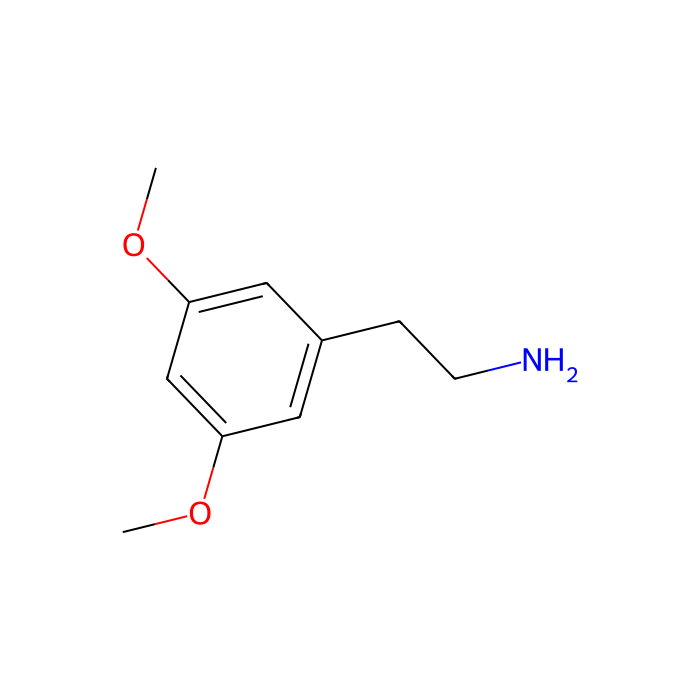
3,5-Dimethoxyphenethylamine is a positional isomer of dimethoxyphenethylamine. Mass spectral studies suggest that on bromination, 3,5-dimethoxyphenethylamine produces 2,6-dibromo product.
This compound belongs to the class of organic compounds known as dimethoxybenzenes. These are organic aromatic compounds containing a monocyclic benzene moiety carrying exactly two methoxy groups.
External Descriptors
Not available
1. Djoumbou Feunang Y, Eisner R, Knox C, Chepelev L, Hastings J, Owen G, Fahy E, Steinbeck C, Subramanian S, Bolton E, Greiner R, and Wishart DS. ClassyFire: Automated Chemical Classification With A Comprehensive, Computable Taxonomy. Journal of Cheminformatics, 2016, 8:61.
Zertifikate (CoA, COO, BSE/TSE und Analyse-Diagramm)
C of A & Other Certificates(BSE/TSE, COO):
Analytical Chart:
Chemische und physikalische Eigenschaften
Siedepunkt (°C)
118/1mm
Molekulargewicht
181.230 g/mol
XLogP3
1.200
Hydrogen Bond Donor Count
1
Hydrogen Bond Acceptor Count
3
Rotatable Bond Count
4
Exact Mass
181.11 Da
Monoisotopic Mass
181.11 Da
Topological Polar Surface Area
44.500 Ų
Heavy Atom Count
13
Formal Charge
0
Complexity
129.000
Isotope Atom Count
0
Defined Atom Stereocenter Count
0
Undefined Atom Stereocenter Count
0
Defined Bond Stereocenter Count
0
Undefined Bond Stereocenter Count
0
The total count of all stereochemical bonds
0
Covalently-Bonded Unit Count
1
Lösungsrechner
Molarity Calculator
Determine the necessary mass, volume, or concentration for preparing a solution.
Dilution Calculator
Determine the dilution needed to prepare a stock solution.
Reconstitution Calculator
Bewertungen
Kundenbewertungen
Application Protocols
No tested bioassay or immunoassay application protocols are provided for this item. As a small-molecule amine building block, typical “applications” are synthetic procedures rather than standardized biological assays. For practical synthetic use, refer to the Reaction Conditions and Synthetic Utility sections. If you require a procedure adapted to your chemistry (e.g., reductive amination setup, amide coupling), contact technical support with your substrate details for tailored guidance.
Biological Roles
This section provides general biochemical context for phenethylamine scaffolds; it does not imply any biological or clinical use for this specific product.
Phenethylamine motif (general):
The phenethylamine backbone is common in biogenic and xenobiotic amines; ring substitution modulates basicity, lipophilicity, and receptor interactions in biological systems.
Methoxy groups (–OCH3) influence electron density and metabolic liability (e.g., O-demethylation to phenols by oxidative enzymes in vivo—general concept from biochemistry literature).
Meta/meta methoxy positioning alters ring electronics compared to the more prevalent 3,4-dimethoxy/catechol patterns, which can affect oxidative pathways and conjugation.
Primary amines are typically protonated at physiological pH, influencing transport and partitioning across membranes (general principle).
Laboratory relevance:
Used as a research intermediate to access libraries of arylalkylamines for biochemical probe development, receptor binding studies, or enzyme substrate analogs in discovery workflows (no claims implied about activity of this exact compound).
Safety note:
Any biological testing should be conducted under appropriate approvals and containment, and results interpreted strictly within research contexts.
Buffer Applications
Not typically used as a buffering agent. 3,5-Dimethoxyphenethylamine is a primary amine building block rather than a dedicated buffer. If aqueous handling is required, the compound can be protonated with a mineral or organic acid to form a water-soluble salt, but defined buffer systems (e.g., phosphate, acetate, HEPES) should be used for pH control. Refer to the Solvent Selection and Storage sections for handling and salt-formation guidance.
Green Alternatives
Greener choices relate primarily to solvent and reagent selection when using 3,5-dimethoxyphenethylamine; the substrate itself is a typical aromatic amine building block.
Greener solvent swaps (general guidance):
Replace DCM/DCE with 2-MeTHF, CPME, or ethyl acetate where feasible; MeCN can substitute DCM for many amide couplings and reductive aminations.
Favor alcohols (EtOH, i-PrOH) as hydrogen donors/solvents for transfer hydrogenation or reductive amination when compatible.
DCM vs 2-MeTHF: 2-MeTHF offers lower toxicity and renewable sourcing; may change solubility and reaction rates.
THF vs CPME: CPME is less peroxide-prone, has broader liquid range, and is easier to dry; both support amine chemistry.
NaBH3CN vs NaBH(OAc)3/H2: Avoid cyanide-containing reagents when possible; catalytic hydrogenation or borohydride–acetic acid systems can reduce waste.
Workup and isolation improvements:
Use aqueous bicarbonate or buffered extractions to minimize strong acid usage; isolate as benign salts (e.g., fumarate, citrate) when crystallinity aids purification.
Consider solvent recycling and minimizing halogenated waste streams.
Trade-offs:
Greener solvents may alter selectivity or solubility of amine salts; small-scale scouting is recommended.
Some green alternatives (e.g., aqueous micellar catalysis) can be incompatible with amine protonation state; adjust pH accordingly.
Pharmaceutical Uses
No pharmacopeial grade or excipient status is provided for this item. Not specified for this item; refer to CoA/Spec Sheet.
General context (non-clinical, manufacturing-focused):
Aromatic primary amines like 3,5-dimethoxyphenethylamine are commonly employed as intermediates in the synthesis of active pharmaceutical ingredient (API) candidates and analytical reference materials.
Typical roles include: forming amide/sulfonamide libraries, preparing amine salts with improved solid-state properties, and serving as a handle for further functionalization (e.g., ureas, carbamates).
Salt selection (HCl, fumarate, citrate, mesylate, tosylate) can be leveraged for crystallization studies and to tune hygroscopicity and stability in process development.
Quality considerations (general):
For GMP-relevant routes, define impurity profiles (residual solvents, inorganics, nitrosamine risk assessment for amines), and establish robust specifications for assay, identity, and related substances.
Ensure clear documentation of form (free base vs specific salt), polymorph/solvate status if applicable, and water content (KF) when relevant to stability and process control.
Physical Properties
Item-specific specifications: Not specified for this item; refer to CoA/Spec Sheet.
Literature/computed (informational, not item specifications):
Molecular weight: ~181.23 g/mol (from formula C10H15NO2).
Physical state: Aromatic primary amines of this class are often low-melting solids or viscous oils at ambient temperature; exact appearance for this item is not specified.
Basicity: Primary benzylic amine; conjugate acid pKaH typically ~9–10 for phenethylamines (literature range; actual value influenced by ring substitution).
Lipophilicity: Two methoxy substituents increase polarity vs unsubstituted phenethylamine; estimated cLogP in the low-to-mid 1–2 range (literature/computed estimates).
Solubility profile (qualitative):
Free base: Miscible or highly soluble in common organic solvents (alcohols, ether solvents, chlorinated solvents, aromatics). Moderately soluble in water as free base; readily soluble in dilute acids due to salt formation.
Salts: As HCl or other mineral-acid salts, typically freely water-soluble.
As a basic compound, measured properties (e.g., solubility, pKa) depend strongly on medium and counterion; document exact conditions when reporting values.
For precise, lot-specific data such as density, refractive index, melting/boiling point, please consult the CoA/Spec Sheet for this item.
Quality and Grades
Item-specific grade/purity: Not specified for this item; refer to CoA/Spec Sheet. If an assay, impurity profile, or stabilizer is critical to your application, request the current lot CoA.
Interpreting common grades (general guidance):
Research or technical grade is suitable for most synthetic and screening applications.
Analytical/AR grade implies tighter limits on assay and common impurities; may also include lower residual solvents/metals.
HPLC grade typically refers to solvents; for amines and building blocks, terms like “≥98%” or “≥99%” purity (by GC/HPLC/NMR) are used. Low UV background is relevant if used as a standard or in detection-sensitive workflows.
Stabilizers/antioxidants: None are listed in the Product Data. If stabilizers are present in a particular lot, they will be disclosed on the CoA/Spec Sheet.
What to verify for amine building blocks (best practice):
Identity by NMR/HRMS; assay by GC/HPLC area% with appropriate amine-sensitive methods.
Residual solvent, water (Karl Fischer), and color index if your process is sensitive.
Salt form vs free base: ensure the form matches your process (this listing refers to the free base by name).
Reaction and Applications
As a benzylic primary amine bearing two ring methoxy groups, 3,5-dimethoxyphenethylamine is a versatile building block for aryl-alkyl amine derivatives and functional materials.
Reductive amination: Coupling with aldehydes/ketones (NaBH3CN, NaBH(OAc)3, H2/Pd) to produce secondary/tertiary amines. Methoxy substituents enhance aryl nucleophilicity without hindering amine reactivity.
Acylation and sulfonylation: Formation of amides (acyl chlorides, anhydrides, EDCI/HATU couplings) and sulfonamides (e.g., TsCl, MsCl) for SAR libraries or protective derivatives.
Carbamate/urea formation: Reaction with chloroformates or isocyanates; phosgene-equivalents (triphosgene, CDI) for ureas.
N-Protection/Depotection: Boc, Cbz, Fmoc protection for multistep synthesis; deprotections via TFA (Boc), hydrogenolysis (Cbz), or base (Fmoc).
O-Demethylation: Conversion of 3,5-dimethoxy to 3,5-dihydroxy analogs using BBr3, BCl3, or AlCl3/thiols; careful control to avoid amine quenching (pre-protect amine if necessary).
Electrophilic aromatic substitution: Methoxy activation directs to ortho/para positions (2-, 4-, 6-); nitration, bromination, or Friedel–Crafts (on protected amine) are feasible.
Cyclizations: Formation of heterocyclic scaffolds via intramolecular acylations or Mannich-type processes; Pictet–Spengler reactivity is generally enhanced with catechol/3,4-dimethoxy motifs but can be explored under strongly activating conditions.
Practical tips:
Protonation state control is critical: free base for nucleophilic amine chemistry; salts for isolation/purification.
For moisture-sensitive couplings, pre-dry reagents/solvents; amines can carry water—azeotrope if needed.
During O-demethylation, protect the amine (e.g., Boc) to avoid side reactions and facilitate workup.
For chromatography, add a small percentage of base (Et3N) to mobile phase to prevent tailing.
Reaction Conditions
General literature guidance for common transformations of aromatic primary amines like 3,5-dimethoxyphenethylamine. These are not product specifications; optimize per substrate and scale.
Reductive amination:
Typical conditions: Carbonyl (1.0 eq), amine (1.2–2.0 eq), AcOH (0.5–1.0 eq) in MeOH/EtOH/MeCN/DCM; reduce with NaBH3CN (pH ~5–6) or NaBH(OAc)3 (neat AcOH or DCE/MeCN) at 0–25 °C, 1–16 h. H2/Pd-C (1–10 wt%) in EtOH/AcOH under 1–5 bar H2 is a greener alternative.
Amide formation:
With acid chlorides/anhydrides: DIPEA or pyridine in DCM/THF, 0–25 °C. With carboxylic acids: EDCI/HOBt, HATU, or T3P in DMF/MeCN; 0–25 °C, 1–12 h.
Sulfonamide formation:
TsCl/MsCl (1.1–1.5 eq) in DCM with base (Et3N/DIPEA) at 0–25 °C, 1–4 h; or sulfamoyl chlorides for sulfamides.
O-Demethylation to phenols:
BBr3 (1.5–3.0 eq per methoxy) in DCM at −78 to 0 °C, then warm to rt; quench cautiously with MeOH/H2O. Protect the amine (e.g., Boc) beforehand to avoid ammonium–Lewis acid complexation.
N-Protection:
Boc2O (1.1–1.5 eq), base (NaHCO3/Et3N), DCM/MeCN, 0–25 °C; deprotect with TFA in DCM at 0–25 °C. Cbz protection via benzyl chloroformate; deprotect by hydrogenolysis (H2/Pd).
Electrophilic aromatic substitution:
Halogenation (e.g., NBS/NCS) or nitration under mild conditions, typically with amine protected to suppress overreaction; solvent DCM/AcOH; 0–25 °C.
Purification/Isolation:
Convert crude free base to an acid salt (e.g., HCl in IPA/Et2O) for crystallization. For chromatography, add 0.5–2% Et3N to reduce tailing.
Note: Reaction temperatures, times, and equivalents are typical literature ranges and should be fine-tuned for the specific substrate set.
Safety and Handling
Item-specific hazard details: Not specified for this item; refer to SDS for authoritative safety information. Signal word, H-statements, GHS classification, and pictograms are not provided in the Product Data.
General hazards for aromatic primary amines (informational):
May cause skin and eye irritation; vapors/mists can irritate the respiratory tract.
Amines are often corrosive to some plastics and can attack certain coatings; assess material compatibility.
Can form salts with acids; avoid contact with strong acids and acylating agents unless intended.
PPE and engineering controls (best practice):
Use in a fume hood. Wear safety glasses or goggles, lab coat, and appropriate chemically resistant gloves (e.g., nitrile). Consider double-gloving for prolonged handling.
Avoid inhalation of vapors/aerosols. Prevent skin contact. Wash thoroughly after handling.
Storage incompatibilities and precautions (general):
Keep tightly closed in a dry, well-ventilated place at room temperature (per Product Data). Protect from moisture and CO2 to limit formation of amine salts/carbamates.
Incompatible with strong oxidizers, acyl halides/anhydrides, isocyanates, and strong acids/bases (uncontrolled reactions possible).
Amines can absorb odors and may discolor on prolonged air/light exposure; store in amber containers if possible.
First-aid overview (general guidance; defer to SDS):
Skin/eye contact: Rinse with water for several minutes; remove contaminated clothing; seek medical attention as appropriate.
Inhalation: Move to fresh air; seek medical attention if symptoms persist.
Ingestion: Rinse mouth; do not induce vomiting; seek medical attention.
Waste: Collect as organic amine-containing waste; neutralize and dispose per institutional and regulatory requirements.
Solvent Selection
3,5-Dimethoxyphenethylamine is a polar, basic, aromatic amine. Solvent choice should balance solubility, reactivity of the amine, and downstream isolation strategy.
Limited water solubility as free base; fully water-soluble upon protonation (e.g., dilute HCl).
Selection guidelines:
For acylations/urea/sulfonamide formation: Use non-protic, moderately polar solvents (DCM, DMF, MeCN, THF). Add base (e.g., DIPEA) if needed.
For reductive amination: Alcoholic solvents (MeOH, EtOH) or DCE/MeCN with AcOH buffering are common; choose based on substrate solubility and reducing agent.
For protecting group manipulations (Boc, Cbz): DCM/MeCN/THF under mild base (NaHCO3, DIPEA). For Boc deprotection, use TFA in DCM/MeOH and capture released amine as salt.
For salt formation/crystallization: Select ether/alcohol mixtures or IPAc/Et2O to precipitate amine salts (HCl/mesylate/tosylate) with good filterability.
Comparison (general):
DCM vs MeCN: DCM offers excellent solubility and easy removal; MeCN is polar aprotic and greener than chlorinated solvents but may solvate salts differently.
Alcohols vs ethers: Alcohols can participate in H-bonding and sometimes in imine exchange; ethers are less interactive but may form peroxides (manage accordingly).
Storage and Reconstitution
Item-specific storage: Room temperature (per Product Data). Shipped-in conditions are not specified for this item; refer to CoA/Spec Sheet if cold chain or special packaging is required.
General storage guidance for aromatic primary amines:
Keep tightly sealed in a dry, inert atmosphere if possible to minimize moisture/CO2 uptake and discoloration. Amber glass recommended to limit light-induced changes.
Segregate from strong oxidizers, acids, and acylating agents. Store in secondary containment to prevent odor transfer.
Reconstitution and handling:
If supplied as a solid or viscous oil, warm gently to room temperature to ensure homogeneity before aliquoting.
Solubility: Dissolves readily in common organic solvents (DCM, MeOH, EtOH, THF, EtOAc). To prepare aqueous solutions, protonate with a suitable acid to form a water-soluble salt (e.g., HCl salt prepared in situ).
Recommended working solutions: Prepare fresh as needed. For longer-term stock, store as the acid salt in dry solvent or as a crystalline solid under desiccation.
Stability notes:
Free bases may slowly darken upon air/light exposure; this is often cosmetic but monitor by HPLC/GC if critical.
Avoid repeated freeze–thaw of solutions; aliquot concentrates and keep under inert gas when feasible.
Documentation reminder: For any lot-specific parameters (assay, residual solvents, water content), consult the CoA/Spec Sheet.
Structure and Identity
Brief overview: 3,5-Dimethoxyphenethylamine is an aromatic primary amine bearing two electron-donating methoxy groups on the phenyl ring (meta/meta), connected via a two-carbon linker to a primary amine.
Item-specific (from Product Data):
SKU: D472393
Product Name: 3,5-Dimethoxyphenethylamine
CAS: 3213-28-3
InChIKey: 457358 (as provided)
Storage Conditions: Room temperature
Grade/Purity: Not specified for this item; refer to CoA/Spec Sheet.
Appearance: Not specified for this item; refer to CoA/Spec Sheet.
Literature/computed identifiers and composition (informational):
InChI (literature): InChI representation corresponds to the above SMILES for 3,5-dimethoxyphenethylamine (exact InChIKey may vary by tautomeric layer; consult reference databases)
Structural features (general description):
Core: A monosubstituted phenyl ring bearing methoxy groups at the 3- and 5-positions (meta/meta orientation).
Side chain: –CH2–CH2–NH2 (primary aliphatic amine).
Electronics: Methoxy groups strongly donate by resonance, increasing ring electron density, especially at the 2-, 4-, and 6-positions; the benzylic chain can engage in typical amine chemistry (protonation, acylation, alkylation).
Stereochemistry: None (achiral as a free base).
Synthetic Utility
Key functional elements driving reactivity:
Primary amine (–NH2): Nucleophilic at nitrogen, enabling acylation, alkylation, reductive amination, urea/carbamate formation, and N-protection strategies.
Activated aromatic ring: Two methoxy groups enhance electron density and direct electrophilic substitutions to ortho/para sites (2-, 4-, 6-positions relative to each OMe), enabling selective halogenation, nitration, and Friedel–Crafts (with protected amine).
Benzylic chain: Offers opportunities for oxidation to aldehyde/acid (after protection), radical functionalization, or tethering in intramolecular cyclizations.
Library synthesis: Rapid diversification via amide/sulfonamide/urea arrays for SAR.
Scaffold elaboration: Reductive amination with aryl/heteroaryl aldehydes to access secondary/tertiary analogs; subsequent quaternization to ammonium salts when desired.
Phenol unveiling: O-Demethylation (BBr3 or BCl3) to yield dihydroxy analogs for cross-coupling (via triflates) or for metal-catalyzed C–O bond transformations.
Protect–modify–deprotect workflows: Boc or Cbz protection of the amine to survive harsh aromatic functionalizations; strategic deprotection restores the free amine late-stage.
Purification and form control:
Free bases often show tailing on silica; add 0.5–2% Et3N to eluents or isolate as a crystalline acid salt for improved handling.
Salt screening (HCl, HBr, sulfate, tosylate) can identify forms with superior filtration and drying characteristics for scale-up.
Target Specificity
Not applicable. This product is a small-molecule chemical building block, not a biological targeting reagent (e.g., antibody, ligand-conjugate) with defined target specificity. No item-specific target or epitope information is provided.
Häufig gestellte Fragen
What is the purity of this product?
This product is supplied at ≥98% purity (chemical assay). Lot-specific values are stated on the Certificate of Analysis.
What are the CAS number, molecular formula and molecular weight?
The CAS Number is 3213-28-3, the molecular formula is C10H15NO2, and the molecular weight is 181.24 g/mol. InChIKey ZHSFEDDRTVLPHH-UHFFFAOYSA-N.
Wir verwenden Cookies, um die ordnungsgemäße Funktion der Website sicherzustellen und, soweit zulässig, Ihr Nutzererlebnis zu verbessern. Sie können Ihre Einstellungen jederzeit unter „Einstellungen“ verwalten. Weitere Informationen finden Sie in unserer Cookie-Richtlinie.
Shall we send you a message when we have discounts available?
Remind me later
Thank you! Please check your email inbox to confirm.
Products are supplied to verified businesses, institutions, and qualified professionals for research and development use only. Not for use in humans, animals, diagnosis, or therapy.