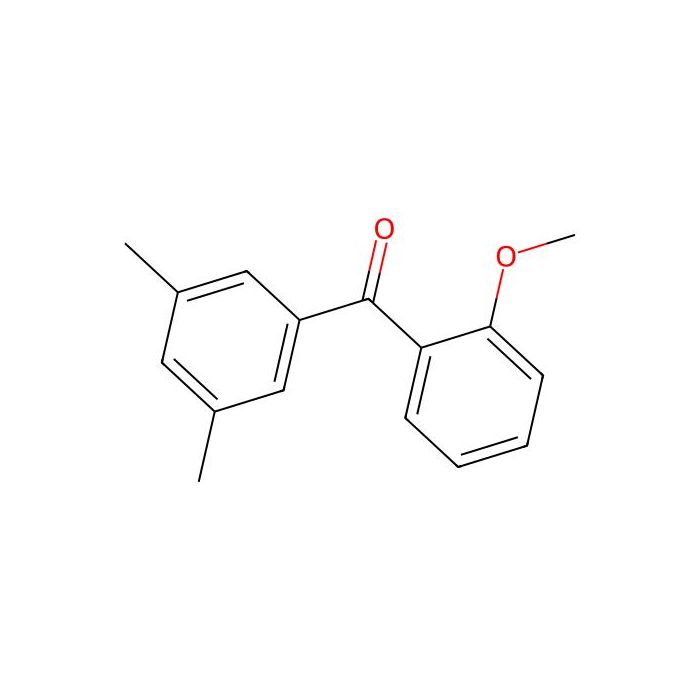
This compound belongs to the class of organic compounds known as benzophenones. These are organic compounds containing a ketone attached to two phenyl groups.
External Descriptors
Not available
1. Djoumbou Feunang Y, Eisner R, Knox C, Chepelev L, Hastings J, Owen G, Fahy E, Steinbeck C, Subramanian S, Bolton E, Greiner R, and Wishart DS. ClassyFire: Automated Chemical Classification With A Comprehensive, Computable Taxonomy. Journal of Cheminformatics, 2016, 8:61.
Zertifikate (CoA, COO, BSE/TSE und Analyse-Diagramm)
C of A & Other Certificates(BSE/TSE, COO):
Analytical Chart:
Chemische und physikalische Eigenschaften
Molekulargewicht
240.300 g/mol
XLogP3
3.700
Hydrogen Bond Donor Count
0
Hydrogen Bond Acceptor Count
2
Rotatable Bond Count
3
Exact Mass
240.115 Da
Monoisotopic Mass
240.115 Da
Topological Polar Surface Area
26.300 Ų
Heavy Atom Count
18
Formal Charge
0
Complexity
277.000
Isotope Atom Count
0
Defined Atom Stereocenter Count
0
Undefined Atom Stereocenter Count
0
Defined Bond Stereocenter Count
0
Undefined Bond Stereocenter Count
0
The total count of all stereochemical bonds
0
Covalently-Bonded Unit Count
1
Lösungsrechner
Molarity Calculator
Determine the necessary mass, volume, or concentration for preparing a solution.
Dilution Calculator
Determine the dilution needed to prepare a stock solution.
Reconstitution Calculator
Bewertungen
Kundenbewertungen
Application Protocols
No validated bioassay or immunoassay protocols are specified for this item. For synthetic or photochemical use, follow standard organic synthesis or photochemistry protocols appropriate to benzophenone derivatives. If formulating stock solutions for research assays, typical practice is to dissolve in dry DMSO or acetonitrile, then dilute into the working medium while maintaining acceptable final cosolvent levels (e.g., ≤1–2% v/v), with parallel solvent controls.
Biological Roles
This product is a small-molecule aromatic ketone, not a biomacromolecule. Biological roles are not typically assigned to such reagents in a laboratory context.
Literature/general context (non-clinical, research only):
Benzophenone chromophores are classic triplet photosensitizers used to generate radicals under UV light. In chemical biology workflows, benzophenone-containing probes are employed for photo-crosslinking to proximal biomolecules, capitalizing on the long-lived triplet and hydrogen-abstraction capability. The 2′-methoxy substituent and ring methyls can modulate photoreactivity and hydrophobic interactions in designed probes.
In materials and polymer chemistry, benzophenone derivatives function as UV absorbers or photoinitiators (research/manufacturing contexts), though specific performance depends on substitution patterns.
Caution: No medical or clinical claims are made. Any use in biological systems should be limited to research applications with appropriate controls and approvals.
Buffer Applications
Not a buffering reagent. As a neutral, hydrophobic aromatic ketone, it is not used to prepare pH buffers or as a buffering component. When working with this compound in biological assays, choose a compatible organic cosolvent (e.g., DMSO or acetonitrile) and then dilute into the desired aqueous buffer system as needed, ensuring final cosolvent content and solvent controls are appropriate.
Green Alternatives
Solvent and process choices (general guidance for benzophenone chemistry):
Replace chlorinated solvents with greener options where feasible:
DCM/CHCl3 → toluene, ethyl acetate, or 2-MeTHF for workup and crystallization.
THF → 2-MeTHF or CPME for organometallic additions; these offer higher boiling points and improved safety/greenness profiles.
DMF/DMAc → acetonitrile or propylene carbonate for certain polar-aprotic needs (verify solubility/kinetics).
Energy and light management:
For photochemical applications, use LED sources tuned to absorption bands to maximize quantum efficiency and reduce energy consumption versus mercury lamps.
Conduct reactions at ambient temperature where possible; leverage flow photochemistry to enhance mass/energy efficiency.
Workup/waste:
Employ solvent recycling (distillation) and minimize halogenated waste streams; choose solvent systems with simple phase splits (e.g., EtOAc/aqueous brine) to reduce emulsions.
Tradeoffs (balanced view):
2-MeTHF and CPME may alter organometallic reactivity and selectivity; titrate and re-optimize conditions.
Ethyl acetate’s lower polarity can limit solubility; may require warming or co-solvents.
Item-specific note: No stabilizers or inhibitors are specified for this product. Confirm impurity profiles before switching to greener media to ensure comparable performance.
Pharmaceutical Uses
No pharmacopeial or excipient status is specified for this item; it is supplied for research use only.
General (non-clinical) context:
Benzophenone derivatives can serve as UV-absorbing moieties in materials and packaging research. In medicinal chemistry, benzophenone scaffolds may be used as synthetic intermediates or photoreactive handles in target identification studies (photoaffinity labeling) during discovery research.
Formulation relevance is limited due to hydrophobicity and chromophoric behavior; if dissolved for assay use, typical lab cosolvents include DMSO, DMF, or ethanol followed by dilution.
Compliance note: No therapeutic or clinical claims are made, and there is no indication of USP/EP monograph coverage for this specific compound. Use is restricted to research and development purposes.
Physical Properties
Item-specific (specifiable parameters):
Appearance: Not specified for this item; refer to CoA/Spec Sheet.
Grade/Purity: Not specified for this item; refer to CoA/Spec Sheet.
Density, refractive index, UV cutoff, water/peroxide/metal limits: Not specified for this item; refer to CoA/Spec Sheet.
Literature/general expectations for this class (benzophenone derivatives; non-spec guidance):
Physical state: typically crystalline solids for substituted benzophenones.
Solubility: low in water; soluble in common organic solvents (e.g., dichloromethane, chloroform, THF, acetone, toluene, ethyl acetate). Solubility increases with temperature and in more aromatic/polar aprotic media.
Lipophilicity: electron-donating substituents (Me, OMe) generally increase logP relative to benzophenone (literature benzophenone logP ~3.0); expect moderately lipophilic behavior.
Spectroscopy: strong UV absorption due to aryl–carbonyl conjugation; parent benzophenone shows π→π* and n→π* bands (literature λmax ~250–260 nm and ~340–360 nm); alkoxy/methyl substituents may cause bathochromic shifts (qualitative note).
Thermal behavior: benzophenone cores exhibit relatively high melting points and thermal stability under inert conditions; specific mp/bp for this derivative are not provided here.
Compliance note: For exact numerical properties (mp, bp, solubility in specific solvents, UV-Vis λmax/ε), consult the CoA/Spec Sheet or measure under your conditions.
Quality and Grades
Item-specific quality details:
Grade/Purity: Not specified for this item; refer to CoA/Spec Sheet.
Stabilizers/Inhibitors: Not specified for this item; refer to CoA/Spec Sheet.
Interpreting common grades (general guidance):
Research/technical grade: suitable for synthetic and analytical workflows; impurity profiles may not be optimized for trace analysis.
High-purity or 98–99%+ materials (if specified on CoA): typically ensure consistent reactivity and lower baseline UV absorbance for photochemical or analytical work.
HPLC/UV grade (if applicable): controlled UV impurities for chromatographic applications; useful when employing UV detection.
Practical quality notes for benzophenone derivatives:
Trace peroxides are generally less of a concern than with ethers; however, photooxidation byproducts can accumulate under light exposure—store in amber containers to preserve purity.
Residual metals/halides from acylation or cross-coupling routes may be present at low levels; verify by ICP or ion chromatography if relevant to your application.
For photochemistry or materials research, confirm absorbance baseline and impurity profile via HPLC/UPLC and UV–Vis.
Documentation: Lot-specific CoA will provide assay, impurity profile, and any stabilizers. When specifications are critical (water content, residual solvents, heavy metals), request or review the current CoA/Spec Sheet.
Reaction and Applications
Typical uses of substituted benzophenones (literature/general; expand as needed):
Photochemistry and photolabeling: benzophenone triplet states can abstract hydrogen and form radicals; ortho-methoxy and meta-methyl groups can tune photophysical properties. Useful as a photoaffinity tag precursor in materials/chemical biology workflows (research context only).
Synthetic intermediate: the aryl ketone carbonyl enables formation of tertiary benzhydrols via Grignard/organolithium additions; subsequent transformations include dehydration to alkenes or conversion to halides (e.g., via Appel or SOCl2 after reduction to alcohol).
Reductions: chemoselective reductions to the corresponding alcohol with NaBH4, DIBAL-H (at low temperature), or catalytic hydrogenation (Raney Ni/Pd under appropriate conditions) are established for benzophenones.
Cross-coupling handles: while this molecule is not halogenated, directed ortho-metalation (DoM) facilitated by the anisole or carbonyl can introduce halides/boryl groups for subsequent Suzuki/Miyaura couplings.
Electrophilic aromatic substitution (EAS): methyl and methoxy substituents are activating/ortho-para directing; the carbonyl is deactivating/meta directing on its ring. Regioselectivity can be leveraged for late-stage functionalization.
Practical tips:
Dry, oxygen-free conditions benefit organometallic additions; use rigorously dried ethers and maintain inert atmosphere.
Light sensitivity: if photostability is required, protect from UV; conversely, for photochemical use, employ controlled UV sources and oxygen removal (freeze–pump–thaw or sparging).
Monitor reactions by TLC/HPLC with UV detection; benzophenone chromophores provide strong UV response.
Reaction Conditions
General literature guidance (not item-specific specifications):
Nucleophilic addition to the carbonyl (e.g., Grignard):
Typical: RMgX (1.2–2.0 equiv) in dry THF or 2-MeTHF, 0 °C to rt, 1–4 h; quench with saturated NH4Cl. Tertiary benzhydrols often form in good yields (60–90%) depending on R and sterics.
Reduction to alcohol:
NaBH4 (1.5–3.0 equiv) in MeOH/THF at 0 °C → rt, 0.5–2 h; or DIBAL-H in toluene at −78 to −20 °C. Work up carefully to avoid over-reduction.
Demethylation of anisole (if desired):
BBr3 (1–3 equiv) in DCM at −78 → 0 °C, 1–3 h; quenched cautiously with MeOH/H2O to afford the phenol. AlCl3/thiols or HBr/acetic acid are alternatives; selectivity depends on conditions.
Electrophilic aromatic substitution on the methylated ring:
Bromination (NBS/benzoyl peroxide for benzylic positions) or nitration/sulfonation under controlled conditions; directing effects from Me/OMe substituents guide regiochemistry.
Photochemistry:
UV irradiation (e.g., 300–365 nm) in degassed acetonitrile or isopropanol under N2/Ar; benzophenone triplet sensitization promotes H-abstraction and radical coupling. Use quartzware and control light intensity.
Analytics:
Monitor by TLC (UV-active), GC/MS (if volatile derivatives), or HPLC with UV detection (typical detection at 254–280 nm). Optimize eluents to account for aromaticity and ether polarity.
Note: Optimize reagent equivalents and times for your substrate set. These conditions are representative for benzophenone derivatives and should be validated experimentally.
Safety and Handling
Item-specific hazard data:
GHS classification, signal word, pictograms, H-statements: Not specified for this item; refer to SDS.
General precautions for aryl ketones/benzophenone derivatives (literature guidance; not a substitute for SDS):
Avoid inhalation of dust and contact with skin/eyes. Use appropriate PPE: lab coat, safety glasses, and suitable gloves (e.g., nitrile). Handle in a fume hood to control dust and solvent vapors during preparation/transfer.
Photoreactivity: benzophenone scaffolds can undergo photochemical reactions (e.g., triplet sensitization, H-abstraction) under UV; minimize unnecessary light exposure during storage and handling if sample integrity is critical.
Incompatibilities: strong oxidizing agents may react with aromatic ethers; strong reducing agents can reduce the carbonyl; avoid strong acids/bases if ether cleavage or side reactions are a concern.
First aid (overview): rinse eyes/skin with water for several minutes if contacted; remove contaminated clothing; if inhaled, move to fresh air; if ingested, rinse mouth. Seek medical attention as needed. Always follow your institution’s EHS procedures.
Fire safety: treat as combustible organic solid. Use CO2, dry chemical, or foam extinguishers. Thermal decomposition may produce CO/CO2 and phenolic/anisolic fragments.
Definitive information: Always consult the product SDS for authoritative hazard classification, exposure limits, and spill/cleanup procedures.
Research Use: For research use only.
Solvent Selection
This compound is a moderately lipophilic, nonionic aromatic ketone with an anisole ether. It behaves as a neutral, polarizable solute.
Poorly soluble in water; readily soluble in chlorinated solvents (DCM, CHCl3), aromatics (toluene), and polar aprotics (THF, acetone, DMF, DMSO, acetonitrile to a lesser extent).
Hydrogen-bond acceptor at the carbonyl and ether oxygen; no H-bond donor functionality.
Choosing a solvent by task:
Spectroscopy/photochemistry: use spectrophotometric-grade acetonitrile, ethanol, or isooctane depending on desired triplet yields and oxygen quenching control; rigorously deoxygenate when needed.
Preparative crystallization: toluene/hexane or EtOAc/hexane mixtures often provide useful solubility contrast for substituted benzophenones.
Reaction medium: for nucleophilic additions to the carbonyl, use dry THF/Et2O; for electrophilic aromatic substitutions on the rings, nonpolar aromatics or DCM with Lewis/Brønsted acids.
Small comparison (general):
DCM vs toluene: DCM offers higher polarity and faster dissolution; toluene affords higher boiling point and greener profile.
THF vs 2-MeTHF: 2-MeTHF provides similar solvation with improved sustainability and phase separation advantages.
Spec note: Exact solubilities and solvent cutoffs are not specified for this item; confirm experimentally or see CoA.
Storage and Reconstitution
Storage (item-specific):
Storage Conditions: Room temperature (per Product Data). Store in a tightly closed container in a dry place.
Additional best practices (general guidance for benzophenone derivatives):
Protect from light to minimize unintended photochemical changes; use amber glass where possible.
Keep desiccated to limit hydrolysis or moisture uptake effects on handling and weighing.
Avoid prolonged exposure to strong oxidizers or acids/bases unless intended for reaction.
Reconstitution/stock solutions:
Solvents: DMSO, DMF, acetonitrile, THF, dichloromethane, toluene, or ethyl acetate are typical choices depending on application. Filter if particulates remain.
Concentrations: prepare concentrated stocks (e.g., 10–100 mM in DMSO or MeCN) for research use; verify solubility at intended temperature.
Stability of solutions: store solutions in amber vials at 2–8 °C or at room temperature as appropriate; minimize freeze–thaw cycles. Assess stability by HPLC/LC–MS over time.
Shipping: Not specified for this item; refer to CoA/Spec Sheet.
Research Use Note: For research use only.
Structure and Identity
A diaryl ketone bearing two methyl groups on the 3- and 5-positions of one ring and a 2′-methoxy substituent on the other ring; structurally, it is a substituted benzophenone.
Item-specific (Product Data):
CAS: 750633-54-6
CID: 24722769
InChIKey: 106571 (as provided)
SMILES: Not specified for this item; refer to CoA/Spec Sheet.
Synonym: 3,5-dimethyl-2′-methoxybenzophenone
Computed/literature (identity-related; non-spec):
Molecular formula (derived from name): C16H16O2
Molecular weight (calculated): ~240.30 g/mol
Core scaffold: benzophenone (diphenyl ketone) with electron-donating substituents (–OCH3, –CH3) influencing ring electronics.
2D description: an sp2-hybridized carbonyl carbon (C=O) connects two phenyl rings; one ring has meta/meta methyls; the other ring bears an ortho methoxy group relative to the carbonyl (2′-OMe). No stereocenters.
Conjugation: two aromatic rings conjugated with carbonyl; substituents increase electron density and can modulate photochemical behavior relative to parent benzophenone.
Synthetic Utility
Functional group reactivity:
Aryl ketone (benzophenone): undergoes nucleophilic additions (e.g., RMgX/RLi) to form tertiary benzhydrols; Wolff–Kishner or Clemmensen reductions to hydrocarbons (if compatible with substituents) after appropriate protection considerations.
Anisole ether (2′-OMe): can direct ortho-metalation; susceptible to demethylation with BBr3/AlCl3 to yield phenolic derivatives, enabling further diversification (e.g., etherifications, acylations).
Methyl substituents (3,5-Me): weakly activating and ortho/para directing; amenable to benzylic oxidations (e.g., with SeO2 or MnO2) under certain conditions to give aldehyde/acid derivatives on that ring.
Retrosynthetic value:
Precursor to substituted diaryl alcohols, tertiary halides, or alkenes via standard two-step sequences (addition → functional group interconversion).
Platform for installing cross-coupling handles through directed lithiation/borylation on either ring, enabling Suzuki–Miyaura, Negishi, or Buchwald–Hartwig transformations after appropriate functionalization.
Photochemical utility:
Benzophenone core acts as a photosensitizer; can initiate radical reactions or be embedded as a photo-crosslinker in polymer backbones or probe molecules.
Practical notes:
Protect anisole during strong Lewis acid conditions if demethylation is not desired; control temperature and reagent equivalents.
For organometallic additions, rigorously dry solvents and exclude moisture/air.
Target Specificity
Not an antibody, enzyme, or biological targeting reagent. No target specificity data are provided for this item. If used as a photoaffinity component in custom probe design, any target engagement arises from the attached ligand, not from the benzophenone moiety itself.
Wir verwenden Cookies, um die ordnungsgemäße Funktion der Website sicherzustellen und, soweit zulässig, Ihr Nutzererlebnis zu verbessern. Sie können Ihre Einstellungen jederzeit unter „Einstellungen“ verwalten. Weitere Informationen finden Sie in unserer Cookie-Richtlinie.
Shall we send you a message when we have discounts available?
Remind me later
Thank you! Please check your email inbox to confirm.
Products are supplied to verified businesses, institutions, and qualified professionals for research and development use only. Not for use in humans, animals, diagnosis, or therapy.