Determine the necessary mass, volume, or concentration for preparing a solution.
| Activity Type | Relation | Activity value | Units | Action Type | Journal | PubMed Id | doi | Assay Aladdin ID |
|---|

Taxonomy Tree
| Kingdom | Organic compounds |
|---|---|
| Superclass | Organic oxygen compounds |
| Klasse | Organooxygen compounds |
| Subclass | Carbonyl compounds |
| Intermediate Tree Nodes | Ketones - Aryl ketones - Phenylketones |
| Direct Parent | Alkyl-phenylketones |
| Alternative Parents | Acetophenones Benzoyl derivatives Benzonitriles Aryl alkyl ketones Nitriles Organopnictogen compounds Organic oxides Hydrocarbon derivatives |
| Molecular Framework | Aromatic homomonocyclic compounds |
| Substituents | Alkyl-phenylketone - Acetophenone - Aryl alkyl ketone - Benzoyl - Benzonitrile - Benzenoid - Monocyclic benzene moiety - Nitrile - Carbonitrile - Organic nitrogen compound - Organopnictogen compound - Organic oxide - Hydrocarbon derivative - Organonitrogen compound - Aromatic homomonocyclic compound |
| Beschreibung | This compound belongs to the class of organic compounds known as alkyl-phenylketones. These are aromatic compounds containing a ketone substituted by one alkyl group, and a phenyl group. |
| External Descriptors | Not available |
| Activity Type | Relation | Activity value | Units | Action Type | Journal | PubMed Id | doi | Assay Aladdin ID |
|---|
Find and download the COA for your product by matching the lot number on the packaging.
| Lot Number | Certificate Type | Datum | Artikel |
|---|---|---|---|
 J2213017 | Certificate of Analysis | Jul 06, 2026 | A113380 |
| J2213064 | Certificate of Analysis | Jul 06, 2026 | A113380 |
| J2213065 | Certificate of Analysis | Jul 06, 2026 | A113380 |
| J2213072 | Certificate of Analysis | Jul 06, 2026 | A113380 |
| E1214017 | Certificate of Analysis | Aug 09, 2024 | A113380 |
| A2416127 | Certificate of Analysis | Nov 25, 2023 | A113380 |
| A2416129 | Certificate of Analysis | Nov 25, 2023 | A113380 |
| A2416130 | Certificate of Analysis | Nov 25, 2023 | A113380 |
| A2416131 | Certificate of Analysis | Nov 25, 2023 | A113380 |
| A2416133 | Certificate of Analysis | Nov 25, 2023 | A113380 |
| E2311033 | Certificate of Analysis | May 18, 2023 | A113380 |
| H1905124 | Certificate of Analysis | May 08, 2023 | A113380 |
| B2327304 | Certificate of Analysis | Mar 07, 2023 | A113380 |
| B2327303 | Certificate of Analysis | Mar 07, 2023 | A113380 |
| Siedepunkt (°C) | 120°C |
|---|---|
| Schmelzpunkt (°C) | 97-101°C |
| Molekulargewicht | 145.16 |
| XLogP3 | 1.200 |
| Hydrogen Bond Donor Count | 0 |
| Hydrogen Bond Acceptor Count | 2 |
| Rotatable Bond Count | 1 |
| Exact Mass | 145.053 Da |
| Monoisotopic Mass | 145.053 Da |
| Topological Polar Surface Area | 40.900 Ų |
| Heavy Atom Count | 11 |
| Formal Charge | 0 |
| Complexity | 201.000 |
| Isotope Atom Count | 0 |
| Defined Atom Stereocenter Count | 0 |
| Undefined Atom Stereocenter Count | 0 |
| Defined Bond Stereocenter Count | 0 |
| Undefined Bond Stereocenter Count | 0 |
| The total count of all stereochemical bonds | 0 |
| Covalently-Bonded Unit Count | 1 |
H302:Harmful if swallowed
H312:Harmful in contact with skin
H315:Causes skin irritation
H319:Causes serious eye irritation
H332:Harmful if inhaled
H335:May cause respiratory irritation
P261:Avoid breathing dust/fume/gas/mist/vapors/spray.
P264:Wash hands [and …] thoroughly after handling.
P270:Do not eat, drink or smoke when using this product.
P271:Use only outdoors or in a well-ventilated area.
P280:Wear protective gloves/protective clothing/eye protection/face protection.
P321:Specific treatment (see ... on this label).
P330:Rinse mouth.
P302+P352:IF ON SKIN: wash with plenty of water.
P304+P340:IF INHALED: Remove person to fresh air and keep comfortable for breathing.
P305+P351+P338:IF IN EYES: Rinse cautiously with water for several minutes. Remove contact lenses if present and easy to do - continue rinsing.
P362+P364:Take off contaminated clothing and wash it before reuse.
P405:Store locked up.
P403+P233:Store in a well-ventilated place. Keep container tightly closed.
P501:Dispose of contents/container to an approved waste disposal plant.
P264+P265:Wash hands [and …] thoroughly after handling. Do not touch eyes.
P301+P317:IF SWALLOWED: Get medical help.
P317:Get emergency medical help.
P337+P317:If eye irritation persists: Get medical help.
P332+P317:If skin irritation occurs: Get medical help.
P319:Get medical help if you feel unwell.
Not applicable as a biological reagent. There are no WB/IHC/IF/FC protocols for this small-molecule building block. For synthetic use, see the Reaction Conditions and Synthetic Utility sections for general laboratory guidance.
This compound is a synthetic organic building block, not a biomolecule.
Applicability: It does not have established physiological roles; any biological interactions would be context-specific to research assays and are not intrinsic “roles.”
Literature context (general, non-clinical):
Guidance:
Not typically applicable. 3-Acetylbenzonitrile is not a buffering agent and lacks acid/base groups with pKa values in the physiological range. For experimental use in aqueous systems, prepare stocks in compatible organic cosolvents (e.g., DMSO, MeCN, EtOH) and dilute into buffered media while keeping organic content low to avoid precipitation.
While 3-acetylbenzonitrile itself is the target building block, greener choices can be applied to the processes that use or make it.
Solvent choices (literature, general):
Reagent/catalyst options (literature):
Workup/waste minimization:
Comparison (general):
Item-specific: None specified; For research use only.
General formulation context (non-clinical):
No claims are made regarding therapeutic applications or clinical use.
Item-specific (from Product Data):
Literature values (general reference, not item-specific; verify against CoA/SDS for your lot):
Not specified for this item; refer to CoA/Spec Sheet for any of the following if required for your method validation:
Item-specific (from Product Data):
How to interpret grades (general guidance):
Considerations specific to 3-acetylbenzonitrile as a building block:
3-Acetylbenzonitrile offers orthogonal reactivity from its two functional groups, enabling divergent synthesis.
Ketone-directed transformations (literature):
Nitrile-directed transformations (literature):
Aromatic ring elaboration (literature):
Use cases:
General literature guidelines (verify and optimize for your system):
Oxime formation (ketone → oxime):
Reductive amination (ketone → secondary amine):
Enolate chemistry (alpha-functionalization):
Nitrile hydrolysis (to amide/acid):
Nitrile reduction (to amine):
Baeyer–Villiger (ketone → ester):
Note: Choose chemoselective conditions to address the nitrile vs ketone as required; protect the alternate functionality when necessary.
Item-specific (from Product Data):
General safety considerations for aromatic nitriles/aryl methyl ketones (literature guidance; not a substitute for the SDS):
Always consult the product’s SDS for definitive hazard classification, exposure limits, and emergency procedures.
This product is a solid organic building block rather than a solvent; solvent selection pertains to its use in reactions, purifications, and analyses.
General polarity/handling (literature):
Choosing solvents by application (literature guidance):
Workup/purification:
Item-specific (from Product Data):
General handling guidance (literature; not item-specific):
For any unstated, item-specific storage specifics (e.g., stabilizers, protected-from-light notices), Not specified for this item; refer to CoA/Spec Sheet and SDS.
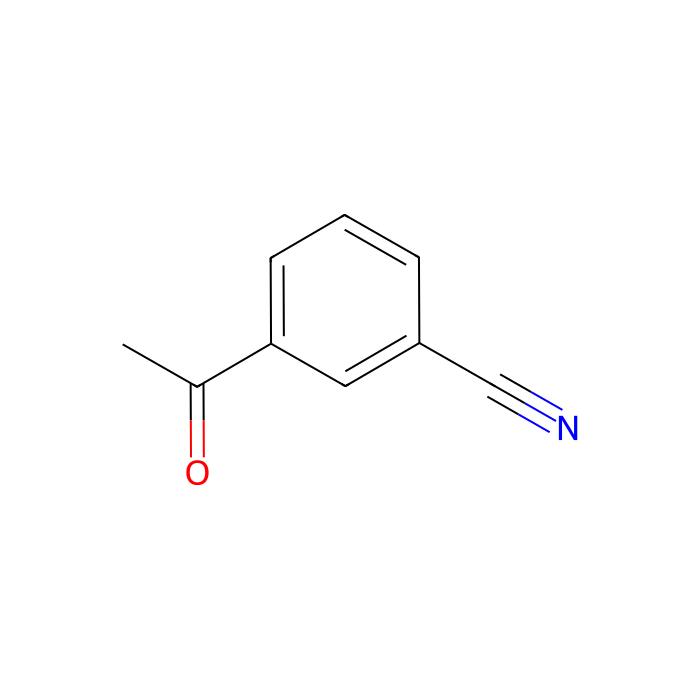
Brief overview: 3-Acetylbenzonitrile is an aromatic building block bearing both a ketone (acetyl) and a nitrile on a benzene ring in the meta relationship, useful for divergent functionalization on either handle.
Item-specific (from Product Data):
Literature/computed identity (general reference, not item-specific):
2D structural description (general):
Strategic value stems from the orthogonal nitrile and aryl methyl ketone, enabling bidirectional synthesis.
Retrosynthetic disconnections (literature):
Forward transformations:
Characterization cues:
Protecting group strategies:
Not applicable. This product is a small-molecule building block and is not an antibody, enzyme, or biologic. No target specificity, epitope, clone, or isotype information applies.