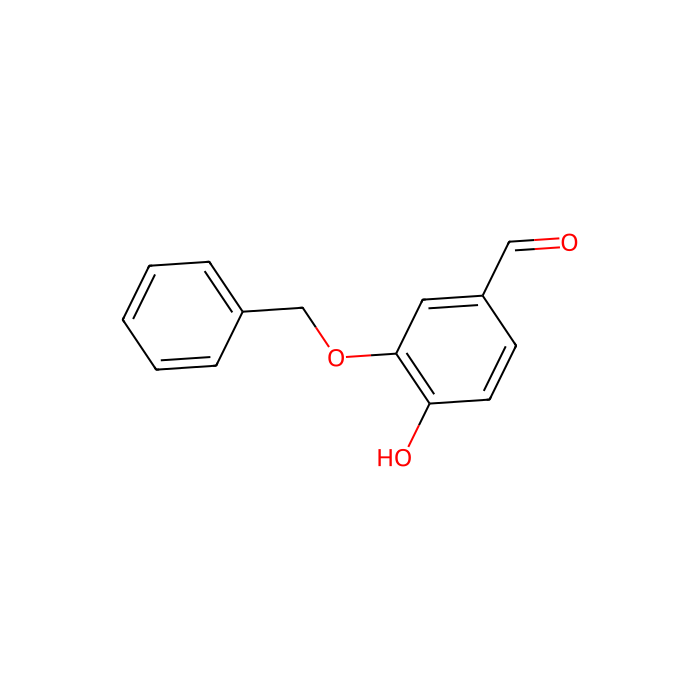
This compound belongs to the class of organic compounds known as hydroxybenzaldehydes. These are organic aromatic compounds containing a benzene ring carrying an aldehyde group and a hydroxyl group.
External Descriptors
Not available
1. Djoumbou Feunang Y, Eisner R, Knox C, Chepelev L, Hastings J, Owen G, Fahy E, Steinbeck C, Subramanian S, Bolton E, Greiner R, and Wishart DS. ClassyFire: Automated Chemical Classification With A Comprehensive, Computable Taxonomy. Journal of Cheminformatics, 2016, 8:61.
Zertifikate (CoA, COO, BSE/TSE und Analyse-Diagramm)
C of A & Other Certificates(BSE/TSE, COO):
Analytical Chart:
Chemische und physikalische Eigenschaften
Molekulargewicht
228.240 g/mol
XLogP3
2.700
Hydrogen Bond Donor Count
1
Hydrogen Bond Acceptor Count
3
Rotatable Bond Count
4
Exact Mass
228.079 Da
Monoisotopic Mass
228.079 Da
Topological Polar Surface Area
46.500 Ų
Heavy Atom Count
17
Formal Charge
0
Complexity
236.000
Isotope Atom Count
0
Defined Atom Stereocenter Count
0
Undefined Atom Stereocenter Count
0
Defined Bond Stereocenter Count
0
Undefined Bond Stereocenter Count
0
The total count of all stereochemical bonds
0
Covalently-Bonded Unit Count
1
Lösungsrechner
Molarity Calculator
Determine the necessary mass, volume, or concentration for preparing a solution.
Dilution Calculator
Determine the dilution needed to prepare a stock solution.
Reconstitution Calculator
Bewertungen
Kundenbewertungen
Application Protocols
No assay-specific protocols (e.g., WB, IHC, IF, FC) are applicable to this small-molecule reagent. For synthetic procedures, see the Reaction Conditions and Synthetic Utility sections for general laboratory guidance.
For analytical use, typical practices include:
Prepare analytical standards in acetonitrile, methanol, or DMSO; filter through 0.2 µm PTFE before HPLC/LC-MS.
Monitor reactions by TLC (UV-active) and confirm by 1H NMR (aldehyde proton near 9.5–10.0 ppm, literature) and LC-MS.
Biological Roles
Item is sold strictly for research use only; no medical or clinical claims are made.
General context (literature):
3-(Benzyloxy)-4-hydroxybenzaldehyde is a synthetic aromatic aldehyde, not a known endogenous metabolite. It serves primarily as a chemical building block.
Schiff bases derived from salicylaldehydes are widely used as chelating ligands in coordination chemistry; such complexes often serve as enzyme model systems or spectroscopic probes in biochemical research. The benzyloxy group offers orthogonal protection during ligand assembly.
Phenolic aldehydes are sometimes used as anchors in affinity or sensor platforms via imine formation with lysine residues on proteins, followed by reductive amination to stabilize the linkage (bioconjugation context). Any such use requires optimization to avoid protein denaturation and is conducted purely for in vitro research.
Redox/antioxidant behavior: phenolic motifs can participate in radical-scavenging in chemical assays; activity is highly substituent-dependent and context-specific. No item-specific biological activity is provided for this product.
Caveat:
For any work involving biomolecules or cells, ensure solvent and residual metal content meet your experimental needs; item-specific impurity limits are: Not specified for this item; refer to CoA/Spec Sheet.
Buffer Applications
This compound is a hydrophobic aromatic aldehyde and is not used as a classical buffering agent. It does not form a defined conjugate acid/base pair within physiological pH the way Good’s buffers do.
Practical note for biochemical experiments (general):
If using in aqueous buffer systems (e.g., for bioconjugation), dissolve first in a miscible co-solvent (DMSO, DMF, or ethanol) to prepare a concentrated stock, then dilute into the buffer with vigorous mixing. Keep final organic content as low as compatible with your system (often ≤1–5% v/v).
Avoid primary amine–containing buffers (e.g., Tris) during imine-forming steps, as they can compete with the intended amine partner. Use phosphate or acetate buffers as appropriate, and adjust pH to favor imine formation (typically mildly acidic to neutral, literature).
Green Alternatives
Greener choices focus on solvent and protection/deprotection strategies rather than on the substrate itself.
Greener solvent options (literature/general):
Replace DCM/chloroform with:
• Ethyl acetate or methyl tert-butyl ether (MTBE) for extractions and chromatography.
• 2-Methyltetrahydrofuran (2-MeTHF) or cyclopentyl methyl ether (CPME) for condensations and Wittig-type reactions; both have better safety/renewability profiles than THF/DCM.
Replace DMF/DMSO (where feasible) with propylene carbonate or dimethyl carbonate for some nucleophilic substitutions and base-mediated steps.
Use ethanol or isopropanol (bio-derived) as reaction media for imine formations and reductions.
Comparison (general; tradeoffs):
2-MeTHF vs THF: 2-MeTHF is less miscible with water (easier workups) and often allows room-temperature operations; THF has broader data support and may give faster kinetics in strongly anionic chemistry.
EtOAc vs DCM: EtOAc is less toxic and biodegradable but may provide lower substrate solubility and slower extractions.
Greener protecting-group strategy:
The benzyloxy group is removable by hydrogenolysis under relatively mild conditions (H2, Pd/C), avoiding harsh acids/bases. Where possible, consider catalytic transfer hydrogenation (e.g., ammonium formate/Pd-C) to eliminate bottled hydrogen.
Process considerations:
Implement solvent recovery (rotary evaporation with trapping) and minimize chlorinated waste streams.
Prefer catalytic over stoichiometric reagents (e.g., organocatalytic Knoevenagel using proline derivatives).
Pharmaceutical Uses
For research and process development context only; no therapeutic claims.
General roles for this structural class:
Synthetic intermediate: The protected catechol aldehyde motif is useful in the preparation of small-molecule libraries, including potential API intermediates where selective deprotection to 3,4-dihydroxybenzaldehyde (or subsequent elaboration) is required.
Ligand precursor: Salicylaldehyde derivatives furnish Schiff-base ligands that can template metal-mediated transformations relevant to catalytic process research in pharmaceutical manufacturing.
Impurity reference standard: Aromatic aldehydes are sometimes used as reference markers in analytical methods development (e.g., related substances profiling) due to distinctive UV and MS signatures.
Regulatory/compendial status:
No pharmacopeial monograph is indicated for this specific derivative.
Excipent use is not typical for aromatic aldehydes due to reactivity; this product should be treated strictly as a synthetic reagent.
Manufacturing considerations (general):
Avoid prolonged exposure to air to limit over-oxidation to the corresponding carboxylic acid.
For hydrogenolysis deprotection steps, ensure catalyst residues are controlled via appropriate scavengers and filtration protocols to meet pharmaceutical impurity guidelines.
Appearance: Not specified for this item; refer to CoA/Spec Sheet.
Molecular formula: Not specified for this item; refer to CoA/Spec Sheet.
Molecular weight: Not specified for this item; refer to CoA/Spec Sheet.
Boiling point, melting point, density, refractive index, UV cutoff, water/peroxide/metal content: Not specified for this item; refer to CoA/Spec Sheet.
Literature/general expectations for this structural class (phenolic benzaldehydes with benzyloxy protection):
Physical state: typically a crystalline solid at ambient temperature.
Volatility: low; aldehyde functionality can undergo slow oxidation on air exposure.
Solubility profile (qualitative, literature):
• Organic solvents: soluble in DCM, chloroform, THF, acetone, ethyl acetate; moderately soluble in MeOH/EtOH; highly soluble in polar aprotic solvents (DMF, DMSO).
• Water: sparingly soluble due to hydrophobic benzyloxy/aryl content.
Acid–base: phenolic OH weakly acidic (phenols typically pKa 9–11, literature), enabling deprotonation under basic conditions for O-alkylation/acylation.
Partitioning: logP expected to be moderate-to-high for a di-aryl ether aldehyde (literature trend for benzyloxybenzaldehydes); exact value varies by source.
Practical implications (general knowledge):
Handling as a solid: minimize moisture to limit base-catalyzed side reactions (e.g., self-aldol condensations of trace impurities or acetal formation in alcohols under acid).
Spectroscopy: aldehyde –CHO typically shows a 9.5–10.0 ppm 1H singlet (literature) and strong IR C=O stretch around 1680–1710 cm−1 (literature), useful for ID and purity checks.
Quality and Grades
Item-specific grade/purity: Not specified for this item; refer to CoA/Spec Sheet.
How to interpret grade and testing (general guidance for researchers):
If offered as “95%+” or “98%+” on a CoA, this typically reflects HPLC/GC or NMR assay of the bulk material. For sensitive transformations (e.g., catalytic hydrogenolysis of the benzyl ether), higher purity can reduce catalyst fouling.
Chromatography suitability: If an HPLC or LC-MS grade is offered elsewhere, it implies tighter control of non-UV absorbing residues and metal content; absent such a label, assume standard research grade.
Stabilizers: None are indicated in the Product Data for this SKU. Phenolic benzaldehydes are generally shipped neat without stabilizers. If a stabilizer is listed on your CoA, consider its impact on downstream reactions (acid/base sensitivity, UV background).
Identity confirmation: Researchers commonly verify identity by 1H/13C NMR, IR (aldehyde C=O), and HRMS. A single sharp aldehyde proton (~9.5–10 ppm, literature) and appropriate aromatic/benzylic signals support identity.
Trace impurities to consider (general): residual toluene/benzyl alcohol (from protection chemistry), unprotected dihydroxybenzaldehyde, or over-oxidized acids. Review the CoA for specific limits—if not stated: Not specified for this item; refer to CoA/Spec Sheet.
Reaction and Applications
This substrate is a versatile aromatic aldehyde building block combining a free phenol, a benzyl-protected phenol, and an aldehyde handle.
Typical reaction families and uses (literature/general):
Imine (Schiff base) formation: condenses with primary amines to give salicylidene imines (often bidentate ligands via O,N-chelation). Benzyloxy protection prevents undesired bis-imination on a catechol framework.
Wittig/Horner–Wadsworth–Emmons: converts the –CHO to alkenes (E/Z selectivity tuned by ylide/phosphonate). The phenol can be protected or left free depending on base strength.
Knoevenagel/Perkin condensations: with active methylenes (e.g., malononitrile, ethyl cyanoacetate) under amine catalysis, producing substituted cinnamaldehydes or acids after oxidation/hydrolysis.
Electrophilic aromatic substitution: the phenolic OH directs ortho/para; the aldehyde is meta-directing/deactivating—net reactivity is position-dependent. Protective strategies (O-silyl, carbonate) may be chosen to modulate reactivity.
O-Functionalization: phenol can be alkylated/acylated (Williamson ether synthesis, Steglich esterification). The benzyloxy group is orthogonal, surviving many conditions and removed later by hydrogenolysis.
Deprotection to catechol aldehyde: catalytic hydrogenolysis (Pd/C, H2) or transfer hydrogenation reveals 3,4-dihydroxybenzaldehyde, a valuable intermediate in ligand, polymer, and small-molecule synthesis.
Acetalization: controlled formation of acetals/hemiacetals from the aldehyde in the presence of alcohols and acid catalysts—useful for temporary protection during phenolic manipulations.
Practical tips:
Dry, oxygen-limited conditions minimize side oxidation of the aldehyde to the corresponding acid.
For base-sensitive steps, protect the phenol (e.g., silyl, carbonate) to avoid competitive O-alkylation or Michael-type side reactions in condensations.
Reaction Conditions
Representative conditions (literature/general; adjust to your system):
Schiff base formation: dissolve aldehyde and a primary amine (1.0–1.2 equiv) in EtOH or i-PrOH; add catalytic acetic acid or use neutral conditions with 3 Å molecular sieves; stir at room temperature to reflux until completion by TLC/LC. Optional NaBH3CN or NaBH(OAc)3 for reductive amination in MeOH/AcOH or DCE.
Wittig olefination: treat with ylide generated from phosphonium salt (e.g., Ph3P=CHR) in THF or 2-MeTHF at 0–25 °C under N2; monitor E/Z ratio based on ylide type (stabilized vs non-stabilized). Work up with aqueous NH4Cl and extract with EtOAc.
HWE (Horner–Wadsworth–Emmons): use phosphonate carbanion (e.g., diethyl (cyanomethyl)phosphonate) with NaH or KOtBu in THF at 0–25 °C; quench carefully and neutralize phenoxide before isolation.
Knoevenagel condensation: combine with malononitrile or ethyl cyanoacetate in EtOH or toluene; add catalytic piperidine or ammonium acetate; 25–110 °C depending on solvent; remove water by Dean–Stark for high conversions.
O-Acylation/O-alkylation: generate phenoxide with K2CO3 or Cs2CO3 in acetone/MeCN/DMF; add alkyl halide or acyl chloride; 0–50 °C. For acylation, DMAP/Et3N with acid chloride in DCM is common.
Debenzylation: H2 (1–3 atm) with 5–10 wt% Pd/C in EtOH or EtOAc at rt–50 °C until benzyl ether is fully cleaved (monitor by TLC/LC-MS). Filter over Celite; treat filtrate with activated carbon if coloration occurs.
General tips:
Use anhydrous solvents and inert atmosphere for base-sensitive steps.
Control pH during workup to avoid emulsions; neutralize phenoxide before extraction.
Light protection can reduce byproduct formation during longer reactions.
Safety and Handling
Item-specific hazard statements/classification: Not specified for this item; refer to the SDS for definitive information.
General safety guidance for phenolic benzaldehydes (literature/industry practice):
GHS expectation: often classified as Irritant; specific H/P phrases depend on test data. Always consult the SDS for this SKU (B176644) before use.
Principal hazards: eye/skin irritation (phenolic OH and aromatic aldehyde); respiratory irritation from dust; combustible organic solid. Aldehydes may cause sensitization in some individuals.
PPE: lab coat, safety glasses or goggles, appropriate gloves (e.g., nitrile). Use in a fume hood to avoid inhalation of dust/vapors.
Handling: avoid prolonged exposure to air and light to minimize slow oxidation or color change. Prevent contact with strong oxidizers (can accelerate oxidation) and strong bases (can promote undesired condensations or phenoxide formation).
Storage: room temperature as specified; keep tightly closed in a dry, well-ventilated place. Protect from light. Use original amber container when provided.
Incompatibilities (general): strong oxidizing agents, strong bases, acid chlorides/anhydrides without proper control, and reducing agents that could cleave the benzyl ether.
First aid (overview; defer to SDS):
• Inhalation: move to fresh air; seek medical attention if symptoms persist.
• Skin/eyes: rinse with water for several minutes; remove contaminated clothing; get medical advice if irritation continues.
• Ingestion: rinse mouth; do not induce vomiting; seek medical attention.
Spill/fire: collect solids by damp wiping or HEPA vacuum; for fire use CO2, dry chemical, or foam. Avoid dust formation.
Solvent Selection
This compound is an aromatic aldehyde with both phenolic and benzyloxy functionalities, giving amphiphilic behavior biased toward hydrophobicity.
General solvent miscibility/use (literature/experience):
Polar aprotic (DMF, DMSO, DMAc): excellent solubility; ideal for base-mediated O-alkylation/acylation of the phenol or for coupling chemistry.
Moderately polar ethereal/ester solvents (THF, dioxane, EtOAc): good solubility; suited to Wittig/Knoevenagel-type condensations, and preparative chromatography loading.
Chlorinated solvents (DCM, CHCl3): good solubility and fast evaporation; useful for rapid extractions and analytical sample prep.
Alcohols (MeOH, EtOH, i-PrOH): moderate solubility; can participate in acetal/hemiacetal formation under acid—control acidity if using.
Hydrocarbons (toluene, xylene): moderate solubility; useful for azeotropic water removal (Dean–Stark) in condensations.
Water: sparingly soluble; biphasic systems typically require a co-solvent or phase-transfer agent.
When to choose vs alternatives:
Choose polar aprotic media for nucleophilic substitutions or strong base (better substrate solvation, phenoxide stabilization).
Choose alcohols for imine (Schiff base) formation with catalytic acid/base at ambient to reflux temperatures, balancing solubility and water tolerance.
Choose toluene/xylene for high-temperature dehydrations (Knoevenagel/Perkin) with efficient water removal.
Small comparison (general):
DCM vs EtOAc: DCM offers faster evaporation and broader solubility; EtOAc is greener and safer but may need warming to dissolve high loads.
THF vs 2-MeTHF: 2-MeTHF is greener and less miscible with water, aiding workups; both dissolve this substrate well (literature).
Keep container tightly closed in a cool, dry place. Protect from light and airborne moisture.
To minimize oxidation of the aldehyde to the corresponding acid, purge headspace with inert gas after opening when long-term storage is anticipated.
If discoloration or increased acidity is observed over time, consider re-purification (e.g., short silica plug) prior to sensitive reactions.
Solution handling (general):
Prepare concentrated stock solutions in dry DMSO, DMF, acetonitrile, or ethanol as needed. Store small aliquots at −20 °C to reduce freeze–thaw cycles; warm to room temperature before opening to avoid moisture condensation.
Aqueous reconstitution is not typical due to low water solubility; use a water-miscible co-solvent if an aqueous application is required.
Stability notes:
Avoid strong bases/acids during storage; aldehydes can undergo self-condensation or acetalization in the presence of catalysts.
Item-specific shelf life and impurity limits: Not specified for this item; refer to CoA/Spec Sheet.
Structure and Identity
A protected catechol-type benzaldehyde featuring a benzyloxy protecting group and a free phenol para to the aldehyde.
SKU: B176644
Product name: 3-(benzyloxy)-4-hydroxybenzaldehyde
CAS: 50773-56-3
PubChem CID: 11020635
InChIKey (as provided in Product Data): 55546
SMILES (item-specific): Not specified for this item; refer to CoA/Spec Sheet.
Item-specific facts from Product Data:
Storage: Room temperature
Shipped in: Normal
Literature/computed identity details (for reference only; not item specifications):
Typical molecular formula (literature): C14H12O3 or C14H12O3/C14H12O3? See note below.
• Note: For the benzyloxy plus phenol plus aldehyde substitution pattern, the commonly reported formula is C14H12O3–C14H12O4 depending on tautomeric/annotational conventions in databases. Verify on the item’s CoA.
A more consistent calculation from structure gives: C14H12O3 (ring aldehyde + phenol + benzyloxy) or C14H13O3 if hydrogen count includes phenolic OH; consult CoA for authoritative formula and exact MW.
Structural features: one benzaldehyde ring bearing a para-phenolic OH and a meta-O-CH2-Ph (benzyloxy) substituent; no stereocenters; two aromatic rings connected via benzylic ether.
2D description: an anisyl-like aldehyde ring with –CHO at C1, –OH at C4, and –O–CH2–Ph at C3; second ring is unsubstituted phenyl.
General chemistry knowledge:
Functional groups: aldehyde, phenol, benzyl ether, two aryl systems.
Protecting-group logic: the benzyloxy group masks one phenolic OH and can be removed by hydrogenolysis to reveal the catechol aldehyde.
Synthetic Utility
Reactivity map:
Aldehyde (electrophile): amenable to condensation (Wittig/HWE, Knoevenagel, Perkin), reductive amination, and nucleophilic additions (cyanohydrin formation, 1,2-additions).
Phenol (nucleophile/ligating site): O-alkylation/acylation; formation of salicylidene imines (O,N-chelation) and subsequent metal complexes.
Benzyloxy (protecting group): orthogonal to many conditions; removable by hydrogenolysis without affecting many carbon–heteroatom bonds or sensitive esters.
Strategic uses in synthesis (literature/general):
Orthogonal phenol protection: retain one free OH for directed reactions (e.g., ortho-lithiation under controlled conditions), while the benzyloxy blocks the other position, enabling selective downstream functionalization.
Access to catechol frameworks: Pd/C hydrogenolysis of the benzyl ether yields 3,4-dihydroxybenzaldehyde, a gateway to ethers, esters, and heterocycles (e.g., benzoxazoles via cyclocondensation with amines).
Cascade assembly: formation of imines followed by intramolecular cyclizations (e.g., Schiff base → oxidative coupling) to generate salicylidene-based ligands and macrocycles.
Polymer/monomer design: aldehyde can be transformed to alcohols (NaBH4/EtOH) or acids (NaClO2/NaH2PO4) to diversify handles for polymer conjugation.
Selectivity/compatibility notes:
Strong bases may deprotonate the phenol; consider transient protection (silyl carbonate) to prevent competitive O-alkylation in carbonyl olefinations.
The benzyl ether is stable to many acids/bases but is cleaved by hydrogenolysis (H2, Pd/C) and to a lesser extent by strongly acidic conditions with carbocation mechanisms; plan sequences accordingly.
Target Specificity
This product is a small-molecule reagent, not an antibody, enzyme, or biological probe validated against a specific biological target. No antigen, epitope, species reactivity, clone, or isotype information applies.
Wir verwenden Cookies, um die ordnungsgemäße Funktion der Website sicherzustellen und, soweit zulässig, Ihr Nutzererlebnis zu verbessern. Sie können Ihre Einstellungen jederzeit unter „Einstellungen“ verwalten. Weitere Informationen finden Sie in unserer Cookie-Richtlinie.
Shall we send you a message when we have discounts available?
Remind me later
Thank you! Please check your email inbox to confirm.
Products are supplied to verified businesses, institutions, and qualified professionals for research and development use only. Not for use in humans, animals, diagnosis, or therapy.