Determine the necessary mass, volume, or concentration for preparing a solution.
Taxonomy Tree
| Kingdom | Organic compounds |
|---|---|
| Superclass | Organic oxygen compounds |
| Klasse | Organooxygen compounds |
| Subclass | Carbonyl compounds |
| Intermediate Tree Nodes | Aldehydes - Aryl-aldehydes - Benzaldehydes |
| Direct Parent | Hydroxybenzaldehydes |
| Alternative Parents | O-chlorophenols Benzoyl derivatives Chlorobenzenes 1-hydroxy-2-unsubstituted benzenoids Aryl chlorides Organochlorides Organic oxides Hydrocarbon derivatives |
| Molecular Framework | Aromatic homomonocyclic compounds |
| Substituents | Hydroxybenzaldehyde - Benzoyl - 2-halophenol - 2-chlorophenol - Phenol - Halobenzene - Chlorobenzene - 1-hydroxy-2-unsubstituted benzenoid - Benzenoid - Aryl halide - Aryl chloride - Monocyclic benzene moiety - Organochloride - Organohalogen compound - Hydrocarbon derivative - Organic oxide - Aromatic homomonocyclic compound |
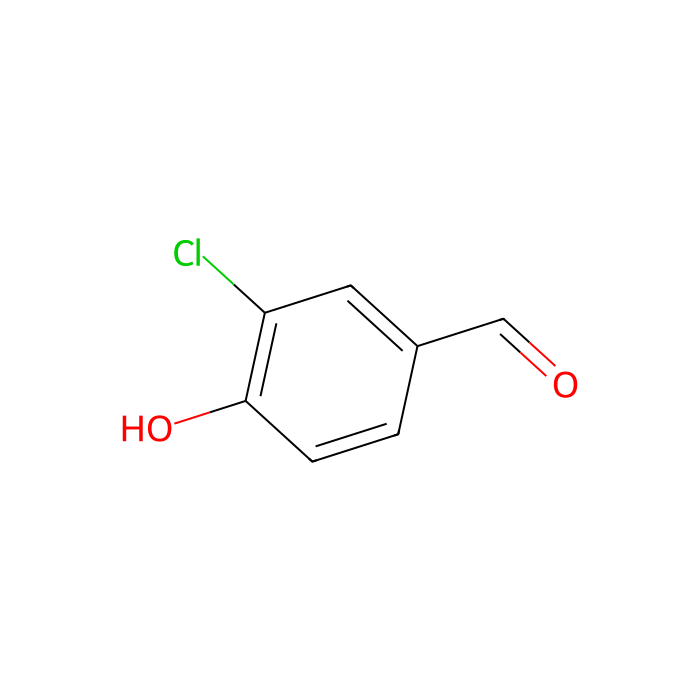
| Beschreibung | This compound belongs to the class of organic compounds known as hydroxybenzaldehydes. These are organic aromatic compounds containing a benzene ring carrying an aldehyde group and a hydroxyl group. |
| External Descriptors | Not available |
Find and download the COA for your product by matching the lot number on the packaging.
| Lot Number | Certificate Type | Datum | Artikel |
|---|---|---|---|
| Certificate of Analysis | Sep 22, 2026 | C133077 | |
| Certificate of Analysis | Dec 01, 2025 | C133077 | |
| Certificate of Analysis | Sep 06, 2025 | C133077 | |
| Certificate of Analysis | Aug 07, 2024 | C133077 | |
| Certificate of Analysis | Jun 19, 2024 | C133077 | |
| Certificate of Analysis | Jun 19, 2024 | C133077 | |
| Certificate of Analysis | Jun 18, 2024 | C133077 | |
| Certificate of Analysis | Dec 24, 2021 | C133077 | |
| Certificate of Analysis | Dec 24, 2021 | C133077 | |
| Certificate of Analysis | Dec 24, 2021 | C133077 | |
| Certificate of Analysis | Dec 24, 2021 | C133077 | |
| Certificate of Analysis | Dec 24, 2021 | C133077 | |
| Certificate of Analysis | Dec 24, 2021 | C133077 |
| Empfindlichkeit | Air Sensitive |
|---|---|
| Siedepunkt (°C) | 150 °C/14 mmHg |
| Schmelzpunkt (°C) | 128.0~137.0 °C |
| Molekulargewicht | 156.56 |
| XLogP3 | 1.900 |
| Hydrogen Bond Donor Count | 1 |
| Hydrogen Bond Acceptor Count | 2 |
| Rotatable Bond Count | 1 |
| Exact Mass | 155.998 Da |
| Monoisotopic Mass | 155.998 Da |
| Topological Polar Surface Area | 37.300 Ų |
| Heavy Atom Count | 10 |
| Formal Charge | 0 |
| Complexity | 127.000 |
| Isotope Atom Count | 0 |
| Defined Atom Stereocenter Count | 0 |
| Undefined Atom Stereocenter Count | 0 |
| Defined Bond Stereocenter Count | 0 |
| Undefined Bond Stereocenter Count | 0 |
| The total count of all stereochemical bonds | 0 |
| Covalently-Bonded Unit Count | 1 |
H302:Harmful if swallowed
H315:Causes skin irritation
H317:May cause an allergic skin reaction
H318:Causes serious eye damage
H319:Causes serious eye irritation
H335:May cause respiratory irritation
P261:Avoid breathing dust/fume/gas/mist/vapors/spray.
P264:Wash hands [and …] thoroughly after handling.
P270:Do not eat, drink or smoke when using this product.
P271:Use only outdoors or in a well-ventilated area.
P272:Contaminated work clothing should not be allowed out of the workplace.
P280:Wear protective gloves/protective clothing/eye protection/face protection.
P321:Specific treatment (see ... on this label).
P330:Rinse mouth.
P302+P352:IF ON SKIN: wash with plenty of water.
P304+P340:IF INHALED: Remove person to fresh air and keep comfortable for breathing.
P305+P351+P338:IF IN EYES: Rinse cautiously with water for several minutes. Remove contact lenses if present and easy to do - continue rinsing.
P333+P313:IF SKIN irritation or rash occurs: Get medical advice/attention.
P362+P364:Take off contaminated clothing and wash it before reuse.
P405:Store locked up.
P403+P233:Store in a well-ventilated place. Keep container tightly closed.
P501:Dispose of contents/container to an approved waste disposal plant.
P264+P265:Wash hands [and …] thoroughly after handling. Do not touch eyes.
P301+P317:IF SWALLOWED: Get medical help.
P305+P354+P338:IF IN EYES: Immediately rinse with water for several minutes. Remove contact lenses if present and easy to do. Continue rinsing.
P317:Get emergency medical help.
P337+P317:If eye irritation persists: Get medical help.
P332+P317:If skin irritation occurs: Get medical help.
P319:Get medical help if you feel unwell.
No assay/application protocols are specified for this item. Typical uses are synthetic transformations described in Reaction & Applications and Reaction Conditions. If employing this reagent in an analytical or materials workflow, develop protocols specific to your system and validate (e.g., crystallization solvent screens, coupling conditions, or condensation setups). For biological assays, ensure independent safety review and method development; this product is for research use only.
This compound is provided for research use in chemical synthesis and materials; no biological/clinical uses are claimed.
General biochemical context (literature, not product-specific claims):
If considering any work involving biological matrices, ensure appropriate containment, compatibility testing, and compliance with institutional EHS policies. No pharmacological or therapeutic properties are asserted for this catalog item.
Not typically applicable. 3-Chloro-4-hydroxybenzaldehyde is not a buffering reagent and lacks a defined conjugate acid/base pair with a practical aqueous buffering range. For pH control, select established buffers (e.g., phosphate, HEPES, acetate) appropriate to your system.
If your application involves aqueous-phase condensations, choose a separate buffer or mild base (e.g., ammonium acetate, piperidine) as dictated by the reaction, and solvent systems described under Solvent Selection and Reaction Conditions.
Although this material is a substrate rather than a solvent, greener choices can be made around its use and, where chemistry allows, in selecting related building blocks.
Greener media choices (literature-guided)
Catalyst and coupling strategy
Substrate alternatives (if halogen is not essential)
Small comparison (general, illustrative):
Always validate that greener choices meet reaction performance and purity specifications.
No excipient or therapeutic uses are claimed. For research use only.
General formulation/manufacturing context (literature):
Regulatory note: If used in a process development context, ensure that reagent specifications, impurity profiles, and residual limits are defined per internal QA and applicable guidelines. This catalog entry provides no pharmacopeial status; consult the CoA for lot-specific quality data.
Item-specific numerical specifications (mp, bp, density, UV cutoff, residuals, etc.) are not provided for this catalog entry. Refer to the CoA/Spec Sheet for lot-specific values.
Literature/typical properties (for reference; not item specifications):
Do not treat these literature values as product specifications; verify experimentally under your conditions.
As a bifunctional aromatic (aryl aldehyde + phenol) bearing a chloro substituent, 3-chloro-4-hydroxybenzaldehyde is a versatile building block.
General literature guidance for common transformations (optimize for your system; values are indicative, not specifications):
Schiff base formation
Knoevenagel condensation (e.g., with malononitrile)
Wittig/Horner–Wadsworth–Emmons olefination
O-alkylation/acylation of phenol
Cross-coupling at Ar–Cl
Cannizzaro (side reaction risk)
Always monitor by TLC/HPLC/GC and verify identity/purity by NMR/IR/MS.
This product is a solid aromatic aldehyde/phenol reagent rather than a solvent. Solvent choice pertains to its dissolution, purification, and reaction environment.
3-Chloro-4-hydroxybenzaldehyde is a chlorinated salicylaldehyde isomer featuring both an aromatic aldehyde and a phenolic hydroxyl.
Item-specific registry data (from Product Data)
Literature/computed identifiers and composition (for reference; not item specifications)
Structural implications (general chemistry)
Key functional groups and handles make this substrate broadly useful in synthesis:
Retrosynthetic value
Practical notes
Not applicable. This product is a small-molecule reagent and is not an antibody, probe, or bioaffinity reagent. No target, epitope, clone, isotype, or species reactivity information applies.