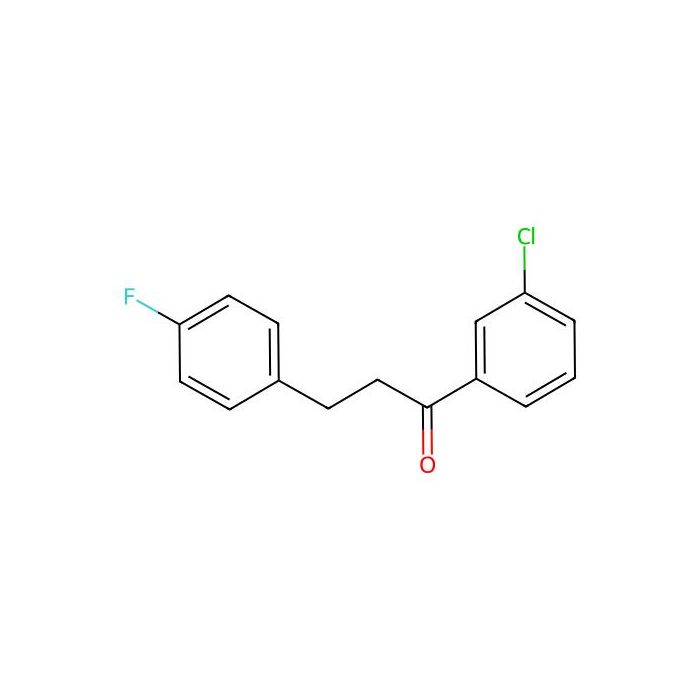
This compound belongs to the class of organic compounds known as retro-dihydrochalcones. These are a form of normal dihydrochalcones that are structurally distinguished by the lack of oxygen functionalities at the C2'- and C6'-positions.
External Descriptors
Not available
1. Djoumbou Feunang Y, Eisner R, Knox C, Chepelev L, Hastings J, Owen G, Fahy E, Steinbeck C, Subramanian S, Bolton E, Greiner R, and Wishart DS. ClassyFire: Automated Chemical Classification With A Comprehensive, Computable Taxonomy. Journal of Cheminformatics, 2016, 8:61.
Zertifikate (CoA, COO, BSE/TSE und Analyse-Diagramm)
C of A & Other Certificates(BSE/TSE, COO):
Analytical Chart:
Chemische und physikalische Eigenschaften
Molekulargewicht
262.700 g/mol
XLogP3
4.200
Hydrogen Bond Donor Count
0
Hydrogen Bond Acceptor Count
2
Rotatable Bond Count
4
Exact Mass
262.056 Da
Monoisotopic Mass
262.056 Da
Topological Polar Surface Area
17.100 Ų
Heavy Atom Count
18
Formal Charge
0
Complexity
274.000
Isotope Atom Count
0
Defined Atom Stereocenter Count
0
Undefined Atom Stereocenter Count
0
Defined Bond Stereocenter Count
0
Undefined Bond Stereocenter Count
0
The total count of all stereochemical bonds
0
Covalently-Bonded Unit Count
1
Lösungsrechner
Molarity Calculator
Determine the necessary mass, volume, or concentration for preparing a solution.
Dilution Calculator
Determine the dilution needed to prepare a stock solution.
Reconstitution Calculator
Bewertungen
Kundenbewertungen
Application Protocols
Not applicable. No biological assay, immunoassay, or diagnostic application has been validated for this item. For synthetic and analytical use, follow standard organic chemistry protocols (reaction setup, purification by chromatography or recrystallization, and analytical characterization by NMR/IR/MS/HPLC) appropriate for aryl ketones.
Biological Roles
This product is a synthetic, halogenated aryl ketone intended for laboratory research and synthesis. It does not possess a defined endogenous biological role.
General considerations (literature/general)
Aryl ketones can interact with biological membranes due to hydrophobicity, and the carbonyl can participate in noncovalent interactions (H‑bond acceptor). These physicochemical traits inform ADME profiling when such scaffolds are used as intermediates in medicinal chemistry.
The presence of aryl chloride and para‑fluoro substituents modulates lipophilicity, metabolic stability, and potential for oxidative metabolism on the rings—useful in SAR exploration but not indicative of any biological activity of this specific material.
No biological activity, target engagement, or toxicological endpoints are specified for this item; refer to SDS and primary literature as needed. For research use only.
Buffer Applications
Not typically applicable. This compound is a neutral, hydrophobic aryl ketone and is not used to prepare aqueous buffer systems. For work involving this material, select appropriate organic solvents as outlined under Solvent Selection, and use compatible aqueous buffers only in biphasic extractions or analytical separations as needed.
Green Alternatives
Greener choices relate primarily to solvent and reagent selection for transformations of this aryl ketone scaffold. The core substance itself is fixed; process intensification and substitution of auxiliaries offer the main sustainability levers.
Selected greener options (literature/general)
Replace chlorinated solvents with ethers/esters: use 2‑MeTHF or CPME in place of DCM/THF when feasible (better safety profile, biorenewable origin for 2‑MeTHF, easier phase separation).
Use aqueous micellar catalysis for cross‑coupling: designer surfactants (e.g., TPGS‑750‑M) can enable Suzuki couplings of aryl chlorides in water at room temperature, lowering solvent burden.
Switch bases/additives: carbonate or phosphate bases over strong inorganic hydroxides minimize hazards and corrosion.
Catalysis at lower loadings: modern Pd–NHC catalysts enable aryl chloride activation at ppm–low mol% loadings, reducing precious metal footprint.
Illustrative comparison (general)
DCM vs 2‑MeTHF: DCM offers excellent solubility and low boiling point but is chlorinated and has environmental/health concerns; 2‑MeTHF is biorenewable, forms less peroxide than THF, and often provides comparable rates in organometallic and coupling chemistry.
Note
These are process recommendations; no change to the substance itself. Verify compatibility with your specific route. Item‑specific environmental metrics are not specified for this item; refer to CoA/Spec Sheet if available.
Pharmaceutical Uses
No pharmacopeial status or excipient role is specified for this item; refer to CoA/Spec Sheet.
General R&D context (literature/general)
Halogenated aryl ketones are common intermediates in medicinal chemistry campaigns. The dual aryl halides (Ar–Cl and Ar–F) facilitate late‑stage diversification by cross‑coupling or SNAr, enabling rapid analogue generation.
As a research chemical, it may be incorporated into multi‑step sequences toward candidate molecules. Any use is restricted to non‑clinical, non‑diagnostic laboratory research. No therapeutic or clinical claims are made or implied.
Physical Properties
Item-specific (from Product Data)
Appearance: Not specified for this item; refer to CoA/Spec Sheet.
Literature/general expectations for this scaffold (non‑specification)
Physical state: typically a pale solid or high‑boiling oil for diaryl‑substituted propiophenones with halogens (literature, varies by substitution pattern).
Solubility: expected to be sparingly soluble in water and readily soluble in common organic solvents (e.g., dichloromethane, ethyl acetate, toluene, THF, acetonitrile, alcohols) due to the neutral aryl ketone core (literature/general chemistry).
Partitioning: high aromatic content suggests moderate-to-high hydrophobicity (elevated logP) relative to simple ketones (literature trend).
UV–vis: aryl ketones typically show strong π→π* absorption in near‑UV (literature trend), useful for TLC visualization under 254 nm.
Not specified for this item; refer to CoA/Spec Sheet
Melting point / boiling point
Density / refractive index
pKa / logP (experimental)
UV cutoff / extinction coefficients
Water and residual solvent content, trace metals, or other analytical limits
Quality and Grades
Item-specific (from Product Data)
Grade/purity: Not specified for this item; refer to CoA/Spec Sheet.
Shipped in: Not specified for this item; refer to CoA/Spec Sheet.
Category path: 全部 / 可售 / 生命科学 (catalog classification only; not a quality designation).
Guidance on interpreting quality (general)
If provided, an assay value (e.g., ≥98%) indicates chromatographic purity of the main component; verify residual solvents and isomeric/by‑product content on the CoA.
For synthetic intermediates like halogenated aryl ketones, typical quality controls include: identity by NMR/IR/MS, HPLC/GC purity, and sometimes residual halide or acid content. If chiral, enantiomeric ratio may be relevant; otherwise, racemic material is common.
Stabilizers: none are typical for this class; if present, they will be declared on the label/CoA. Stabilizers can influence downstream reactivity (e.g., base‑sensitive steps).
Regulatory: no pharmacopeial monograph is expected for this research chemical; use is restricted to research and development as stated (For research use only). Always consult the batch‑specific CoA for acceptance criteria.
Reaction and Applications
Use context (general for this scaffold)
Intermediate in aryl‑ketone chemistry: the 3′‑chloro substituent and para‑fluoro ring enable divergent derivatization via cross‑coupling (on Ar–Cl), SNAr (on p‑F under activating conditions), and carbonyl‑centered transformations.
Cross‑coupling of the 3′‑chloro aryl: Pd‑catalyzed Suzuki–Miyaura, Buchwald–Hartwig, or Heck reactions after appropriate optimization (use bulky, electron‑rich ligands for aryl chlorides; bases such as K3PO4 or Cs2CO3; solvents like toluene/THF/dioxane).
SNAr on the 4‑fluorophenyl ring: nucleophilic aromatic substitution if ring is further activated (e.g., additional nitro/CF3) or under strong conditions (ionic liquids or DMSO with strong nucleophiles); otherwise consider metalation/halogen–lithium exchange.
Carbonyl chemistry: α‑alkylation/arylation (via enolate or enamine), reduction to secondary alcohol (NaBH4, catalytic hydrogenation) or to the corresponding methylene (Wolff–Kishner/Clemmensen); Baeyer–Villiger oxidation to aryl acetates/benzoates.
Photochemistry: aryl ketones can engage in Norrish reactions; typically avoided unless intentionally studied.
Practical tips
Maintain dryness for base‑mediated α‑functionalization; rigorously exclude water and oxygen for metal‑catalyzed couplings.
Halogens aid TLC visualization (UV 254 nm) and can increase GC/MS sensitivity.
If chiral center is present at Cα, control configuration via chiral auxiliaries or asymmetric catalysis; otherwise, expect racemic outcomes.
Reaction Conditions
General literature guidance (non‑specification; optimize per substrate)
Suzuki–Miyaura on the 3′‑chloro ring: Pd2(dba)3 (0.5–1 mol%) + SPhos/XPhos (1–3 mol%), base K3PO4 or Cs2CO3 (2–3 equiv), solvent toluene/THF/dioxane/H2O (80–110 °C), 2–12 h. For challenging couplings, Pd–NHC precatalysts and higher temperature may be required.
Buchwald–Hartwig amination: Pd(OAc)2 (1–2 mol%) + BrettPhos or RuPhos (2–4 mol%), NaOtBu or Cs2CO3, toluene or dioxane (90–110 °C), 6–24 h.
Heck/Vinylations: Pd(OAc)2 (1–2 mol%), P(t‑Bu)3 or dialkylbiarylphosphines, Et3N or DIPEA, DMF/MeCN, 80–120 °C.
α‑Alkylation of the ketone: LDA or NaHMDS (1.1–1.5 equiv) in THF at −78 to 0 °C, then alkyl halide electrophile; quench and warm to ambient. Alternatively, phase‑transfer catalysis with K2CO3 in toluene/MeCN for activated alkyl halides.
Reduction to secondary alcohol: NaBH4 (1–2 equiv) in MeOH/EtOH at 0–25 °C; or catalytic hydrogenation (Raney Ni/Pd‑C) under 1–5 bar H2 in EtOH/EtOAc.
Baeyer–Villiger oxidation: mCPBA (1.2–1.5 equiv) in DCM at 0–25 °C to give aryl esters; control regioselectivity by substituent effects.
Notes
Aryl fluorides are typically inert under Pd cross‑coupling; exploit selectivity to modify Ar–Cl first. For SNAr at Ar–F, strong nucleophiles (e.g., alkoxides, amines) in DMSO/DMF at 80–140 °C may be necessary.
Always verify stability of the substrate under chosen conditions; halogens can direct or hinder ortho‑metalation.
Safety and Handling
Item-specific (from Product Data)
GHS classification, pictograms, signal word, H‑statements: Not specified for this item; refer to SDS.
Storage conditions: Room temperature (as provided).
General safety guidance for aryl ketones (literature/general)
Likely hazards: many halogenated aromatic ketones are harmful if swallowed or inhaled and can cause skin/eye irritation. Treat as combustible organic material. Avoid dust/vapor generation and ignition sources. Defer to the product SDS for definitive classifications.
PPE: safety glasses with side shields, lab coat, suitable nitrile gloves; handle in a fume hood to minimize inhalation exposure.
Incompatibilities: strong oxidizers (risk of exotherm), strong bases (may induce aldol/self‑condensation or halogen–metal exchange in reactive systems), strong reducing agents (may reduce the carbonyl). Avoid prolonged exposure to light/heat to prevent degradation.
First aid (overview, consult SDS): eye/skin contact—rinse with plenty of water for ≥15 min; inhalation—move to fresh air; ingestion—rinse mouth. Seek medical attention in all cases of significant exposure.
Spill response: absorb small liquid spills with inert material (vermiculite, silica); collect solids by careful sweeping while minimizing dust. Dispose of according to local regulations.
Fire fighting: use CO2, dry chemical, or alcohol‑resistant foam; combustion may generate CO/CO2 and hydrogen halides.
Solvent Selection
General solvent behavior (literature/general)
Polarity class: moderately polar, non‑protic aryl ketone; behaves as a typical neutral organic compound.
Miscibility/solubility: expected to dissolve well in chlorinated solvents (DCM, CHCl3), ethers (THF, MTBE), aromatics (toluene), esters (EtOAc), and polar aprotics (MeCN, DMF, DMSO); low aqueous solubility.
Dielectric/UV: aryl ketones absorb in near‑UV; choose HPLC‑grade solvents with low UV background for analytical work.
Choosing solvents by task
Synthesis: DCM or toluene for acylations and electrophilic aromatic substitutions; THF/MeTHF for organometallic additions or base‑mediated α‑functionalizations; MeCN for SNAr on the p‑fluorophenyl ring under basic conditions.
Purification: normal‑phase silica with hexane/EtOAc or hexane/MTBE gradients typically gives good resolution for halogenated aryl ketones; reverse‑phase MeCN/H2O (0.1% acid) for LC as needed.
Analysis: MeCN or MeOH for LC; DMSO‑d6, CDCl3, or acetone‑d6 for NMR.
Not specified for this item; refer to CoA/Spec Sheet
Any solvent‑specific solubility limits, azeotropes, or water content requirements for this SKU.
Storage and Reconstitution
Item-specific (from Product Data)
Storage conditions: Room temperature.
Shipped in: Not specified for this item; refer to CoA/Spec Sheet.
General guidance (literature/practice)
Store tightly sealed in an inert atmosphere (e.g., nitrogen) to limit moisture uptake and oxidative processes; protect from prolonged light and heat.
Containers: amber glass vials or bottles are preferred for light‑sensitive aryl ketones; ensure compatible cap liners (PTFE) to avoid leaching.
Long‑term stability: aryl ketones are typically stable for ≥12 months at ambient when protected from light and air; confirm by periodic HPLC/GC.
Reconstitution/usage: dissolve in anhydrous organic solvents (e.g., DCM, THF, toluene, EtOAc, MeCN, DMSO) to prepare stock solutions. For quantitative work, prepare fresh solutions and document solvent grade (HPLC or anhydrous as required).
Note
Any item‑specific stability data, solution shelf‑life, or impurity limits are not specified for this item; refer to CoA/Spec Sheet and SDS for authoritative guidance.
SMILES: Not specified for this item; refer to CoA/Spec Sheet.
Molecular formula: Not specified for this item; refer to CoA/Spec Sheet.
Molecular weight: Not specified for this item; refer to CoA/Spec Sheet.
Literature/structure description (general)
Structural class: halogenated aryl–alkyl aryl ketone (propiophenone scaffold bearing two aryl rings, one substituted with Cl and the other with p-F).
Functional groups: one aromatic chloride (on the benzoyl ring, designated 3′), one para-fluorophenyl ring, and one aryl–alkyl ketone (–CO–CH–/–CH2– linkage depending on substitution pattern).
Stereochemical note: depending on substitution at the carbon adjacent to the carbonyl, a stereogenic center may be present in 3-(aryl)propiophenones; materials are typically obtained/routinely used as racemates unless otherwise specified.
2D description in words: an acylated chlorobenzene (chlorine meta to the carbonyl on the benzoyl ring) connected through a three‑carbon chain to a para‑fluorophenyl substituent, forming a diaryl‑substituted propiophenone framework.
Synthetic Utility
Functional group handles
Carbonyl (aryl ketone): platform for α‑deprotonation/alkylation, reductive transformations (to alcohols or methylenes), and oxidative rearrangements (Baeyer–Villiger) to access esters/phenols.
Aryl chloride (3′‑position): cross‑coupling linchpin (Suzuki–Miyaura, Kumada, Negishi, Buchwald–Hartwig). Modern Pd–NHC or dialkylbiarylphosphine ligands expand reactivity of aryl chlorides.
Para‑fluorophenyl: potential site for SNAr with strong nucleophiles if ring is suitably activated or under forcing conditions; alternatively, serves as a robust spectroscopic tag and modulator of lipophilicity and metabolic stability.
Retrosynthetic value (general)
Forward routes often originate from Friedel–Crafts acylation of 3‑chloroacetophenone derivatives followed by chain extension/arylation, or from coupling of appropriately functionalized benzoyl halides with aryl‑substituted organometallics.
Divergent synthesis: selective activation of Ar–Cl over Ar–F (or vice versa) allows orthogonal functionalization, enabling library synthesis from a single starting material.
Practical notes
Protect the carbonyl when performing highly basic metalations on the aryl rings (e.g., halogen–lithium exchange) to avoid undesired enolate formation.
Sequence planning: exploit differential reactivity—perform Pd‑catalyzed coupling on Ar–Cl first, preserve Ar–F as a late‑stage handle if needed.
Target Specificity
Not applicable. This product is a small‑molecule research chemical (aryl ketone) and is not an antibody, enzyme, or biological reagent with defined target specificity. No target/epitope/isotype information is provided or relevant.
Wir verwenden Cookies, um die ordnungsgemäße Funktion der Website sicherzustellen und, soweit zulässig, Ihr Nutzererlebnis zu verbessern. Sie können Ihre Einstellungen jederzeit unter „Einstellungen“ verwalten. Weitere Informationen finden Sie in unserer Cookie-Richtlinie.
Shall we send you a message when we have discounts available?
Remind me later
Thank you! Please check your email inbox to confirm.
Products are supplied to verified businesses, institutions, and qualified professionals for research and development use only. Not for use in humans, animals, diagnosis, or therapy.