Determine the necessary mass, volume, or concentration for preparing a solution.
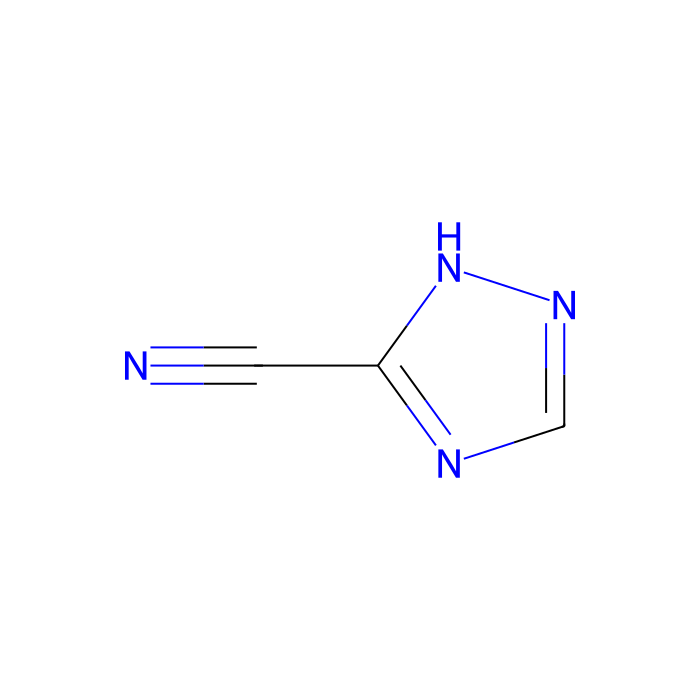
3-Cyano-1,2,4-triazole - ≥97% , CAS No.3641-10-9
Zu bestellen verfügbar
QUALITÄT & REINHEIT ≥97%
Storage
Room temperature
Shipped In
Normal

Taxonomy Tree
| Kingdom | Organic compounds |
|---|---|
| Superclass | Organoheterocyclic compounds |
| Klasse | Azoles |
| Subclass | Triazoles |
| Intermediate Tree Nodes | Not available |
| Direct Parent | Triazoles |
| Alternative Parents | Heteroaromatic compounds Nitriles Azacyclic compounds Hydrocarbon derivatives |
| Molecular Framework | Aromatic heteromonocyclic compounds |
| Substituents | Heteroaromatic compound - 1,2,4-triazole - Azacycle - Nitrile - Carbonitrile - Organic nitrogen compound - Cyanide - Hydrocarbon derivative - Organonitrogen compound - Aromatic heteromonocyclic compound |
| Beschreibung | This compound belongs to the class of organic compounds known as triazoles. These are compounds containing a five-member aromatic ring of two carbon atoms and three nitrogen atoms. |
| External Descriptors | Not available |
Find and download the COA for your product by matching the lot number on the packaging.
| Lot Number | Certificate Type | Datum | Artikel |
|---|---|---|---|
 F2605120 | Certificate of Analysis | Aug 01, 2025 | C193003 |
| F2608091 | Certificate of Analysis | Aug 01, 2025 | C193003 |
| H2519186 | Certificate of Analysis | Aug 01, 2025 | C193003 |
| H2519187 | Certificate of Analysis | Aug 01, 2025 | C193003 |
| H2519188 | Certificate of Analysis | Aug 01, 2025 | C193003 |
| H2519189 | Certificate of Analysis | Aug 01, 2025 | C193003 |
| G2228521 | Certificate of Analysis | May 12, 2025 | C193003 |
| G2228522 | Certificate of Analysis | May 12, 2025 | C193003 |
| G2228682 | Certificate of Analysis | May 12, 2025 | C193003 |
| I1817071 | Certificate of Analysis | Apr 07, 2024 | C193003 |
| Schmelzpunkt (°C) | 185°C-187°C |
|---|---|
| Molekulargewicht | 94.08 |
| XLogP3 | 0.000 |
| Hydrogen Bond Donor Count | 1 |
| Hydrogen Bond Acceptor Count | 3 |
| Rotatable Bond Count | 0 |
| Exact Mass | 94.0279 Da |
| Monoisotopic Mass | 94.0279 Da |
| Topological Polar Surface Area | 65.400 Ų |
| Heavy Atom Count | 7 |
| Formal Charge | 0 |
| Complexity | 101.000 |
| Isotope Atom Count | 0 |
| Defined Atom Stereocenter Count | 0 |
| Undefined Atom Stereocenter Count | 0 |
| Defined Bond Stereocenter Count | 0 |
| Undefined Bond Stereocenter Count | 0 |
| The total count of all stereochemical bonds | 0 |
| Covalently-Bonded Unit Count | 1 |
H301:Toxic if swallowed
H311:Toxic in contact with skin
H315:Causes skin irritation
H319:Causes serious eye irritation
H331:Toxic if inhaled
H335:May cause respiratory irritation
P261:Avoid breathing dust/fume/gas/mist/vapors/spray.
P264:Wash hands [and …] thoroughly after handling.
P270:Do not eat, drink or smoke when using this product.
P271:Use only outdoors or in a well-ventilated area.
P280:Wear protective gloves/protective clothing/eye protection/face protection.
P321:Specific treatment (see ... on this label).
P330:Rinse mouth.
P302+P352:IF ON SKIN: wash with plenty of water.
P304+P340:IF INHALED: Remove person to fresh air and keep comfortable for breathing.
P305+P351+P338:IF IN EYES: Rinse cautiously with water for several minutes. Remove contact lenses if present and easy to do - continue rinsing.
P361+P364:Take off immediately all contaminated clothing and wash it before reuse.
P362+P364:Take off contaminated clothing and wash it before reuse.
P405:Store locked up.
P403+P233:Store in a well-ventilated place. Keep container tightly closed.
P501:Dispose of contents/container to an approved waste disposal plant.
P264+P265:Wash hands [and …] thoroughly after handling. Do not touch eyes.
P301+P316:IF SWALLOWED: Get emergency medical help immediately.
P337+P317:If eye irritation persists: Get medical help.
P332+P317:If skin irritation occurs: Get medical help.
P316:Get emergency medical help immediately.
P319:Get medical help if you feel unwell.
No application protocols are specified for this item. As a heteroaromatic building block, usage will depend on the intended synthetic transformation.
General best practices (non-specific):
For any specialized application (e.g., tetrazole synthesis, amidoxime formation), consult primary literature and scale cautiously after bench-top optimization.
This listing is a chemical reagent for research use only. No biological activity testing is provided for this item.
General background (literature/context; not specific to this product):
Note: No claims of efficacy, potency, or therapeutic action are made. For biochemical screening or target-based studies, users should generate their own activity and ADME/T data.
Not typically applicable. 3-Cyano-1,2,4-triazole is a heteroaromatic building block rather than a buffering agent. It does not form a defined conjugate acid/base pair in the physiological pH range with well-characterized buffer capacity suitable for standard buffer systems.
Practical note:
Greener considerations focus on solvent and reagent choices because the substrate is fixed. Options (literature best practices):
Solvent selection:
Reagent choices:
Small comparison (illustrative; not product-specific):
Operational tips:
No pharmacopeial or excipient role is specified for this item; it is supplied for research use only.
General context (literature; not product-specific):
Compliance reminder:
Item-specific specifications (this product):
Literature/general physico-chemical data for 3-cyano-1,2,4-triazole (for context only; not product specifications):
Notes:
Item-specific grade/purity information: Not specified for this item; refer to CoA/Spec Sheet.
Guidance on grades (general information for professional chemists):
Recommendation: For air/moisture-sensitive sequences (e.g., strong base-mediated couplings), consider a quick dry under vacuum over P2O5 or in a desiccator before use; confirm no degradation by re-checking HPLC/NMR.
This heteroaromatic nitrile serves as a compact, electron-poor azole building block. Typical synthetic applications (literature/general) include:
N-Functionalization of the triazole:
Nitrile transformations at C-3 substituent:
Cross-coupling relevance:
Applications context:
Practical tips:
General conditions reported in the literature for functionalizing 1,2,4-triazole nitriles (guidance only; optimize per substrate):
N-alkylation/N-acylation of the triazole N–H:
Hydrolysis of the nitrile:
Amidoxime formation:
Tetrazole synthesis from nitrile:
Nitrile reduction:
Expected yields: Highly substrate- and setup-dependent; consult primary literature for the chosen transformation. Always confirm identity and purity (NMR, LC-MS, HRMS).
Item-specific hazard data:
General safety considerations for nitrile-bearing azoles (literature/practice; not product-specific):
Polarity and miscibility (general guidance for 3-cyano-1,2,4-triazole):
When to choose which solvent:
Comparison notes (literature):
Item-specific storage/shipping (from Product Data):
General handling and storage guidance for this class of compounds:
Disposal: Follow institutional and local regulations for disposal of organic nitrogen-containing compounds; avoid release to the environment.
Brief overview: 3-Cyano-1,2,4-triazole is a nitrile-substituted 1,2,4-triazole heteroaromatic used as a compact, nitrogen-rich building block for heterocycle elaboration and nitrile transformations.
Key functional groups and reactivity (literature/general):
Typical transformations using 3-cyano-1,2,4-triazole:
Retrosynthetic value:
Practical considerations:
Not applicable. This product is a small-molecule chemical reagent and not a biological targeting agent (e.g., antibody, enzyme inhibitor with defined target profiling in this catalog entry). No antigen, epitope, or species reactivity information is provided for this item.