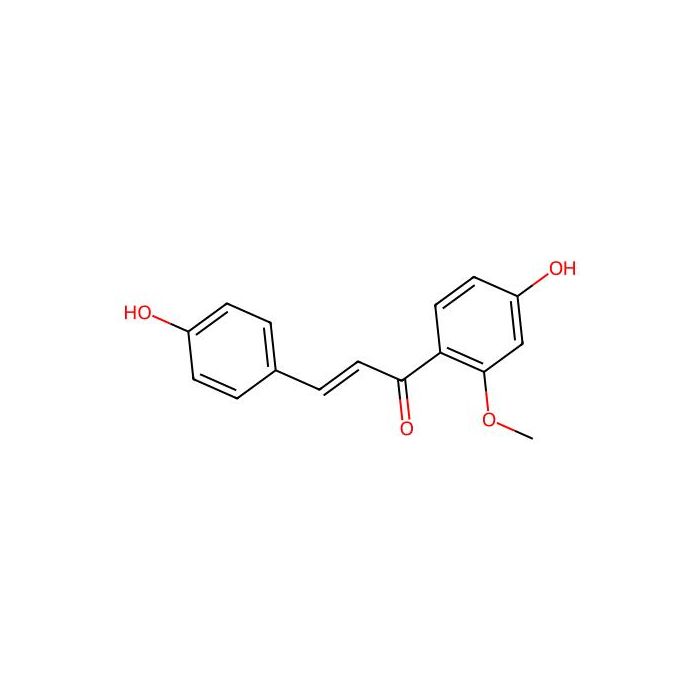
3-Deoxysappanchalcone is a naturally-occurring chalcone compound isolated from Caesalpinia sappan L. (Leguminosae), which possesses anti-allergic, antiviral, anti-inflammatory and antioxidant activities. 3-Deoxysappanchalcone exerts anti-inflammatory activity via induce heme oxygenase-1 (HO-1) expression by activating the AKT/mTOR pathway in murine macrophages. 3-Deoxysappanchalcone also exhibits anti-influenza virus activity (H3N2, IC 50 = 1.06 μM)
3-Deoxysappanchalcone is a naturally-occurring chalcone compound isolated from Caesalpinia sappan L. (Leguminosae), which possesses anti-allergic, antiviral , anti-inflammatory and antioxidant activities. 3-Deoxysappanchalcone exerts anti-inflammatory ac
Storage
Protected from light,Store at -80°C
Verschickt in
Dry ice packs + Cold packs
Dieses Produkt erfordert Kühlkettenversand. Grundversand und andere Economy-Optionen sind nicht verfügbar.
This compound belongs to the class of organic compounds known as cinnamylphenols. These are organic compounds containing the 1,3-diphenylpropene moiety with one benzene ring bearing one or more hydroxyl groups.
External Descriptors
Chalcones and dihydrochalcones
1. Djoumbou Feunang Y, Eisner R, Knox C, Chepelev L, Hastings J, Owen G, Fahy E, Steinbeck C, Subramanian S, Bolton E, Greiner R, and Wishart DS. ClassyFire: Automated Chemical Classification With A Comprehensive, Computable Taxonomy. Journal of Cheminformatics, 2016, 8:61.
Zertifikate (CoA, COO, BSE/TSE und Analyse-Diagramm)
C of A & Other Certificates(BSE/TSE, COO):
Analytical Chart:
Chemische und physikalische Eigenschaften
Löslichkeit
DMSO : 50 mg/mL (184.99 mM; Need ultrasonic)
Molekulargewicht
270.280 g/mol
XLogP3
3.000
Hydrogen Bond Donor Count
2
Hydrogen Bond Acceptor Count
4
Rotatable Bond Count
4
Exact Mass
270.089 Da
Monoisotopic Mass
270.089 Da
Topological Polar Surface Area
66.800 Ų
Heavy Atom Count
20
Formal Charge
0
Complexity
344.000
Isotope Atom Count
0
Defined Atom Stereocenter Count
0
Undefined Atom Stereocenter Count
0
Defined Bond Stereocenter Count
1
Undefined Bond Stereocenter Count
0
The total count of all stereochemical bonds
1
Covalently-Bonded Unit Count
1
Lösungsrechner
Molarity Calculator
Determine the necessary mass, volume, or concentration for preparing a solution.
Dilution Calculator
Determine the dilution needed to prepare a stock solution.
Reconstitution Calculator
Bewertungen
Kundenbewertungen
Application Protocols
No validated application protocols are provided in the Product Data.
Item-specific protocols: Not specified for this item; refer to CoA/Spec Sheet and SDS for handling.
General guidance (for small-molecule stock preparation; not item specifications):
Prepare concentrated stocks in dry DMSO (e.g., millimolar range appropriate to your assay) using amber vials; vortex and sonicate if needed.
Filter solutions through 0.22 μm PTFE if particulate is present. Record exact solvent lot and concentration for reproducibility.
For biological assays, dilute into buffer immediately before use to minimize precipitation; maintain final organic solvent within system tolerance.
All procedures should be validated and optimized in your laboratory setting.
Biological Roles
Context (general literature; no medical claims):
3-Deoxysappanchalcone belongs to the chalcone family, which are biosynthetic precursors in the flavonoid pathway in plants, formed via chalcone synthase from p-coumaroyl-CoA and malonyl-CoA derivatives.
Such compounds often function as secondary metabolites involved in plant defense and pigmentation, and can act as intermediates toward diverse flavonoids (e.g., flavanones, isoflavonoids) via enzymatic cyclizations.
Relevance in research (general):
Used as a reference standard in phytochemical investigations to characterize extracts (e.g., Caesalpinia spp.) and in metabolomics workflows due to distinctive UV and MS fingerprints.
The conjugated enone motif is of interest in chemical biology for studying covalent interactions with nucleophiles in biomolecules under defined conditions; selectivity and off-target effects must be rigorously controlled.
ADME/stability considerations (general):
Chalcones typically show limited aqueous solubility and can bind to serum proteins; solution stability may be influenced by pH, light, and oxidative environment.
Metabolic soft spots often include reduction of the enone, conjugation (e.g., glucuronidation/sulfation of phenolic OH groups if present), and oxidative metabolism on the aromatic rings.
Notes specific to this item:
No item-specific bioactivity, targets, or ADME data are provided in the Product Data. Use strictly for research purposes; consult primary literature for mechanistic hypotheses and validate in your system.
Buffer Applications
This compound is a hydrophobic small molecule and is not itself a buffering agent. It is typically dissolved in an organic co-solvent prior to dilution into aqueous buffers for assays.
Item-specific buffer details: Not specified for this item; refer to CoA/Spec Sheet.
Practical guidance (general):
Prepare concentrated stocks in DMSO or ethanol; add to pre-warmed buffer under vigorous mixing to prevent precipitation. Keep final organic content within the tolerance of your biological or analytical system.
Common assay buffers (e.g., PBS, HEPES, Tris) can be used when compatible with the experimental design; avoid strong bases if undesired Michael addition could occur.
Use low-binding plastics or silanized glass vials to minimize adsorption of hydrophobic analytes.
Green Alternatives
While 3-Deoxysappanchalcone is a target compound rather than a solvent or reagent used in bulk, greener choices usually concern its handling solvents and transformation conditions.
Solvent choices (general guidance):
Prefer greener solvents where feasible: ethanol, isopropanol, ethyl acetate, and water–co-solvent systems can often replace chlorinated or high-toxicity solvents.
For high-solubility stocks, DMSO remains common; consider Cyrene (dihydrolevoglucosenone) or propylene carbonate when compatible.
Process considerations:
Photostability: minimize light exposure to avoid photochemical waste and rework.
Catalysis: use catalytic rather than stoichiometric reagents for cyclizations or reductions (e.g., transfer hydrogenation vs metal hydrides), provided the substrate tolerates conditions.
Example comparison (general; not item specifications):
Greener option vs conventional
Ethanol or 2-propanol vs DMF/DMF-rich mixtures: lower toxicity/biopersistence; may require modest heating to achieve comparable solubility.
Ethyl acetate vs dichloromethane for extractions: reduced halogenated waste; partition efficiency may differ due to polarity.
Water–ethanol co-solvent vs acetonitrile in prep-HPLC: works for some gradients with UV detection, though ACN provides lower viscosity and often better peak shape.
Tradeoffs:
Solubility of chalcones can limit the use of greener, less polar solvents; co-solvents or biphasic systems may be necessary.
Some green solvents absorb strongly in UV, impacting analytical detection—validate for each method.
Pharmaceutical Uses
Item-specific pharmacopeial status or excipient role: Not specified for this item; refer to CoA/Spec Sheet.
General context (non-clinical, research only):
Chalcones like 3-Deoxysappanchalcone may serve as reference standards for analytical method development, impurity profiling, and stability-indicating assays in natural product-derived ingredient workflows.
In formulation research, they are sometimes evaluated in preclinical discovery as prototype scaffolds; however, no clinical or therapeutic claims are made here, and this product is for research use only.
Practical considerations (general):
Low aqueous solubility often necessitates enabling formulations (e.g., cyclodextrin inclusion, lipid-based systems, or co-solvent strategies) for in vitro experiments; validate compatibility and stability.
Photostability and oxidative sensitivity should be assessed during forced-degradation studies to build robust analytical methods (HPLC/LC-MS with photodiode array detection is typical).
Physical Properties
Item-specific physicochemical specifications were not provided.
Item-specific values:
Appearance: Not specified for this item; refer to CoA/Spec Sheet.
Molecular weight: Not specified for this item; refer to CoA/Spec Sheet.
Molecular formula: Not specified for this item; refer to CoA/Spec Sheet.
Melting point, boiling point, density, refractive index, UV cutoff, water content, residual solvent: Not specified for this item; refer to CoA/Spec Sheet.
General/literature expectations for chalcones (context, not item specifications):
Physical state: typically yellow to orange solids owing to extended conjugation of the enone system.
Solubility profile: sparingly soluble in water; soluble in polar aprotic organics (DMSO, DMF) and moderately in ethanol/methanol; solubility improves with gentle warming or co-solvent use.
UV-Vis: strong π→π* absorption band in the 320–380 nm region is common for chalcone chromophores; exact λmax depends on substitution.
LogP: chalcones often exhibit moderate lipophilicity; actual value depends strongly on ring substituents.
Practical notes (general):
For solution preparation, dry, anhydrous solvents are recommended when the compound will be used in moisture-sensitive transformations.
Filter sterilization or use of amber vials is advised to minimize photodegradation of conjugated systems. Always verify solubility and stability with a small-scale pre-test.
Quality and Grades
Item-specific quality details:
Grade/purity: Not specified for this item; refer to CoA/Spec Sheet.
Stabilizers/inhibitors: Not specified for this item; refer to CoA/Spec Sheet.
Interpreting common grades (general guidance):
Research or screening grade: suitable for discovery workflows; purity typically confirmed by HPLC/LC-MS, but exact thresholds vary by supplier.
Analytical/Reference standard grade: includes certified purity, detailed chromatographic profiles, and often quantitative NMR; intended for method development and QC.
HPLC/LC-MS grade materials prioritize low non-volatile residue and low UV background when used as analytes or system suitability standards.
Purity confirmation considerations for chalcones (general):
Orthogonal analyses recommended: HPLC with diode-array detection (monitor at enone λmax), LC-MS for mass confirmation, and 1H/13C NMR for structural integrity (diagnostic α,β-unsaturated carbonyl signals and aromatic patterns).
Impurity vigilance: potential isomerization (E/Z around the C=C), oxidative dimers, or residual synthetic intermediates from Claisen–Schmidt condensation.
What is specific to this item:
In the absence of published grade/purity and stabilizer information in the Product Data, please refer to the CoA/Spec Sheet for acceptance criteria, chromatographic purity, water content, and any stabilizer/additive disclosures.
Reaction and Applications
Manufacturer applications (verbatim): Not provided in Product Data.
General research uses for chalcones and related analogs (context, not item-specific claims):
Chemical biology probes: chalcones’ Michael acceptor can react with nucleophilic residues in peptides/proteins under certain conditions, enabling mechanistic studies; such uses require careful control to avoid nonspecific reactions.
Analytical standards: employed as reference compounds for phytochemical profiling (HPLC/LC-MS quantitation) and method development due to their characteristic UV-Vis signatures.
Cyclizations: base- or acid-promoted cyclization to flavanones and aurones; oxidative cyclizations to flavones.
1,3-Dipolar cycloadditions: with nitrile oxides to isoxazolines; with azomethine ylides to pyrrolidines.
Michael additions: nucleophile addition at β-carbon (thiols, amines, malonates) followed by further elaboration.
Hydrogenation: selective reduction to dihydrochalcones or full saturation of the enone.
Heterocycle construction: formation of pyrazolines with hydrazines and oximes/oxazoles with hydroxylamine derivatives.
Practical tips (general):
Maintain anhydrous conditions for base-mediated cyclizations; monitor E/Z isomerization under light or heat.
Use inert atmosphere for oxygen-sensitive transformations; employ UV shielding to stabilize the enone during long reactions.
Characterize stereoisomeric purity of the C=C bond where relevant (E is typically favored in chalcones).
Reaction Conditions
No item-specific reaction condition data are provided in the Product Data. The following are general literature guidelines for chalcone transformations; adjust to your substrate and verify experimentally.
Cyclization to flavanones/aurones (general):
Base-catalyzed (e.g., K2CO3, NaOMe) in ethanol or DMF at 25–80 °C; or acid-catalyzed using protic acids in alcohols. Reaction times from 1–24 h depending on substitution. Monitor by TLC/HPLC at enone λmax.
Oxidative cyclizations to flavones: I2/DMSO, DDQ, or catalytic oxidative systems under O2; temperatures 25–100 °C.
1,3-Dipolar cycloadditions:
With nitrile oxides generated in situ (from oximes and oxidants) in toluene, MeCN, or EtOAc at 25–80 °C; typically 2–12 h.
With hydrazines to pyrazolines in ethanol or MeOH under reflux; 2–6 h.
Conjugate additions:
Soft nucleophiles (e.g., thiols, malonates) with base (Et3N, DBU) in MeCN, THF, or DMF at 0–40 °C; 1–8 h. Stereochemical outcomes depend on conditions.
Reductions:
Catalytic hydrogenation (Pd/C, H2 1–3 bar) in EtOH/EtOAc at 20–40 °C for 1–6 h affords dihydrochalcones; over-reduction can be minimized by lower pressure/time.
Analytical monitoring:
HPLC-DAD (monitor 320–380 nm typical for chalcones), LC-MS for mass balance, and 1H NMR to confirm disappearance of β-H vinylic signal.
All conditions are general literature guidance; they are not specifications for this item.
Safety and Handling
Item-specific hazard data:
GHS classification: Not specified for this item; refer to SDS.
Signal word / H-statements / Pictograms: Not specified for this item; refer to SDS.
General handling guidance for chalcone-type small molecules (professional practice; defer to SDS for authoritative instructions):
PPE: use lab coat, safety glasses, and appropriate chemically resistant gloves (e.g., nitrile). Handle powders in a fume hood to avoid dust inhalation.
Incompatibilities: strong oxidizers; strong bases/acids may induce degradation (e.g., retro-aldol, Michael addition side reactions). Avoid prolonged exposure to light and heat—conjugated enones can photoisomerize.
Hygiene: avoid ingestion/inhalation and skin/eye contact. Wash thoroughly after handling. Do not pipette by mouth.
First aid (overview): in case of skin or eye contact, rinse with water for at least 15 minutes; remove contaminated clothing. If inhaled, move to fresh air. If ingested, rinse mouth and seek medical attention. Always consult the SDS for procedure details.
Waste: dispose according to institutional and local regulations for organic chemical waste; segregate halogenated from non-halogenated streams if applicable.
Special risks/notes:
Many chalcones are polyphenolic and can undergo slow oxidation; minimize headspace oxygen for long-term solutions, and store under inert atmosphere when feasible.
Photolabile: keep in amber containers or wrap vessels in foil to limit light exposure.
Solvent Selection
3-Deoxysappanchalcone is a conjugated chalcone expected to be sparingly soluble in water and more soluble in polar organic solvents.
Item-specific solvent data: Not specified for this item; refer to CoA/Spec Sheet.
General/literature guidance for chalcones:
Polarity class: moderately lipophilic neutral compound with H-bond donor/acceptor sites depending on substitution pattern; behaves as an organic small molecule chromophore.
Preferred solvents for stock solutions: DMSO (highly effective), DMF, ethanol, methanol, acetonitrile. For aqueous assays, pre-dissolve in DMSO, then dilute into buffer keeping final DMSO ≤0.1–1% v/v as your system permits.
Miscibility/handling: avoid highly basic aqueous media unless intentionally performing reactions; the enone motif can undergo base-catalyzed addition.
Practical comparisons (general):
DMSO vs ethanol: DMSO typically provides higher solubility and stability for polyphenolics; ethanol offers easier removal but may have lower capacity.
Acetonitrile vs methanol: acetonitrile offers lower proticity (beneficial for some assays); methanol can aid dissolution of polar phenolic groups but may participate in transesterification if esters are present.
Tips:
Warm gently (≤40 °C) with sonication to aid dissolution; avoid extended heating or bright light.
Use amber glassware to limit photodegradation of the chromophore.
Storage and Reconstitution
Storage (item-specific, from Product Data):
Store at −80 °C.
Protect from light.
Shipping (item-specific, from Product Data):
Shipped with dry ice packs + cold packs to maintain low temperature during transit.
Additional item-specific details:
Appearance: Not specified for this item; refer to CoA/Spec Sheet.
Reconstitution solvent/concentration, aliquoting guidance, freeze–thaw tolerance: Not specified for this item; refer to CoA/Spec Sheet.
General best practices (supplementary guidance):
Allow the container to equilibrate to room temperature in a desiccator before opening to avoid moisture condensation.
If preparing solutions, use anhydrous, oxygen-poor, and light-protected conditions; dispense into small amber aliquots to minimize freeze–thaw cycles.
Clearly label aliquots with concentration, solvent, and preparation date; store frozen and protected from light.
Always consult the product’s CoA and SDS for authoritative storage and handling instructions.
Structure and Identity
3-Deoxysappanchalcone is a plant-derived chalcone (open-chain flavonoid) featuring an α,β-unsaturated ketone conjugated to two aromatic rings.
Item-specific identifiers (from Product Data):
CAS: 112408-67-0
PubChem CID: 5319688
InChIKey: 272064 (as provided)
SMILES: Not specified for this item; refer to CoA/Spec Sheet.
Molecular formula: Not specified for this item; refer to CoA/Spec Sheet.
Molecular weight: Not specified for this item; refer to CoA/Spec Sheet.
Structural class and features (general/literature):
Class: Chalcone (1,3-diphenyl-2-propen-1-one scaffold) lacking a 3-hydroxyl group relative to sappanchalcone (hence “3-deoxy”).
Key functional group: α,β-unsaturated carbonyl (enone), acting as a soft Michael acceptor.
Typical aromatic substitution: polyphenolic substitution patterns on one or both rings (exact positions depend on the specific chalcone variant).
2D description: two phenyl rings (A- and B-rings) linked via a three-carbon enone bridge (–CO–CH=CH–), planar conjugation across aryl–enone–aryl.
Notes for identity verification (general guidance):
Orthogonal confirmation commonly uses HRMS, 1H/13C NMR (diagnostic β-H and carbonyl signals for chalcones), and UV-Vis (enone π→π* band). Consult the CoA/SDS for item-specific identifiers and analytical acceptance criteria.
Synthetic Utility
As an electron-poor alkene conjugated to a ketone, 3-Deoxysappanchalcone offers multiple points of diversification and is a versatile building block in small-molecule synthesis.
Transformations (general/literature):
Michael acceptor chemistry: conjugate addition of soft nucleophiles (thiols, malonates, enamines) enabling β-functionalization followed by oxidation or cyclization.
Annulations and cyclizations: conversion to flavanones, flavones, and aurones under base, acid, or oxidative conditions; intramolecular oxa–Michael or aldol-type closures when ortho-substituents are present.
1,3-Dipolar cycloadditions: formation of isoxazolines/isoxazoles (via nitrile oxides/hydroxylamine derivatives) and pyrazolines (via hydrazines), frequently used to create heterocycle libraries.
Reductive chemistry: selective hydrogenation of the C=C affords dihydrochalcones; chemoselectivity can be tuned with catalysts/conditions.
Strategic utility:
The chalcone scaffold serves as a convergence point for late-stage diversification—aromatic substitution can be retained while the enone is transformed, or vice versa.
UV-activity facilitates inline or atline monitoring by HPLC-DAD, aiding high-throughput parallel synthesis.
Practical notes:
Control E/Z isomerization under light/heat; verify geometry by NMR (β-H coupling constants) or chiroptical methods if asymmetry is introduced.
Protect phenolic OH groups when required to direct regioselectivity or to prevent side reactions during strong base or electrophile exposure.
Target Specificity
No target, epitope, or biological specificity data are provided for this small-molecule product.
Item-specific target information: Not applicable/not specified for this item; refer to literature if using as a research probe.
Note: As a chemical entity rather than an antibody or ligand with defined binding epitopes, any “specificity” arises from context-dependent interactions determined experimentally. Rigorous controls and orthogonal assays are recommended to evaluate selectivity.
Häufig gestellte Fragen
What is the purity of this product?
This product is supplied at ≥99% purity (chemical assay). Lot-specific values are stated on the Certificate of Analysis.
How should this product be stored?
Store at ?80 °C, protected from light. The material is light-sensitive — keep it in its original opaque or amber container.
How is this product shipped?
This product ships frozen with dry ice and cold packs. Unpack on arrival and transfer it to the storage condition stated above; handle dry ice with insulated gloves in a ventilated area.
What are the CAS number, molecular formula and molecular weight?
The CAS Number is 112408-67-0, the molecular formula is C16H14O4, and the molecular weight is 270.28 g/mol. InChIKey PACBGANPVNHGNP-RUDMXATFSA-N.
What documentation is provided?
Available product documentation, including Certificates of Analysis (COA), Safety Data Sheets (SDS), and specification sheets, is shown in the product document area. Document availability and access follow the current site policy.
Wir verwenden Cookies, um die ordnungsgemäße Funktion der Website sicherzustellen und, soweit zulässig, Ihr Nutzererlebnis zu verbessern. Sie können Ihre Einstellungen jederzeit unter „Einstellungen“ verwalten. Weitere Informationen finden Sie in unserer Cookie-Richtlinie.
Dürfen wir Sie über Rabattaktionen informieren?
Später erinnern
Vielen Dank! Bitte überprüfen Sie Ihren E-Mail-Posteingang, um zu bestätigen.
Products are supplied to verified businesses, institutions, and qualified professionals for research and development use only. Not for use in humans, animals, diagnosis, or therapy.