Determine the necessary mass, volume, or concentration for preparing a solution.
≥97% for sensitive chromatographic and analytical workflows requiring minimal baseline interference.
Room temperature,Argon charged Ships Normal Check lot-specific COA for exact specifications.
SDS, COA, datasheet, and spec sheet available for download. Lot-specific COA accessible via lot number lookup.
Cited in 0 peer-reviewed publications across chromatography, organic synthesis, and cross-coupling reactions.
Application
Building block used in a recent synthesis of a fluoroquinolone antibiotic.
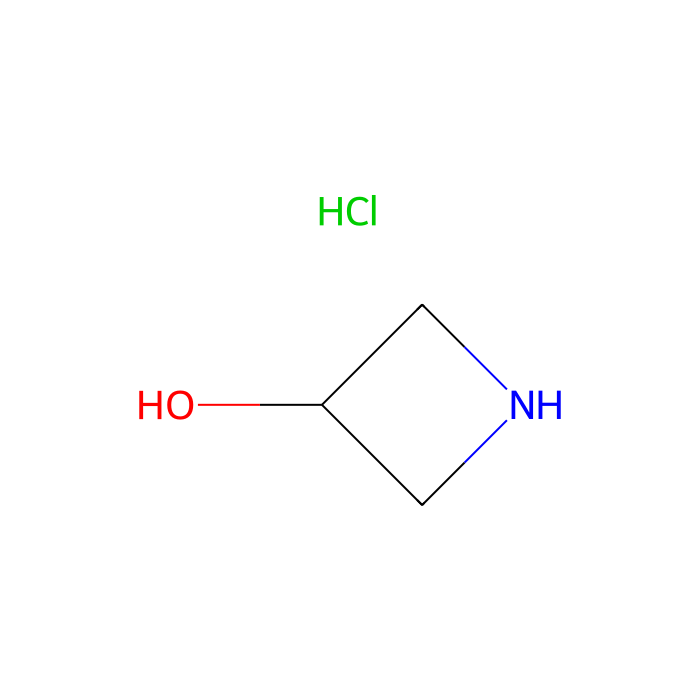
3-Hydroxyazetidine hydrochloride is an building block used in a recent synthesis of a fluoroquinolone antibiotic and a useful intermediate in the synthesis of polypeptides.
Comprehensive hazard, handling, storage, and regulatory compliance document.
Download SDS →Lot-specific quality data. Enter your lot number to retrieve the exact COA.
Look up COA →Full quality attributes and acceptance criteria for this grade.
View spec sheet →Taxonomy Tree
| Kingdom | Organic compounds |
|---|---|
| Superclass | Organoheterocyclic compounds |
| Klasse | Azetidines |
| Subclass | Not available |
| Intermediate Tree Nodes | Not available |
| Direct Parent | Azetidines |
| Alternative Parents | Secondary alcohols 1,2-aminoalcohols Dialkylamines Azacyclic compounds Organopnictogen compounds Hydrochlorides Hydrocarbon derivatives |
| Molecular Framework | Aliphatic heteromonocyclic compounds |
| Substituents | 1,2-aminoalcohol - Azetidine - Secondary alcohol - Azacycle - Secondary amine - Secondary aliphatic amine - Hydrocarbon derivative - Hydrochloride - Organooxygen compound - Organonitrogen compound - Alcohol - Amine - Organopnictogen compound - Organic oxygen compound - Organic nitrogen compound - Aliphatic heteromonocyclic compound |
| Beschreibung | This compound belongs to the class of organic compounds known as azetidines. These are organic compounds containing a saturated four-member heterocycle where one nitrogen atom replaces a carbon atom. |
| External Descriptors | Not available |
Find and download the COA for your product by matching the lot number on the packaging.
| Lot Number | Certificate Type | Datum | Artikel |
|---|---|---|---|
| Certificate of Analysis | Sep 28, 2025 | H102085 | |
| Certificate of Analysis | Sep 28, 2025 | H102085 | |
| Certificate of Analysis | Sep 28, 2025 | H102085 | |
| Certificate of Analysis | Sep 28, 2025 | H102085 | |
| Certificate of Analysis | Sep 28, 2025 | H102085 | |
| Certificate of Analysis | Jun 14, 2024 | H102085 | |
| Certificate of Analysis | Jun 14, 2024 | H102085 | |
| Certificate of Analysis | Jun 14, 2024 | H102085 | |
| Certificate of Analysis | Jun 14, 2024 | H102085 | |
| Certificate of Analysis | Mar 18, 2023 | H102085 | |
| Certificate of Analysis | Mar 18, 2023 | H102085 | |
| Certificate of Analysis | Mar 18, 2023 | H102085 | |
| Certificate of Analysis | Mar 18, 2023 | H102085 | |
| Certificate of Analysis | Mar 18, 2023 | H102085 | |
| Certificate of Analysis | Mar 18, 2023 | H102085 | |
| Certificate of Analysis | Mar 18, 2023 | H102085 | |
| Certificate of Analysis | Mar 18, 2023 | H102085 | |
| Certificate of Analysis | Mar 18, 2023 | H102085 | |
| Certificate of Analysis | Mar 18, 2023 | H102085 | |
| Certificate of Analysis | Mar 31, 2022 | H102085 | |
| Certificate of Analysis | Mar 31, 2022 | H102085 |
| Löslichkeit | Soluble in water, DMSO, methanol. |
|---|---|
| Empfindlichkeit | Hygroscopic |
| Schmelzpunkt (°C) | 85-90°C |
| Molekulargewicht | 109.550 g/mol |
| XLogP3 | |
| Hydrogen Bond Donor Count | 3 |
| Hydrogen Bond Acceptor Count | 2 |
| Rotatable Bond Count | 0 |
| Exact Mass | 109.029 Da |
| Monoisotopic Mass | 109.029 Da |
| Topological Polar Surface Area | 32.299 Ų |
| Heavy Atom Count | 6 |
| Formal Charge | 0 |
| Complexity | 33.900 |
| Isotope Atom Count | 0 |
| Defined Atom Stereocenter Count | 0 |
| Undefined Atom Stereocenter Count | 0 |
| Defined Bond Stereocenter Count | 0 |
| Undefined Bond Stereocenter Count | 0 |
| The total count of all stereochemical bonds | 0 |
| Covalently-Bonded Unit Count | 2 |