Determine the necessary mass, volume, or concentration for preparing a solution.
Dilution Calculator
Determine the dilution needed to prepare a stock solution.
Reconstitution Calculator
Bewertungen
Kundenbewertungen
Application Protocols
Below are general, literature-based example workflows using fluorinated glucose analogues; adapt to your system. No item-specific validated protocols are provided.
Preparation of aqueous stock solutions for biochemical assays
Dissolve 4-deoxy-4-fluoro-D-glucose in sterile water or assay buffer to 100–500 mM. Gentle warming (≤37°C) and vortex/sonication aid dissolution.
Filter-sterilize (0.22 µm) if used in cell-based assays. Aliquot and store at −20°C protected from light.
19F NMR binding/uptake assay (cell-free or cell lysate)
Buffer: 50 mM HEPES, 150 mM NaCl, pH 7.4 (example). Add 1–5 mM compound and protein/lysate of interest.
Acquire 19F NMR spectra (e.g., 470 MHz for 19F on an 11.7 T spectrometer). Monitor chemical shift changes or line broadening upon protein addition. Include reference (CF3CO2H external or internal 19F standard).
HPLC method development (analytical reference)
Column: Amino column or HILIC for carbohydrates.
Mobile phase: ACN/H2O mixtures (e.g., 75:25 to 60:40) with 0.1% formic acid if MS-coupled.
Detection: ELSD, CAD, or MS; UV is generally weak for carbohydrates.
Note: Verify concentration-dependent effects on biological systems (osmolarity), and include D-glucose controls for comparative studies. All uses are for research only.
Biological Roles
Functional context (literature-general): 4-deoxy-4-fluoro-D-glucose is a non-natural analogue of D-glucose designed to probe the role of the C4 hydroxyl in transport and metabolism. The C4–F substitution removes hydrogen-bond donation at C4 while introducing a stereoelectronically distinctive C–F bond.
Transport: Uptake by facilitative glucose transporters (GLUTs) may occur to varying degrees depending on isoform, since binding pockets often sense hydroxyl orientation at C2–C4. Comparative assays with D-glucose are recommended to quantify isoform-dependent transport.
Enzymatic processing: Hexokinase acts at C6; thus initial phosphorylation may be possible in principle, but subsequent steps in glycolysis and isomerization/epimerization that depend on the C4 hydroxyl can be perturbed. The analogue can therefore act as a mechanistic probe in pathways sensitive to C4 functionality (literature-general). Specific enzyme rates must be determined empirically for your system.
Biophysical utility: The 19F nucleus provides a sensitive, background-free NMR handle to monitor binding, transport, or compartmentation without radioactivity. Chemical shift and relaxation behavior can report on environment (literature-general).
Cell/organism compatibility: As with many sugar analogues, osmolarity and potential metabolic interference should be considered. Titrate concentrations to minimize non-specific effects and confirm lack of cytotoxicity under assay conditions (research use only).
Buffer Applications
This compound is not a buffering agent and does not form defined buffer systems. It is typically dissolved in existing buffers for biochemical assays.
Practical guidance (literature-general):
Prepare stock solutions in water or assay buffer (e.g., PBS, HEPES, Tris) at appropriate ionic strength. Verify pH after addition if using concentrated stocks.
Filter-sterilize (0.22 µm) for cell-based assays; avoid microbial growth by preparing fresh or storing aliquots frozen.
Avoid strongly basic buffers that can promote carbohydrate degradation over time.
For detailed buffer recipes, refer to standard buffering agents (HEPES pH 6.8–8.2, MOPS pH 6.5–7.9, acetate pH 3.6–5.6).
Green Alternatives
This product is a solid research reagent (not a process solvent), so green-solvent substitution is generally not applicable. Nevertheless, greener choices can be made for solvents and reagents used with this compound in synthesis and handling.
Preferred media (literature-general):
Aqueous buffers are inherently greener for biochemical work.
When organic solvent is required for dissolution, choose lower-toxicity alcohols (EtOH) over chlorinated solvents.
Synthetic workflows (literature-general):
Use 2-MeTHF or CPME instead of THF/Et2O for extractions of protected derivatives.
Choose greener acylation reagents (isobutyl chloroformate alternatives, or enzyme-catalyzed acylations) where feasible.
Comparison (general):
Water vs DMSO: Water minimizes worker exposure and waste hazards; DMSO offers higher solubility but can increase persistence in waste streams.
EtOH vs MeOH: Ethanol is generally preferred on toxicity grounds when method performance allows.
Note: Selection of greener options must be balanced with experimental requirements (enzyme compatibility, solubility, and selectivity).
Pharmaceutical Uses
This product is supplied for research use only. It is not an approved excipient or active ingredient.
Formulation role: Not typically used in pharmaceutical formulations. Fluorinated glucose analogues are mainly research tools for studying transport/metabolism and for analytical method development (literature-general).
Regulatory status: No pharmacopeial monograph is known for 4-deoxy-4-fluoro-D-glucose (literature-general). Any consideration for use beyond research would require full characterization and regulatory assessment.
Process development notes (research/manufacturing labs): If used as an analytical reference or process intermediate, ensure traceability, validated analytical methods (HPLC/GC where applicable, NMR including 19F), and controlled storage (-20°C, protected from light per Product Data).
Physical Properties
Item-specific physicochemical specifications are not provided for this product.
Appearance: Not specified for this item; refer to CoA/Spec Sheet.
Melting point: Not specified for this item; refer to CoA/Spec Sheet. (Fluorinated glucose analogues typically exhibit high melting points and may decompose upon heating; literature-general.)
Boiling point: Not applicable (decomposes before boiling; literature-general for carbohydrates).
Density: Not specified for this item; refer to CoA/Spec Sheet.
Solubility: Not specified for this item; refer to CoA/Spec Sheet. (Carbohydrates are generally highly soluble in water and polar protic solvents such as methanol; poorly soluble in nonpolar solvents; literature-general.)
LogP: Not specified for this item; refer to CoA/Spec Sheet. (Expected very low logP given multiple hydroxyls; literature-general.)
pKa: Not applicable (no acidic/basic centers in typical aqueous range; multiple alcohols have very high pKa ~14–16; literature-general).
Refractive index: Not specified for this item; refer to CoA/Spec Sheet.
Optical rotation: Not specified for this item; refer to CoA/Spec Sheet. (Carbohydrates exhibit characteristic rotations dependent on solvent, temperature, and anomeric ratio; literature-general.)
Note: Where numerical values are needed for method development or QC, please consult the product’s CoA/Spec Sheet or measure under your exact conditions.
Quality and Grades
Grade/Purity: Not specified for this item; refer to CoA/Spec Sheet.
Interpreting grades (general guidance):
Research or biochemical grade typically targets high chemical purity and low residual solvents for reproducible biological and enzymological assays.
HPLC grade (if applicable) emphasizes low UV-absorbing impurities and suitability as a reference/standard in chromatographic methods.
Anhydrous or low-water specifications (if provided) are relevant to moisture-sensitive derivatizations during carbohydrate protection/glycosylation chemistry.
Impurity considerations (general):
Potential isomeric/byproduct impurities in fluorinated sugars may include positional isomers, anomeric mixtures, and partially protected residues from synthesis. These can alter enzymatic assay outcomes; confirm by NMR (1H, 13C, 19F) and HPLC.
Residual inorganic fluoride or salts can affect ion-exchange or enzyme assays; check inorganic content if critical.
Documentation: For lot-specific purity, water content, anomeric ratio, residual solvents, and analytical methods, consult the Certificate of Analysis. If an application requires a particular anomer ratio or form (α/β, pyranose vs furanose), verify on receipt by NMR in D2O.
Reaction and Applications
This fluorinated glucose analogue is primarily used as a chemical biology probe and synthetic building block.
Probe of carbohydrate-processing enzyme specificity where C4 substitution is mechanistically relevant (e.g., epimerases or hydrolases sensitive to the C4 substituent).
Transport studies for GLUT family carriers to compare uptake kinetics of glucose vs C4-modified analogues; 19F NMR provides an orthogonal readout without radioactivity.
Reference compound for developing analytics (HPLC, MS, 19F/1H NMR) in fluorosugar workflows.
Synthetic applications (literature-general):
Precursor to protected glycosyl donors/acceptors bearing a C4–F substituent, enabling exploration of stereoelectronic effects (gauche effect) on glycosylation outcomes.
Utilized to prepare 4-fluoro-glycoconjugates (glycosides, glycans) for SAR in lectin binding or enzyme inhibition studies.
Compatible with standard carbohydrate transformations after appropriate protection (acylation, silylation, benzylation) of remaining hydroxyls.
Practical tips:
Verify anomeric ratio by NMR in your solvent system; kinetics in enzymes and chromatographic behavior can depend on α/β distribution.
For enzymology, prepare fresh aqueous stocks, filter-sterilize (0.22 µm) if required, and control ionic strength. Avoid phosphate if the assay involves phosphorylation steps sensitive to Pi.
For synthesis, consider starting from per-O-acetylated derivatives to improve solubility in organic media, then perform selective deprotection/glycosylation.
Reaction Conditions
Representative, literature-general conditions for common manipulations of fluorinated sugars (not item-specific specifications):
Per-O-acetylation: Dissolve substrate in dry pyridine, cool to 0–5°C, add Ac2O (3–5 eq per OH). Stir 1–3 h at 0–25°C. Quench with MeOH/ice, work up with aqueous NaHCO3 and extract with EtOAc. Typical isolated yields: 80–95% for peracetates.
Silylation: TBDMSCl (1.2–1.5 eq per OH), imidazole (2–3 eq) in dry DMF, 0–25°C, 2–16 h. Protects selectively or globally depending on stoichiometry. Yields often 70–90%.
Formation of trichloroacetimidate donors: From anomeric hemiacetal (after peracetylation then Zemplén deprotection at anomeric OH if needed), react with CCl3CN (1.2–1.5 eq) and DBU or K2CO3 in dry CH2Cl2 at 0°C to rt for 1–3 h. Use immediately or store cold.
Thioglycoside formation: React peracetylated sugar with thiol (e.g., EtSH or p-tolylthiol) and Lewis acid (BF3·Et2O) in CH2Cl2 at −20 to 0°C; typical yields 60–85%.
Glycosylation: Donor (imidate/thioglycoside) activated with TMSOTf or NIS/TfOH in dry CH2Cl2 or toluene at −78 to −20°C. Acceptors with free OH; monitor by TLC/HPLC. Work under rigorously anhydrous conditions.
Deprotections:
Zemplén transesterification: NaOMe in MeOH (cat.), 0–25°C, minutes to hours.
Hydrogenolysis of benzyl groups: H2 (1–3 atm), Pd/C, MeOH/H2O, rt to 40°C.
Note: Reaction performance can be influenced by the C4–F substituent. Optimize conditions empirically, monitoring by 19F NMR as complementary analytics.
Safety and Handling
GHS classification, signal word, and pictograms: Not specified for this item; refer to SDS for authoritative safety data.
Likely hazards (general for carbohydrate analogues): Low acute toxicity is typical for neutral sugars; however, fluorinated analogues should be handled as laboratory chemicals that may cause irritation to eyes, skin, or respiratory tract (literature-general). Avoid ingestion and inhalation of dust.
Protective equipment: Use lab coat, safety glasses, and appropriate gloves (e.g., nitrile). Handle powders in a fume hood or on a balance enclosure to minimize dust exposure.
Storage incompatibilities: Avoid strong oxidizers and strong acids/bases that may induce degradation (e.g., dehydration or cleavage). Keep dry and protected from moisture when stored as a solid.
Thermal/photostability: Product Data indicates protection from light; minimize light exposure to avoid potential slow degradation or isomerization. Avoid elevated temperatures.
First aid (general):
Inhalation: Move to fresh air; seek medical attention if symptoms persist.
Skin contact: Wash with soap and water; remove contaminated clothing.
Eye contact: Rinse cautiously with water for several minutes; remove contact lenses if present and easy to do.
Ingestion: Rinse mouth; seek medical advice.
Waste disposal: Collect and dispose in accordance with institutional and local regulations for non-halogenated organic solids; do not discharge to drains.
Always consult the product SDS for definitive guidance.
Solvent Selection
As a highly polar, polyhydroxylated small molecule, 4-deoxy-4-fluoro-D-glucose behaves similarly to D-glucose in solvent choice.
Polarity/miscibility (literature-general):
Expected to be freely soluble in water; also soluble in polar protic solvents (methanol, ethanol) and certain highly polar aprotic solvents (DMSO, DMF).
Poorly soluble in nonpolar and moderately polar aprotic solvents (e.g., hexanes, toluene, dichloromethane) without derivatization.
Practical selection by application:
Biochemical assays: Use aqueous buffers (e.g., PBS, HEPES) adjusted to ionic strength; consider minimal DMSO cosolvent (<1–2%) if solubility limits are encountered.
NMR studies: D2O for 1H/13C; 19F NMR in D2O, MeOD-d4, or DMSO-d6 depending on concentration and line shape.
Synthetic transformations: Protecting-group chemistry typically requires anhydrous polar aprotic solvents (DMF, DMSO, MeCN) after per-acylation or silylation to enhance solubility.
Comparison (literature-general):
Water vs DMSO: Water is preferred for biological relevance; DMSO allows higher concentrations but may affect enzymes and cell systems.
MeOH/EtOH: Useful for stock solutions and precipitation control; consider volatility and enzyme compatibility.
Tip: If direct dissolution is slow, gentle warming (≤37°C) and sonication can accelerate dissolution; avoid strong base/acid that can promote degradation.
Storage and Reconstitution
Storage (from Product Data): Store at −20°C, protected from light.
Shipping (from Product Data): Shipped in an ice chest with ice pads to maintain a cold chain.
Solid handling:
Keep container tightly closed in a dry environment. Allow vial to equilibrate to room temperature in a desiccator before opening to minimize moisture condensation.
Protect from light during handling and storage.
Reconstitution:
Solvents: Water or compatible aqueous buffers are generally preferred; D2O for NMR; DMSO can be used for highly concentrated stocks if required by the assay (literature-general).
Procedure: Add calculated volume to achieve the desired concentration, mix by gentle vortexing. Use mild warming (≤37°C) and sonication if needed. Filter-sterilize (0.22 µm) for cell-based work.
Aliquoting and stability:
Prepare single-use aliquots to avoid repeated freeze–thaw.
Store solutions at −20°C protected from light. For short-term use, 2–8°C storage over 1–2 days may be acceptable; verify by analytical QC (HPLC/NMR).
Incompatibilities and precautions:
Avoid prolonged exposure to strong acids/bases and elevated temperature which can promote degradation (literature-general).
Do not store in metal containers; use glass or compatible plastic.
Always consult the CoA/SDS for lot-specific stability and handling recommendations. Research use only.
Structure and Identity
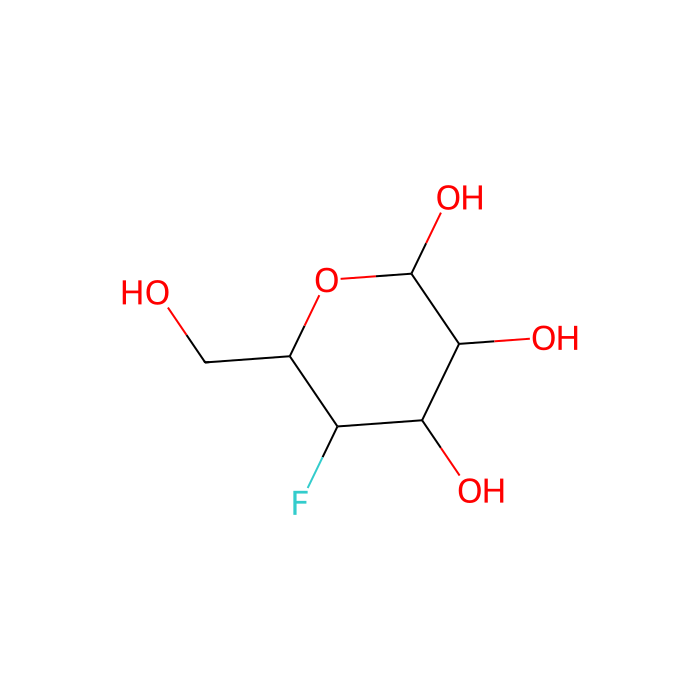
Brief description: 4-Deoxy-4-fluoro-D-glucose is a D-glucose analogue in which the C4 hydroxy group is replaced by fluorine (with concomitant deoxygenation at C4), preserving the native D-configuration at all stereocenters.
SMILES: Not specified for this item; refer to CoA/Spec Sheet.
InChIKey: Not specified for this item; refer to CoA/Spec Sheet.
Stereochemistry: Retains the D-series configuration corresponding to D-glucose at C2, C3, and C5. Substitution at C4 is fluorine in place of OH.
Functional groups and features:
Aldose (open-chain form) with an aldehyde at C1 in equilibrium with cyclic hemiacetal (pyranose predominates in aqueous solution; literature-general).
Multiple secondary alcohols (C2, C3, C5); C4 is a C–F stereocenter rather than C–OH.
One primary alcohol at C6.
2D structural description (words): Starting from the aldehyde carbon (C1), the carbon chain runs C1–C6; at C2, C3, and C5 there are secondary hydroxyls in the D-glucose configuration; at C4 the substituent is fluorine; at C6 a primary CH2OH. In water, the dominant form is a six-membered pyranose ring with the anomeric center at C1 (α/β anomers in equilibrium; literature-general).
Synthetic Utility
Retrosynthetic value (literature-general): 4-deoxy-4-fluoro-D-glucose serves as a chiral pool building block to access C4-fluorinated glycoconjugates. The intact sugar framework provides multiple handles for protection and selective functionalization while embedding the strategic C4–F substituent.
Key transformations:
Protection strategies: Per-O-acylation (Ac2O/pyridine or Ac2O/DMAP) or silylation (TBDMSCl/imidazole) to modulate solubility and reactivity.
Glycosyl donor formation: Conversion to trichloroacetimidates, thioglycosides, or glycosyl halides at the anomeric center for subsequent glycosylation.
Selective deprotection to generate donors/acceptors with defined reactivity (neighboring group participation via 2-O-acyl where desired).
Stereoelectronic effects: The C4–F substituent can bias conformational equilibria (gauche effect) and influence glycosylation stereoselectivity and acceptor reactivity—useful in designing routes to fluorinated oligosaccharides.
Analytical leverage: The embedded 19F nucleus offers a convenient spectroscopic handle to track reaction progress, detect side-products, and quantify loading by 19F NMR without additional labels.
Practical notes:
Begin with dryness and inert atmosphere for acylation and glycosylation steps.
Verify integrity after each step by 1H, 13C, and 19F NMR; assign C4–F coupling patterns (large 1JCF) to confirm substitution.
If solubility in organic media is limiting, temporary peracetylation typically resolves this.
Target Specificity
Not applicable. This product is a small-molecule carbohydrate analogue, not a biological affinity reagent or antibody. No target/epitope specificity data are provided for this item.
Wir verwenden Cookies, um die ordnungsgemäße Funktion der Website sicherzustellen und, soweit zulässig, Ihr Nutzererlebnis zu verbessern. Sie können Ihre Einstellungen jederzeit unter „Einstellungen“ verwalten. Weitere Informationen finden Sie in unserer Cookie-Richtlinie.
Shall we send you a message when we have discounts available?
Remind me later
Thank you! Please check your email inbox to confirm.
Products are supplied to verified businesses, institutions, and qualified professionals for research and development use only. Not for use in humans, animals, diagnosis, or therapy.

 F2524351