This compound belongs to the class of organic compounds known as pyridinium derivatives. These are compounds containing a pyridinium ring, which is the cationic form of pyridine.
External Descriptors
Not available
1. Djoumbou Feunang Y, Eisner R, Knox C, Chepelev L, Hastings J, Owen G, Fahy E, Steinbeck C, Subramanian S, Bolton E, Greiner R, and Wishart DS. ClassyFire: Automated Chemical Classification With A Comprehensive, Computable Taxonomy. Journal of Cheminformatics, 2016, 8:61.
Determine the necessary mass, volume, or concentration for preparing a solution.
Dilution Calculator
Determine the dilution needed to prepare a stock solution.
Reconstitution Calculator
Bewertungen
Kundenbewertungen
Application Protocols
No biological assay protocols (WB, IHC, IF, FC) are applicable to this small-molecule reagent. For synthetic use, see Reaction Conditions and Synthetic Utility sections for practical guidance on cross-couplings and alkyne transformations.
Biological Roles
This product is a small heteroaromatic research chemical; it is not intended for biological administration. No endogenous biological role is associated with 4-ethynylpyridine.
Structural motifs (general): The pyridine ring is a recurring pharmacophore and ligand motif in biochemical probes; the terminal alkyne serves as a bioorthogonal handle in probe design after appropriate derivatization.
Potential research context (literature/general):
• As a building block to create pyridine-containing ligands for metalloenzymes or receptors (for in vitro studies).
• The alkyne can be leveraged to append tags/spacers (e.g., via Sonogashira coupling to aryl iodide-containing dyes or handles), enabling downstream bioconjugation strategies.
Physicochemical note: In hydrochloride form, the compound is cationic and typically water-soluble, which can aid formulation for biochemical assays, but biological compatibility depends on the final construct.
No biological activity or target engagement is claimed for this catalog item; all uses are for research only.
Buffer Applications
This compound is not a buffering agent and is not typically used to prepare biological buffers.
Practical note: In hydrochloride form it can acidify aqueous media; however, it does not provide useful buffer capacity over a defined pH range. If aqueous work is needed (e.g., extractions or reactions), use an appropriate buffer system (phosphate, HEPES, acetate) selected for your pH window and compatibility with pyridine/alkyne chemistry.
Recommendation: For reactions or assays requiring controlled pH, choose a buffer based on the reaction mechanism and metal catalysts (avoid buffers that strongly chelate Pd/Cu in cross-couplings unless intended).
Green Alternatives
Choosing greener conditions centers on solvent and catalytic system selection, since the substrate is fixed.
Greener solvent choices (literature/general):
• Replace DMF/DMAc with bio-derived or lower-toxicity media such as 2-MeTHF, CPME, propylene carbonate, or aqueous micellar systems (TPGS-750-M).
• For Sonogashira reactions, aqueous ethanol or water/PEG under ligand-enabled Pd catalysis can work, reducing reliance on amide solvents.
Catalyst considerations:
• Copper-free Sonogashira variants minimize copper waste and Glaser byproducts.
• Heterogeneous Pd (e.g., Pd/C, Pd on biochar) can ease recovery/recycling, though activity may be lower.
Energy efficiency:
• Microwave or flow chemistry can reduce reaction times/energy inputs.
• Room-temperature couplings with modern ligands can avoid heating.
Comparison snapshot (general guidance):
Conventional: Pd(PPh3)2Cl2 + CuI, amine base, DMF, 60–80°C — efficient but uses high-boiling polar aprotic solvent and copper co-catalyst.
Greener alternative: Pd-NHC or Buchwald-type ligand in 2-MeTHF or aqueous micellar media, amine base (Et3N), 25–50°C, copper-free — reduced toxicity and simpler workup.
Note: Verify solubility of the free base in bio-based solvents; the hydrochloride salt may require pre-neutralization and phase management.
Pharmaceutical Uses
No excipient or pharmacopeial status is provided for this item; it is offered strictly for research use.
Typical roles of related materials (general): Pyridine-containing alkynes are used as synthetic intermediates in the preparation of drug candidates or analytical reference standards, not as finished dosage excipients.
Considerations for process chemistry (literature/general):
• Salt form can improve handling and reduce volatility in plant settings.
• For GMP-adjacent work, define residual solvent limits, counterion content, and polymorph/crystallinity if relevant — obtain from CoA/Spec Sheet.
Regulatory note: No therapeutic claims are made; this product is not intended for human or veterinary use.
Physical Properties
Item-specific numeric specifications are not provided in the Product Data; consult the CoA/Spec Sheet for definitive values.
State/appearance: Not specified for this item; refer to CoA/Spec Sheet. (Hydrochloride salts of pyridines are commonly crystalline solids; literature note)
Melting point: Not specified for this item; refer to CoA/Spec Sheet. (Literature for the hydrochloride salt is not universally consistent; verify on CoA)
Boiling point: Not applicable for a salt (decomposes before boiling under ambient pressure) — literature/general note
Density: Not specified for this item; refer to CoA/Spec Sheet.
Solubility (qualitative, literature/general):
• Water: Typically high for pyridinium hydrochlorides
• Polar organics (MeOH, EtOH, DMSO): Generally good
• Nonpolar solvents (hexanes, toluene): Poor
pKa (literature/general): Pyridinium conjugate acids have pKa (of the conjugate acid) ~5.1 in water for unsubstituted pyridine; para-ethynyl substitution may slightly modulate acidity. Actual value for this salt not specified for this item; refer to literature if critical.
LogP: Not specified for this item; refer to CoA/Spec Sheet. (Expect low partitioning into nonpolar phases due to ionic nature of the salt; literature/general)
Hygroscopicity: Many pyridinium salts are hygroscopic; handle under dry inert gas as directed in Storage Conditions (Product Data).
Quality and Grades
Grade/purity: Not specified for this item; refer to CoA/Spec Sheet for assay, residual solvents, and impurity profile.
What “salt form” implies (general):
• The hydrochloride salt ensures a defined, isolable, and often more water-soluble form versus the volatile/free base.
• Salt form can improve handling (reduced odor/volatility) and enable precise stoichiometry in aqueous-phase chemistry.
• For organometallic cross-couplings or base-sensitive steps, the free base is often generated in situ by addition of a non-nucleophilic base.
UV/Vis background, metal content, water/peroxide levels: Not specified for this item; refer to CoA/Spec Sheet. Do not assume HPLC/UV-grade characteristics unless explicitly stated.
Batch documentation: Each lot should be accompanied by a Certificate of Analysis (CoA) outlining identity (e.g., NMR, HRMS, HPLC), assay, and moisture. Request the Spec Sheet for acceptance criteria if needed for GMP-adjacent research (research use only).
Reaction and Applications
4-Ethynylpyridine hydrochloride is a versatile heteroaryl terminal alkyne precursor. The salt form facilitates handling; the reactive species for most transformations is the free base (4-ethynylpyridine), generated in situ by base.
Cross-coupling (literature/general):
• Sonogashira coupling: Couples the terminal alkyne with aryl/vinyl halides or triflates under Pd(0)/Cu(I) catalysis and amine base, delivering 4-(aryl/vinyl-ethynyl)pyridines.
• Copper-free Sonogashira variants are preferred for sensitive substrates to avoid Glaser homocoupling.
Alkyne transformations:
• Click chemistry (CuAAC): After conversion to an azide-bearing partner or by prior functionalization to an azide-terminated chain, enables triazole formation; note that the substrate here is an alkyne without azide.
• Hydroboration/oxidation or hydrohalogenation across the triple bond gives vinyl boronates/halides for further elaboration.
• Electrophilic additions (I2, Br2) to form dihalo-alkenes (with regio-/stereo-control depending on conditions).
Heteroaromatic utility: The para-pyridine nitrogen can direct metalation or coordinate to metals, yielding ligand-functional materials; salt form must be neutralized to reveal the coordinating N.
Materials/ligand scaffolds (general): The ethynyl unit enables construction of conjugated linkers for MOFs/COFs and surface functionalization (via Au–C≡C interactions), where pyridine acts as a binding site.
Practical tips:
• Neutralize the HCl salt with organic base (e.g., NEt3, DIPEA) prior to or during coupling.
• Maintain anhydrous, oxygen-free conditions for metal-catalyzed couplings to suppress Glaser side products.
• For aqueous-phase functionalizations, exploit the salt’s water solubility and buffer the medium near neutral to limit acid/base side reactions.
Reaction Conditions
Guidance below reflects literature/general practice for terminal alkynes and 4-alkynylpyridines. Optimize per substrate and scale.
Sonogashira coupling (to install Ar–C≡C–Py):
• Catalyst: Pd(PPh3)2Cl2 (1–3 mol%) or Pd2(dba)3 (0.5–1 mol%) + phosphine ligand; optional CuI (1–5 mol%) or copper-free variants.
• Base: Et3N, DIPEA, or inorganic bases (K2CO3, Cs2CO3) in polar solvent; neutralize HCl salt in situ.
• Solvent: DMF, DMAc, acetonitrile, toluene/Et3N, or 2-MeTHF (greener).
• Temperature/time: 25–80°C, 1–16 h; monitor by TLC/LC-MS.
• Atmosphere: Inert (N2/Ar) to suppress Glaser coupling.
Glaser homocoupling (if desired):
• CuI (5–10 mol%), amine/oxygen present; forms diyne. Control is required to avoid overoxidation.
Hydroboration of alkyne:
• Reagents: Catecholborane or 9-BBN; Pd or Rh catalysts optional. Subsequent oxidation affords vinyl boronates/alcohols.
Protection strategies:
• Alkyne protection as silyl ethers (e.g., TMS-acetylene formation) is possible but less common here since the alkyne is the handle.
• Pyridine N can be protected/modified (N-oxide formation) to tune directing effects; start from free base (neutralized from HCl salt).
Yields: Depend strongly on substrate pairing and conditions; consult primary literature for the specific coupling partner. Always confirm stoichiometry when charging the hydrochloride salt (account for HCl mass).
Safety and Handling
Authoritative safety information must be taken from the SDS. The following are general laboratory considerations for pyridinium hydrochloride salts and terminal alkynes.
GHS classification, signal word, pictograms, H-statements: Not specified for this item; refer to SDS.
Primary hazards (general):
• Irritation/corrosion: Acidic pyridinium salts may cause skin/eye/respiratory irritation.
• Combustibility: Organic salts can be combustible; avoid dust formation and ignition sources.
• Incompatibilities: Strong bases (will liberate free base and HCl), strong oxidizers, and strong reducing agents. Avoid contact with reactive metals in presence of moisture/acids (H2 evolution).
• Terminal alkyne caution: Copper salts can catalyze Glaser-type oxidative coupling; avoid unintended exposure to Cu in storage or work-up when not desired.
PPE: Lab coat, safety glasses or splash goggles, and appropriate chemical-resistant gloves (e.g., nitrile). Use in a fume hood to avoid inhalation of dust/aerosols and HCl vapors that may be released with bases.
First aid (overview; defer to SDS):
• Skin/eye contact: Rinse with water for ≥15 minutes; remove contaminated clothing; seek medical attention if irritation persists.
• Inhalation: Move to fresh air; consult medical attention if symptoms occur.
• Ingestion: Rinse mouth; do not induce vomiting; seek medical attention.
Handling tips:
• Follow Product Data storage: protect from light, keep under argon at room temperature.
• Minimize moisture uptake; promptly reseal under inert gas.
• When converting to the free base, neutralize cautiously with a suitable base in a controlled, ventilated setup.
Solvent Selection
This compound is supplied as a pyridinium hydrochloride salt, which informs its solubility profile and the choice of media for reactions or processing.
Polarity/miscibility (literature/general):
• Water: Typically freely soluble to highly soluble for pyridinium hydrochlorides.
• Polar protic/aprotic solvents: Good solubility in MeOH, EtOH, DMF, DMSO, acetonitrile (with some water).
• Nonpolar solvents (toluene, ethers, alkanes): Poor solubility as the salt; convert to free base if nonpolar media are required.
Choosing the form for synthesis:
• For aqueous or mixed aqueous-organic procedures, the hydrochloride salt is convenient.
• For Pd-catalyzed couplings in nonpolar media, pre-neutralize with organic base (e.g., NEt3, DIPEA) to generate the free base and enhance solubility.
Workup considerations:
• Partitioning: The salt prefers aqueous layers; the free base partitions more into organic phases.
• Ion-pair extraction or pH-switching can be used to transfer between phases.
Small comparison (general):
• Hydrochloride salt: best for water compatibility, weighed stoichiometry in aqueous settings.
• Free base: best for nonpolar solvents and metal-catalyzed cross-couplings; handle under inert atmosphere due to volatility/odor relative to salt.
Storage and Reconstitution
Follow the item-specific storage guidance provided and standard practices for moisture/air-sensitive salts.
Storage (Product Data):
• Protected from light
• Room temperature
• Argon charged
• Shipped under normal conditions
Container handling: Keep tightly sealed under inert gas after opening. Minimize headspace air/moisture; use desiccant if frequently opened.
Stability: Not specified for this item; refer to CoA/Spec Sheet. (General: pyridinium hydrochloride salts are typically shelf-stable when kept dry and away from light.)
Reconstitution/dissolution (general guidance):
• For aqueous work: Dissolve directly in deionized water or buffer; expect acidic pH due to HCl.
• For organic reactions: Pre-dissolve in polar solvents (MeOH, MeCN, DMF, DMSO) and neutralize with a stoichiometric organic base to generate the free base prior to charging into less polar media if needed.
• Filtration: If insoluble particulates are observed, clarify through a PTFE or PVDF syringe filter (0.2–0.45 µm).
Freeze–thaw: Not applicable to solids; if prepared as a solution, store aliquots to avoid repeated freeze–thaw.
Research use note: For research use only (Product Data).
Structure and Identity
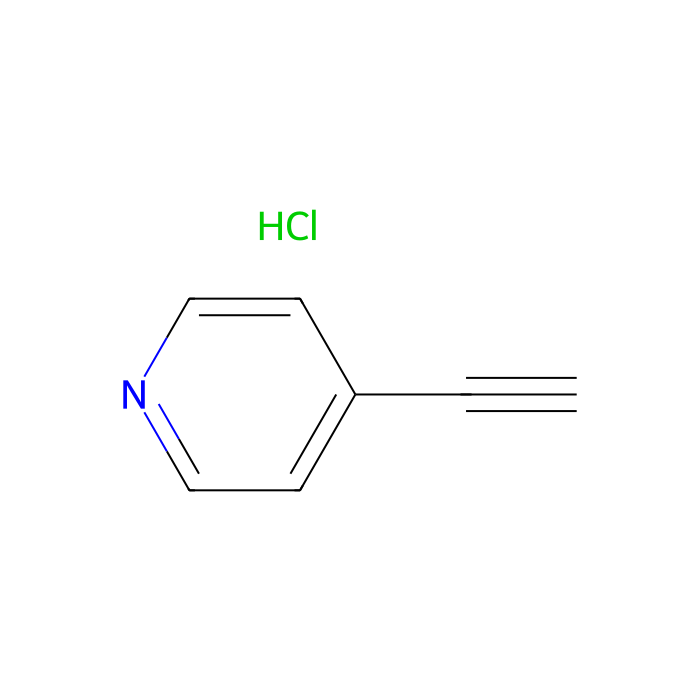
Brief description: 4-Ethynylpyridine hydrochloride is the protonated pyridinium chloride salt of para-ethynyl-substituted pyridine; it features a terminal alkyne para to the ring nitrogen.
Product name (catalog): 4-Ethynylpyridine hydrochloride salt (as listed: “4-Ethynylpyridinehychloride salt”)
CAS: 352530-29-1 (Product Data)
PubChem CID: 16216931 (Product Data)
InChIKey: 178450 (as provided; note: format appears non-standard; verify on CoA/SDS)
SMILES: Not specified for this item; refer to CoA/Spec Sheet.
Molecular formula: Not specified for this item; refer to CoA/Spec Sheet.
• Literature (free base, 4-ethynylpyridine): C7H5N
• Literature (hydrochloride salt): C7H6N·Cl or C7H6NCl (salt form notation varies)
Molecular weight: Not specified for this item; refer to CoA/Spec Sheet.
• Literature estimate (salt) ≈ 139.6 g/mol (base ~103.1 + HCl 36.46) — for reference only
Structural features (description):
• Aromatic six-membered pyridine ring (one ring nitrogen)
• Para (4-position) terminal alkyne substituent (–C≡CH) relative to ring N
• Exists as a pyridinium chloride salt; the ring nitrogen is protonated (N–H+) with Cl− counterion
• No stereocenters; planar conjugated scaffold coupling the alkyne with the aromatic ring
2D verbal sketch: A pyridine ring with the ring nitrogen at the top; directly opposite (para) is a –C≡CH group. In the hydrochloride form, the ring N bears a positive charge balanced by chloride.
Synthetic Utility
Key functional features enabling synthesis:
Terminal alkyne (–C≡CH):
• Nucleophilic deprotonation (pKa ~25 in DMSO for generic terminal alkynes; literature/general) to form acetylide equivalents.
• Engages in Sonogashira, C–H alkynylation (via hypervalent iodine alkynyl reagents), hydrofunctionalizations (hydroboration, hydrostannylation), and cycloadditions.
Pyridine ring:
• Directs metal-catalyzed transformations and serves as a ligand site (as free base).
• Undergoes N-oxidation, quaternization, and further electrophilic functionalization at ring positions (after protecting/directing strategies).
Salt-to-base switch:
• The hydrochloride salt is convenient for storage/handling; free base is generated in situ for nonaqueous couplings or metal coordination chemistry.
Retrosynthetic value (general): It provides a convergent “alkynyl handle” on a heteroarene, enabling late-stage diversification into aryl-ethynyl-pyridines, extended conjugated systems, or linkers to attach functional payloads (fluorophores, affinity tags).
Target Specificity
Not applicable. This product is a small-molecule reagent, not a biological targeting reagent or antibody. No antigen/epitope, clone, isotype, or species reactivity data apply.
Wir verwenden Cookies, um die ordnungsgemäße Funktion der Website sicherzustellen und, soweit zulässig, Ihr Nutzererlebnis zu verbessern. Sie können Ihre Einstellungen jederzeit unter „Einstellungen“ verwalten. Weitere Informationen finden Sie in unserer Cookie-Richtlinie.
Shall we send you a message when we have discounts available?
Remind me later
Thank you! Please check your email inbox to confirm.
Products are supplied to verified businesses, institutions, and qualified professionals for research and development use only. Not for use in humans, animals, diagnosis, or therapy.

 L2418382