This compound belongs to the class of organic compounds known as triarylamines. These are organic compounds containing a trialkylamine group, characterized by exactly three aryl groups bonded to the amino nitrogen.
External Descriptors
Not available
1. Djoumbou Feunang Y, Eisner R, Knox C, Chepelev L, Hastings J, Owen G, Fahy E, Steinbeck C, Subramanian S, Bolton E, Greiner R, and Wishart DS. ClassyFire: Automated Chemical Classification With A Comprehensive, Computable Taxonomy. Journal of Cheminformatics, 2016, 8:61.
For Sonogashira couplings, see the Reaction Conditions tab for starting points.
For thin-film preparation in materials R&D, dissolve in chlorobenzene/toluene (as solubility allows), filter (0.2 µm PTFE), and spin-coat under inert atmosphere; optimize concentration (e.g., 5–20 mg/mL) and spin parameters to desired thickness. These are generic guidelines, not item-specific protocols.
Biological Roles
This product is a synthetic, hydrophobic triarylamine/arylacetylene used primarily in materials and synthetic organic chemistry. It is not a metabolite, enzyme cofactor, or natural product derivative.
General notes (literature/general)
Triarylamines are widely used as electron-donating, hole-transport motifs in organic semiconductors and are not associated with specific biological pathways.
The terminal alkyne can engage in bioconjugation chemistry in principle; however, solubility and hydrophobicity limit direct aqueous/biological use without further functionalization.
No biological function is claimed or implied. For research use only.
Buffer Applications
Not typically applicable. 4-Ethynyltriphenylamine is a non-ionic, water-insoluble organic building block and does not serve as a pH buffer or a common component in aqueous buffer systems.
Practical note: If any aqueous manipulations are required (e.g., workup of a coupling reaction), maintain the compound in an organic phase (e.g., CH2Cl2 or EtOAc) and avoid extended exposure to strong base to prevent formation of metal acetylides.
Green Alternatives
While 4-ethynyltriphenylamine itself is a specialty building block, greener choices can be made in the associated chemistry and processing.
Greener solvent substitutions (general guidance)
Replace DMF/DMAc with Cyrene or NBP (where compatible) for Pd-catalyzed couplings.
Use 2-MeTHF or CPME instead of THF/diethyl ether (better safety, bio-based origin for 2-MeTHF, lower peroxide formation for CPME).
Prefer toluene/anisole over chlorinated solvents for processing when solubility/performance allow.
Catalyst/condition optimizations
Copper-free Sonogashira conditions reduce copper waste and suppress Glaser byproducts.
Heterogeneous or ligandless Pd at low loadings, or Ni-catalyzed alkynylations, can reduce precious metal usage.
Flow chemistry can minimize solvent volumes and improve safety in oxidative steps.
Comparative snapshot (general)
THF vs 2-MeTHF: similar polarity; 2-MeTHF has higher boiling point, better phase separation, often from renewable sources.
CH2Cl2 vs toluene/anisole: non-chlorinated options are less problematic for waste handling but may require higher temperatures.
Trade-offs: greener solvents can alter rates/solubility and may require ligand/base adjustments. Validate at small scale before adoption.
Pharmaceutical Uses
No excipient or pharmacopeial role is specified for this item.
General context (non-clinical)
Triarylamine derivatives occasionally appear as intermediates in the synthesis of advanced organic molecules; however, 4-ethynyltriphenylamine is primarily a materials/synthetic chemistry building block rather than a pharmaceutical excipient.
If used in R&D, it would typically be as a synthetic intermediate toward conjugated scaffolds, not as a formulation component.
No therapeutic or clinical claims are made. For research use only.
Physical Properties
Item-specific physical specifications for this catalog item are not provided in the Product Data.
Item-specific specifications
Appearance: Not specified for this item; refer to CoA/Spec Sheet.
Molecular Formula: Not specified for this item; refer to CoA/Spec Sheet.
Molecular Weight: Not specified for this item; refer to CoA/Spec Sheet.
Melting point, boiling point, density, refractive index, water/peroxide/metal limits: Not specified for this item; refer to CoA/Spec Sheet.
Literature/general reference values (for context; not item specifications)
Empirical formula (literature): C20H15N (triarylamine with one terminal alkyne).
Exact mass (monoisotopic, computed from C20H15N): ~269.1208 Da.
Physical form: Typically a pale to off-white solid for many substituted triphenylamines (literature/general observation for the class).
Solubility (general): Moderately soluble in chlorinated solvents (CH2Cl2, CHCl3), aromatics (toluene), and THF; poor solubility in water. Solubility depends on crystallinity and batch; verify experimentally.
Acidity/basicity: Terminal alkyne pKa typically ~25 (DMSO, literature, for phenylacetylenes); tertiary aryl amine is weakly basic but substantially deactivated by aryl substitution (often non-protonated under neutral conditions).
LogP: Expected high (hydrophobic triarylaryl), but specific value not established here.
Always rely on the item’s CoA/SDS for definitive specifications.
Quality and Grades
Item-specific grade/purity
Grade/Purity: Not specified for this item; refer to CoA/Spec Sheet.
Interpreting typical grades for this compound class (general guidance)
Building-block grade: Suitable for metal-catalyzed cross-couplings (Sonogashira, Glaser). Key attributes include low metal contamination, controlled residual halides, and dryness.
Analytical grade: Ensures defined purity by HPLC/GC/NMR with specified residual solvent/water limits.
Stabilizers/additives
None specified for this item. Terminal alkynes are typically supplied neat. If stabilizers are present, they will be disclosed on the CoA/SDS.
What to check on receipt (best practices)
NMR for identity/purity; HRMS for mass confirmation (~269.12 Da mono-isotopic).
Water content (Karl Fischer) if moisture-sensitive processes are planned.
Trace metals (ICP-MS) if used in optoelectronic materials where metal residues affect performance.
Refer to the product’s CoA for definitive specifications and release criteria.
Reaction and Applications
Key application domains (general/literature)
Organic electronics and photonics: triarylamine units serve as electron donors/hole-transport motifs; para-ethynyl extends conjugation and enables modular cross-coupling to form D–A architectures, oligomers, and polymers.
Synthetic building block: terminal alkyne participates in Sonogashira, C–H alkynylation, click-type transformations (after conversion to azide/iodoalkyne), and Glaser coupling.
Sonogashira coupling to aryl/vinyl halides/triflates → aryl-ethynyl-aryl linkages. Pd(PPh3)2Cl2 or Pd(PtBu3)2 with base (i-Pr2NH, NEt3, or Cs2CO3). Copper co-catalyst optional; copper-free conditions reduce homocoupling.
Glaser–Hay oxidative dimerization → diacetylene-bridged bis(triphenylamine) species using Cu(I)/amine under O2.
Alkyne hydrofunctionalizations: hydrosilylation, hydroboration (e.g., catecholborane or pinacolborane) leading to vinyl boronates for further Suzuki–Miyaura coupling.
Cycloadditions after derivatization: convert terminal alkyne to iodoalkyne (e.g., NIS) for further halogenation/annulation; azidation of appropriate partners followed by CuAAC if terminal alkyne is retained and conditions are compatible with aryl system.
Practical notes
Dry, degassed solvents and bases improve cross-coupling yields; oxygen promotes Glaser side reactions.
The tertiary aryl amine can coordinate weakly; bulky phosphine ligands often mitigate catalyst inhibition.
Monitor reactions by TLC with UV; triarylamines are strongly UV-active. Add a drop of NEt3 in eluent to sharpen bands if needed.
Downstream uses
Formation of donor–acceptor chromophores, hole-transport layers, and electroactive polymers via step-growth (e.g., Sonogashira–polycondensation).
Reaction Conditions
General, literature-guided conditions for common transformations of terminal arylacetylenes/triarylamines (optimize per substrate; values are guidance only, not specifications):
Sonogashira coupling (to aryl bromide)
Catalyst: 0.5–2 mol% Pd(PPh3)2Cl2 or Pd(dppf)Cl2; optional 1–5 mol% CuI (omit for copper-free).
Catalyst: 1–10 mol% CuI/CuCl with TMEDA or amine base.
Solvent: pyridine, DMF, or toluene; presence of O2/air required.
Temperature/time: rt–60°C, 2–24 h.
Notes: Sensitive to oxygen availability and copper loading.
Hydroboration of terminal alkyne
Reagent: HBPin or catecholborane (1.1–1.5 eq), with [Ir] or [Rh] catalysts or base-promoted systems.
Solvent: THF or toluene.
Temperature: 25–80°C.
Product: vinyl boronate suitable for Suzuki couplings.
Electrophilic halogenation of alkyne
Reagents: NIS/NBS with AgNO3 or I2/Br2 under controlled conditions.
Outcome: haloalkynes for further cross-couplings or cycloadditions.
Yields are substrate- and condition-dependent; consult primary literature and run small-scale screens.
Safety and Handling
GHS/SDS status (item-specific)
Signal Word: Not specified for this item; refer to SDS.
H-Statements: Not specified for this item; refer to SDS.
GHS Classification: Not specified for this item; refer to SDS.
Pictograms: Not specified for this item; refer to SDS.
General hazards (literature/general for arylacetylenes/triarylamines)
May cause skin, eye, and respiratory irritation. Terminal alkynes can be flammable and may form metal acetylides upon contact with strong bases/copper salts.
Triarylamines are generally of low volatility but should be handled to avoid dust generation.
Handling recommendations
Use in a fume hood with appropriate PPE: lab coat, nitrile gloves, splash goggles.
Avoid ignition sources; keep away from strong oxidizers and strong bases that can deprotonate the alkyne.
For cross-coupling, control copper content to prevent unintended Glaser homocoupling unless desired.
First aid (overview; defer to SDS)
Inhalation: Move to fresh air; seek medical advice if symptoms persist.
Skin/eye contact: Rinse with water for 15 minutes; remove contaminated clothing; seek medical attention for persistent irritation.
Ingestion: Rinse mouth; do not induce vomiting; seek medical attention.
Although not a peroxide-forming ether, terminal alkynes can undergo oxidative homocoupling; store under inert atmosphere if possible.
Always consult the SDS for authoritative safety information.
Solvent Selection
This compound is a hydrophobic, π-conjugated arylacetylene/triarylamine. Solvent choice is driven by solubility, reaction compatibility (esp. Pd-catalysis), and end-use (thin-film processing).
Polarity and miscibility (general)
Nonpolar to moderately polar organic solvents are preferred: toluene, chlorobenzene, dichloromethane, chloroform, THF, dioxane. Poorly soluble in alcohols/water.
For thin-film deposition (spin coating), chlorobenzene, toluene, or o-dichlorobenzene are commonly used due to slower evaporation and good wetting (literature/general practice in organic electronics).
Coupling chemistry media (literature/general)
Sonogashira: THF, toluene, dioxane, DMF, DMAc; base like Et3N, i-Pr2NH, or carbonate. Copper-free variants favor polar aprotic solvents (DMF/DMAc) to limit Glaser coupling.
Glaser (oxidative homocoupling): pyridine, DMF, or toluene under O2/Cu.
Practical tips
Start with chlorobenzene or toluene for materials processing; switch to THF/DMF blends for Pd-catalyzed couplings where solubility of inorganic base is needed.
For purification by column chromatography, hexanes/EtOAc or hexanes/CH2Cl2 gradients are typical; monitor for tailing due to basic amine—add 0.1–1% NEt3 to the eluent if required.
Small comparison (general)
Toluene: good solubility, high bp; benign relative to chlorinated solvents.
CH2Cl2/CHCl3: excellent solubility, fast processing; higher environmental/health concerns.
THF/1,4-dioxane: coupling-friendly; peroxide formation risk (solvent, not solute) and need for drying.
Storage and Reconstitution
Item-specific storage/shipping
Storage Conditions: Store at 2–8°C (from Product Data).
Shipped In: Wet ice (from Product Data).
General best practices for this compound class
Keep container tightly closed under inert gas (e.g., nitrogen or argon) to minimize oxidative homocoupling of the terminal alkyne over long storage.
Protect from light and moisture; store in an amber vial if possible.
Allow the container to equilibrate to room temperature before opening to prevent moisture condensation.
Reconstitution/solution preparation
No reconstitution required if supplied as a solid. For solution use, prepare stock solutions in dry, oxygen-free solvents (e.g., toluene, chlorobenzene, THF, CH2Cl2) and store at 2–8°C under inert atmosphere. Use PTFE-lined caps.
Avoid prolonged storage of basic solutions to prevent formation of metal acetylides.
Stability notes
Long-term stability is formulation- and environment-dependent; check by NMR/HPLC before critical use if stored for extended periods.
Follow the CoA/SDS for any additional, lot-specific guidance.
Structure and Identity
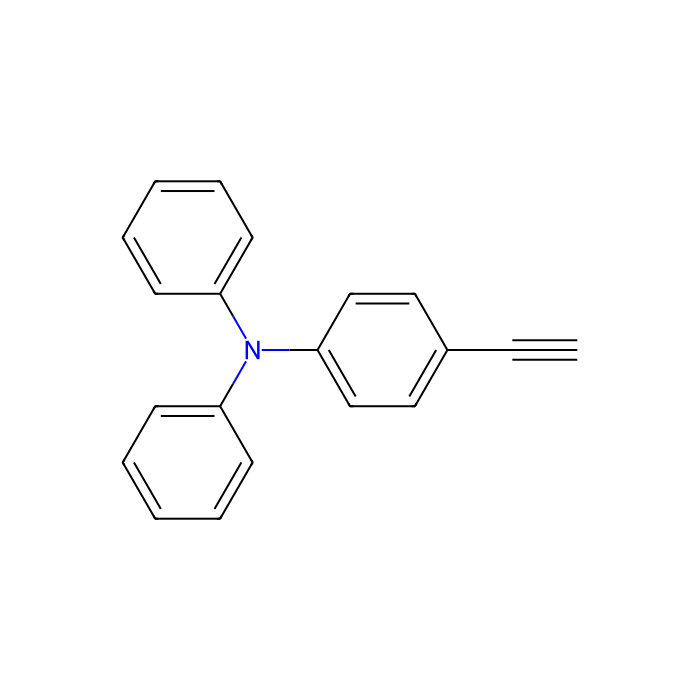
Brief description: 4-Ethynyltriphenylamine is a triarylamine bearing a terminal alkyne at the para position of one phenyl ring. It is a conjugated, electron-rich arylacetylene building block valued in organic electronics and cross-coupling chemistry.
Item-specific identifiers (from Product Data)
SKU: E156043
Product Name: 4-Ethynyltriphenylamine
CAS: 205877-26-5
InChIKey: 294432 (as provided)
Storage: Store at 2–8°C; shipped on wet ice
Research Use Note: For research use only
Literature/typical structural data (for reference; not item specifications)
Core features: triarylamine (tertiary anilinium core, neutral), three phenyl rings attached to sp3-like nitrogen (pyramidal, but often depicted as planarized in conjugating media), one ring para-substituted with a terminal ethynyl (–C≡CH) group.
Functional groups: tertiary aryl amine (electron-donating), terminal alkyne (acidic C–H, π-system for metal-catalyzed couplings), three aryl rings (π-extended system).
2D structure in words
Central nitrogen bound to three phenyl rings (triphenylamine). On one phenyl, the position para to the N-substitution bears a –C≡CH substituent, giving a linear alkyne extending from the aromatic ring. No defined stereocenters; the alkyne is linear and terminal.
Synthetic Utility
Functional group leverage
Terminal alkyne: amenable to Sonogashira cross-coupling, hydroboration/hydrosilylation, oxidative couplings (Glaser), and electrophilic halogenation to iodo/bromo-alkynes for further transformations.
Triarylamine core: strong electron donor enabling donor–acceptor constructs; can be further modified by electrophilic aromatic substitution on unsubstituted rings (nitration, bromination) to introduce additional handles.
Retrosynthetic value
Serves as a convergent node: one can append acceptors (e.g., benzothiadiazoles, diketopyrrolopyrroles) via the ethynyl handle, while independently functionalizing other aryl rings for multi-point diversification.
Named/canonical strategies (literature/general)
Sonogashira–Hagihara coupling to aryl/vinyl halides/triflates to elongate π-backbones.
Glaser–Hay dimerization to give diynes for rigid-rod architectures.
Hydroboration of the alkyne → vinyl boronates enabling Suzuki–Miyaura couplings.
Gold-catalyzed cyclizations/annulations of arylethynes to form polycyclic frameworks (substrate-dependent).
Purification/characterization tips
Basic amine can cause silica tailing; add 0.1–1% triethylamine to eluent.
Not applicable. This product is a small-molecule building block and does not have biological target specificity, antibody clone information, or species reactivity. No antigen/epitope data apply.
Wir verwenden Cookies, um die ordnungsgemäße Funktion der Website sicherzustellen und, soweit zulässig, Ihr Nutzererlebnis zu verbessern. Sie können Ihre Einstellungen jederzeit unter „Einstellungen“ verwalten. Weitere Informationen finden Sie in unserer Cookie-Richtlinie.
Dürfen wir Sie über Rabattaktionen informieren?
Später erinnern
Vielen Dank! Bitte überprüfen Sie Ihren E-Mail-Posteingang, um zu bestätigen.
Products are supplied to verified businesses, institutions, and qualified professionals for research and development use only. Not for use in humans, animals, diagnosis, or therapy.

 F2616343