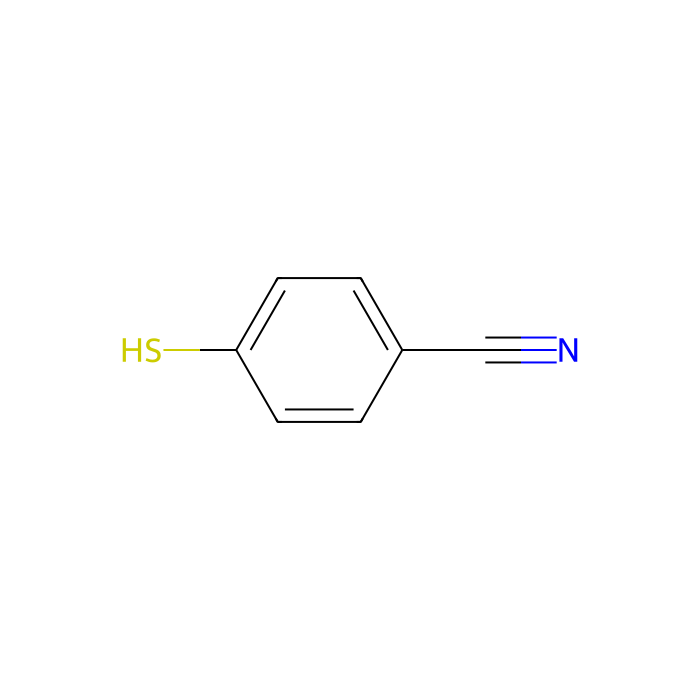
This compound belongs to the class of organic compounds known as thiophenols. These are compounds containing a thiophenol ring, which a phenol derivative obtained by replacing the oxygen atom from the hydroxyl group (attached to the benzene) by a sulfur atom.
External Descriptors
Not available
1. Djoumbou Feunang Y, Eisner R, Knox C, Chepelev L, Hastings J, Owen G, Fahy E, Steinbeck C, Subramanian S, Bolton E, Greiner R, and Wishart DS. ClassyFire: Automated Chemical Classification With A Comprehensive, Computable Taxonomy. Journal of Cheminformatics, 2016, 8:61.
Determine the necessary mass, volume, or concentration for preparing a solution.
Dilution Calculator
Determine the dilution needed to prepare a stock solution.
Reconstitution Calculator
Bewertungen
Kundenbewertungen
Application Protocols
Item-specific, tested applications and dilutions: Not specified for this item.
General guidance (non-validated; literature practices)
Self-assembled monolayers (SAMs) on gold:
Clean Au substrates (e.g., piranha or UV–ozone; observe safety), rinse, and dry.
Prepare 0.1–1 mM solution of 4-mercaptobenzonitrile in anhydrous ethanol or acetonitrile under inert gas.
Immerse substrates 2–24 h in the dark; rinse thoroughly with dry solvent and dry under inert gas.
Characterize by contact angle, IR (C≡N stretch as reporter), XPS.
S-alkylation example setup:
Generate thiolate with K2CO3 in acetone or MeCN; add primary alkyl bromide (1.1 equiv) at rt; monitor by TLC/GC; quench, extract, and purify.
Note: The above are literature-style procedures and are not validated for this specific catalog item. Verify and optimize experimentally.
Biological Roles
Scope note
4-Mercaptobenzonitrile is a synthetic, small-molecule aromatic thiol. It is not a biological metabolite and has no known endogenous role. Content below is general background to aid research planning; no clinical/medical claims are made.
General biochemical considerations (literature context)
The –SH group can form strong bonds to soft metal centers (e.g., Au, Ag, Cu) and is widely used in biomaterials interfaces (e.g., SAMs on gold for biosensing). The para-nitrile can act as a weak ligand or a spectroscopic probe (IR-active C≡N stretch ~2220–2260 cm⁻¹; literature range), useful for tracking surface coverage or microenvironmental polarity.
In protein chemistry analogies, thiols undergo disulfide formation; however, this aryl thiol is not used in vivo and is intended strictly for in vitro/materials or synthetic applications.
Reactivity toward electrophiles (maleimides, acrylates) mirrors common bioconjugation strategies, but this compound lacks water solubility commonly required for bioconjugation in aqueous buffers; organic or mixed media are typically necessary.
Buffer Applications
Not typically applicable.
4-Mercaptobenzonitrile is hydrophobic and not used as a buffering agent. It does not form defined buffer systems over biological pH ranges.
For experiments involving this compound in aqueous settings (e.g., surface functionalization of Au in mixed solvents), buffers may be used to condition substrates or for post-assembly rinses, but the compound itself does not contribute to buffering capacity.
Green Alternatives
Considerations for greener practice (general guidance)
Main environmental/health burdens arise from: (1) sulfur odor/volatility control, and (2) choice of solvent and initiators/catalysts.
Greener solvent choices
Prefer low-toxicity, biodegradable, and low-VOC solvents when compatible with the chemistry:
Ethyl acetate or isopropanol for extractions and SAM solution preparation (if solubility is adequate).
2-Methyltetrahydrofuran (2-MeTHF) over THF for base-promoted S-alkylations (biomass-derived, better EHS profile).
Dimethyl carbonate (DMC) or propylene carbonate as replacements for chlorinated solvents where feasible.
Process improvements
Use solvent recycling and closed systems to capture thiol vapors/odors and minimize emissions.
Employ photochemical LED sources for thiol–ene reactions (energy-efficient) and organobase or carbonate bases instead of strong, hazardous bases where possible.
Favor catalytic S-arylation (e.g., Cu-catalyzed) under mild conditions in green solvents (alcohols, water/ethanol with phase-transfer) when substrate scope permits.
Ethyl acetate, 2-MeTHF, isopropanol: lower toxicity/impact; may require longer times or temperature adjustments to match rates/solubility.
Note
Compound substitution is often not practical because the thiol and nitrile functions are intrinsic to the intended reactivity/surface chemistry. Greener practice therefore focuses on solvent, energy, and waste reduction.
Pharmaceutical Uses
Not a pharmaceutical product.
This item is offered for research use only. It is not formulated as a drug substance or excipient.
In a manufacturing or analytical research context, aromatic thiols and nitriles can serve as process intermediates, surface modifiers, or analytical probes, but there are no pharmacopeial monographs or excipient roles specific to 4-mercaptobenzonitrile noted here.
Physical Properties
Item-specific specifications
Appearance: Not specified for this item; refer to CoA/Spec Sheet.
Grade/Purity: Not specified for this item; refer to CoA/Spec Sheet.
Literature/typical properties (for general guidance; not item specifications)
Physical state: Typically a low-melting solid or crystalline powder for many aryl thiols of similar size; distinct thiol odor (general class property).
Solubility: Expected to be sparingly soluble in water; soluble in common organic solvents (e.g., ethanol, methanol, acetone, acetonitrile, THF, dichloromethane, toluene). Actual solubility depends on temperature and purity.
Acid/base: Aryl thiols are weak acids (pKa typically ~6–7 for thiophenols; literature, compound-specific values may vary). The nitrile is neutral and non-basic.
Partitioning: Aromatic thiols with a single nitrile substituent generally show moderate hydrophobicity (literature expectation); exact logP for this item is not specified.
Melting point, boiling point, density, refractive index, UV cutoff: Not specified for this item; refer to CoA/Spec Sheet.
Notes for use
The –SH group can oxidize to disulfide upon air exposure; physical observations (darkening, loss of thiol odor) may correlate with oxidation but must be confirmed analytically.
Quality and Grades
Item-specific
Grade/Purity: Not specified for this item; refer to CoA/Spec Sheet.
Stabilizers/inhibitors: Not specified for this item; refer to CoA/Spec Sheet.
Context for this compound type (general guidance)
For sulfur-containing aromatics, specifications often include thiol assay by titration or GC/HPLC area %, residual disulfide content, and limits on sulfur oxidation products. Trace metal limits may be relevant if used for surface chemistry on metals (e.g., Au SAMs).
Low-water content is generally preferred to limit thiolate hydrolysis and to control surface assembly or nucleophilic reactions. If Karl Fischer data are needed, consult the CoA.
If the item is offered as “anhydrous” or “inhibitor-free,” that typically indicates rigorous drying and oxygen exclusion during packaging; because this listing specifies argon-charged storage, it suggests protection against oxidative dimerization (formation of the corresponding disulfide), but no item-specific inhibitor is stated.
For surface science use (e.g., self-assembled monolayers, SAMs), high purity and low disulfide content are often critical to achieve homogeneous packing densities and reproducible contact angles—verify via CoA/GC/MS/NMR as needed.
Reaction and Applications
General applications (literature; expand as relevant to this structure)
Gold-binding thiol headgroup enables formation of self-assembled monolayers (SAMs) on Au surfaces. The para-nitrile tail can serve as an infrared-visible reporter (C≡N stretch) and as a handle for further transformations or coordination.
Nucleophilic S-chemistry: The aryl thiol can be deprotonated (e.g., with NaH, K2CO3, or organobases) to form the thiolate, enabling S-alkylation (thioether formation), S-acylation (thioesters), and S-arylation (e.g., via SNAr on activated aryl halides or Ullmann-type couplings with aryl halides under Cu catalysis).
Radical thiol–ene/thiol–yne additions: Under photochemical or thermal radical initiation (e.g., UV + photoinitiator or AIBN), adds across alkenes/alkynes to form thioethers/vinyl sulfides with anti-Markovnikov preference in many cases.
Thio-Michael additions: Conjugate addition to electron-deficient alkenes (e.g., acrylates, maleimides) in the presence of base or nucleophilic catalysts.
Oxidation/reduction: Controlled oxidation affords disulfides; over-oxidation can yield sulfinyl/sulfonyl derivatives. Reductive protocols (e.g., Raney Ni desulfurization) remove sulfur for specific transformations.
Nitrile derivatization: Hydrolysis to amide (mild) or carboxylic acid (vigorous) under acidic/basic conditions; reduction to amine (e.g., catalytic hydrogenation or metal hydride systems); Pinner/imidate chemistry in alcohol + HCl; [3+2] cycloaddition with azide to give tetrazoles under Lewis acid catalysis.
Practical tips
Work under inert atmosphere to preserve thiol; include oxygen scrubbing/degassing of solvents. Monitor for disulfide by TLC/GC/HPLC; reduce back to thiol with DTT, TCEP, or thiol-selective reducing conditions if needed.
For SAMs, rigorously clean Au substrates, use anhydrous solvent, and allow sufficient assembly time (hours) with minimal light/air exposure for high-quality monolayers.
Reaction Conditions
General literature guidance (not item-specific; optimize per substrate scope)
Formation of thiolate:
Bases: K2CO3, Cs2CO3 (mild); NaH, t-BuOK (strong). Solvents: DMF, DMSO, MeCN, THF. Temperatures: 0–25 °C (mild) to 50–80 °C (for sluggish couplings).
S-alkylation / thioether formation:
Alkyl halides or sulfonates, 1.0–1.5 equiv; thiolate generated in situ. Solvents: acetone, MeCN, DMF. Typical times: 0.5–6 h; yields often high with primary halides.
Thio-Michael addition:
Acceptors: acrylates, maleimides, vinyl sulfones. Catalysis: base (e.g., DBU, TEA) or nucleophilic catalysts (thiolates). Solvents: MeCN, DMF, alcohols. Temp: 0–25 °C. Rapid reactions; monitor by TLC.
Thiol–ene (radical):
Initiation: Photochemical (365–405 nm LEDs) with photoinitiator, or AIBN (thermal, 60–80 °C). Solvents: toluene, MeCN, bulk. Oxygen exclusion recommended. Times: minutes to hours.
S-acylation (thioesters):
Reagents: acyl chlorides/anhydrides, 1.0–1.2 equiv; base: pyridine, NEt3. Solvents: DCM, THF. Temp: 0 °C to rt; fast.
Nitrile hydrolysis:
To amide: acid (H2SO4, HCl) or base (NaOH) under reflux in aqueous alcohols; to acid: stronger/longer conditions. Workups neutralize carefully to avoid disulfide formation.
Nitrile reduction:
Catalytic hydrogenation (Raney Ni, Pd/C) or metal hydrides (e.g., BH3·THF with prior thiol protection). Protect –SH as needed to avoid catalyst poisoning.
Notes
Maintain inert atmosphere and low oxygen/light to limit oxidation to disulfide throughout handling. Include antioxidant-free, deoxygenated solvents and freshly dried glassware.
Safety and Handling
Item-specific (from Product Data)
GHS classification, signal word, H-statements, pictograms: Not specified for this item; refer to the SDS.
Storage: Protected from light; Store at −20 °C; Argon charged (to minimize oxidative dimerization to disulfide).
General safety guidance for aromatic thiols and nitrile-containing compounds (literature/class-based; defer to SDS)
Hazards (typical): May cause skin and eye irritation; thiols often have strong odor and can cause headache or nausea at high vapor concentrations. Nitriles can hydrolyze under extreme conditions to release acidic/byproduct species.
Incompatibilities: Strong oxidizers (risk of rapid oxidation to disulfides or sulfonic derivatives); strong bases (thiolate formation, enhanced nucleophilicity/odor release); strong acids or bases for prolonged times (nitrile hydrolysis). Avoid contact with metals that catalyze oxidation.
Peroxide/disulfide formation: Thiols readily oxidize to disulfides upon exposure to air/oxygen, light, or elevated temperature. Use under inert gas with antioxidant-free, oxygen-minimized conditions.
PPE: Lab coat, safety glasses or chemical splash goggles, and appropriate chemically resistant gloves (e.g., nitrile). Work in a functioning chemical fume hood to control odor and vapors.
First aid (overview): Eye/skin contact—flush with water for ≥15 min, remove contaminated clothing; inhalation—move to fresh air; ingestion—rinse mouth. Seek medical attention per SDS.
Spill response: Absorb with inert material; avoid sources of ignition; ventilate area. Manage waste as hazardous organic sulfur-containing waste.
SDS: For definitive hazard classification and response procedures, consult the product-specific SDS.
Solvent Selection
Applicability
4-Mercaptobenzonitrile is a neutral aromatic containing a thiol and nitrile. It is moderately polar aprotic overall and typically dissolves in common organic solvents; it is only sparingly soluble in water.
Solvent compatibility (literature-based guidance)
Good solvents: Ethanol, methanol, acetone, acetonitrile, THF, DCM, chloroform, toluene, ethyl acetate. Dry, oxygen-poor solvents are preferred to limit oxidation to disulfide.
Poor solvents: Water (low solubility expected); highly basic aqueous media generate thiolate salts, altering reactivity/solubility.
For SAM formation on gold: Anhydrous ethanol, isopropanol, or acetonitrile are commonly used to prepare 0.1–5 mM thiol solutions (literature practice). Oxygen exclusion improves monolayer quality.
When to choose alternatives
If odor control is critical, choose higher-boiling, less volatile solvents (e.g., propylene carbonate or dimethyl carbonate) in closed systems.
For base-promoted thio-Michael additions, polar aprotic solvents (DMF, DMSO, MeCN) often accelerate reactions; for radical thiol–ene, non-protic, deoxygenated media (toluene, MeCN) support photochemical initiation.
Notes
Avoid strongly oxidizing or peroxide-laden solvents. If using ethers (THF, Et2O), ensure they are peroxide-free and oxygen-removed; for protic alcohols, keep water content low if surface chemistry or moisture-sensitive coupling is planned.
Storage and Reconstitution
Item-specific (from Product Data)
Storage conditions: Protected from light; Store at −20 °C; Argon charged.
Shipping: Ice chest + Ice pads.
General handling recommendations
Keep container tightly closed under inert gas (argon or nitrogen). Minimize headspace oxygen and light exposure to limit oxidation to the disulfide.
After opening, backfill with inert gas promptly. If repeated access is anticipated, consider aliquoting into small vials under inert atmosphere.
Reconstitution/dissolution: Use anhydrous, oxygen-free solvents (e.g., ethanol, acetonitrile, THF, DCM) to prepare stock solutions. Degas solvents (sparging or freeze–pump–thaw) for sensitive applications (e.g., SAM formation).
Stability: Thiols can slowly oxidize even at low temperature; periodic QC (e.g., 1H NMR for disulfide signals, HPLC/GC) is recommended for long-term stored material.
Freeze–thaw: Solid material tolerates freezing; minimize temperature cycling. For solutions, store at low temperature under inert gas and avoid repeated freeze–thaw cycles by aliquoting.
Disposal: Treat waste and rinsates as hazardous sulfur-containing organic waste; follow institutional/municipal regulations.
Note: For definitive shelf-life, impurity limits, and solution stability of this item, consult the product’s CoA and SDS.
Structure and Identity
Item-specific (from Product Data)
SKU: M184058
Product name: 4-Mercaptobenzonitrile
CAS: 36801-01-1
InChIKey: 229684 (as provided)
Storage notes: Protected from light; Store at -20°C; Argon charged
Shipping: Ice chest + Ice pads
Literature/derived identity (general reference information; not item-specific)
2D description: A benzene ring with –C≡N at C1 and –SH at C4 (para to each other); no stereocenters.
Reactivity handles: the thiol sulfur is nucleophilic/reducible/oxidizable; the nitrile carbon is electrophilic and can be hydrolyzed/reduced or used as a directing/coordination site.
Synthetic Utility
Functional group leverage
Thiol (–SH):
Deprotonation to thiolate enables S-alkylation (forming thioethers) and S-acylation (thioesters). Useful for installing sulfur as a handle in further cross-couplings or for modulating electronics.
Participation in radical thiol–ene/–yne additions to build C–S bonds rapidly under mild photochemical or thermal conditions.
Oxidation to disulfide can be exploited synthetically as a reversible protecting/dimerization strategy.
Nitrile (–C≡N):
Convertible to amide/acid (hydrolysis), amine (reduction), or tetrazole (azide cycloaddition) enabling diversity-oriented synthesis with retention of the aryl–S framework.
Acts as a directing/coordination group in certain metal-catalyzed transformations and as a vibrational reporter for surface/bulk studies.
Retrosynthetic value
Provides a para relationship between electron-withdrawing nitrile and thiol, enabling selective downstream functionalizations and conjugations while maintaining a compact aromatic core.
Cu-catalyzed S-arylation (Ullmann-type) of the thiolate to give diaryl sulfides.
SNAr with activated fluoro- or nitro-arenes.
Base-promoted thioester formation from acid chlorides/anhydrides.
Hydrogenation or hydride reduction of the nitrile to yield p-aminothiophenol analogs (post-protection of –SH often required).
Target Specificity
Not applicable.
This product is a small-molecule reagent, not a biological targeting reagent (e.g., antibody, ligand with defined biomolecular target). No antigen/epitope or species reactivity is relevant.
Wir verwenden Cookies, um die ordnungsgemäße Funktion der Website sicherzustellen und, soweit zulässig, Ihr Nutzererlebnis zu verbessern. Sie können Ihre Einstellungen jederzeit unter „Einstellungen“ verwalten. Weitere Informationen finden Sie in unserer Cookie-Richtlinie.
Shall we send you a message when we have discounts available?
Remind me later
Thank you! Please check your email inbox to confirm.
Products are supplied to verified businesses, institutions, and qualified professionals for research and development use only. Not for use in humans, animals, diagnosis, or therapy.

 A2410056