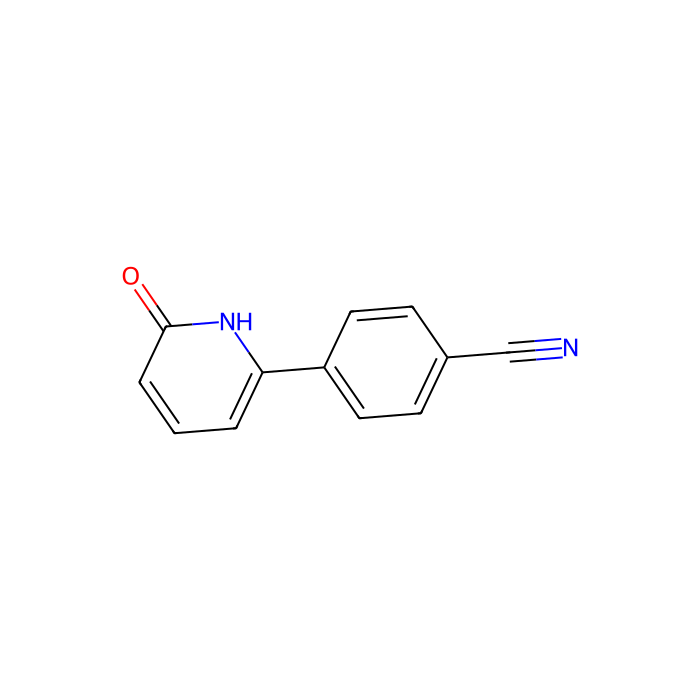
This compound belongs to the class of organic compounds known as phenylpyridines. These are polycyclic aromatic compounds containing a benzene ring linked to a pyridine ring through a CC or CN bond.
External Descriptors
Not available
1. Djoumbou Feunang Y, Eisner R, Knox C, Chepelev L, Hastings J, Owen G, Fahy E, Steinbeck C, Subramanian S, Bolton E, Greiner R, and Wishart DS. ClassyFire: Automated Chemical Classification With A Comprehensive, Computable Taxonomy. Journal of Cheminformatics, 2016, 8:61.
Zertifikate (CoA, COO, BSE/TSE und Analyse-Diagramm)
C of A & Other Certificates(BSE/TSE, COO):
Analytical Chart:
Chemische und physikalische Eigenschaften
Molekulargewicht
196.200 g/mol
XLogP3
1.600
Hydrogen Bond Donor Count
1
Hydrogen Bond Acceptor Count
2
Rotatable Bond Count
1
Exact Mass
196.064 Da
Monoisotopic Mass
196.064 Da
Topological Polar Surface Area
52.900 Ų
Heavy Atom Count
15
Formal Charge
0
Complexity
364.000
Isotope Atom Count
0
Defined Atom Stereocenter Count
0
Undefined Atom Stereocenter Count
0
Defined Bond Stereocenter Count
0
Undefined Bond Stereocenter Count
0
The total count of all stereochemical bonds
0
Covalently-Bonded Unit Count
1
Lösungsrechner
Molarity Calculator
Determine the necessary mass, volume, or concentration for preparing a solution.
Dilution Calculator
Determine the dilution needed to prepare a stock solution.
Reconstitution Calculator
Bewertungen
Kundenbewertungen
Application Protocols
No application protocols are specified for this item in the Product Data.
Typical research uses (general guidance):
Preparation of 10–100 mM DMSO stock solutions for screening or chemical biology assays; dilute into assay buffer keeping final DMSO ≤1–2% v/v as tolerated by the system.
Use in synthetic sequences transforming the nitrile (hydrolysis/reduction) or the 2-pyridone (O/N-alkylation). Follow standard organic synthesis protocols, monitor by TLC/HPLC/LC–MS, and purify by flash chromatography or recrystallization as appropriate.
For any biological or analytical protocol, validate conditions (solubility, stability, solvent content) in your system before scale-up.
Biological Roles
Item-specific biological function: Not specified for this item; this product is supplied for research use only.
General chemistry/biochemistry context (literature):
2-Hydroxypyridine/2-pyridone motifs are common in bioactive heterocycles and can engage in dual H-bond donor/acceptor interactions, but 6-(4-cyanophenyl)-2-hydroxypyridine itself is not a known natural metabolite or cofactor.
The para-cyano group is a polar, weakly withdrawing substituent often used in medicinal chemistry to tune electronics and metabolic stability; it can also act as a synthetic linchpin to access amides, acids, and amines.
As a scaffold, this compound may be used to probe binding in heteroaromatic recognition sites or as a fragment in structure–activity relationship (SAR) studies; any biological evaluation should be performed by qualified researchers with appropriate controls. No claims of biological activity are made here.
ADME-related notes (general):
Aromatic nitriles are generally metabolically stable; however, in vitro/in vivo behavior depends strongly on substitution pattern, ionization state (pyridone vs hydroxypyridine), and formulation. These considerations are outside the scope of the product specification and must be determined experimentally.
Buffer Applications
This compound is not a conventional buffering agent and is not typically used to prepare pH buffer systems. It lacks a well-defined conjugate acid/base pair with a practical buffering window in aqueous media at useful concentrations.
For aqueous work, consider standard buffers (e.g., phosphate, HEPES, Tris) instead. If dissolution is needed for assays, prepare stock solutions in DMSO or other miscible organic solvents and dilute into the buffered system with attention to final cosolvent percentage.
Green Alternatives
Greener choices relate primarily to solvent selection and reagent choice for transforming the nitrile and the 2-pyridone motif.
Cyrene or GVL (gamma-valerolactone) for coupling and condensation steps when compatible.
Propylene carbonate for polar aprotic needs (beware base sensitivity).
2-MeTHF or CPME instead of THF/toluene for extractions/reactions when solubility allows.
Comparison (general, not item-specific specs):
DMF vs Cyrene: Cyrene offers lower toxicity and biodegradability; viscosity and base sensitivity may slow some reactions.
THF vs 2-MeTHF: 2-MeTHF is bio-based, less miscible with water (easier workups), and forms peroxides more slowly; slight differences in polarity can impact rates/selectivity.
Greener reagents/routes:
Nitrile hydration: Consider catalytic nitrile hydration (e.g., Ru, Pt, or enzyme-catalyzed) in water or water-rich media instead of strong mineral acids/bases.
Nitrile reduction: Use catalytic hydrogenation with recyclable Pd/C under low H2 pressure instead of stoichiometric metal hydrides where feasible.
O-/N-alkylation: Employ greener alkylating agents (carbonate electrophiles) and bases (K2CO3) in safer solvents (MeCN, 2-MeTHF) to minimize halogenated waste.
Note: Evaluate solubility and reactivity trade-offs during solvent switching; conduct small-scale trials to confirm conversion/selectivity.
Pharmaceutical Uses
Item-specific pharmacopeial status or excipient role: Not specified for this item; refer to CoA/Spec Sheet.
General manufacturing/discovery context (no therapeutic claims):
This heteroaromatic scaffold can serve as a medicinal chemistry intermediate for library synthesis and SAR campaigns. The nitrile group enables rapid exploration of analog series via downstream conversion to amides, acids, or amines without altering the biaryl core.
As a solid, it is typically handled as a research reagent rather than as a formulated excipient. If incorporated into screening decks, it is commonly dosed from DMSO stocks and diluted into assay media, observing solvent limits and compound stability.
Regulatory note: This product is for research use only and is not intended for human or veterinary use, diagnostic procedures, or as an API/excipient in commercial formulations without further qualification.
Physical Properties
Item-specific specifications were not provided in the Product Data. Values below are literature/computed guidance only and are NOT product specifications.
Appearance: Not specified for this item; refer to CoA/Spec Sheet.
Melting point, boiling point, density, refractive index: Not specified for this item; refer to CoA/Spec Sheet.
Solubility (literature/general expectations):
Likely low solubility in water due to aromatic biaryl core and limited ionizable functionality under neutral conditions.
Expected good solubility in polar aprotic organic solvents (DMSO, DMF, NMP) and moderate solubility in chlorinated solvents and hot ethyl acetate/acetone (literature/general behavior for comparable heteroaryl nitriles and 2-pyridones).
Acid–base/tautomerism (literature):
2-hydroxypyridine ⇌ 2-pyridone tautomerism; the lactam (pyridone) form is often favored in polar media and in the solid state, enabling O,N-chelation to metals and strong H-bonding.
Phenolic OH of 2-hydroxypyridine exhibits weak acidity; apparent pKa values for analogous systems are typically in the 11–12 range for the enolic OH, while the ring nitrogen is weakly basic (literature, scaffold-level trends). Exact pKa for this compound: Not specified for this item; refer to CoA/Spec Sheet.
LogP/logD: Not specified for this item; refer to CoA/Spec Sheet.
Quality and Grades
Grade/Purity: Not specified for this item; refer to CoA/Spec Sheet.
What grade means (general guidance):
Research-grade heteroaromatic building blocks are typically supplied with chromatography-verified purity (HPLC/GC/NMR) suitable for synthesis and screening. If HPLC-grade or LC-MS-grade were specified, it would imply reduced non-volatile residues and low UV background; no such claims are made here.
Stabilizers/additives: Not specified for this item; refer to CoA/Spec Sheet.
Impurity considerations (general for this scaffold):
Potential residuals may include regioisomers, unfunctionalized biaryl, hydrolysis products of the nitrile (amide/acid), and traces of metal catalysts from cross-coupling routes. If metal content limits are critical, consult the CoA.
Documentation: For definitive assay, residual solvent levels, water content, and UV cutoffs, refer to the item-specific CoA/Spec Sheet. Do not use literature values as specifications.
Reaction and Applications
With its transformable para-cyano group and the tautomeric 2-hydroxypyridine/2-pyridone, this scaffold serves as a versatile intermediate in heteroaryl chemistry.
Functional-handle chemistry (literature):
Nitrile derivatizations: hydrolysis to amide (mild: H2O2/base; classical: H2SO4 or KOH, reflux), to carboxylic acid (stronger conditions); Pinner reaction to imidates/esters; reduction to primary amine (Raney Ni/H2, catalytic hydrogenation, or BH3/THF); addition of nucleophiles (e.g., hydroxylamine → amidoxime; organometallics → ketimines/amidines after workup).
2-Pyridone chemistry: O-alkylation/acylation (K2CO3/alkyl halide in DMF; acid chloride/base) vs N-alkylation (stronger base, e.g., NaH, phase-transfer). Chelation enables C–H activation or directed metallation at adjacent positions in advanced synthesis.
Coordination and materials angles:
The 2-pyridone form can act as an O,N-bidentate ligand to transition metals (e.g., Pd, Cu), useful in catalysis development or complex synthesis (literature precedent).
Applications in discovery (non-clinical):
As a heteroaryl core for SAR exploration in medicinal chemistry and as a fragment for building donor–acceptor systems in materials.
For nitrile reductions, suppress over-reduction of the aromatic ring by choosing chemoselective systems (e.g., catalytic hydrogenation at low pressure with poisoned catalysts, or hydride reagents like DIBAL under controlled conditions).
Reaction Conditions
Guidance below reflects literature practices for related functional groups; it is not item-specific specification.
Nitrile hydrolysis:
To amide: 30–80 °C in MeOH/H2O with catalytic base or acid; or H2O2/Na2CO3 in MeOH/H2O. Monitor by HPLC; hours-scale.
To acid: Aqueous KOH or H2SO4, reflux (80–110 °C) for 6–24 h; isolate after neutralization.
Nitrile reduction to amine:
Catalytic hydrogenation (Pd/C, 1–5 bar H2) in MeOH/EtOH or EtOAc; 2–16 h. Alternative: BH3·THF (0 °C → rt) or LiAlH4 (anhydrous ether; caution) with careful quench.
O-/N-alkylation of 2-pyridone:
O-alkylation: K2CO3 or Cs2CO3 (1.2–2.0 equiv) in DMF/MeCN/acetone, alkyl halide (1.1–1.5 equiv), 20–60 °C, 2–12 h.
N-alkylation: NaH (1.1–1.5 equiv) or stronger base in DMF/THF, alkyl halide (1.1–1.5 equiv), 0–25 °C then warm to 40–60 °C; 2–8 h.
Cross-coupling (for analog synthesis on related halogenated substrates):
Suzuki–Miyaura: Pd(dppf)Cl2 (1–3 mol%), K2CO3 (2–3 equiv) in dioxane/H2O or 2-MeTHF/H2O, 60–90 °C, 2–12 h.
Workup/purification tips:
Strong adsorption on silica is common; add 0.1–1% Et3N or 1–5% MeOH to eluents. For hydrogenations, filter through Celite to remove catalyst and avoid metal contamination.
All temperatures/times are typical literature ranges and should be optimized for the specific substrate and scale.
Safety and Handling
Authoritative safety information should be obtained from the SDS. The Product Data did not include GHS details for this item.
GHS classification, pictograms, H-statements: Not specified for this item; refer to SDS.
General hazards (literature/analog-based):
Aromatic nitriles can release toxic fumes (including HCN, NOx) under combustion/thermal decomposition; handle away from ignition sources and high heat.
2-hydroxypyridine/2-pyridone scaffolds are irritant to skin/eyes in analogous compounds; avoid contact and inhalation of dust.
Wear lab coat, safety glasses or goggles, and appropriate chemical-resistant gloves (e.g., nitrile). Work in a fume hood; avoid dust generation.
Prevent environmental release; collect waste in halogenated or non-halogenated organic waste streams per your SOP.
Incompatibilities (general):
Strong oxidizers; strong bases/acids under forcing conditions can hydrolyze the nitrile (to amide/acid) or induce side reactions.
Reactive acylating/alkylating agents may modify the pyridone oxygen or ring nitrogen.
First aid overview (non-specific):
Skin/eye contact: Rinse with water for at least 15 minutes; remove contaminated clothing; seek medical attention if irritation persists.
Ingestion/inhalation: Move to fresh air; rinse mouth; seek medical attention. Provide SDS to responders.
Storage/transport per Product Data: Room temperature; shipped under normal conditions.
Solvent Selection
This compound is a neutral, moderately polar heteroaromatic biaryl with a nitrile and a 2-hydroxypyridine/2-pyridone motif.
Polarity/miscibility (literature/general):
Water: Limited solubility expected.
Organic: High solubility expected in DMSO, DMF, NMP; moderate in MeCN, acetone, ethyl acetate; variable in toluene/THF; typically better at elevated temperature.
Stock solutions and handling:
For bioassay or library screening workflows, 10–100 mM stocks in anhydrous DMSO are common; filter if particulates persist.
Selection tips:
Use DMSO/DMF for coupling or derivatization on the nitrile (e.g., amidoxime formation) and for metal-catalyzed transformations where substrate polarity aids dissolution.
Chlorinated solvents (DCM, CHCl3) or EtOAc are suitable for extractions and flash chromatography; add a polar modifier (1–5% MeOH or 0.1–1% Et3N) if tailing due to pyridone hydrogen bonding.
Comparison (general):
DMSO vs DMF: DMSO offers higher solvating power and greener profile; DMF often provides faster kinetics in nucleophilic additions but has more stringent EH&S concerns.
MeCN: useful for polar reactions and HPLC, but substrate solubility may be lower than in DMSO/DMF.
Container: Store tightly closed in a dry, well-ventilated area. Protect from light and moisture to preserve integrity of the nitrile and to minimize tautomerization-driven polymorphic changes.
Stability: Item-specific stability data not provided; refer to CoA/Spec Sheet. In general, aromatic nitriles and 2-pyridones are stable under ambient, dry conditions.
Reconstitution/preparation of solutions (general guidance):
Prepare concentrated stock solutions in anhydrous DMSO (e.g., 10–100 mM). For synthetic use, DMF, MeCN, or EtOAc may be appropriate depending on the transformation.
Filter solutions if insoluble particulates persist. Use dry solvents for base- or moisture-sensitive transformations.
Freeze–thaw: Solid form typically tolerates ambient storage; if solutions are prepared, store aliquots at −20 °C to avoid repeated freeze–thaw cycles that may promote degradation or precipitation.
Shelf life: Not specified for this item; refer to CoA/Spec Sheet.
Research Use Note: For research use only.
Structure and Identity
A heteroaromatic biaryl bearing a 2-hydroxypyridine (2-pyridone tautomeric system) linked at C-6 to a para-cyanophenyl ring.
Item identifiers (Product Data):
SKU: C179422
CAS: 1111110-50-9
PubChem CID: 53217518
InChIKey: 42748 (as provided; appears truncated — consult CoA/SDS for full key)
SMILES: Not specified for this item; refer to CoA/Spec Sheet.
Computed/literature identity (non-spec):
Preferred name: 6-(4-Cyanophenyl)-2-hydroxypyridine (tautomeric with 6-(4-cyanophenyl)-2-pyridone)
Molecular formula (computed from structure): C12H8N2O
Core ring systems: a pyridine ring bearing a 2-hydroxyl (keto–enol tautomerism with 2-pyridone) and a phenyl ring para-substituted by a cyano group.
Functional groups: phenyl–pyridine biaryl linkage; cyano (–C≡N) as an electrophilic, transformable handle; 2-hydroxypyridine/2-pyridone motif offering H-bond donor/acceptor and potential metal chelation (O,N-bidentate in the pyridone form).
2D topology (verbal): a para-cyanophenyl ring is bonded to the 6-position of the pyridine; the pyridine bears an OH at C-2 adjacent to the ring nitrogen. The cyano sits para to the biaryl junction on the phenyl.
Synthetic Utility
Transformable motifs:
Para-cyano group: gateway to amides/acids (hydrolysis), amidines/imidates (Pinner), primary amines (reductions), heterocycles (e.g., via cycloaddition or condensation of the nitrile carbon and nucleophiles).
2-Pyridone/2-hydroxypyridine: ambident nucleophile permitting O- vs N-functionalization; strong H-bond acceptor/donor enabling supramolecular assembly and ligand design.
Retrosynthetic value:
The biaryl connectivity suggests prior assembly via cross-coupling (e.g., Suzuki–Miyaura of a 6-halopyridin-2-one derivative with a 4-cyanophenyl boronate/boronic acid, or Negishi/Kumada variants). Knowledge of this enables late-stage diversification at either ring.
Diversification map (literature):
O-acylation/alkylation to mask the pyridone and modulate polarity.
Directed metalation adjacent to the pyridone carbonyl (in the pyridone tautomer) for C–H functionalization.
Conversion of –CN to –CONH2/–CO2H/–CH2NH2 enabling subsequent coupling (amide formation), diazotization (from anilines after reduction), or heterocycle formation (e.g., imidates → triazines).
Purification/practical notes:
The pyridone motif can cause strong silica interactions; add polar modifiers (MeOH, Et3N) to eluents. Recrystallization from polar aprotic/EtOAc–hexanes mixtures may be effective depending on substituent pattern.
Target Specificity
This product is a small-molecule research chemical, not an antibody or biological targeting reagent.
Antigen/epitope, clone, isotype, species reactivity: Not applicable.
No item-specific target-binding data are provided. Any target engagement must be established experimentally by the end user.
Wir verwenden Cookies, um die ordnungsgemäße Funktion der Website sicherzustellen und, soweit zulässig, Ihr Nutzererlebnis zu verbessern. Sie können Ihre Einstellungen jederzeit unter „Einstellungen“ verwalten. Weitere Informationen finden Sie in unserer Cookie-Richtlinie.
Shall we send you a message when we have discounts available?
Remind me later
Thank you! Please check your email inbox to confirm.
Products are supplied to verified businesses, institutions, and qualified professionals for research and development use only. Not for use in humans, animals, diagnosis, or therapy.