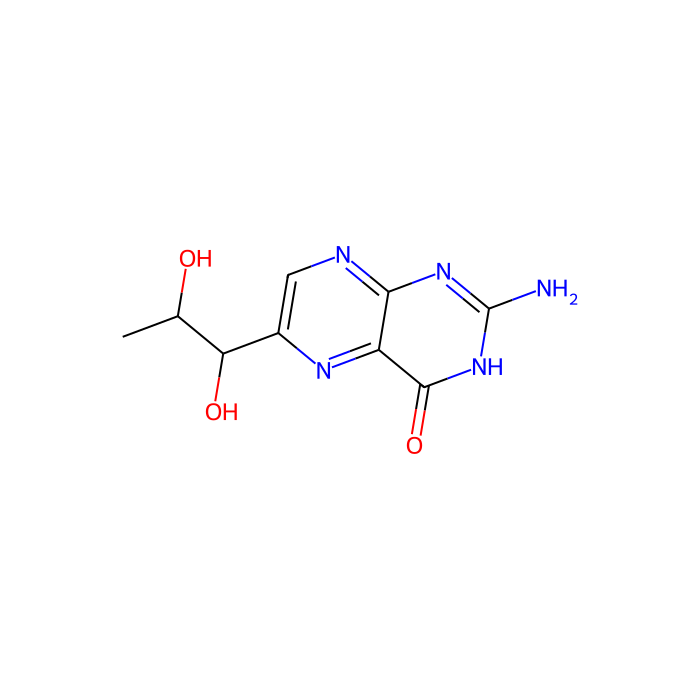
Biopterin has two isomers (D- and L-biopterin). We sell only L-Biopterin. The hydrogenated forms of biopterin i.e. dihydrobiopterin and tetrahydrobiopterin are involved in many important biochemical functions in the human body, among which are the hydroxylation of tyrosine, phenylalanine and tryptophan. 6-Biopterin is an oxidation product from the melanogenesis regulating cofactor (6R)5,6,7,8 tetrahydrobiopterin (6-BH4). In vitro, 6-Biopterin is cytotoxic to melanocytes. However, in vivo, 6-Biopterin is rapidly and sequentially reduced back to 6-GH4 via q-BH2. Recent studies suggest that 6-Biopterin among other pteridines may be a useful non-invasive biomarker for cancer
Spezifikationen
Synonyme
2-amino-6-((1R,2S)-1,2-dihydroxypropyl)pteridin-4(1H)-one | (S-(R*,S*))-2-Amino-6-(1,2-dihydroxypropyl)-1H-pteridin-4-one | L-Biopterin | 2-amino-6-[(1R,2S)-1,2-dihydroxypropyl]-3H-pteridin-4-one | 4(1H)-Pteridinone, 2-amino-6-[(1R,2S)-1,2-dihydroxypropyl]- | [S-(R*,S*)]-2-amino-6-(1,2-dihydroxypropyl)-4(1H)-Pteridinone | Oxygenase, tyros Show more
Spezifikationen & Reinheit
≥97%
Biochemische und physiologische Mechanismen
Coenzyme and obligate cofactor of iNOS activity. Regulated by adrenergic cyclic adenosine monophasphate-dependent mechanism. Cofactor for neurotransmitters. Active in vitro and in vivo .
Storage
Store at 2-8°C
Verschickt in
Wet ice
Dieses Produkt erfordert Kühlkettenversand. Grundversand und andere Economy-Optionen sind nicht verfügbar.
Hinweis
Wherever possible, you should prepare and use solutions on the same day. However, if you need to make up stock solutions in advance, we recommend that you store the solution as aliquots in tightly sealed vials at -20°C. Generally, these will be useable for up to one month. Before use, and prior to opening the vial we recommend that you allow your product to equilibrate to room temperature for at least 1 hour. Need more advice on solubility, usage and handling? Please visit our frequently asked questions (FAQ) page for more details.
This compound belongs to the class of organic compounds known as biopterins and derivatives. These are coenzymes containing a 2-amino-pteridine-4-one derivative. They are mainly synthesized in several parts of the body, including the pineal gland.
External Descriptors
biopterin
1. Djoumbou Feunang Y, Eisner R, Knox C, Chepelev L, Hastings J, Owen G, Fahy E, Steinbeck C, Subramanian S, Bolton E, Greiner R, and Wishart DS. ClassyFire: Automated Chemical Classification With A Comprehensive, Computable Taxonomy. Journal of Cheminformatics, 2016, 8:61.
Bioptein is very slightly soluble in water. The solubility of biopterin is about 0.01 g per 100 g of water (220C). Concentrated solutions of biopterin may be prepared using 0.05M NaOH. Ultrasonication may be used to improve dissolution.
Determine the necessary mass, volume, or concentration for preparing a solution.
Dilution Calculator
Determine the dilution needed to prepare a stock solution.
Reconstitution Calculator
Bewertungen
Kundenbewertungen
Application Protocols
No manufacturer-validated protocols were provided for this SKU. The following are general, literature-based examples to guide method development.
Example 1: Preparation of a 10 mM stock solution
Weigh desired amount under low light. Dissolve in DMSO to 10 mM or in 0.1 M NaOH. Vortex gently. Filter (0.22 µm) if particulate remains. Aliquot in amber vials and store refrigerated.
Example 2: HPLC quantification (fluorescence)
Column: C18 (or HILIC for enhanced retention of polar pterins).
Mobile phase A: 20 mM ammonium formate, pH ~3.0–3.5 (formic acid). Mobile phase B: ACN.
Gradient: 5–20% B over 10–15 min (optimize per column).
Detection: Ex ~350 nm, Em ~440 nm (optimize per instrument). Include 0.1–1 mM EDTA in mobile phase or sample to limit metal-catalyzed redox.
Example 3: Redox calibration set
Prepare separate solutions of biopterin, BH2, and BH4 under appropriate redox conditions. Confirm identities by retention time and spectra. Use freshly prepared reduced standards; keep on ice and protected from light.
Note
These are illustrative only. Optimize conditions for your equipment and matrix. Refer to the SDS and CoA for safety, identity, and purity details.
Biological Roles
General biology (literature; not a claim of activity for this SKU)
Redox cofactor system: Biopterin is the fully oxidized product of the tetrahydrobiopterin (BH4) redox cycle. BH4 is an essential cofactor for aromatic amino acid hydroxylases (phenylalanine, tyrosine, tryptophan hydroxylases) and all nitric oxide synthases (NOS). Oxidative turnover or enzymatic cycling produces 7,8-dihydrobiopterin (BH2) and then oxidized biopterin.
Pathway context: The biopterin/BH2/BH4 pool is maintained by enzymes such as dihydrofolate reductase (salvage of BH2) and quinoid dihydropteridine reductase. Accumulation of oxidized biopterin often indicates oxidative stress or impaired cofactor recycling in cells/tissues (research indicator; literature).
Analytical marker: Because oxidized pterins are comparatively stable and fluorescent, biopterin is frequently quantified by HPLC with electrochemical or fluorescence detection as a proxy of BH4 pathway status in biochemical samples.
Transport and localization: Pterins are polar and may require transporters for cellular uptake; protein binding is generally low to moderate, with strong dependence on pH and ionic strength (literature trends).
Important caveat
The above describes biological context for the pterin family. This product is provided strictly for research use only and is not intended for diagnostic or therapeutic applications.
Buffer Applications
Not a buffering reagent.
6-Biopterin itself is not used as a pH buffer. However, its preparation and analysis often occur in defined buffers.
Practical note (literature): For HPLC or enzymology sample prep, common buffers include phosphate, HEPES, or ammonium formate/acetate. When maintaining redox state or minimizing metal-catalyzed oxidation, include EDTA (e.g., 0.1–1 mM) and control pH (often mildly acidic for oxidized biopterin chromatography; mildly basic for dissolution before immediate neutralization).
When preparing standards, adjust ionic strength to improve injection reproducibility in LC analyses. Avoid high concentrations of primary amines that may interact with the pterin ring in fluorescence measurements.
Green Alternatives
Perspective
As a solid analyte/standard rather than a bulk solvent or reagent, “green alternatives” mainly concern dissolution media and workup practices. The goals are to minimize hazardous solvents, reduce waste, and preserve analyte integrity.
Greener choices for dissolution (general)
Prefer alkaline aqueous stocks (e.g., 0.05–0.1 M NaOH) over dipolar aprotics when compatible with your assay. Rapidly dilute into buffered aqueous media to reach assay pH while minimizing organic cosolvent content.
If organic cosolvent is required, use water-miscible, lower-toxicity options (ethanol, propylene carbonate) when solubility allows; verify stability and spectral properties.
Comparison (general guidance; not item-specific)
Alkaline water: renewable, low-toxicity; may limit long-term stability; requires careful pH control on dilution.
Ethanol/water: greener than DMSO/DMF; moderate solubility; potential enzyme modulation at higher %.
DMSO: excellent solubilizer; higher EHS burden; typically acceptable at ≤1% v/v in bioassays.
Process considerations
Use small-volume, high-concentration stocks to reduce solvent consumption.
Protect from light to avoid photoproduct waste.
Employ HPLC gradients with aqueous-dominant phases when feasible; minimize halogenated solvents.
The greenest path is often alkaline aqueous handling with prompt use and light protection, reserving DMSO for cases where solubility absolutely requires it.
Pharmaceutical Uses
Formulation and manufacturing context (general; no therapeutic claims)
Analytical reference: Oxidized biopterin is used as a reference/impurity standard during process development and quality control of tetrahydrobiopterin-related actives and in research on NOS or aromatic amino acid hydroxylase cofactors.
Excipient status: Not commonly used as a pharmaceutical excipient. No pharmacopeial monograph is typically assigned for oxidized biopterin itself (literature perspective).
Method development: Its characteristic UV/fluorescence enables development of stability-indicating methods for BH4-containing formulations. It can serve to validate extraction, derivatization, and chromatographic recovery.
Regulatory and handling notes
If used as a reference standard in regulated settings, batch-specific CoA, purity, and stability data are required. Photostability and solution stability studies under ICH-like conditions are advisable for method validation.
Residual solvent and elemental impurity profiles are Not specified for this item; refer to CoA/Spec Sheet if such controls are required for your application.
Physical Properties
Item-specific specifications
Appearance: Not specified for this item; refer to CoA/Spec Sheet.
Molecular Weight: Not specified for this item; refer to CoA/Spec Sheet.
General/literature properties (for oxidized pterins/biopterins; not item-specific specs)
Aggregated physical character: low-volatility, high-melting heteroaromatic solid; typically non-hygroscopic to mildly hygroscopic. Many pterins are yellow to off-white and light-sensitive.
Solubility profile: sparingly soluble in neutral water and most nonpolar organics; solubility increases substantially in basic aqueous media (e.g., ≥0.05–0.1 M NaOH) and in strong H-bonding dipolar aprotic solvents (DMSO, DMF). The vicinal diol enhances H-bonding but ring aromaticity limits aqueous solubility at neutral pH.
Acid/base behavior: weakly basic ring nitrogens and an exocyclic amine; deprotonation of side-chain alcohols under strong base enhances solubility. Amphoteric behavior overall, with limited ionization in the neutral range.
Spectroscopy: conjugated pterin chromophore shows UV absorption in the near-UV (typical pterins have bands around 245–260 nm and 340–360 nm; literature). Fluorescent emission (blue-green) may be observed for some oxidized pterins under UV excitation; intensity depends on pH and solvent (literature).
Stability considerations: sensitive to strong UV and oxidative photochemistry; oxidized biopterin is the aromatic end-state of the BH4/BH2/B biopterin redox series and is generally more air-stable than its reduced congeners, but can undergo further photodegradation and side-chain oxidation (literature).
Always consult the CoA for definitive item-specific values.
Quality and Grades
Item-specific
Grade/Purity: Not specified for this item; refer to CoA/Spec Sheet.
Guidance on quality expectations for 6-Biopterin
Identity control: Pterin compounds are typically verified by a combination of HPLC/UPLC purity, UV–Vis spectral profile, and HRMS. 1H/13C NMR may be limited by solubility; DMSO-d6 or alkaline D2O often used.
Purity considerations: Oxidized degradation products (e.g., ring-open or carboxylated pterins) and side-chain oxidations are common impurities in aged materials. Light exposure may alter UV/fluorescence signatures; hence light-protected packaging is recommended.
Residual solvents/trace inorganics: If critical for your method (e.g., LC–MS quantitation or enzyme assays), request a detailed Spec Sheet for residual solvents/metals. Absent explicit limits, assume Not specified for this item; refer to CoA/Spec Sheet.
Stabilizers: None stated for this SKU. If present in related products, stabilizers (e.g., antioxidants) can influence UV/fluorescence baselines and enzyme assays.
What the grade typically implies (general)
Analytical/reagent grade material for research often targets ≥95–98% HPLC purity with controlled water content and well-defined UV spectrum (literature norms). Chromatographic suitability (low baseline noise at 254–360 nm) is important when used as a reference standard.
Recommendation
For quantitative analytical use (e.g., standards for BH4 pathway studies), obtain the current CoA with batch-specific purity, water, and spectral data.
Reaction and Applications
Research and analytical applications (general/literature)
Redox pathway studies: 6-Biopterin is the oxidized endpoint of the tetrahydrobiopterin (BH4) cofactor cycle. It serves as a reference standard for quantifying BH4/BH2/biopterin pools in nitric oxide synthase and aromatic amino acid hydroxylase research.
Chromatographic/fluorescence standards: The pterin chromophore exhibits characteristic UV and fluorescence signatures useful for HPLC/UPLC method development and instrument qualification in the pterin family.
Photochemistry model: Oxidized pterins are models for photophysical studies (intersystem crossing, ROS generation under UV) and for mapping degradation routes of reduced cofactors (literature).
Synthetic/transformation context
Interconversion: Chemical reduction (e.g., sodium dithionite, BH3·THF, or catalytic hydrogenation under carefully controlled conditions) converts oxidized pterin to dihydro/tetrahydro states; mild iodine or air/metal-catalyzed oxidation re-forms oxidized biopterin from reduced congeners (literature). These are useful for preparing defined redox standards.
Derivatization: The vicinal diol can be selectively protected (acetonide, silyl) to enable further modifications or labeling (e.g., fluorescent tags, isotopes). N-alkylation/acylation on ring nitrogens proceeds under strongly basic conditions but may affect aromaticity and spectral behavior.
Practical tips
Light management: Work under low-light; use amber glass during sample prep and HPLC collection.
pH control: Prepare stocks in DMSO or mild base; avoid prolonged exposure to strong acids/bases that degrade the ring.
Metal ions: Transition metals can catalyze redox changes; include metal chelators (e.g., EDTA) in analytical buffers when redox state control is critical (literature).
Note: No manufacturer-specific application text was provided; the above expands typical research uses for oxidized biopterins.
Reaction Conditions
General conditions (literature guidance; not item-specific specifications)
Interconversion chemistry
Reduction to BH2/BH4: Sodium dithionite in buffered aqueous media (pH 7–9) at 0–25°C can partially reduce oxidized pterins; stronger reducers (e.g., BH3·THF) or catalytic hydrogenation (H2/Pd-C) under controlled time/temperature afford deeper reduction. Strict anaerobic, light-protected conditions help maintain reduced states.
Oxidation from BH2/BH4: Iodine in aqueous/alcoholic media or air oxidation with metal catalysts converts reduced forms back to biopterin; reactions are typically fast at ambient temperature with monitoring by UV/fluorescence HPLC.
Derivatization
Diol protection: 2,2-dimethoxypropane/acetone with catalytic acid (e.g., p-TsOH) at 0–25°C affords acetonide protection; work under subdued light.
N-alkylation: Strong base (e.g., NaH) in DMF/DMSO at 0–25°C with alkyl halides can functionalize ring nitrogens; regioselectivity depends on base, solvent, and protecting groups.
Analytical method conditions
HPLC: Reversed-phase or HILIC; mobile phases such as ammonium formate/acetate (5–50 mM) with MeOH/ACN; detection by fluorescence (Ex ~350 nm/Em ~440 nm typical for oxidized pterins; literature) or UV (245–360 nm). Keep samples protected from light; include EDTA to suppress metal-catalyzed redox.
Expected outcomes
Yields and conversions depend strongly on solvent, pH, and light exposure; literature reports emphasize fast interconversion but instability of reduced forms unless strictly controlled.
Always validate these conditions at small scale before scale-up.
Safety and Handling
Safety overview
Research use only. Not for human or veterinary use.
GHS/SDS: Specific hazard classifications and statements are Not specified for this item; refer to CoA/Spec Sheet and the SDS for authoritative safety data.
General handling guidance (pterin-class compounds; literature/practice)
Light sensitivity: Protect from light. Use amber vials and minimize UV exposure to prevent photochemical degradation.
Air/oxidation: The oxidized biopterin form is relatively air-stable vs. tetrahydro derivatives, yet avoid prolonged exposure to strong oxidants. Work under ambient atmosphere is typically acceptable.
PPE: Wear lab coat, safety glasses, and suitable gloves (e.g., nitrile). Use a chemical fume hood when weighing, dissolving, or transferring powders/solutions.
Incompatibilities: Strong oxidizers and strong acids/bases can degrade the pterin ring or side chain. Avoid reactive acylating/alkylating agents unless intended.
Hygiene: Avoid inhalation of particulates and contact with skin/eyes. Wash thoroughly after handling.
First-aid (general)
Inhalation: Move to fresh air; seek medical attention if symptoms develop.
Skin/eye contact: Rinse with water for at least 15 minutes; remove contaminated clothing; seek medical attention if irritation persists.
Ingestion: Rinse mouth with water; do not induce vomiting; seek medical attention.
Fire/thermal hazards
Combustible organic solid; use water spray, CO2, foam, or dry chemical. Thermal decomposition may produce nitrogen oxides and carbon oxides (general for nitrogen-rich heteroaromatics).
Disposal
Dispose of in accordance with institutional and local regulations. Collect light-sensitive waste in opaque containers.
Solvent Selection
Polarity and miscibility (general, literature)
Class: Polar, heteroaromatic small molecule; neutral overall at physiological pH but weakly basic/acidic sites present.
Solubility tendencies: Poor in nonpolar solvents (hexanes, toluene); limited in alcohols; improved in DMSO and DMF; markedly improved in basic aqueous media (e.g., ≥0.05–0.1 M NaOH). Acidic media often decreases solubility of the oxidized form.
Practical choices
Stock solutions for assays: DMSO (10–50 mM), or aqueous 0.1 M NaOH for immediate dilution into buffer. Filter sterilize if needed (0.22 µm) and protect from light.
LC methods: Water–acetonitrile or water–methanol with acidic modifiers (formic acid) are common for reversed-phase; however, oxidized pterins can show strong retention and secondary interactions—consider ion-pairing or column technologies for polar analytes (HILIC) when necessary.
When to choose alternatives
If DMSO is incompatible with your biology, prepare a concentrated alkaline aqueous stock and dilute rapidly into buffered media while monitoring pH to prevent local high-pH exposure of sensitive components.
For fluorescence studies, avoid solvents that quench or shift emission (highly protic/acidic media); verify spectra in your exact solvent system.
Small comparison (general)
DMSO: maximal solubility, easy handling; may interfere with enzymes at >1–2% v/v.
DMF: similar solubilization; greater regulatory scrutiny and potential toxicity.
Alkaline water: greenest choice; limited shelf life due to possible base-catalyzed transformations; adjust pH on dilution.
Always confirm solvent and concentration compatibility with your assay.
Storage and Reconstitution
Item-specific
Storage Conditions: Store at 2–8°C.
Shipped In: Wet ice.
General/literature guidance for 6-Biopterin
Light protection: Store in amber, airtight containers. Minimize headspace to limit oxidative photochemistry.
Humidity: Keep tightly closed; include desiccant if long-term storage is anticipated.
Shelf life: Monitor by HPLC/UV–Vis for any changes in purity or spectral profile during storage; re-test after 6–12 months or per institutional SOPs.
Reconstitution suggestions (for immediate use)
DMSO stock: Prepare 10–50 mM under low light; mix until fully dissolved. Aliquot into amber vials; store at 2–8°C for short term. For longer term, freezing aliquots at −20°C may be used; avoid repeated freeze–thaw.
Alkaline aqueous stock: Dissolve in 0.05–0.1 M NaOH. Use promptly or aliquot and refrigerate; prolonged basic storage may promote degradation. Neutralize immediately upon dilution into assay buffer.
Working solutions: Prepare fresh on the day of use when possible. Filter sterilize (0.22 µm) if needed for cell-free assays.
Stability notes
Avoid strong acids/bases, oxidants, and light. Reduced congeners (BH2/BH4) are far less stable than oxidized biopterin; handle redox interconversions under inert atmosphere and low light when applicable.
Always refer to the CoA/Spec Sheet for any batch-specific storage and handling instructions.
Structure and Identity
Brief overview: 6-Biopterin is a pterin-class heteroaromatic, the fully oxidized (aromatic) counterpart in the biopterin/BH4 redox family, featuring a fused pteridine ring and a 6-substituent characteristic of biopterins.
Item-specific (from Product Data)
CAS: 22150-76-1
InChIKey: 199702
SMILES: Not specified for this item; refer to CoA/Spec Sheet.
Molecular Formula: Not specified for this item; refer to CoA/Spec Sheet.
Molecular Weight: Not specified for this item; refer to CoA/Spec Sheet.
Structural features (general/literature description)
Core ring system: bicyclic pteridine (pyrimidine fused to pyrazine), typically bearing a 2-amino and 4-oxo (2-amino-4(1H)-oxopteridin-6-yl…) motif in oxidized pterins.
6-substituent: biopterins carry a chiral 1,2-dihydroxypropyl side chain at C-6 (stereochemistry defined for specific biopterin isomers; “6-Biopterin” refers to the oxidized ring state at that substituted position).
Functional groups: conjugated diazine ring nitrogens (basic centers of low basicity), one ring carbonyl (lactam), an exocyclic amino group (weakly basic), and vicinal diol on the side chain (hydrogen-bond donor/acceptor).
2D description in words: a planar, highly conjugated pteridine nucleus with an exocyclic –NH2 near the ring carbonyl and a C-6 side chain terminating in a secondary alcohol with an adjacent primary alcohol.
Notes
Exact stereochemistry, formula, and identifiers beyond CAS should be confirmed on the CoA/Spec Sheet for this SKU.
Synthetic Utility
Role in synthesis (general/literature)
Scaffold for derivatization: The pterin core provides multiple nitrogen sites and a conjugated system amenable to selective N-alkylation/acylation under strong base or via transient protection of the exocyclic amine. Such modifications yield probes, affinity tags, or solubility-tuned analogs.
Side-chain chemistry: The vicinal diol at C-6 (biopterin) allows protection (e.g., acetonide) followed by oxidation, substitution, or labeling (e.g., isotopic enrichment) to craft standards and reporter molecules.
Redox toggling: Interconversion among biopterin/BH2/BH4 states under controlled chemical or enzymatic conditions enables synthesis of calibration panels for redox biology and analytical method validation.
Cross-coupling/annulation relevance: Direct cross-coupling on the unactivated pterin ring is challenging; strategies include pre-halogenation or using activated pterin derivatives. N-oxide routes and directed metalation have been explored in pteridine chemistry (literature).
Retrosynthetic value
6-Biopterin serves as a late-stage oxidized endpoint from reduced precursors; using it as a starting point is advantageous when the target is an oxidized, fluorescent pterin derivative, minimizing over-oxidation risks during final steps.
Cautions
Reaction conditions must avoid ring opening or loss of aromaticity unless intended. Extended strong acid or base can degrade the heterocycle; protect from light during multi-step manipulations.
Target Specificity
Not applicable.
This product is a small-molecule pterin standard, not a biological targeting reagent (e.g., antibody, ligand with defined receptor specificity, or inhibitor with validated selectivity profile). No antigen, clone, isotype, or species reactivity applies.
Any biological context provided elsewhere describes general roles of the biopterin/BH4 pathway for research orientation only.
Wir verwenden Cookies, um die ordnungsgemäße Funktion der Website sicherzustellen und, soweit zulässig, Ihr Nutzererlebnis zu verbessern. Sie können Ihre Einstellungen jederzeit unter „Einstellungen“ verwalten. Weitere Informationen finden Sie in unserer Cookie-Richtlinie.
Dürfen wir Sie über Rabattaktionen informieren?
Später erinnern
Vielen Dank! Bitte überprüfen Sie Ihren E-Mail-Posteingang, um zu bestätigen.
Products are supplied to verified businesses, institutions, and qualified professionals for research and development use only. Not for use in humans, animals, diagnosis, or therapy.

 I1419092