Determine the necessary mass, volume, or concentration for preparing a solution.
Dilution Calculator
Determine the dilution needed to prepare a stock solution.
Reconstitution Calculator
Bewertungen
Kundenbewertungen
Application Protocols
No application protocols are specified for this item. As a small molecule, usage conditions depend on your synthetic or analytical goals.
General suggestions (literature/general)
Prepare stock solutions in dry DMSO (e.g., 10–50 mM) for screening; filter-sterilize if needed through 0.22 µm PTFE.
For coordination studies, adjust pH to deprotonate the phenol (mild base) before metal addition; characterize complexes by UV–Vis, fluorescence, and MS.
For derivatization, follow standard protocols for O-alkylation/acylation using anhydrous conditions and inert atmosphere where appropriate.
Always validate conditions on small scale and confirm identity/purity by appropriate analytical methods.
Biological Roles
No biological role is specified for this item; it is supplied for research use only.
Literature/general background
Hydroxyquinolines are known for metal-chelation capacity via the phenolate oxygen and ring nitrogen, forming stable 5- or 6-membered chelates. Such ligation can modulate redox behavior and fluorescence of metal centers.
Substituents (2-propyl, 6-ethoxy) are expected to tune lipophilicity and electronic density on the ring, which can influence target engagement in discovery screens (e.g., metalloenzyme interactions) but do not define a specific biological target on their own.
The phenolic group may participate in hydrogen bonding or act as a protonophore under certain conditions; deprotonation state will depend on local pH and microenvironment.
Any biological assays should be designed with appropriate controls for metal chelation and redox activity to avoid confounding results. No clinical or therapeutic claims are made for this product.
Buffer Applications
This compound is not a buffering reagent and is not typically used to prepare biological buffers. It lacks a defined conjugate acid/base pair with a targeted pH range for classical buffers.
Practical note
For aqueous work requiring dissolution, small amounts of base (e.g., NaOH) can form the phenolate to aid solubility, but this is not equivalent to buffering. Choose established buffers (HEPES, phosphate, Tris) appropriate to your pH range and ionic strength needs.
Green Alternatives
Sustainability considerations primarily concern solvent choice and reagent selection; the molecule itself is a specialty heteroaromatic not readily replaced.
Preferable solvent choices (general guidance)
Replace DMF/NMP where possible with greener polar aprotics: acetonitrile, propylene carbonate, or dimethyl carbonate for some O-alkylations/acylations.
Use 2-MeTHF or CPME instead of toluene/THF for extractions and nonpolar reactions when compatible.
For metal complexation in solution, consider ethanol/water mixtures over chlorinated solvents.
Oxidants/bases
If N-oxidation is needed, explore urea–hydrogen peroxide or percarbonate systems as milder, greener alternatives to m-CPBA, subject to compatibility.
Choose carbonate bases (K2CO3, Cs2CO3) over strong inorganic bases to minimize hazards when feasible.
Trade-offs: Greener solvents may alter solubility or reaction rates; verify kinetics and selectivity via small-scale trials. Always confirm product quality with appropriate analytics after changing solvents/reagents.
Pharmaceutical Uses
No pharmacopeial status or excipient role is specified for this item. It is offered for research use only, not for use in humans or clinical applications.
General context (literature/general)
Hydroxyquinoline motifs appear in research-stage compounds due to their metal-binding and heteroaromatic characteristics; however, the presence of a chelating phenol and a basic ring nitrogen requires careful impurity and safety assessment in any development context.
As a synthetic intermediate, such scaffolds can be elaborated to prodrugs or masked phenols (ethers/esters) to tailor ADME in preclinical studies. These considerations are outside the scope of this catalog listing and require program-specific evaluation.
For any regulated or GMP-related use, request comprehensive documentation (CoA, impurity profile, residual solvent data) and qualify material to your internal specifications.
Physical Properties
Item-specific (Product Data)
Appearance: Not specified for this item; refer to CoA/Spec Sheet.
Grade/Purity: Not specified for this item; refer to CoA/Spec Sheet.
Physical state: hydroxyquinoline derivatives of similar substitution are typically crystalline solids; exact melting point not specified for this item.
Acid-base character: weakly basic ring nitrogen (pyridine-like) and weakly acidic phenolic OH; specific pKa values not located for this exact substitution (consult primary literature if needed).
Solubility (qualitative, literature/general): many hydroxyquinolines show good solubility in polar aprotic organic solvents (DMSO, DMF, NMP) and modest solubility in chlorinated solvents; aqueous solubility is usually low at neutral pH but can increase under basic conditions via phenolate formation.
LogP: Not located for this structure; substitution pattern suggests moderate lipophilicity relative to parent quinolinol.
Boiling/melting points, density, refractive index: Not specified for this item; refer to CoA/Spec Sheet or measure under your conditions.
Note: The above are general expectations for substituted hydroxyquinolines and should not be treated as product specifications.
Quality and Grades
Item-specific (Product Data)
Grade/Purity: Not specified for this item; refer to CoA/Spec Sheet.
Research use note: For research use only.
Guidance on grades (general)
When purity is not specified, Aladdin typically supplies research-grade material suitable for synthetic and discovery workflows. If your application requires defined analytical grades (e.g., ≥98% purity by HPLC/GC, low-residual solvents, or trace-metal specifications), request the current CoA/specification sheet for this lot.
UV background: Hydroxyquinolines absorb strongly in the UV range; if using in photophysical assays or as an HPLC analyte/standard, consider requesting a UV trace for impurity profiling.
Stabilizers/antioxidants: None indicated for this item. If your application is air- or light-sensitive, store under inert atmosphere and protect from light as a best practice, even though this item ships/stores at room temperature.
Lot-to-lot consistency
Verify identity and purity by NMR, LC–MS, or HPLC as appropriate for regulated workflows. Retain samples for reference as part of your internal quality management.
Reaction and Applications
Hydroxyquinoline scaffolds are widely used in coordination chemistry, materials, and as synthetic intermediates. The 4-quinolinol nucleus provides both a chelating site (via O and ring N) and a functional handle for derivatization.
Coordination/Materials (literature/general)
Phenoxide formation enables bidentate chelation to metals (e.g., Al(III), Zn(II), Cu(II)), potentially yielding luminescent complexes akin to 8-hydroxyquinolinates. Substituent pattern modulates electronic properties and solubility.
Derivatization chemistry
O-Acylation and O-alkylation at the 4-OH give esters/ethers; base choices include K2CO3, Cs2CO3, or NaH in DMF/MeCN.
N-oxidation (m-CPBA, peracids) affords the N-oxide, useful for further functionalization (e.g., Polonovski-type rearrangements) or as a directing group.
Electrophilic substitution on the aromatic ring (nitration, sulfonylation) is influenced by existing 2-propyl/6-ethoxy substituents; directing effects typically favor positions 5 or 7 in quinoline systems.
Library/screening applications
As a member of a small-molecule library, this scaffold can serve in SAR exploration where metal chelation or hydrogen bonding via the phenol is relevant.
Practical tips
Dry the compound prior to strong base-mediated transformations to avoid competitive hydrolysis. Protect from strong oxidants when preserving the phenol. Monitor reactions by LC–MS at 254–310 nm to exploit the chromophore.
Reaction Conditions
General guidance based on literature for hydroxyquinoline derivatives; adapt to this substrate’s substitution pattern.
O-alkylation
Typical: alkyl halide (1.2–2.0 equiv), K2CO3 or Cs2CO3 (2–3 equiv), dry DMF or MeCN, 20–80 °C, 2–16 h. Monitor by TLC/LC–MS. For hindered electrophiles, NaH (1.1–1.5 equiv) in THF/DMF at 0–25 °C then warm.
O-acylation
Acyl chloride/anhydride (1.2–1.5 equiv), Et3N or pyridine (2–3 equiv), CH2Cl2 or MeCN, 0 °C to rt, 1–4 h. Catalytic DMAP (5–10 mol%) accelerates.
N-oxidation (quinoline → N-oxide)
m-CPBA (1.1–1.5 equiv), CH2Cl2, 0–25 °C, 1–3 h; or H2O2/acetic acid systems with careful temperature control. Quench peracid residues and wash thoroughly.
Mixed acid or fuming reagents at 0–25 °C; substitution pattern and directing effects dictate regioselectivity; pre-evaluate by DFT or small-scale trials.
Metal complexation
Generate phenolate with base (e.g., NaOMe, pH 8–10 in alcoholic media) and add metal salts (acetates, chlorides) at rt to reflux. Stoichiometry commonly 3:1 ligand:Al(III) for tris complexes; verify by elemental analysis or MS.
Yields vary widely by substitution and conditions; consult primary references for target transformations. All parameters above are literature-style guidance, not product specifications.
Safety and Handling
Item-specific (Product Data)
GHS signal word: Not specified for this item; refer to SDS.
H-statements/GHS classification/pictograms: Not specified for this item; refer to SDS.
Storage conditions: Room temperature (as supplied). Shipped under normal conditions.
General safety guidance (literature/general)
Likely hazards: Substituted hydroxyquinolines generally act as irritants to skin, eyes, and respiratory tract. Avoid inhalation of dust and contact with skin/eyes.
PPE: Wear lab coat, safety goggles, and appropriate chemically resistant gloves (e.g., nitrile). Handle powders in a fume hood to minimize dust exposure.
Incompatibilities: Strong oxidizers may react with phenolic/aryl ether functionalities; strong bases/acids can induce decomposition or salt formation. Avoid prolonged exposure to light/air if oxidative discoloration is observed.
First aid overview: If on skin/eyes, rinse with water for several minutes; remove contaminated clothing. If inhaled, move to fresh air. If ingested, rinse mouth; do not induce vomiting; seek medical attention. Provide SDS to health professionals.
Fire safety: Treat as a combustible organic solid. Use CO2, dry chemical, or foam for small fires. Combustion may produce nitrogen oxides and carbon oxides.
Always consult the product’s SDS for authoritative and up-to-date safety information.
Solvent Selection
This compound is an aromatic heterocycle with a phenolic OH and an aryl ether; it behaves as a moderately lipophilic, weakly polar organic molecule.
General solubility tendencies (literature/general)
Polar aprotic: DMSO, DMF, NMP – typically good to excellent solubility for hydroxyquinoline derivatives.
Aromatic: Toluene – moderate solubility; may improve at elevated temperature.
Alcohols: MeOH/EtOH – variable; phenolic hydrogen bonding can aid solvation.
Water: Usually low at neutral pH; solubility may increase under basic conditions (phenolate formation).
Selection tips
For biological screening stocks: prepare concentrated solutions in anhydrous DMSO, then dilute into assay media as needed, monitoring for precipitation.
For O-acylation/O-alkylation: use dry polar aprotic solvents (DMF, MeCN) with a suitable base.
For metal-coordination studies: mixed solvent systems (EtOH/H2O or MeOH/H2O) can assist dissolution of both ligand and metal salt; adjust pH to deprotonate the phenol when needed.
Comparison (general)
Versus parent quinolin-4-ol, the 2-propyl and 6-ethoxy substituents increase hydrophobicity, improving solubility in less polar organic solvents while reducing aqueous solubility.
Storage and Reconstitution
Item-specific (Product Data)
Storage conditions: Room temperature.
Shipped in: Normal conditions.
Research use: For research use only.
General guidance (literature/general)
Keep container tightly closed in a dry, well-ventilated place. Protect from excessive light and moisture to minimize potential oxidative discoloration.
If long-term storage is planned, consider storing under inert gas (argon/nitrogen) and in amber glass.
Reconstitution: For stock solutions, dissolve in anhydrous DMSO or DMF to the desired concentration; vortex or sonicate if needed. For aqueous work, dissolve in minimal DMSO or ethanol, then dilute into buffer with mixing. Adjust pH with mild base to increase solubility via phenolate formation if compatible with your application.
Freeze–thaw: If preparing aliquots, store frozen stocks at −20 to −80 °C to avoid repeated freeze–thaw cycles. Inspect for precipitation or color change before use.
Refer to the CoA/Spec Sheet for any lot-specific handling notes.
Structure and Identity
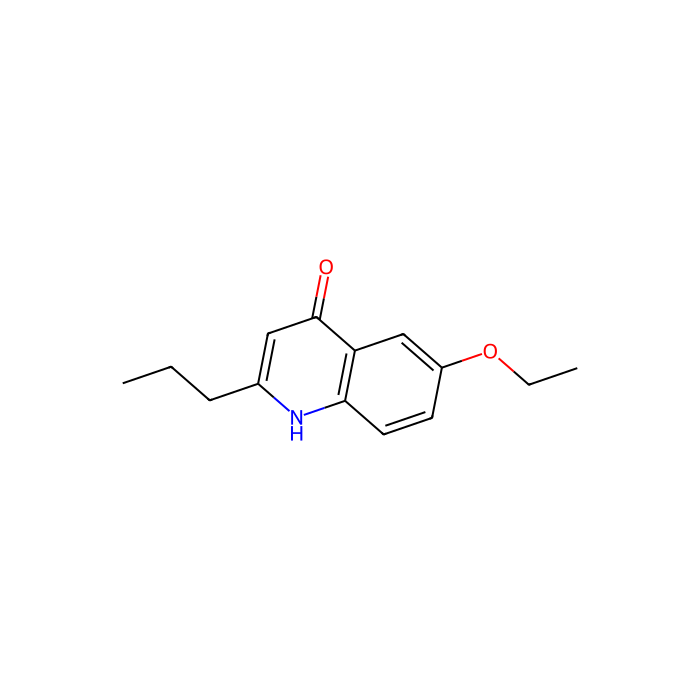
A substituted hydroxyquinoline featuring an ethoxy group at C-6 and a propyl group at C-2 on a quinolin-4-ol scaffold.
A bicyclic aromatic system comprising a pyridine ring fused to a benzene ring. The nitrogen is at position-1 of quinoline. The 4-position bears a hydroxyl group (enol/phenol functionality), the 6-position bears an ethoxy substituent (–O–CH2–CH3) attached to the aromatic carbon, and the 2-position bears a straight-chain propyl (–CH2–CH2–CH3). No stereocenters are present; the compound is achiral.
Synthetic Utility
6-Ethoxy-2-propyl-4-quinolinol is a versatile heteroaromatic building block.
Transformations centered on the 4-phenol
O-alkylation/acylation to generate ethers/esters as protecting or functional groups; subsequent deprotection strategies available (e.g., hydrogenolysis for benzyl ethers, hydrolysis for esters).
Conversion to sulfonates (tosylates/mesylates) enabling further substitution or serving as leaving groups in SNAr or cross-coupling after suitable activation.
Ring nitrogen chemistry
N-oxidation to the quinoline N-oxide can direct electrophilic substitution or enable rearrangements. Reduction regenerates the parent ring.
Aromatic functionalization
Directed metalation or electrophilic substitution at positions still accessible (commonly C-5 or C-7 in quinoline, influenced by the 2-propyl and 6-ethoxy groups) allows installation of halides, nitro, or sulfonyl groups for subsequent cross-coupling.
Halogenation followed by Suzuki/Miyaura, Buchwald–Hartwig, or Sonogashira couplings expands diversity.
Coordination chemistry
Phenolate–quinoline ligation to metals provides access to complexes for photophysical studies or as catalysts precursors.
The dual functionality (phenol and ring N) offers orthogonal handles for stepwise derivatization, valuable for SAR libraries and materials design.
Target Specificity
Not applicable. This product is a small-molecule heteroaromatic, not a biological macromolecule or antibody. No antigen/epitope or species reactivity is defined in the Product Data.
Häufig gestellte Fragen
How is this product shipped?
This product ships under standard ambient conditions. No temperature-controlled packaging is required.
What is the purity of this product?
This product is supplied at ≥98% purity (chemical assay). Lot-specific values are stated on the Certificate of Analysis.
How should this product be stored?
Store at room temperature.
What are the CAS number, molecular formula and molecular weight?
The CAS Number is 1070879-92-3, the molecular formula is C14H17NO2, and the molecular weight is 231.29 g/mol. InChIKey UYJKXKJQZDESSJ-UHFFFAOYSA-N.
What documentation is provided?
Available product documentation, including Certificates of Analysis (COA), Safety Data Sheets (SDS), and specification sheets, is shown in the product document area. Document availability and access follow the current site policy.
Wir verwenden Cookies, um die ordnungsgemäße Funktion der Website sicherzustellen und, soweit zulässig, Ihr Nutzererlebnis zu verbessern. Sie können Ihre Einstellungen jederzeit unter „Einstellungen“ verwalten. Weitere Informationen finden Sie in unserer Cookie-Richtlinie.
Dürfen wir Sie über Rabattaktionen informieren?
Später erinnern
Vielen Dank! Bitte überprüfen Sie Ihren E-Mail-Posteingang, um zu bestätigen.
Products are supplied to verified businesses, institutions, and qualified professionals for research and development use only. Not for use in humans, animals, diagnosis, or therapy.

 K2228227