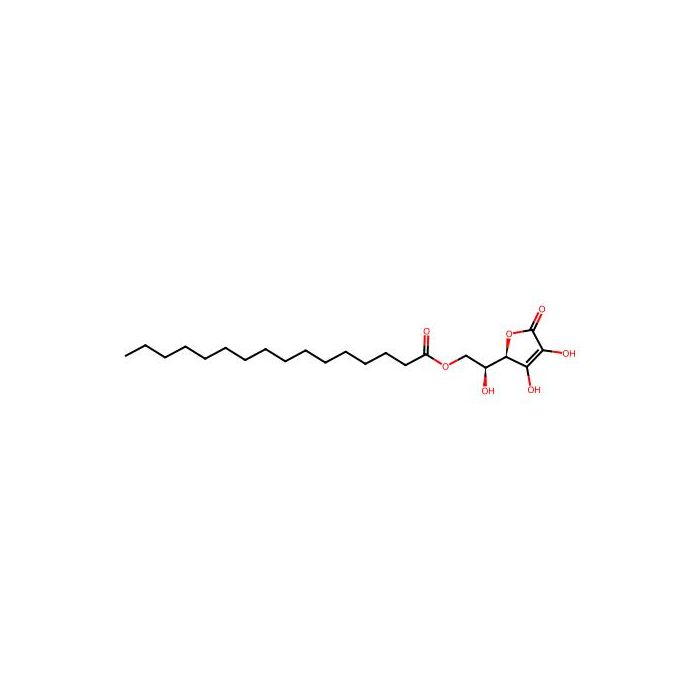
6-O-Palmitoyl-L-ascorbic acid - BioReagent, ≥99%(RT) , CAS No.137-66-6

CAS: 137-66-6 Cat. No.: O755637 Summenformel: C22H38O7 Molekulargewicht: 414.53 Beilstein Registry Number: 96552 EG-Nummer: 205-305-4
Zu bestellen verfügbar
GRADE & PURITY BioReagent ? BioReagent grade — tested suitable for life-science and molecular-biology use. Use for cell culture, assays, and biochemical work needing biological compatibility. ≥99%(RT)
Storage
Room temperature
Shipped In
Normal
★
Size
Deutschland (EU)
USA*
Price
Qty
25g
O755637-25g
Auf Bestellung · 8–12 Wochen
115,32€
100g
O755637-100g
Auf Bestellung · 8–12 Wochen
217,72€
Enter a quantity for the sizes you want to add.
🧪

Why this grade

BioReagent, ≥99%(RT) BioReagent for sensitive chromatographic and analytical workflows requiring minimal baseline interference.

🌡

Storage & shipping

Room temperature Ships Normal Check lot-specific COA for exact specifications.

📋

Quality documents

SDS, COA, datasheet, and spec sheet available for download. Lot-specific COA accessible via lot number lookup.

📚

Literature proof

Cited in 12 peer-reviewed publications across chromatography, organic synthesis, and cross-coupling reactions.

Übersicht

6-O-Palmitoyl-L-ascorbic acid is a lipid soluble ester of ascorbic acid. Ascorbic acid 6-palmitate is a lipophilic derivative of ascorbic acid.
Application:
6-O-Palmitoyl-L-ascorbic acid has been used to study the effects of dietary supplement in Solea senegalensis larvae.

Specifications

Spezifikationen & Reinheit
BioReagent, ≥99%(RT)
Biochemische und physiologische Mechanismen
6-O-Palmitoyl-L-ascorbic acid possesses metastasis inhibitory and anti-tumor activity. Ascorbyl palmitate exhibits antioxidant activity by protecting the cell membranes from oxidative damage.
Storage
Room temperature
Verschickt in
Normal
Note
BioReagent
Reinheit
≥99%(RT)
Namen und Kennungen
Kanonisches LächelnCCCCCCCCCCCCCCCC(=O)OCC(C1C(=C(C(=O)O1)O)O)O
IUPAC Name[(2S)-2-[(2R)-3,4-dihydroxy-5-oxo-2H-furan-2-yl]-2-hydroxyethyl] hexadecanoate
InChIKeyQAQJMLQRFWZOBN-LAUBAEHRSA-N
INCHI1S/C22H38O7/c1-2-3-4-5-6-7-8-9-10-11-12-13-14-15-18(24)28-16-17(23)21-19(25)20(26)22(27)29-21/h17,21,23,25-26H,2-16H2,1H3/t17-,21+/m0/s1
Isomere SMILES CCCCCCCCCCCCCCCC(=O)OC[C@@H]([C@@H]1C(=C(C(=O)O1)O)O)O
WGK Deutschland 1
Molekulargewicht 414.53
Beilstein 96552
Reaxy-Rn 347248
Reaxys-RN_link_address https://www.reaxys.com/reaxys/secured/hopinto.do?context=S&query=IDE.XRN=347248&ln=

Documentation

📋 Safety Data Sheet (SDS)

Comprehensive hazard, handling, storage, and regulatory compliance document.

Download SDS →

✅ Certificate of Analysis (COA)

Lot-specific quality data. Enter your lot number to retrieve the exact COA.

Look up COA →

📊 Datasheet

Quick-reference summary of product specifications and applications.

View datasheet →

🔬 Specification Sheet

Full quality attributes and acceptance criteria for this grade.

View spec sheet →

Advanced Data

Taxonomic Classification

Taxonomy Tree

KingdomOrganic compounds
SuperclassLipids and lipid-like molecules
KlasseFatty Acyls
SubclassFatty acid esters
Intermediate Tree Nodes Not available
Direct ParentFatty acid esters
Alternative Parents Dicarboxylic acids and derivatives  Butenolides  Vinylogous acids  Enoate esters  Secondary alcohols  Lactones  Enediols  Oxacyclic compounds  Organic oxides  Hydrocarbon derivatives  Carbonyl compounds  
Molecular FrameworkAliphatic heteromonocyclic compounds
Substituents Fatty acid ester - 2-furanone - Dicarboxylic acid or derivatives - Dihydrofuran - Enoate ester - Vinylogous acid - Alpha,beta-unsaturated carboxylic ester - Carboxylic acid ester - Enediol - Lactone - Secondary alcohol - Oxacycle - Carboxylic acid derivative - Organoheterocyclic compound - Hydrocarbon derivative - Organic oxide - Alcohol - Organic oxygen compound - Organooxygen compound - Carbonyl group - Aliphatic heteromonocyclic compound
BeschreibungThis compound belongs to the class of organic compounds known as fatty acid esters. These are carboxylic ester derivatives of a fatty acid.
External Descriptors Not available
3D-Struktur
Interaktives chemisches Strukturmodell


Zertifikate (CoA, COO, BSE/TSE und Analyse-Diagramm)
C of A & Other Certificates(BSE/TSE, COO):
Analytical Chart:

Find and download the COA for your product by matching the lot number on the packaging.

2 results found

Lot NumberCertificate TypeDatumArtikel
K2519761Certificate of AnalysisNov 26, 2025 O755637
K2513135Certificate of AnalysisNov 15, 2025 O755637
Chemische und physikalische Eigenschaften
Spezifische Drehung [α]22.5 ° (C=1, EtOH)
Schmelzpunkt (°C)114°C
Molekulargewicht414.500 g/mol
XLogP36.300
Hydrogen Bond Donor Count3
Hydrogen Bond Acceptor Count7
Rotatable Bond Count18
Exact Mass414.262 Da
Monoisotopic Mass414.262 Da
Topological Polar Surface Area113.000 Ų
Heavy Atom Count29
Formal Charge0
Complexity515.000
Isotope Atom Count0
Defined Atom Stereocenter Count2
Undefined Atom Stereocenter Count0
Defined Bond Stereocenter Count0
Undefined Bond Stereocenter Count0
The total count of all stereochemical bonds0
Covalently-Bonded Unit Count1
FAQs und Artikel
A Practical Guide to Fragrance Compositions: Turning a Black-Box Formula into an Engineerable System—Compatibility, Stability, Controlled Release, Traceability, and Selection
Why Limonene Can Soften Greasy Soils Yet Is Difficult to Dissolve in Water: Understanding the Cleaning Mechanism and Formulation Applications of Naturally Derived Solvents from Molecular Structure
The Skin Anti-Aging Mechanisms of α-Lipoic Acid: ALA/DHLA Redox Cycling, the Antioxidant Network, and Regulation of Collagen AGE Formation
Tocopherols in the Vitamin E Family: How They Block the Chain Reaction of Lipid Peroxidation in Skin Lipids
Antioxidant Mechanisms, Stability, and Delivery Strategies of Resveratrol in Skincare Research
Antioxidant Mechanisms of Ferulic Acid in Skincare, Vitamin C/E Synergy, and Stable Delivery Applications
Protective and Potential Reparative Mechanisms of Prinsepia utilis Seed Oil on the Skin Barrier: Fatty Acid Composition, Epidermal Lipid Metabolism, and Research Evidence
UVA Absorption Mechanism of Avobenzone: Keto–Enol Tautomerism, Photochemical Instability, and Formulation Photostabilization Strategies
Mechanisms of Retinol Action in the Skin: From Metabolic Activation and RAR/RXR-Mediated Transcriptional Regulation to Epidermal Renewal and Collagen Homeostasis
How Coenzyme Q10 Acts on the Skin: Mitochondrial Electron Transfer, Antioxidant Protection of Membrane Lipids, and Lipid-Carrier Delivery
Citations of This Product
Referenzen
1. Qicai Zhang, Xianli Wang, Chengbin Liu, Huaxi Li, Zhongsheng Deng, Chunxia Yao, Yameng Li, Qinxiong Rao, Weiguo Song.  (2024)  Accurate and stable detection of p-phenylenediamine antioxidants and their transformation products in aquatic products using antioxidant protection – Analysis of actual aquatic products.  JOURNAL OF HAZARDOUS MATERIALS,      [PMID:39405713] [10.1016/j.jhazmat.2024.136099]
2. Yongkang Lai, Tinglin Zhang, Xiaojing Yin, Chunping Zhu, Yiqi Du, Zhaoshen Li, Jie Gao.  (2024)  An antibiotic-free platform for eliminating persistent Helicobacter pylori infection without disrupting gut microbiota.  Acta Pharmaceutica Sinica B,      [PMID:39027245] [10.1016/j.apsb.2024.03.014]
3. Guilan Jiang, Silin Li, Jingyi Zhu, Binbin Li, Zhuhong Ding.  (2024)  Study on β-glucosidase activators by 3D-QSAR, molecular docking and molecular dynamics simulation.  JOURNAL OF MOLECULAR LIQUIDS,      [PMID:] [10.1016/j.molliq.2024.124932]
4. Yunping Yao, Yuanyuan Jia, Yifan Yu, Changmo Li.  (2025)  Preserving pungency and color: thermal/storage stability of bioactive compounds in chili oil and shelf-life extension strategies.  Food Bioscience,      [PMID:] [10.1016/j.fbio.2025.107212]
5. Xinlong Wang, Huijie Zhou, Mengjiao Su, Yingxue Xu, Zhengxian Zhang, Haotian Peng, Huahui Zeng, Mingsan Miao, Xiangxiang Wu.  (2025)  A charge reversal nanomedicine based on dual pH-responsive crosslinked dextran-based polysaccharide for synergistic cancer chemo/chemodynamic therapy.  INTERNATIONAL JOURNAL OF BIOLOGICAL MACROMOLECULES,      [PMID:41038472] [10.1016/j.ijbiomac.2025.148004]
6. Ziwei Wang, Fujun Liu, Ying Luo, Xiangbo Zeng, Xuechen Pei, Guanhua Zhao, Min Zhang, Dayong Zhou, Fawen Yin.  (2022)  Effects of Tea Polyphenol and Its Combination with Other Antioxidants Added during the Extraction Process on Oxidative Stability of Antarctic Krill (Euphausia superba) Oil.  Foods,  11  (23): (3768).  [PMID:36496576] [10.3390/foods11233768]
7. Yuling Li, Xiaotong Wu, Zixuan Wu, Mingmin Zhong, Xiaoping Su, Youai Ye, Yan Liu, Lei Tan, Yong Liang.  (2022)  Colorimetric sensor array based on CoOOH nanoflakes for rapid discrimination of antioxidants in food.  Analytical Methods,  14  (28): (2754-2760).  [PMID:35781305] [10.1039/D2AY00692H]
8. Sun Dongdong, Wang Zekun, Zhang Pu, Yin Chenyang, Wang Jingyuan, Sun Yu, Chen Ying, Wang Weiyun, Sun Baoliang, Fan Cundong.  (2021)  Ruthenium-loaded mesoporous silica as tumor microenvironment-response nano-fenton reactors for precise cancer therapy.  JOURNAL OF NANOBIOTECHNOLOGY,  19  (1): (1-16).  [PMID:33827604] [10.1186/s12951-021-00848-x]
9. Shujie Wang, Guoqin Liu, Weiwei Cheng.  (2020)  Comparative evaluation of four free radical scavengers for the inhibition of individual glycidyl ester formation in rice bran oil determined by UPLC-MS/MS.  INTERNATIONAL JOURNAL OF FOOD SCIENCE AND TECHNOLOGY,  56  (6): (2983-2991).  [PMID:] [10.1111/ijfs.14941]
10. Junhua Li, Yimei Shen, Jiali Zhai, Yujie Su, Luping Gu, Cuihua Chang, Yanjun Yang.  (2020)  Enhancing the oxidative stability of algal oil powders stabilized by egg yolk granules/lecithin composites.  FOOD CHEMISTRY,      [PMID:33302099] [10.1016/j.foodchem.2020.128782]
11. Weiwei Cheng, Jiahe Xu, Xiaowen Wang, Xinyang Li, Yufeng Chen, Guoqin Liu, Xuxia Zhou, Yuting Ding, Shulai Liu.  (2024)  Multiple Mechanisms of Haematococcus pluvialis–Derived Carotenoids to Inhibit Glycidyl Ester Formation in Rice Oil and a Chemical Model at High Temperatures.  JOURNAL OF AGRICULTURAL AND FOOD CHEMISTRY,      [PMID:39140411] [10.1021/acs.jafc.4c04019]
12. Chang Li, Hanbing Jia, Mingyue Shen, Yuting Wang, Shaoping Nie, Yi Chen, Yongqiang Zhou, Yuanxing Wang, Mingyong Xie.  (2015)  Antioxidants Inhibit Formation of 3-Monochloropropane-1,2-diol Esters in Model Reactions.  JOURNAL OF AGRICULTURAL AND FOOD CHEMISTRY,      [PMID:26478126] [10.1021/acs.jafc.5b03503]
Lösungsrechner
Bewertungen

Kundenbewertungen

Häufig gestellte Fragen

What does BioReagent mean?
BioReagent indicates that the product has been processed and tested for biological and biochemical applications. Specifications may include endotoxin limits, microbial controls, sterility, low DNase/RNase/protease activity, and verified biological activity where relevant.
How should this product be stored?
Store at room temperature.
How is this product shipped?
This product ships under standard ambient conditions. No temperature-controlled packaging is required.
What are the CAS number, molecular formula and molecular weight?
The CAS Number is 137-66-6, the molecular formula is C22H38O7, and the molecular weight is 414.53 g/mol. InChIKey QAQJMLQRFWZOBN-LAUBAEHRSA-N.
What documentation is provided?
Available product documentation, including Certificates of Analysis (COA), Safety Data Sheets (SDS), and specification sheets, is shown in the product document area. Document availability and access follow the current site policy.

Shall we send you a message when we have discounts available?

Remind me later

Thank you! Please check your email inbox to confirm.

Oops! Notifications are disabled.