Determine the necessary mass, volume, or concentration for preparing a solution.
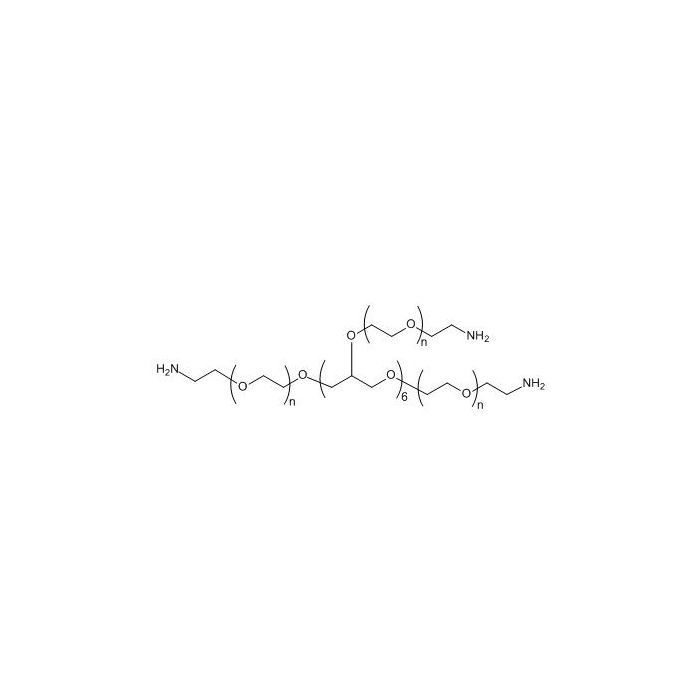
8-Arm PEG Amine - MW 20000 Da
Zu bestellen verfügbar
GRADE & PURITY MW 20000 Da
Storage
Store at -20°C,Argon charged
Shipped In
Ice chest + Ice pads

MW 20000 Da for sensitive chromatographic and analytical workflows requiring minimal baseline interference.
Store at -20°C,Argon charged Ships Ice chest + Ice pads Check lot-specific COA for exact specifications.
SDS, COA, datasheet, and spec sheet available for download. Lot-specific COA accessible via lot number lookup.
Cited in 0 peer-reviewed publications across chromatography, organic synthesis, and cross-coupling reactions.
8 arm PEG derivatives have multiple reactive groups that can be used to modify proteins, peptides and other materials via their functional groups. PEGylation can increase solubility and stability and reduce immunogenicity of peptides and proteins. It can also suppress the non-specific binding of charged molecules to the modified surfaces. .
Comprehensive hazard, handling, storage, and regulatory compliance document.
Download SDS →Lot-specific quality data. Enter your lot number to retrieve the exact COA.
Look up COA →Full quality attributes and acceptance criteria for this grade.
View spec sheet →Find and download the COA for your product by matching the lot number on the packaging.
| Lot Number | Certificate Type | Datum | Artikel |
|---|---|---|---|
 H1722073 | Certificate of Analysis | May 21, 2026 | A163143 |
| G2511120 | Certificate of Analysis | Jun 26, 2025 | A163143 |
| G2511121 | Certificate of Analysis | Jun 26, 2025 | A163143 |
| B2528226 | Certificate of Analysis | Jan 16, 2025 | A163143 |
| C2504017 | Certificate of Analysis | Jan 16, 2025 | A163143 |
| C2504018 | Certificate of Analysis | Jan 16, 2025 | A163143 |
| K2110459 | Certificate of Analysis | Aug 09, 2024 | A163143 |
| E2429130 | Certificate of Analysis | May 07, 2024 | A163143 |
| Löslichkeit | Off-white/white solid or viscous liquid depends on molecule weight;Soluble in regular aqeous solution as well as most organic solvents; |
|---|---|
| Empfindlichkeit | Hygroscopic |
Tested application protocols, recommended dilutions, and positive controls are not specified for this item; refer to the product’s CoA/Spec Sheet and SDS.
Given the diversity of uses (e.g., NHS-ester coupling, EDC/NHS activation workflows, reductive amination, hydrogel formation), users should tailor protocols to their substrates, considering:
For detailed, application-specific procedures, consult peer-reviewed literature and validated internal SOPs.
General context (no clinical claims)
Note: Any biological compatibility or endotoxin specifications are application- and grade-dependent and are not provided for this item. Verify bioburden/endotoxin levels on the CoA/Spec Sheet if use in sensitive biological systems is intended.
This product is not a buffer system; however, its performance in conjugation and materials workflows depends on buffer choice. The following are general, literature-based considerations for using 8-arm PEG amine in aqueous buffers:
Item-specific buffer compatibility/limits: Not specified for this item; refer to CoA/Spec Sheet.
Greener practices for PEG-amine chemistry (general/literature)
Trade-offs
Illustrative comparison (general)
Adopt right-first-time stoichiometry (based on CoA amine loading) to reduce rework and waste.
No therapeutic or clinical claims are made. The following are general, non-clinical roles for multi-arm PEG amines in formulation and manufacturing research:
Regulatory/compendial status for this specific item (e.g., USP/NF, Ph. Eur., endotoxin/bioburden limits, residual solvent specs): Not specified for this item; refer to CoA/Spec Sheet.
Note: Any use in manufacturing or clinical settings requires verification of grade, impurity profile, and regulatory compliance appropriate to the application; this listing is for research use only.
Item-specific properties
General/literature characteristics (poly(ethylene glycol) multi-arm amine)
Note: For exact Mn, polydispersity (Đ), water/solvent content, and residual metals, consult the item’s CoA/Spec Sheet.
Item-specific grade/purity
How multi-arm PEG amines are typically specified (general/literature)
Implications for use
Typical application families (general/literature)
Practical tips
The following are general, literature-based conditions commonly used with multi-arm PEG amines. They are guidance only and should be optimized per substrate and the item’s CoA end-group loading.
NHS-ester coupling (to carboxyl-bearing partners)
EDC/NHS aqueous coupling
Reductive amination (with aldehydes)
Urea/thiourea formation
Aza-Michael addition to acrylates
Purification: dialysis (MWCO 3–50 kDa depending on Mn), ultrafiltration, or precipitation from IPA/acetone/ether as compatible. Always confirm conversion via amine titration and SEC/GPC.
Item-specific hazard data
General safety guidance (literature/practice)
Polarity and miscibility (general/literature)
Choosing solvents by application
Comparative notes
Item-specific storage and shipping
General handling/reconstitution advice (literature/practice)
Any item-specific reconstitution solvent preferences, stabilizers, or shelf life: Not specified for this item; refer to CoA/Spec Sheet.
Item-specific identifiers
Structural description (general/literature)
2D structural features (verbal)
Functional group chemistry (general/literature)
Architectural advantages
Retrosynthetic considerations
Not applicable. This product is a multi-functional polymer reagent, not a biological targeting reagent or antibody. No antigen/epitope, clone, isotype, or species reactivity information applies to this item.