≥98% for sensitive chromatographic and analytical workflows requiring minimal baseline interference.
🌡
Storage & shipping
Store at -20°C Ships Ice chest + Ice pads Check lot-specific COA for exact specifications.
📋
Quality documents
SDS, COA, datasheet, and spec sheet available for download. Lot-specific COA accessible via lot number lookup.
📚
Literature proof
Cited in 0 peer-reviewed publications across chromatography, organic synthesis, and cross-coupling reactions.
Übersicht
Abiraterone sulfate is a metabolite of Abiraterone . Abiraterone is a potent and irreversible CYP17A1 inhibitor with antiandrogen activity.
Form:Solid
Specifications
Spezifikationen & Reinheit
≥98%
Biochemische und physiologische Mechanismen
Abiraterone sulfate is a metabolite of Abiraterone ( HY-148377 ). Abiraterone is a potent and irreversible CYP17A1 inhibitor with antiandrogen activity.
Storage
Store at -20°C
Verschickt in
Ice chest + Ice pads
Dieses Produkt erfordert Kühlkettenversand. Grundversand und andere Economy-Optionen sind nicht verfügbar.
Zertifikate (CoA, COO, BSE/TSE und Analyse-Diagramm)
C of A & Other Certificates(BSE/TSE, COO):
Analytical Chart:
Lösungsrechner
Molarity Calculator
Determine the necessary mass, volume, or concentration for preparing a solution.
Dilution Calculator
Determine the dilution needed to prepare a stock solution.
Reconstitution Calculator
Bewertungen
Kundenbewertungen
Application Protocols
Item-specific validated application protocols are not provided for this entry.
General example protocols (research use)
Preparation of assay stock: Weigh appropriate amount gravimetrically. Dissolve in anhydrous DMSO to 10–50 mM. Vortex and, if needed, sonicate briefly. Filter (0.22 µm PTFE) for analytical use. Aliquot into amber vials; store at −20°C.
Cell-based assay dosing: Dilute DMSO stock into pre-warmed culture medium to desired concentration, keeping final DMSO ≤0.1–0.5% v/v. Include vehicle controls. For adsorption-prone systems, add 0.01–0.05% nonionic surfactant and use low-binding plastics.
LC–MS/MS calibration: Prepare serial dilutions in 50:50 acetonitrile:water with 0.1% formic acid or ammonium acetate, using an internal standard where available. Assess linearity, LOD/LOQ, carryover, and matrix effects.
Enzymatic desulfation assay: Incubate with arylsulfatase in pH 6.5–7.5 buffer at 37°C; sample over time, quench with organic solvent containing acid; quantify parent alcohol formation via LC–MS.
Always adapt conditions to your system. For authoritative parameters specific to this lot/form, refer to the CoA and SDS.
Biological Roles
Literature/general context (no medical claims)
Abiraterone sulfate is a phase II conjugated metabolite of the steroidal scaffold abiraterone, formed via sulfotransferase-catalyzed esterification of the 3β-hydroxyl with 3′-phosphoadenosine-5′-phosphosulfate (PAPS) as the sulfate donor.
Sulfation generally increases aqueous compatibility and modulates transport: sulfated steroids can be substrates for organic anion transporting polypeptides (OATPs) and other solute carriers, affecting distribution and clearance in in vitro models.
Enzymatic reversibility: arylsulfatases can hydrolyze steroidal sulfates, regenerating the corresponding phenolic/alcoholic species; this interplay is relevant in studies of steroid homeostasis.
Target engagement: Conjugation often attenuates the intrinsic activity of the parent scaffold at enzymatic or receptor targets due to altered polarity and binding interactions; comparing parent vs. sulfate informs structure–property–function relationships.
Use in research
Serves as a well-defined analyte for validating quantitative LC–MS/MS assays assessing conjugation pathways and metabolite profiling in microsomes, hepatocytes, or recombinant SULT systems.
Employed as a tool compound to probe sulfatase activity and transporter specificity in biochemical and cell-based systems.
Buffer Applications
Not typically applicable
Abiraterone sulfate is not a buffering agent and does not define a useful pH range for buffering purposes.
Practical notes for assay buffers (general)
When preparing biological assays, standard buffers (e.g., PBS, HEPES, Tris) may be used to dilute DMSO stocks. Keep final DMSO at ≤0.1–0.5% v/v to minimize solvent effects.
Avoid highly basic buffers if prolonged incubation is expected, as strong base can promote sulfate ester hydrolysis (literature).
Green Alternatives
Scope
This product is a specialized research compound (steroidal sulfate). “Green alternative solvent” discussions are not directly applicable. However, greener practices can still be applied to dissolution, analysis, and waste handling.
Greener practice suggestions (general)
Prefer aqueous buffers over aprotic polar solvents when solubility permits; minimize DMSO concentrations in assay media.
Use microscale preparations and high-sensitivity analytics (UPLC–MS) to reduce material and solvent consumption.
For mobile phases, favor water with volatile, low-toxicity modifiers (e.g., ammonium formate/acetate) over nonvolatile salts.
Implement solvent recycling where feasible (e.g., acetonitrile recovery from LC systems) and segregate halogenated vs. non-halogenated waste.
Trade-offs
While water is greener, complete dissolution and stability of sulfate esters may require DMSO or MeOH co-solvent; balance minimal effective amounts with assay tolerance.
Pharmaceutical Uses
Scope and limitations
No therapeutic or clinical claims are made. This product is supplied strictly for research use.
Literature/general formulation roles
Reference standard: Used as a characterized impurity/metabolite reference in pharmaceutical development workflows (impurity profiling, metabolite identification, bioanalytical calibration).
Stability studies: Applied in forced-degradation panels to establish degradation pathways and validate stability-indicating methods for steroidal drug products.
ADME tools: Utilized in in vitro transporter/enzyme assays to understand conjugation and clearance mechanisms of related scaffolds.
Regulatory note
Pharmacopeial monographs specific to abiraterone sulfate may not exist; qualification typically follows ICH Q6/Q2 (specifications/analytical validation) using vendor CoA and in-house verification. Confirm exact salt/counterion and water content prior to preparing standard solutions for regulated testing.
Physical Properties
Item-specific (from Product Data)
Appearance: Not specified for this item; refer to CoA/Spec Sheet.
Molecular weight: Not specified for this item; refer to CoA/Spec Sheet.
Other specifications (mp/bp, density, solubility, refractive index, pKa, logP, UV cutoff): Not specified for this item; refer to CoA/Spec Sheet.
Literature/General (for reference; not item-specific specifications)
Physical state: steroidal sulfate esters are typically crystalline solids.
Ionization/solubility: sulfate monoesters are strongly acidic; as free acids they are poorly soluble in nonpolar media and more soluble in polar protic/aqueous systems; as salts (e.g., sodium/potassium), water and polar aprotic solvent solubility can increase markedly. Abiraterone sulfate is commonly handled as a DMSO stock for screening.
pKa: aryl/alkyl sulfate monoesters typically have very low pKa1 (<1) for the acidic proton; the conjugate base (ROSO3−) is strongly anionic (literature, class behavior).
Stability: sulfate esters are generally stable to neutral conditions; they can hydrolyze under strongly basic conditions and can be cleaved enzymatically (sulfatases) in biological matrices (literature).
Practical note
For exact numerical physical constants of this catalog item (salt form, hydration state, exact MW), consult the product CoA/Spec Sheet.
Quality and Grades
Item-specific (from Product Data)
Grade/Purity: Not specified for this item; refer to CoA/Spec Sheet.
Interpretation and expectations (general guidance)
Research-use small molecules in screening libraries are typically provided at high chemical purity (often ≥95% by HPLC/LC–MS) with supporting chromatograms/HRMS upon request. Exact acceptance criteria (assay %, residual solvents, counterion content, water) are defined on the item’s CoA/Spec.
Identity confirmation may rely on NMR, LC–MS, and/or HRMS. For sulfate esters, counterion determination (e.g., Na+, K+, or free acid) and hydration state can affect calculated molecular weight and assay.
Stabilizers: None are typically added to steroidal sulfates; if any stabilizer or form (e.g., sodium salt, hydrate) is used, it will be stated on the Spec Sheet.
Recommendations
If using for quantitative bioanalytical assays, verify exact form (free acid vs. specific counterion), water content, and purity method (UV vs. ELSD). Adjust stock solution concentrations accordingly based on the certified molecular weight/form on the CoA.
Reaction and Applications
Item-specific (from Product Data)
Manufacturer applications: Not specified for this item.
Research and application contexts (literature/general)
Reference/analytical standard: Frequently employed as a metabolite reference for LC–MS/MS method development in steroid metabolism or drug metabolism studies, including phase II conjugation profiling.
Transport/enzyme studies: Useful probe for sulfate transporters (e.g., OATP, SOAT family) and arylsulfatase-mediated hydrolysis in vitro. Enables assessment of sulfation/desulfation pathways of steroidal scaffolds.
Comparative activity studies: Enables investigation of how 3β-O-sulfation modulates physico-chemical properties and target engagement relative to the parent abiraterone in biochemical assays (no medical claims).
Stability investigations: Applied in forced-degradation and hydrolysis kinetics to understand sulfate ester stability across pH and in biological matrices.
Practical tips
Prepare fresh DMSO stocks and store small aliquots at −20°C to minimize hydrolysis.
Include internal standards and monitor the sulfate (m/z corresponding to the exact form per CoA) and potential desulfated products by LC–MS.
Use plasticware with low-binding surfaces or add 0.01–0.05% surfactant to reduce nonspecific adsorption common to hydrophobic steroids.
Reaction Conditions
Item-specific reaction conditions are not provided for this catalog entry.
Literature/general guidance for handling steroidal sulfate esters
Hydrolysis studies: Typical buffers pH 2–9, 25–37°C, monitor by LC–MS; base-catalyzed cleavage accelerates above pH ~9. Include controls to assess nonenzymatic vs. enzymatic (sulfatase) pathways.
Enzymatic desulfation: Arylsulfatase assays often run at pH 6.0–7.5, 25–37°C, with enzyme concentrations titrated to give linear initial rates; monitor appearance of desulfated alcohol and inorganic sulfate.
LC–MS analysis: Mobile phase A = water with 0.1% formic acid or 5–10 mM ammonium acetate; B = acetonitrile or methanol. For negative ESI, volatile ammonium buffers (pH ~7–8) can improve response. Retention on C18 may be low; consider phenyl-hexyl, mixed-mode, or HILIC.
Stock preparation: Dissolve in anhydrous DMSO (e.g., 10–50 mM), aliquot, store at −20°C; thaw on ice and avoid repeated freeze–thaw.
Note
The above conditions are general literature guidance. Optimize experimentally for your system and consult the CoA/SDS for constraints specific to this item.
Safety and Handling
Item-specific (from Product Data)
GHS classification / pictograms / signal word / H-statements: Not specified for this item; refer to SDS.
Storage: Store at -20°C. Shipments are sent cold (ice chest + ice pads) to maintain integrity.
General safety guidance (literature/typical for small-molecule research standards)
Handle in a fume hood, avoiding dust formation and aerosolization.
PPE: lab coat, safety glasses, and suitable gloves (e.g., disposable nitrile). Change gloves regularly and avoid skin contact.
Incompatibilities: strong bases (risk of sulfate ester hydrolysis), strong nucleophiles; avoid prolonged exposure to strong acids or high temperatures that may promote decomposition.
First aid overview: in case of skin/eye contact, rinse with water for ≥15 min and remove contaminated clothing; if inhaled, move to fresh air; if ingested, rinse mouth. Seek medical attention for any exposure concerns.
Environmental precautions: prevent release to drains; collect spills with inert absorbent and dispose of according to institutional and local regulations.
Analytical handling: when preparing microgram–milligram quantities for screening, minimize repeated freeze–thaw and prepare single-use aliquots to limit degradation.
Authoritative information
Always consult the product-specific SDS for definitive hazard classification, exposure controls, and disposal guidance.
Solvent Selection
Item-specific (from Product Data)
Solubility/miscibility: Not specified for this item; refer to CoA/Spec Sheet.
General guidance for abiraterone sulfate (literature/experience-based)
Preferred stock solvents: Anhydrous DMSO is commonly used for preparing concentrated screening stocks (e.g., 10–50 mM) due to good solvating power for steroidal sulfates. DMF may be an alternative.
Aqueous work: Depending on form (free acid vs. salt), direct dissolution in water or aqueous buffers may be feasible; mild basification (e.g., 10–50 mM Tris, pH 7.5–8.0) can aid dissolution without risking rapid sulfate cleavage.
Cosolvent systems: For biological assays, diluting DMSO stocks into aqueous media (final DMSO ≤0.1–0.5% v/v) is typical. Include a surfactant (e.g., 0.01–0.05% Tween-20) if adsorption to plastics is observed.
Avoid: Strongly basic alcoholic solvents or prolonged exposure to concentrated base which can hydrolyze sulfate esters; nonpolar solvents (hexanes, toluene) generally provide poor solubility.
Comparison (general)
DMSO: highest solvency, compatible with most in vitro assays at low %.
Methanol/ethanol: moderate solubility; may be used for analytical dilutions.
Water/buffer: variable, strongly dependent on salt/counterion and ionic strength.
Confirm actual solubility and form for this item from the CoA prior to critical experiments.
Storage and Reconstitution
Item-specific (from Product Data)
Storage conditions: Store at −20°C.
Shipping: Ice chest with ice pads (cold chain) to preserve integrity.
General guidance (literature/typical best practices)
Container: Store in tightly sealed, inert (glass) vials with desiccant. Protect from light and moisture.
Reconstitution: Dissolve the material in anhydrous DMSO or another suitable solvent to prepare a concentrated stock (e.g., 10–50 mM). If aqueous use is intended and the form permits, dissolve in buffer near neutral pH; avoid strong base.
Aliquoting: Prepare single-use aliquots to avoid repeated freeze–thaw. Thaw on ice, mix gently, and use promptly.
Stability: Sulfate esters are generally stable at low temperature; monitor by LC–MS for any desulfation upon storage, especially in partially aqueous solutions. For long-term storage of solutions, prefer ≤−20°C and anhydrous conditions.
Not specified for this item; refer to CoA/Spec Sheet
Exact solubility, salt/counterion, hydration state, and solution stability time windows.
Any recommended stabilizers or special precautions beyond the above general guidance.
Structure and Identity
Item-specific (from Product Data)
SKU: A649778
Product name: Abiraterone sulfate
CAS: 1993430-25-3
Storage: Store at -20°C (per item listing)
Shipped in: Ice chest + ice pads
Research use: For research use only
Molecular formula: Not specified for this item; refer to CoA/Spec Sheet.
Molecular weight: Not specified for this item; refer to CoA/Spec Sheet.
SMILES / InChI / InChIKey: Not specified for this item; refer to CoA/Spec Sheet.
Literature/General structural description (for reference; not item-specific specifications)
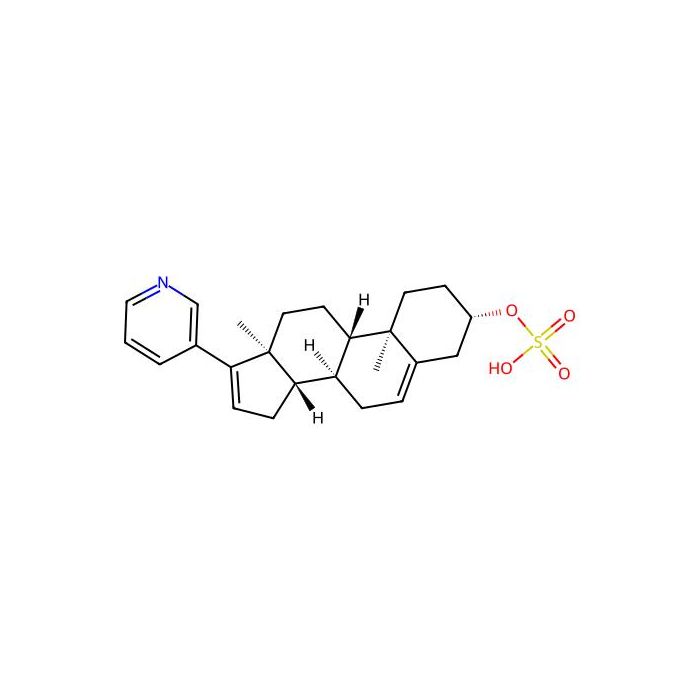
Abiraterone sulfate is the sulfate ester conjugate of abiraterone, a steroidal scaffold bearing a 17-(pyridin-3-yl) substituent and a 3β-hydroxyl group that, in the sulfate, is esterified to –OSO3H/–OSO3− (counterion varies by material).
Key functional groups: steroid polycyclic ring system (cyclopenta[a]phenanthrene), a pyridine heteroaromatic ring at C17, and a sulfate monoester at C3.
Stereochemistry: multiple defined chiral centers inherent to the steroid framework (typically 8–9 stereocenters), maintaining the trans-fused A/B, B/C, and C/D ring junctions of androstane-type steroids.
2D structure in words (literature)
Four fused rings (A–D) of the androstane nucleus; ring A bearing a 3β-O-sulfate; side chain at C17 terminates in a 3-pyridyl group; conjugated unsaturation may be present in the steroid backbone depending on abiraterone core (commonly Δ5,16).
Synthetic Utility
General synthetic context (literature)
While primarily a research analyte, abiraterone sulfate exemplifies steroidal sulfate monoesters used to modulate polarity or as protected forms of 3β-hydroxyls. Sulfate esters can serve as latent leaving groups under specific conditions (e.g., activation/desulfation), though aryl/alkyl sulfates are less commonly used as synthetic intermediates than tosylates/mesylates.
Preparation typically involves selective sulfation of the 3β-OH on the abiraterone scaffold using sulfurylating reagents (e.g., SO3·pyridine, chlorosulfonic acid under controlled conditions) followed by neutralization to give defined salts. Strict control of regio- and stereochemistry is required to preserve the steroid configuration.
Analytical characterization: Characteristic downfield shifts for 3β-OSO3 in 1H/13C NMR, strong sulfate S=O bands in IR (~1250–1050 cm−1), and diagnostic [M−H]− or adducts in negative-mode ESI-MS.
Use in method development
Provides a challenging, polar/hydrophobic mixed analyte helpful for optimizing LC methods (ion-pairing vs. HILIC vs. reversed phase with aqueous-rich gradients) and for testing sulfatase-catalyzed transformations in enzymology.
Target Specificity
Not applicable
This product is a small-molecule steroidal sulfate, not an antibody or affinity reagent. No clone/isotype/epitope or species reactivity applies.
Literature note
In biochemical studies, abiraterone sulfate may be used to probe transporter or enzyme interactions (e.g., sulfotransferases, sulfatases, anion transporters), but no target-binding specificity is certified for this catalog item.
Wir verwenden Cookies, um die ordnungsgemäße Funktion der Website sicherzustellen und, soweit zulässig, Ihr Nutzererlebnis zu verbessern. Sie können Ihre Einstellungen jederzeit unter „Einstellungen“ verwalten. Weitere Informationen finden Sie in unserer Cookie-Richtlinie.
Shall we send you a message when we have discounts available?
Remind me later
Thank you! Please check your email inbox to confirm.
Products are supplied to verified businesses, institutions, and qualified professionals for research and development use only. Not for use in humans, animals, diagnosis, or therapy.