QUALITÄT & REINHEITMoligand™?Moligand™ — Aladdin's line of ligands and bioactive small molecules. Use for receptor, pathway, and binding studies needing defined small-molecule tools.≥98%(HPLC)
AC1903 has been used as a drug candidate in a high-throughput agar colony formation assay to identify its therapeutic efficiency against medulloblastoma.
Spezifikationen
Synonyme
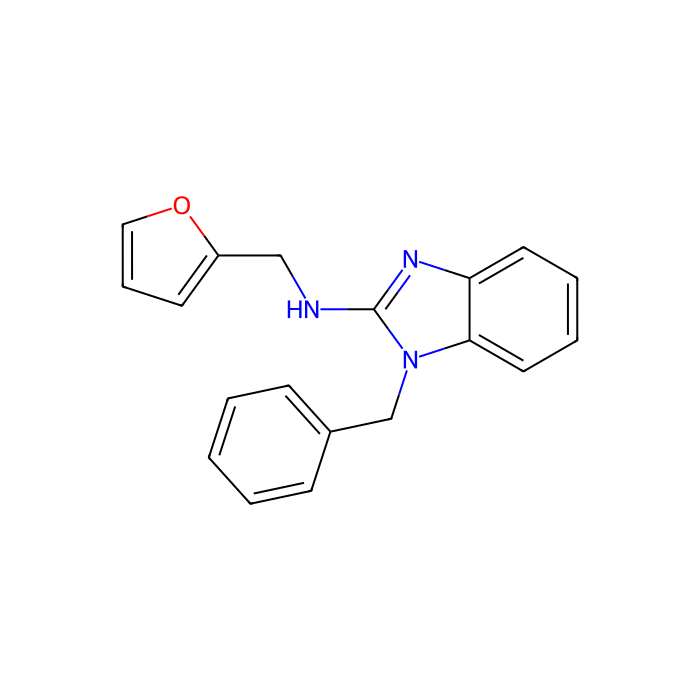
1-benzyl-N-(furan-2-ylmethyl)-1H-benzimidazol-2-amine | N-(1-BENZYL-1H-1,3-BENZIMIDAZOL-2-YL)-N-(2-FURYLMETHYL)AMINE | (1-benzylbenzimidazol-2-yl)-(2-furfuryl)amine | AC 1903 | N-(2-Furanylmethyl)-1-(phenylmethyl)-1H-benzimidazol-2-amine | 1-benzyl-N-[(furan-2-yl)methyl]-1H-1,3-benzodiazol-2-amine | AC1903 | 1-benzyl-N-(2-furylmethyl)-1H- Show more
Spezifikationen & Reinheit
Moligand™, ≥98%(HPLC)
Biochemische und physiologische Mechanismen
Selective TRPC5 blocker (IC50= 13.6 μM). Also displays weak inhibition at TRPC4 (IC50>100 μM) but not TRPC6. Exhibits no effect against a standard panel of profiling kinases. Blocks TRPC5 channel activity in glomeruli of proteinuric rats. Suppresses sever
Storage
Store at -20°C
Verschickt in
Ice chest + Ice pads
Dieses Produkt erfordert Kühlkettenversand. Grundversand und andere Economy-Optionen sind nicht verfügbar.
This compound belongs to the class of organic compounds known as benzimidazoles. These are organic compounds containing a benzene ring fused to an imidazole ring (five member ring containing a nitrogen atom, 4 carbon atoms, and two double bonds).
External Descriptors
Not available
1. Djoumbou Feunang Y, Eisner R, Knox C, Chepelev L, Hastings J, Owen G, Fahy E, Steinbeck C, Subramanian S, Bolton E, Greiner R, and Wishart DS. ClassyFire: Automated Chemical Classification With A Comprehensive, Computable Taxonomy. Journal of Cheminformatics, 2016, 8:61.
Solvent:DMSO, Max Conc. mg/mL: 15.17, Max Conc. mM: 50
Molekulargewicht
303.400 g/mol
XLogP3
3.900
Hydrogen Bond Donor Count
1
Hydrogen Bond Acceptor Count
3
Rotatable Bond Count
5
Exact Mass
303.137 Da
Monoisotopic Mass
303.137 Da
Topological Polar Surface Area
43.000 Ų
Heavy Atom Count
23
Formal Charge
0
Complexity
372.000
Isotope Atom Count
0
Defined Atom Stereocenter Count
0
Undefined Atom Stereocenter Count
0
Defined Bond Stereocenter Count
0
Undefined Bond Stereocenter Count
0
The total count of all stereochemical bonds
0
Covalently-Bonded Unit Count
1
Lösungsrechner
Molarity Calculator
Determine the necessary mass, volume, or concentration for preparing a solution.
Dilution Calculator
Determine the dilution needed to prepare a stock solution.
Reconstitution Calculator
Bewertungen
Kundenbewertungen
Application Protocols
No vendor-tested applications, dilutions, or protocols are provided for this item in the product data.
General handling guidance (not item-specific; for planning only):
Prepare a 10 mM DMSO stock solution under dry conditions; vortex and briefly sonicate if needed. Filter through 0.2 µm PTFE if particulates persist.
For biochemical assays: Serially dilute the stock into assay buffer to achieve final DMSO ≤0.1–1% v/v (validate tolerance). Include vehicle-only controls and, when possible, orthogonal readouts.
For cell-based assays: Titrate across 8–10 points (e.g., 0.03–30 µM) with final DMSO typically ≤0.1–0.2% v/v; monitor viability to control for nonspecific toxicity.
Plate handling: Use low-binding polypropylene plates for hydrophobic compounds; pre-wet tips and plates with vehicle-containing buffer to reduce adsorption.
Important: These are generic practices for small-molecule screening and are not validated for AC 1903. For any definitive instructions, consult the product’s CoA/Spec Sheet and your institutional SOPs.
Biological Roles
Item-specific biological role, target class, or mechanism for AC 1903 is not provided in this listing. No claims are made regarding bioactivity.
General considerations for small-molecule library members:
Potential roles: Small molecules in screening libraries may function as enzyme inhibitors/activators, receptor ligands, ion channel modulators, or pathway probes—however, AC 1903’s specific role is not specified for this item and should not be assumed.
Assay development: Initial appraisal often includes biochemical target assays, broad cell viability counterscreens, and off-target panels to evaluate selectivity and cytotoxicity windows.
ADME-relevant properties: If data become available (logD, pKa, TPSA), they can inform permeability, protein binding, and distribution predictions. Such data are not specified for this item; refer to CoA/Spec Sheet or internal measurements.
Control strategy: Use orthogonal assays and, where possible, inactive analogs or stereoisomers to validate that a phenotype is on-target.
Important note: This product is for research use only. It is not intended for diagnostic, therapeutic, or clinical use. No biological performance or efficacy is stated or implied in this catalog entry.
Buffer Applications
AC 1903 is a small-molecule screening compound and is not itself a buffering agent. Therefore, classical buffer system formulation does not apply.
Practical handling in buffered systems (general guidance):
Vehicle effects: Maintain DMSO (or other co-solvent) at a constant final percentage across all wells/tubes, including vehicle controls.
Typical buffers: Assay-dependent (e.g., HEPES, Tris, phosphate buffers); choose based on enzyme/pathway requirements and compatibility with the detection modality.
Precipitation control: Add compound stock last with rapid mixing; consider 0.01–0.1% nonionic surfactant (e.g., Pluronic F-127) if compatible and if aggregation/precipitation is suspected.
Adsorption minimization: Use low-binding polypropylene plates/tubes for hydrophobic compounds; precondition plasticware with buffer containing the vehicle.
No pKa, solubility, or ionic strength specifications are available for this item; refer to the CoA/Spec Sheet and perform small-scale compatibility tests in the intended buffer matrix.
Green Alternatives
Without item-specific structure, green chemistry discussion focuses on solvent and operational choices for handling small-molecule screening compounds.
Greener handling choices (general):
Prefer DMSO–water systems over chlorinated solvents for stock preparation and dilutions when compatible with the assay.
Minimize solvent volumes by using concentrated stocks (e.g., 10–50 mM in DMSO) and microplate-based workflows.
Use sealed, low-dead-volume vials and nitrogen backfill to extend stock life and reduce waste.
Comparison of common solvent options (general):
DMSO: Broad solvency; low volatility; good EHS profile compared to many organics; may require energy for drying glassware due to hygroscopicity.
Ethanol: Renewable feedstock; biodegradable; higher volatility (emissions) but favorable EHS profile when used in small percentages.
Acetonitrile: Useful for LC and some stocks; derived from petrochemical processes; moderate toxicity; prioritize recovery via solvent recycling where available.
Chlorinated solvents (e.g., DCM, CHCl3): Avoid for routine stock preparation; reserve for necessary analytical or purification steps.
Operational tips:
Adopt miniaturized assays (384–1536 well formats) to reduce solvent and compound consumption.
Implement solvent recovery where permissible (rotary evaporation/solvent recycler for method development stages).
Pharmaceutical Uses
No pharmacopeial status or excipient role is provided for this listing. AC 1903 is sold strictly for research use only and is not intended for human or veterinary use.
General, non-clinical contexts where screening compounds may be used in pharmaceutical R&D (without implying any activity for this item):
Early discovery: As tool molecules or starting points in high-throughput screening (HTS), fragment/lower-throughput screening, or hit validation workflows.
Assay controls: Potentially as exploratory reference compounds within internal programs once identity/quality are confirmed—no such role is specified here for AC 1903.
Analytical reference: If a reference spectrum is established internally, the compound may serve as a system suitability check for LC–MS methods (not specified for this item).
Regulatory note:
This product has not been evaluated for safety or efficacy and has no approved pharmaceutical use. Do not use in humans or animals. All work should be confined to appropriately equipped research laboratories with institutional approvals.
Physical Properties
Item-specific physicochemical data are not provided in the product record.
Appearance: Not specified for this item; refer to CoA/Spec Sheet.
Melting point: Not specified for this item; refer to CoA/Spec Sheet.
Boiling point: Not specified for this item; refer to CoA/Spec Sheet.
Density: Not specified for this item; refer to CoA/Spec Sheet.
Refractive index: Not applicable for solids; if liquid, Not specified for this item; refer to CoA/Spec Sheet.
Solubility: Not specified for this item; refer to CoA/Spec Sheet. For screening use, DMSO stocks are commonly employed (general practice).
logP/logD: Not specified for this item; refer to CoA/Spec Sheet.
pKa: Not specified for this item; refer to CoA/Spec Sheet.
UV–Vis absorbance: Not specified for this item; refer to CoA/Spec Sheet.
General guidance for library compounds (literature/practice):
Stock solutions: 10–50 mM in anhydrous DMSO are typical for small-molecule screening libraries. Solubility may vary with chemotype and salt form.
Co-solvents: If precipitation occurs on aqueous dilution, include 0.1–1% DMSO or 1–5% ethanol to aid solubilization; verify assay tolerance.
Light/air sensitivity: Unknown for this item. Handle under low light and inert atmosphere if instability is suspected from pilot tests or literature on related chemotypes.
Hygroscopicity/polymorphism: Not specified; confirm by mass change on exposure and DSC/XRPD if relevant to your application.
Quality and Grades
Grade/Purity: Moligand™ (product data)
What Moligand™ typically implies (general, program-level description):
A curated small-molecule/ligand format intended for discovery screening, target engagement studies, and chemogenomic workflows.
Identity typically supported by analytical data (e.g., LC–MS, NMR), with assay-ready handling in mind. Exact analytical specifications, purity threshold, counterion/salt form, and residual solvent limits are item- and lot-specific.
Item-specific notes:
Purity: Not specified for this item; refer to CoA/Spec Sheet.
Salt form/hydrate/solvate: Not specified for this item; refer to CoA/Spec Sheet.
Stabilizers/inhibitors: Not specified for this item; refer to CoA/Spec Sheet.
Practical considerations for Moligand materials (general guidance):
Lot-to-lot reproducibility: Record SKU, lot, and concentration of prepared stocks to ensure data traceability across campaigns.
Bioassay readiness: Prepare DMSO stocks under dry conditions; pre-filter solutions (0.2 µm PTFE) if particulate is present and compatible with the assay.
Analytical confirmation: Verify identity and purity on receipt by LC–MS and orthogonal methods (1H NMR) before critical experiments.
Documentation:
For exact grade attributes (e.g., UV cutoff, heavy metal limits, water content, residual solvents), and any stabilizers, refer to the product’s CoA/Spec Sheet. Not specified values in this listing should not be treated as specifications.
Reaction and Applications
This product is offered as a Moligand™ small molecule for research screening rather than as a general-purpose synthetic reagent. No specific synthetic application is provided in the product data.
Research applications (general for screening ligands):
Target engagement studies: Use in biochemical/biophysical assays (e.g., enzyme activity assays, thermal shift, SPR, DSF) to explore binding or modulation. Specific target(s) for AC 1903 are not specified for this item.
Cellular phenotyping: Evaluate concentration–response behavior in cell-based assays with careful control of vehicle concentrations and cytotoxicity counterscreens.
SAR exploration: If AC 1903 yields a phenotype, it can serve as a seed for hit expansion and analog-by-catalog SAR; confirm on-target activity by orthogonal assays.
Chemoproteomics target deconvolution (general): If a handle is available or can be introduced synthetically, derivatives may be used in pull-downs or photoaffinity workflows (this is general guidance; not item-specific).
Analytical considerations:
Confirm identity/purity by LC–MS and NMR prior to screening.
Determine apparent solubility and stability in assay buffers (time-course by LC–UV/MS) to avoid false negatives/positives.
Note: No specific reaction families (e.g., cross-coupling, reductions) are highlighted here because AC 1903 is not positioned as a building block in this listing.
Reaction Conditions
No preparative or synthetic reaction conditions are applicable here because AC 1903 is supplied as a screening small molecule rather than used as a reagent or catalyst in standard organic transformations.
General notes for solution preparation and assay handling (non-synthetic):
Stock preparation: Commonly 10–50 mM in anhydrous DMSO; exact solubility for this item is not specified—verify empirically.
Working concentrations: Determine by assay design and expected potency range; typical screening spans 0.1 nM to 100 µM with serial dilutions and appropriate vehicle controls.
Temperature and light: Prepare and store stocks at ambient to 4°C during handling and minimize light exposure unless stability data indicate otherwise. Long-term storage at −20°C per product data.
Stability checks: Use LC–MS to monitor for degradation under assay conditions (time 0, 1 h, 24 h) and under storage (freeze–thaw cycles) to establish handling windows.
If AC 1903 is to be employed as a synthetic intermediate (not the intended use in this listing), relevant conditions would depend on its functional groups, which are not provided; consult the CoA/Spec Sheet before planning any transformations.
Safety and Handling
Safety information specific to this item is not provided in the product data. Always consult the SDS for authoritative guidance.
GHS classification: Not specified for this item; refer to SDS.
Signal word / H-statements / pictograms: Not specified for this item; refer to SDS.
Best-practice handling (general for small organic molecules):
PPE: Use lab coat, safety glasses, and nitrile gloves; handle powders in a fume hood to avoid inhalation and dust exposure.
Avoid contact with skin and eyes; prevent ingestion and inhalation. Wash thoroughly after handling.
Incompatibilities: Unknown for this item. As general caution, segregate from strong oxidizers, strong acids/bases, and reactive reducing agents unless compatibility is confirmed.
Thermal hazards: Do not heat in sealed containers. If thermally characterizing, conduct DSC/TGA on milligram scale first.
Spill/accident: Collect solids by gentle sweeping with minimal dust generation; for solutions, absorb with inert material. Dispose according to institutional and local regulations.
First aid (overview; defer to SDS): Eye/skin contact—rinse with water for ≥15 min. Inhalation—move to fresh air. Ingestion—rinse mouth; seek medical attention in all cases.
Waste: Treat as organic hazardous chemical waste; segregate halogenated vs non-halogenated solvents as applicable.
Note: No peroxide-formation or explosive-labile group risk can be inferred without structural data; apply conservative controls until identity and hazards are confirmed from the CoA/SDS.
Solvent Selection
Because the specific structure and polarity of AC 1903 are not provided, solvent recommendations are given as general best practices for small-molecule screening compounds.
Primary stock solvent (practice):
DMSO (anhydrous) is the default solvent for assay-ready stocks due to broad solubilizing power and biological compatibility at low percentages.
Secondary solvents (if DMSO is contraindicated):
Ethanol (absolute), methanol, or acetonitrile may be used depending on assay tolerance. Water miscibility and compound polarity will govern performance.
Aqueous dilution:
Dilute DMSO stocks into buffers slowly with vortexing and brief sonication to minimize precipitation. Keep final [DMSO] typically ≤0.1–1% v/v in biochemical assays and ≤0.05–0.2% v/v in cellular assays (general guidance; verify for your system).
Small comparison (general):
DMSO: Highest solvency; broadly assay-compatible at low %; hygroscopic; can affect some enzyme kinetics at >1%.
Ethanol: Volatile; moderate solvency; often tolerated ≤0.5% in cells; can perturb membranes.
Acetonitrile: High solvency; useful for LC; limited cell assay tolerance; volatile/toxic.
Tips:
Assess solubility empirically by preparing a 10 mM DMSO stock and testing serial dilutions in the intended buffer/media. Inspect for turbidity/precipitation.
For poorly soluble chemotypes, consider co-solvent systems (e.g., DMSO + PEG400 or DMSO + 1–5% ethanol) if biologically acceptable.
Filter sterilization through 0.2 µm PTFE is acceptable for organic stocks; avoid cellulose esters in strong solvents.
Storage and Reconstitution
Storage conditions (product data): Store at −20°C.
Shipping (product data): Shipped in ice chest with ice pads to maintain cold chain.
Appearance: Not specified for this item; refer to CoA/Spec Sheet.
Reconstitution and handling (general guidance for screening compounds):
Solvent: Prepare initial stocks in anhydrous DMSO unless otherwise specified. If DMSO is unsuitable for your assay, evaluate ethanol, methanol, or acetonitrile as alternatives.
Concentration: 10–50 mM stock solutions are common; exact solubility for AC 1903 is not specified and must be verified empirically.
Aliquoting: Dispense single-use aliquots (e.g., 10–50 µL) in inert vials or 96-well plates; backfill with inert gas (N2/Ar) to minimize oxidation and moisture uptake.
Freeze–thaw: Minimize cycles. Maintain a working aliquot at 4°C during the day; refreeze unused portions promptly.
Light sensitivity: Unknown for this item. Protect from light during storage until stability is established.
Aqueous stability: Unknown for this item. Prepare fresh working solutions and use within the same day when possible; verify by LC–MS if longer incubations are required.
Specifications such as water content, residual solvents, stabilizers, and exact purity are Not specified for this item; refer to the CoA/Spec Sheet.
Structure and Identity
Brief overview: AC 1903 is listed as a Moligand-class small molecule in Aladdin’s small-molecule/compound library portfolio. Item-specific structural identifiers are largely not provided for this catalog entry.
Product name: AC 1903 (SKU: A287610)
CAS: 831234-13-0 (product data)
PubChem CID: 667146 (product data)
InChIKey: 255539 (product data; note: this is not a standard-length InChIKey; refer to CoA/Spec Sheet for confirmation)
SMILES: Not specified for this item; refer to CoA/Spec Sheet.
Molecular formula: Not specified for this item; refer to CoA/Spec Sheet.
Molecular weight: Not specified for this item; refer to CoA/Spec Sheet.
Structural features (general guidance):
Specific ring systems, heteroatoms, and stereochemistry are not provided in the product data. Do not assume functionality or chirality without the CoA/Spec Sheet.
As a Moligand-class screening compound, AC 1903 is intended for ligand- and target-association studies; however, target class and chemotype are not specified for this item.
2D structure description:
Not specified for this item; refer to CoA/Spec Sheet.
Identity verification recommendations (general):
Confirm identity against traceable standards using high-resolution LC–MS and 1H/13C NMR.
If available, cross-check spectral data with vendor CoA and literature entries linked to CAS/CID.
For screening collections, retain aliquots and record lot numbers to ensure data traceability across assays.
Synthetic Utility
This product is offered as a Moligand™ screening compound rather than a building block, and the product data do not disclose functional groups or reactivity. As such, direct synthetic utility is not defined for this item.
General guidance (when considering analog work):
If AC 1903 provides useful screening signals, medicinal chemistry teams may pursue analog design. Use retrosynthetic analysis guided by the confirmed structure (from CoA/literature) to identify diversification points (e.g., heteroaryl swaps, amide/urea vectors, solubilizing side chains).
Protecting-group strategies, cross-couplings, and heterocycle-forming reactions will depend entirely on the actual chemotype; none can be prescribed without the structural data.
For SAR, consider parallel synthesis in microplate formats to rapidly explore vectors while controlling for physicochemical properties (cLogP, pKa, TPSA)—all of which are not specified here and must be measured or computed once the structure is confirmed.
Conclusion: Treat AC 1903 as a finished screening tool for biological testing. If synthetic derivatization is intended, obtain the verified structure and design transformations accordingly.
Target Specificity
Target, pathway, or protein specificity for AC 1903 is not provided in the product data.
Target class: Not specified for this item; refer to CoA/Spec Sheet and primary literature if available for the CAS/CID.
Species reactivity: Not applicable for a small molecule.
Assay recommendations (general): Employ orthogonal biochemical and cellular assays to evaluate on-target vs off-target effects; include counter-screens to exclude assay interference (e.g., redox activity, aggregation, fluorescence quenching), particularly when mechanism is unknown.
Note: No claims are made regarding selectivity, potency, or efficacy. Any inferred biological specificity should be supported by your own experimental data and peer-reviewed references.
Häufig gestellte Fragen
What is the purity of this product, and how is it determined?
This product is supplied at ≥98% purity, determined by HPLC. Lot-specific values are stated on the Certificate of Analysis.
What is Moligand??
Moligand? is one of Aladdin Scientific's premium product lines, formulated for high-purity applications across multiple workflows. Compared to standard grades in the same workflow, Moligand? products typically offer tighter specifications, more rigorous QC, and stronger lot-to-lot consistency.
How should this product be stored?
Store at ?20 °C. Freezer storage is required to maintain the specified shelf life.
How is this product shipped?
This product ships in an insulated container with ice pads. Unpack on arrival and transfer it to the storage condition stated above.
What are the CAS number, molecular formula and molecular weight?
The CAS Number is 831234-13-0, the molecular formula is C19H17N3O, and the molecular weight is 303.36 g/mol. InChIKey OECUWHDVQIITIS-UHFFFAOYSA-N.
What documentation is provided?
Available product documentation, including Certificates of Analysis (COA), Safety Data Sheets (SDS), and specification sheets, is shown in the product document area. Document availability and access follow the current site policy.
Benötigen Sie Hilfe bei der Auswahl der Qualität?
Unser Leitfaden zur Qualitätsauswahl behandelt Reinheit, Stabilisatorstatus und Anwendungseignung für alle Varianten in unserem Katalog.
Wir verwenden Cookies, um die ordnungsgemäße Funktion der Website sicherzustellen und, soweit zulässig, Ihr Nutzererlebnis zu verbessern. Sie können Ihre Einstellungen jederzeit unter „Einstellungen“ verwalten. Weitere Informationen finden Sie in unserer Cookie-Richtlinie.
Dürfen wir Sie über Rabattaktionen informieren?
Später erinnern
Vielen Dank! Bitte überprüfen Sie Ihren E-Mail-Posteingang, um zu bestätigen.
Products are supplied to verified businesses, institutions, and qualified professionals for research and development use only. Not for use in humans, animals, diagnosis, or therapy.

 C2211327