QUALITÄT & REINHEITMoligand™?Moligand™ — Aladdin's line of ligands and bioactive small molecules. Use for receptor, pathway, and binding studies needing defined small-molecule tools.≥98%(HPLC)
Ligand of translocator protein (TSPO, peripheral benzodiazepine receptor). Exhibits high affinity for TSPO in rat whole brain (Ki= 0.297 nM), and high potency against human and rat glial TSPO (IC50values are 2.73 and 3.04 nM respectively). Displays no not
Storage
Store at -20°C
Verschickt in
Ice chest + Ice pads
Dieses Produkt erfordert Kühlkettenversand. Grundversand und andere Economy-Optionen sind nicht verfügbar.
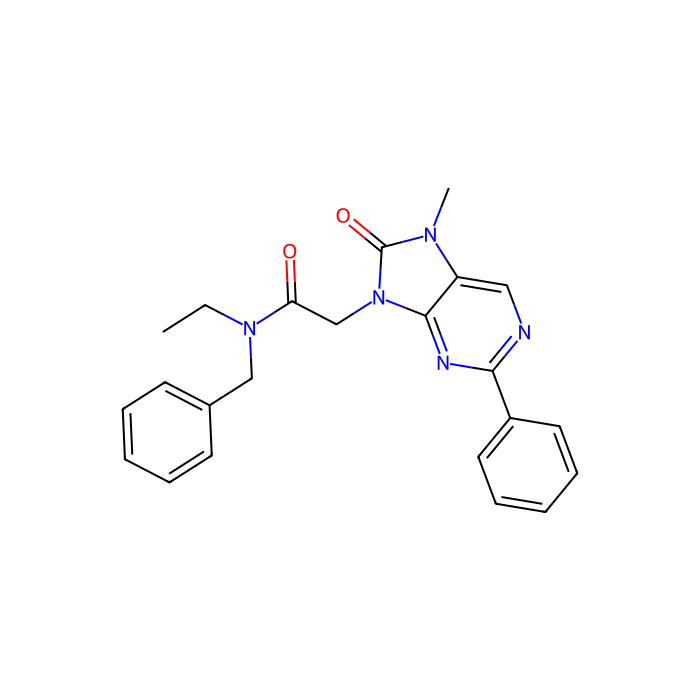
This compound belongs to the class of organic compounds known as purinones. These are purines in which the purine moiety bears a C=O group. Purine is a bicyclic aromatic compound made up of a pyrimidine ring fused to an imidazole ring.
External Descriptors
Not available
1. Djoumbou Feunang Y, Eisner R, Knox C, Chepelev L, Hastings J, Owen G, Fahy E, Steinbeck C, Subramanian S, Bolton E, Greiner R, and Wishart DS. ClassyFire: Automated Chemical Classification With A Comprehensive, Computable Taxonomy. Journal of Cheminformatics, 2016, 8:61.
Solvent:DMSO, Max Conc. mg/mL: 40.15, Max Conc. mM: 100
Molekulargewicht
401.500 g/mol
XLogP3
2.600
Hydrogen Bond Donor Count
0
Hydrogen Bond Acceptor Count
4
Rotatable Bond Count
6
Exact Mass
401.185 Da
Monoisotopic Mass
401.185 Da
Topological Polar Surface Area
69.600 Ų
Heavy Atom Count
30
Formal Charge
0
Complexity
602.000
Isotope Atom Count
0
Defined Atom Stereocenter Count
0
Undefined Atom Stereocenter Count
0
Defined Bond Stereocenter Count
0
Undefined Bond Stereocenter Count
0
The total count of all stereochemical bonds
0
Covalently-Bonded Unit Count
1
Lösungsrechner
Molarity Calculator
Determine the necessary mass, volume, or concentration for preparing a solution.
Dilution Calculator
Determine the dilution needed to prepare a stock solution.
Reconstitution Calculator
Bewertungen
Kundenbewertungen
Application Protocols
The following protocol outlines general, literature‑based practices for using lipophilic TSPO ligands like AC 5216 in common assay formats. Adapt and validate for your system. These are not product specifications.
Stock solution preparation
Equilibrate vial to room temperature in a desiccator. Briefly centrifuge to collect material.
Dissolve in anhydrous DMSO to prepare a 10–50 mM stock (adjust based on solubility; exact solubility Not specified for this item). Vortex until fully dissolved. Prepare single‑use aliquots and store at −20°C, protected from light.
Incubate fixed concentration of radiolabeled TSPO ligand with membranes in binding buffer (e.g., Tris‑HCl with BSA) at 4–25°C.
Add serial dilutions of AC 5216 or vehicle control (constant DMSO %). Incubate 30–120 min to reach equilibrium.
Separate bound/free (rapid filtration or centrifugation), wash, and quantify radioactivity. Fit inhibition curves to obtain apparent affinity metrics.
Cell‑based target engagement
Plate cells (TSPO‑positive line). Dose with serial dilutions of AC 5216 (constant vehicle). Incubate per assay design (acute to 24 h).
Measure readout (e.g., reporter, imaging, mitochondrial potential). Include positive/negative controls and cytotoxicity counterscreens.
Data integrity
Include vehicle controls, replicate wells, and randomize plate layout. Confirm compound identity/purity by LC‑MS as part of your QA.
Biological Roles
Context (literature): AC 5216 is widely cited as a high‑affinity ligand for the 18‑kDa translocator protein (TSPO), an evolutionarily conserved outer mitochondrial membrane protein implicated in cholesterol trafficking and various mitochondrial functions.
Key biological themes associated with TSPO modulation (literature discussion; no clinical claims):
Mitochondrial biology: TSPO associates with protein complexes that influence mitochondrial permeability and bioenergetic state. Ligand binding can modulate mitochondrial membrane potential and reactive oxygen species signaling in experimental systems.
Steroidogenesis: TSPO has been linked to the intramitochondrial transport of cholesterol, the precursor for steroid biosynthesis. Ligands are used to probe these steps in vitro and in cellulo, enabling dissection of acute versus transcriptional regulation.
Cellular stress responses: Experimental modulation of TSPO has been associated with pathways relevant to apoptosis, autophagy, and inflammatory signaling. Ligands such as AC 5216 serve as tools to examine causality in these processes.
Chemical biology utility: As a selective tool compound, AC 5216 is suitable for benchmark experiments (e.g., radioligand displacement, thermal shift assays, and CETSA‑like stabilization studies) to confirm TSPO engagement across species and systems.
Use considerations:
Apparent potency can vary with species, membrane preparation, and assay format; careful control experiments and parallel reference ligands are recommended.
Off‑target profiling (broad receptor/enzyme panels) is advisable when interpreting phenotypes in complex biological models.
Buffer Applications
Not a buffering agent. This product does not form classical buffer systems, and no pKa information is provided for recipe development.
Practical notes for assay buffer use (general guidance for small‑molecule ligands):
Stock preparation: Prepare a concentrated stock in anhydrous DMSO. Filter if needed using solvent‑compatible 0.2 µm filters.
Dilution: Add the DMSO stock to the assay buffer (e.g., PBS, HBSS, HEPES‑buffered saline, or culture media) with vigorous mixing to achieve the working concentration while keeping final DMSO typically ≤0.5–1% v/v to minimize solvent effects.
Order of addition: Add compound last to minimize precipitation; pre‑warm buffers when appropriate to aid mixing. Verify that proteins, serum, or detergents in the buffer do not sequester the ligand and alter free concentration.
Controls: Include vehicle controls at the same final DMSO percentage and, if applicable, positive/negative reference ligands for TSPO assays.
Item‑specific pKa and solubility parameters are Not specified for this item; refer to CoA/Spec Sheet and confirm empirically.
Green Alternatives
Because AC 5216 is a research ligand used at micromole to milligram scales rather than a bulk solvent or commodity reagent, “green” considerations center on solvent choice, waste minimization, and handling practices rather than replacement of the compound itself.
Prefer aqueous assay buffers with minimal organic cosolvent; target ≤0.5–1% v/v DMSO in final assay mixtures when performance allows.
Use high‑boiling, low‑volatility lids/seals on microplates to limit solvent emissions. Employ solvent‑saving serial dilution schemes to reduce DMSO consumption.
Consider cyclodextrin inclusion or serum‑free protein carriers to improve apparent solubility in water, reducing the need for organic cosolvents (confirm no interference with readouts).
Consolidate analytical runs to reduce rinse volumes and sample vial waste; consider UHPLC to cut solvent use.
Small comparison (general guidance):
DMSO: Excellent solubilizer; broadly assay‑compatible at low %; not particularly hazardous but manage exposure and waste properly.
Ethanol: Biocompatible in many assays; lower solvating power for highly lipophilic ligands; flammable.
PEG‑400/propylene glycol (minor co‑solvent): Can aid solubilization in some in vitro formats; viscosity may complicate liquid handling.
Note: There is no practical “green substitute” for the ligand itself when the research objective is TSPO engagement. Focus on solvent reduction, microscale experimentation, and appropriate waste segregation.
Pharmaceutical Uses
This product is provided strictly for research use only and is not intended for human or veterinary applications.
Relevant non‑clinical uses (general context):
Analytical/reference standard: May serve as a reference compound for TSPO‑related analytical method development (e.g., LC‑MS quantitation in in vitro systems) and as a benchmark in screening panels.
Discovery workflows: Commonly used as a tool compound in early‑stage research to probe TSPO biology, evaluate assay performance, and establish structure–activity relationships when synthesizing analogs.
Not applicable/Not provided:
Pharmacopeial status (USP/EP/JP), impurity profiles, residual solvent limits, and excipient qualifications are Not specified for this item; refer to CoA/Spec Sheet if available.
No claims are made regarding formulation suitability, dosage forms, stability in clinical excipients, or GMP status.
If your use case requires regulated‑grade material (GMP/API/excipient), this research‑grade Moligand™ product is not appropriate; contact your QA group for sourcing guidance.
Physical Properties
Item-specific physicochemical specifications are not provided in the current record.
Appearance: Not specified for this item; refer to CoA/Spec Sheet.
Melting point: Not specified for this item; refer to CoA/Spec Sheet.
Boiling point: Not applicable (solid small molecule; decomposition temperatures would be more relevant); specific value not specified for this item; refer to CoA/Spec Sheet.
Density: Not specified for this item; refer to CoA/Spec Sheet.
Solubility: Not specified for this item; refer to CoA/Spec Sheet.
LogP/logD: Not specified for this item; refer to CoA/Spec Sheet.
pKa: Not specified for this item; refer to CoA/Spec Sheet.
Refractive index: Not applicable for solids; not specified for this item; refer to CoA/Spec Sheet.
General (literature/contextual) guidance for library TSPO ligands like AC 5216:
Such chemotypes are typically lipophilic and commonly prepared as concentrated stock solutions in anhydrous DMSO for biochemical assays and cell‑based studies.
Aqueous solubility is often limited; co‑solvent strategies (DMSO dilution into buffered saline or culture media) and surfactant/carrier systems (e.g., 0.1–1% v/v final DMSO, or inclusion complexes) are frequently used. Verify compatibility with your assay system.
Important: Do not treat these general notes as product specifications. For method validation or regulatory documentation, obtain the lot-specific CoA/Spec Sheet.
Quality and Grades
Grade/Purity: Moligand™
What Moligand™ typically signifies (general information):
A research‑grade small‑molecule ligand suitable for screening, target engagement, and probe development workflows. Such offerings usually emphasize correct identity and high purity for biochemical and cell‑based assays, while avoiding medical/clinical positioning.
Identity is commonly supported by orthogonal characterization (e.g., NMR and MS), and purity is typically assessed by HPLC/UPLC with UV or MS detection. Exact acceptance criteria and test methods are lot‑specific.
Item‑specific notes:
Specific purity, residual solvents, water content, stabilizers, and analytical limits are Not specified for this item; refer to CoA/Spec Sheet.
UV cutoff or chromatographic baselines for analytical applications are Not specified for this item; refer to CoA/Spec Sheet.
Practical implications for users:
For assay reproducibility, request and retain the lot CoA and, if needed, perform in‑house verification (e.g., qNMR, HRMS, HPLC purity) consistent with your QC SOPs.
If using as a reference standard (e.g., for LC‑MS method development), verify extinction coefficients and response factors with your own system suitability tests unless provided in the CoA.
Regulatory note: Research‑use only; not tested for pharmaceutical excipient compliance or clinical use.
Reaction and Applications
This product is offered as a bioactive small molecule/ligand for research and screening, rather than as a general synthetic reagent. As such, it is not typically used as a stoichiometric reagent or catalyst in preparative chemistry.
Relevant research applications (literature/context for AC 5216‑like TSPO ligands):
Target engagement studies with the 18‑kDa translocator protein (TSPO) in biochemical binding assays using membranes or purified protein.
Competitive displacement assays versus radiolabeled TSPO ligands to quantify binding affinity and rank SAR series.
Cell‑based assays assessing TSPO‑dependent pathways (e.g., mitochondrial function readouts, cholesterol transport) to probe mechanism in vitro.
Reference control in screening libraries to benchmark TSPO assay performance and to validate assay dynamic range and specificity.
Not typically applicable:
Named organic reactions (e.g., Grignard, cross‑coupling) and general reagent roles are not common use‑cases for this item. For those needs, consider dedicated reagents/solvents described under relevant catalog sections.
Practical tips:
Prepare fresh aliquots to minimize freeze–thaw and adsorption losses.
Validate solvent and plate material compatibility to ensure consistent delivery at low concentrations.
Confirm identity/purity by LC‑MS prior to quantitative pharmacology studies to avoid confounding impurities.
Reaction Conditions
This section is generally not applicable, as AC 5216 is used as a bioactive small molecule in assays rather than as a reagent in chemical transformations.
If employing AC 5216 in chemical biology assays (general guidance; literature context):
Binding assays: Perform competitive radioligand binding with TSPO‑expressing membranes at low nanomolar tracer concentrations. Incubations are typically conducted at 4–25°C for 30–120 minutes, with gentle agitation; exact conditions depend on the tracer and membrane prep. Fit displacement curves using appropriate binding models (one‑site vs two‑site if warranted by residuals).
Cell‑based assays: Dose cellular systems with serial dilutions prepared from DMSO stocks, maintaining constant vehicle percentage (commonly ≤0.5–1% v/v). Incubation times vary from acute (minutes–hours) for signaling readouts to longer (16–48 h) for transcriptional or metabolic endpoints.
Thermal shift/CETSA: Establish compound‑dependent stabilization shifts across a temperature gradient; use matched vehicle controls.
Important: The above are general literature practices for TSPO ligands and are not product‑specific specifications. Optimize empirically for your system. For true chemical reaction conditions (solvent, temperature, catalysts), this product is not typically used.
Safety and Handling
Primary safety data are not provided in this listing. Always consult the SDS for authoritative information.
GHS classification: Not specified for this item; refer to SDS.
Signal word / H‑statements / pictograms: Not specified for this item; refer to SDS.
General laboratory safety for small, lipophilic bioactive ligands:
PPE: Use lab coat, safety glasses, and appropriate chemically resistant gloves (e.g., nitrile). Handle powders and DMSO solutions in a fume hood to minimize inhalation and dermal exposure.
Avoid: Contact with skin/eyes; inhalation of dust or aerosols; ingestion. Prevent release to the environment—collect waste as organic hazardous waste per institutional policy.
Storage incompatibilities: Keep segregated from strong oxidizers and strong acids/bases unless stability is verified. Avoid prolonged exposure to heat, light, and moisture.
First aid (overview; defer to SDS): If on skin, wash with soap and water; remove contaminated clothing. If in eyes, rinse cautiously with water for several minutes. If inhaled, move to fresh air. If ingested, rinse mouth; seek medical attention in all cases of significant exposure.
Spill response: For solids, gently cover with absorbent (dampened to reduce dust), collect mechanically, and dispose properly. For solutions, absorb with inert material and clean the area with solvent‑compatible detergent.
Note: This product is for research use only. Not for human or veterinary use.
Solvent Selection
Applicability: AC 5216 is supplied as a research small molecule rather than a process reagent or bulk solvent. Solvent considerations therefore focus on preparing analytical/biological stock solutions and ensuring assay compatibility.
General guidance for lipophilic small‑molecule ligands (literature/context):
Primary solvent: Anhydrous DMSO is commonly used to prepare concentrated stocks (e.g., 10–50 mM) for biochemical and cell‑based assays due to broad solubilizing power and assay compatibility at low final percentages.
Co‑solvents/alternatives: Ethanol or DMF can be used in some workflows; however, DMF may be less cell‑friendly. For in vitro systems, keep final organic content low (commonly ≤0.5–1% v/v DMSO) to minimize solvent artifacts.
Aqueous formulations: Where aqueous delivery is needed, dilute DMSO stocks into buffered saline/media with vigorous mixing. Cyclodextrins or nonionic surfactants can aid solubilization if compatible with the assay.
Adsorption/handling: Nonpolar ligands may adsorb to plastic; consider low‑bind plastics or glass vials for accurate dosing, particularly at low nM–µM concentrations.
Selection rationale versus alternatives:
Choose DMSO for maximum solubility and stability of hydrophobic ligands.
Choose ethanol for rapid miscibility in aqueous buffers when DMSO is contraindicated by the readout (e.g., certain enzyme assays), after confirming solubility and stability.
Item‑specific solubility and stability in these solvents are Not specified for this item; refer to CoA/Spec Sheet and confirm empirically.
Storage and Reconstitution
Storage conditions (as provided): Store at −20°C.
Shipping: Shipped in an ice chest with ice pads to preserve material integrity during transit.
Appearance: Not specified for this item; refer to CoA/Spec Sheet.
Reconstitution and handling (general guidance for small‑molecule ligands):
Upon receipt: Allow the sealed container to equilibrate to room temperature in a desiccator before opening to avoid moisture condensation.
Solvent: Dissolve in anhydrous DMSO for primary stocks. Exact solubility is Not specified for this item; refer to CoA/Spec Sheet and confirm empirically.
Aliquoting: Prepare single‑use aliquots to avoid repeated freeze–thaw cycles. Store aliquots at −20°C, protected from light and moisture.
Working solutions: Dilute DMSO stocks into assay buffer/media with thorough mixing. Keep final organic content low (commonly ≤0.5–1% v/v) to minimize solvent effects.
Stability: Long‑term stability and degradation pathways are Not specified for this item; refer to CoA/Spec Sheet. Check integrity by LC‑MS/HPLC before critical experiments.
Disposal: Dispose of unused material, solutions, and contaminated consumables as organic hazardous waste in accordance with institutional and local regulations.
Research use note: For research use only; not for human or veterinary use.
Structure and Identity
Brief overview: AC 5216 (often referenced in the literature as a high‑affinity TSPO ligand) is supplied here as a Moligand™ small‑molecule library member for research screening and target engagement studies.
SKU: A286555
Product Name: AC 5216
CAS: 226954-04-7
PubChem CID: 6433109 (literature identifier)
InChIKey: Not specified for this item; refer to CoA/Spec Sheet.
SMILES: Not specified for this item; refer to CoA/Spec Sheet.
Molecular Formula: Not specified for this item; refer to CoA/Spec Sheet.
Molecular Weight: Not specified for this item; refer to CoA/Spec Sheet.
Structural features (general, literature context):
AC 5216 is described in the literature as a lipophilic heteroaromatic small molecule that binds the 18‑kDa translocator protein (TSPO) located on the outer mitochondrial membrane.
Functional group content and precise ring system description are not specified in the current item record. For definitive structural representation (2D depiction, stereochemistry, and tautomeric state), consult the item’s CoA/Spec Sheet or the cited literature record for CID 6433109.
2D structure (verbal description):
Not specified for this item; refer to CoA/Spec Sheet. If a 2D structural diagram is required for documentation, retrieve from a trusted database using CAS 226954-04-7 or PubChem CID 6433109 and verify against the lot-specific CoA.
Synthetic Utility
AC 5216 is sold as a finished small‑molecule ligand rather than as a functionalized building block. It is not typically employed as a reagent or synthon in routine organic synthesis.
Potential roles in discovery chemistry (general context):
SAR scaffold: The compound can serve as a reference template in structure–activity relationship campaigns targeting TSPO, guiding substitution patterns, polarity tuning, and vector selection for probe design.
Probe derivatization: Where the molecular structure permits, chemists sometimes append linkers, reporter tags (e.g., fluorophores, biotin), or isotopic/radiolabels to create affinity probes or imaging agents. Feasibility depends on substitution tolerance and synthetic handles present on the scaffold; consult primary literature for attachment points.
Computational chemistry: As a validated TSPO ligand in the literature, AC 5216 can be used to calibrate docking, pharmacophore models, and free‑energy perturbation benchmarks.
Not typically applicable:
Use as a nucleophile/electrophile, ligand for metal catalysis, or polymerization monomer is not standard practice for this compound class.
Note: Any chemical modification strategy should begin with confirmed structural data (SMILES/InChI) for the specific lot; these details are Not specified for this item and must be taken from the CoA/Spec Sheet or primary literature before planning synthesis.
Target Specificity
This section (clone/isotype/antigen) applies to biologics/antibodies and is not directly applicable to a small‑molecule ligand.
General literature context for AC 5216:
Primary target: 18‑kDa translocator protein (TSPO) located in the outer mitochondrial membrane. AC 5216 is widely reported as a high‑affinity, selective TSPO ligand in vitro.
Selectivity considerations: Apparent selectivity can vary with assay format, species orthologs, and membrane/protein preparation. Off‑target assessment using receptor/enzyme panels is recommended when interpreting complex phenotypes.
No item‑specific target binding constants or selectivity panels are provided here; for quantitative values, consult the primary literature and verify experimentally with your lot.
Benötigen Sie Hilfe bei der Auswahl der Qualität?
Unser Leitfaden zur Qualitätsauswahl behandelt Reinheit, Stabilisatorstatus und Anwendungseignung für alle Varianten in unserem Katalog.
Wir verwenden Cookies, um die ordnungsgemäße Funktion der Website sicherzustellen und, soweit zulässig, Ihr Nutzererlebnis zu verbessern. Sie können Ihre Einstellungen jederzeit unter „Einstellungen“ verwalten. Weitere Informationen finden Sie in unserer Cookie-Richtlinie.
Dürfen wir Sie über Rabattaktionen informieren?
Später erinnern
Vielen Dank! Bitte überprüfen Sie Ihren E-Mail-Posteingang, um zu bestätigen.
Products are supplied to verified businesses, institutions, and qualified professionals for research and development use only. Not for use in humans, animals, diagnosis, or therapy.

 K2229071