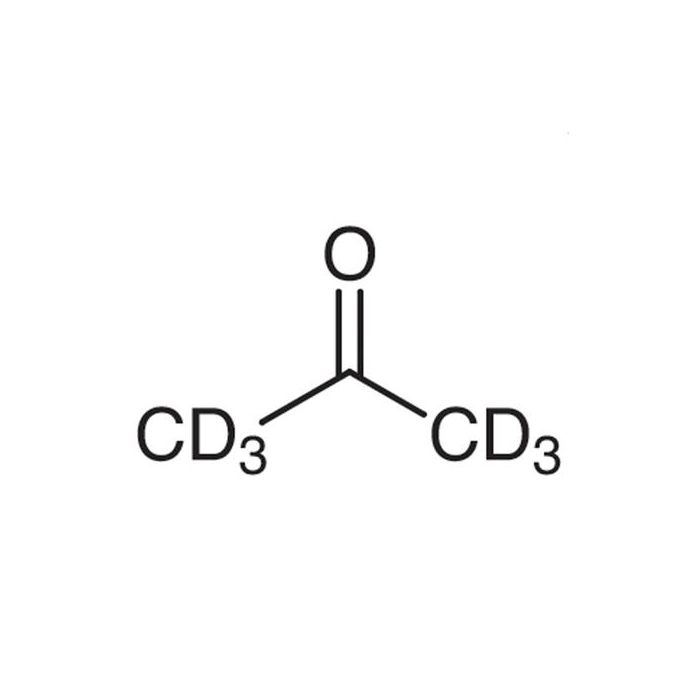
Acetone-d6 - ≥99.9 atom% D , CAS No.666-52-4

CAS: 666-52-4 Cat. No.: A100965 Summenformel: C3D6O Molekulargewicht: 64.12 Beilstein Registry Number: 1702935 EG-Nummer: 211-563-9
Zu bestellen verfügbar
QUALITÄT & REINHEIT ≥99.9 atom% D
Synonyms
Carbamic acid, N-(4-amino-1-methylcyclohexyl)-, 1,1-dimethylethyl ester|Acetone-d6 (99.9 atom per cent D)|1,1,1,3,3,3-HEXADEUTERO-2-PROPANONE|2-PROPANONE-D6|Acetone, perdeutero-|aceton-d6|d6-acetone|Perdeuteroacetone|PERDEUTERIOACETONE|d-6 acetone|Acetone d6|1-Boc-4-(3-Fluoro-benzylamino)-piperidine|Hexadeuteroacetone|(2H6)Acetone|((2)H6)propan-2-one|Acetone-d6|(3aR,5r,6aS)-tert-Butyl5-hydroxyhexahydrocyclopenta[c]pyrrole-2(1H)-carboxylate|hexadeuterioacetone|2-Propanone-1,1,1,3,3,3-D6|2-Propanone-1,1,1,3,3,3-D6-|ACETONE (1,1,1,3,3,3-D6)
Storage
Room temperature,Argon charged
Shipped In
Normal
★
Größe
Deutschland (EU)
USA*
Preis
Menge
10×0.6ml
A100965-10×0.6ml
—
2 Auf Lager
60,65€
10ml
A100965-10ml
—
3 Auf Lager
86,69€
25ml
A100965-25ml
—
3 Auf Lager
173,46€
100ml
A100965-100ml
—
2 Auf Lager
567,41€
Enter a quantity for the sizes you want to add.

Übersicht

Acetone-d6 is a deuterated NMR solvent useful in NMR-based research and analyses. Its Infrared and Raman spectra have been analyzed. Pyrolysis and photolysis of acetone-d6 and methane mixtures have been investigated as a function of temperature. It has been reported to be prepared by reacting heavy water with propyne-d4 in the presence of mercury catalyst.

Spezifikationen

Synonyme
Carbamic acid, N-(4-amino-1-methylcyclohexyl)-, 1,1-dimethylethyl ester | Acetone-d6 (99.9 atom per cent D) | 1,1,1,3,3,3-HEXADEUTERO-2-PROPANONE | 2-PROPANONE-D6 | Acetone, perdeutero- | aceton-d6 | d6-acetone | Perdeuteroacetone | PERDEUTERIOACETONE | d-6 acetone | Acetone d6 | 1-Boc-4-(3-Fluoro-benzylamino)-piperidine | Hexadeuteroace Show more
Spezifikationen & Reinheit
≥99.9 atom% D
Storage
Room temperature,Argon charged
Verschickt in
Normal
Reinheit
≥99.9 atom% D
Namen und Kennungen
Pubchem Sid
Pubchem Sid Url
https://pubchem.ncbi.nlm.nih.gov/substance/504759114
SMILES
CC(=O)C
IUPAC Name
1,1,1,3,3,3-hexadeuteriopropan-2-one
InChIKey
CSCPPACGZOOCGX-WFGJKAKNSA-N
InChI
1S/C3H6O/c1-3(2)4/h1-2H3/i1D3,2D3
Isomere SMILES
[2H]C([2H])([2H])C(=O)C([2H])([2H])[2H]
WGK Deutschland
3
Alternative CAS-Nummer
67-64-1
UN-Nummer
1090
Verpackungsgruppe
II
Molekulargewicht
64.12
Beilstein
1702935
Reaxys
635680
Reaxys-RN_link_address
https://www.reaxys.com/reaxys/secured/hopinto.do?context=S&query=IDE.XRN=635680&ln=

Erweiterte Daten

Taxonomic Classification

Taxonomy Tree

KingdomOrganic compounds
SuperclassOrganic oxygen compounds
KlasseOrganooxygen compounds
SubclassCarbonyl compounds
Intermediate Tree Nodes Not available
Direct ParentKetones
Alternative Parents Organic oxides  Hydrocarbon derivatives  
Molecular FrameworkAliphatic acyclic compounds
Substituents Ketone - Organic oxide - Hydrocarbon derivative - Aliphatic acyclic compound
BeschreibungThis compound belongs to the class of organic compounds known as ketones. These are organic compounds in which a carbonyl group is bonded to two carbon atoms R2C=O (neither R may be a hydrogen atom). Ketones that have one or more alpha-hydrogen atoms undergo keto-enol tautomerization, the tautomer being an enol.
External Descriptors propanone - deuterated compound
3D-Struktur
Interaktives chemisches Strukturmodell


Zertifikate (CoA, COO, BSE/TSE und Analyse-Diagramm)
C of A & Other Certificates(BSE/TSE, COO):
Analytical Chart:

Find and download the COA for your product by matching the lot number on the packaging.

21 results found

Lot NumberCertificate TypeDatumArtikel
G2610144G2610144Certificate of AnalysisJun 17, 2026 A100965
G2610143G2610143Certificate of AnalysisJun 17, 2026 A100965
G2610142G2610142Certificate of AnalysisJun 17, 2026 A100965
F2629211F2629211Certificate of AnalysisJun 17, 2026 A100965
F2629210F2629210Certificate of AnalysisJun 17, 2026 A100965
A2604153A2604153Certificate of AnalysisJan 05, 2026 A100965
L2517005L2517005Certificate of AnalysisDec 30, 2025 A100965
A2221016A2221016Certificate of AnalysisJun 09, 2025 A100965
A2221015A2221015Certificate of AnalysisJun 09, 2025 A100965
A2221014A2221014Certificate of AnalysisJun 09, 2025 A100965
A2221013A2221013Certificate of AnalysisJun 09, 2025 A100965
H2114047H2114047Certificate of AnalysisMay 12, 2023 A100965
H2114048H2114048Certificate of AnalysisMay 12, 2023 A100965
H2114050H2114050Certificate of AnalysisMay 12, 2023 A100965
K2018104K2018104Certificate of AnalysisSep 19, 2022 A100965
I2202465I2202465Certificate of AnalysisJul 30, 2022 A100965
I2202466I2202466Certificate of AnalysisJul 30, 2022 A100965
I2202469I2202469Certificate of AnalysisJul 30, 2022 A100965
I2202471I2202471Certificate of AnalysisJul 30, 2022 A100965
D2525035D2525035Certificate of AnalysisJan 12, 2022 A100965
D2525033D2525033Certificate of AnalysisJan 12, 2022 A100965
Chemische und physikalische Eigenschaften
LöslichkeitSoluble in water.
EmpfindlichkeitMoisture sensitive
Brechungsindex1.36
Flammpunkt (°F)-2.2 °F
Flammpunkt (°C)-19°C
Siedepunkt (°C)55.5 °C
Schmelzpunkt (°C)−93.8 °C
Molekulargewicht64.12
XLogP3-0.100
Hydrogen Bond Donor Count0
Hydrogen Bond Acceptor Count1
Rotatable Bond Count0
Exact Mass64.0795 Da
Monoisotopic Mass64.0795 Da
Topological Polar Surface Area17.100 Ų
Heavy Atom Count4
Formal Charge0
Complexity26.300
Isotope Atom Count6
Defined Atom Stereocenter Count0
Undefined Atom Stereocenter Count0
Defined Bond Stereocenter Count0
Undefined Bond Stereocenter Count0
The total count of all stereochemical bonds0
Covalently-Bonded Unit Count1
Sicherheit und Gefahren (GHS)
Piktogramm(e)
GHS02,   GHS07
Signal
Danger
Gefahrenhinweise

H225:Highly Flammable liquid and vapor

H319:Causes serious eye irritation

H336:May cause drowsiness or dizziness

Sicherheitshinweise

P210:Keep away from heat, hot surface, sparks, open flames and other ignition sources. - No smoking.

P233:Keep container tightly closed.

P240:Ground/bond container and receiving equipment.

P241:Use explosion-proof [electrical/ventilating/lighting/.../] equipment.

P242:Use only non-sparking tools.

P243:Take precautionary measures against static discharge.

P261:Avoid breathing dust/fume/gas/mist/vapors/spray.

P271:Use only outdoors or in a well-ventilated area.

P280:Wear protective gloves/protective clothing/eye protection/face protection.

P303+P361+P353:IF ON SKIN (or hair): Take off Immediately all contaminated clothing. Rinse SKIN with water [or shower].

P304+P340:IF INHALED: Remove person to fresh air and keep comfortable for breathing.

P305+P351+P338:IF IN EYES: Rinse cautiously with water for several minutes. Remove contact lenses if present and easy to do - continue rinsing.

P370+P378:In case of fire: Use ... to extinguish.

P405:Store locked up.

P403+P233:Store in a well-ventilated place. Keep container tightly closed.

P403+P235:Store in a well-ventilated place. Keep cool.

P501:Dispose of contents/container to an approved waste disposal plant.

P264+P265:Wash hands [and …] thoroughly after handling. Do not touch eyes.

P337+P317:If eye irritation persists: Get medical help.

P319:Get medical help if you feel unwell.

WGK Deutschland
3
Reaxys
635680
Reaxys-RN_link_address
https://www.reaxys.com/reaxys/secured/hopinto.do?context=S&query=IDE.XRN=635680&ln=
Klasse
3
FAQs und Artikel
Citations of This Product
Lösungsrechner
Bewertungen

Kundenbewertungen

Application Protocols

No item-specific tested application data were provided. The following generic NMR sample preparation workflow can be adapted to acetone-d6:

  • Sample dissolution
    • Dry the sample (vacuum, mild heat) if moisture-sensitive. Use oven- or flame-dried glassware.
    • Add 0.6–0.7 mL acetone-d6 to 5 mm NMR tube; dissolve 5–30 mg analyte (as solubility permits).
  • Referencing
    • Use internal standard if quantitative analysis is required (certified standard). For chemical shift referencing, use residual solvent peak (~2.05 ppm in 1H; ~206.7/29.8 ppm in 13C; literature values).
  • Water management
    • Minimize air exposure; cap promptly. If necessary, pre-dry solvent over activated 3 Å sieves (verify no isotopic loss).
  • Data acquisition tips
    • For 1H NMR, suppress residual water if present (WET, PRESAT) and ensure solvent peak does not obscure analyte resonances.
    • For 13C NMR, adjust spectral width to capture carbonyl region if needed and avoid aliasing of solvent signals.

These steps are general guidance. For validated methods and acceptance criteria, follow your laboratory SOPs.

Biological Roles

No item-specific biological data are provided. The following reflects general biochemical context for acetone (literature); the deuterated isotopologue has analogous chemistry but no distinct biological role beyond use as a tracer.

  • Endogenous occurrence (acetone, literature): Acetone is a minor ketone body in mammals, arising from spontaneous decarboxylation of acetoacetate and via isopropanol metabolism. It is present at low concentrations in blood and breath, increasing during ketosis.
  • Metabolism: Oxidized to acetate through intermediate steps (e.g., via acetol and methylglyoxal pathways) in hepatic tissues.
  • Isotopic tracing: Acetone-d6 can be used in metabolic research as a labeled tracer to investigate solvent–metabolite interactions or to calibrate analytical methods (e.g., GC/MS, NMR) without making any physiological claims.
  • Protein/nucleic acid interactions: As a small polar aprotic solvent, acetone perturbs biomolecular hydration and can denature proteins at sufficient concentrations; such effects are exploited in precipitation protocols (general lab practice), though acetone-d6 is rarely used for these purposes due to cost.

Research-use only note

  • This product is intended for research and analytical applications; not for human or veterinary use, diagnostics, or clinical procedures.
Buffer Applications

Acetone-d6 is not a buffering agent and is not typically used to prepare aqueous buffer systems. For solution-phase NMR of aqueous samples, deuterium oxide (D2O) or H2O/D2O mixtures with appropriate buffer salts (e.g., phosphate, HEPES) are preferred. Use this section only as a reminder:

  • If minimal organic content is acceptable, consider small volumes of acetone-d6 as co-solvent to aid solubility, but be mindful it provides no buffer capacity and may affect pH measurements.
  • For detailed solvent considerations, see the Solvent Selection section.
Green Alternatives

Acetone is generally viewed as one of the greener organic solvents due to low toxicity, high biodegradability, and favorable environmental profile compared with chlorinated solvents. For deuterated NMR work, selection balances safety, performance, and spectral needs.

Comparison (literature-based, general):

  • Acetone-d6
    • Pros: Polar aprotic; miscible with water; low viscosity; easy removal; relatively benign EHS profile; useful temperature range.
    • Cons: Highly flammable; residual peak near 2.05 ppm may overlap with analytes; can participate in H/D exchange under acid/base.
  • CDCl3
    • Pros: Excellent for nonpolar solutes; simple 1H residual at ~7.26 ppm.
    • Cons: Toxicity and environmental concerns; ozone-depleting potential historically associated with chlorinated solvents; not water-miscible.
  • DMSO-d6
    • Pros: Dissolves very polar/ionic samples; high boiling point; low flammability.
    • Cons: Difficult to remove; strong solvating ability may perturb equilibria; higher E-factor in cleaning.
  • CD3CN
    • Pros: Higher polarity; good for coordination/ionic species; low viscosity.
    • Cons: Toxicity concerns for nitriles; stronger complexation to metals.

Green practice tips

  • Choose the minimum volume needed for NMR tubes (e.g., 0.5–0.7 mL) to limit solvent use.
  • Reclaim by distillation over activated molecular sieves when purity and isotopic integrity can be validated.
  • Store under inert gas (as provided) to extend lifetime and minimize waste.
Pharmaceutical Uses

No item-specific pharmacopeial status or excipient grade is provided for this product. The following are general, non-clinical notes relevant to pharmaceutical R&D labs.

  • Role in analytics (general): Deuterated solvents, including acetone-d6, are widely used for NMR characterization of drug substances (DS) and drug products (DP), impurity profiling, and quantitation (qNMR) with certified internal standards.
  • Residual solvent testing: Acetone is a Class 3 solvent (low toxic potential) under ICH Q3C (literature). Deuterated acetone may be employed as an analytical tool or internal standard in spectroscopic or spectrometric methods, not as a process solvent.
  • Formulation relevance: Not used as an excipient; occasionally used as a process solvent in R&D screening (non-deuterated acetone). Deuterated variant is employed strictly for spectroscopic or mechanistic studies.
  • Documentation: For submission-quality data, ensure the solvent’s assay (%D, water, non-volatile residue, and identity) is documented via CoA and verified per internal SOPs.

Note: No medical or therapeutic claims are made. This product is for research use only.

Physical Properties

Note: No item-specific specifications were provided. Values below are literature/typical for acetone/acetone‑d6 and should be used as guidance only. For exact specifications of this item, refer to CoA/Spec Sheet.

  • Phase/appearance: Colorless, volatile liquid (literature)
  • Boiling point: ~56 °C at 1 atm (literature, acetone; deuteration has negligible effect on BP)
  • Melting point: ~−95 °C (literature)
  • Density: ~0.79–0.80 g/mL at 20–25 °C (literature for acetone; deuterated grade can be slightly higher)
  • Refractive index (nD20): ~1.358 (literature)
  • Dielectric constant (25 °C): ~20.7 (literature)
  • Vapor pressure (20 °C): ~24 kPa (literature)
  • LogP (octanol/water): approx. −0.2 to −0.3 (literature)
  • Solubility: Miscible with water and most organic solvents (literature)
  • Residual solvent NMR peaks (common reference values; literature)
    • 1H NMR: trace residual CHD5 typically ~2.05 ppm (singlet)
    • 13C NMR: ~206–207 ppm (C=O), ~29–30 ppm (CD3) for solvent signals

Important: These are general/literature values. Not specified for this item; refer to CoA/Spec Sheet for any assured specifications (water, residual proton content, metals, UV cut-off, etc.).

Quality and Grades
  • Item-specific status
    • Grade/Purity: Not specified for this item; refer to CoA/Spec Sheet.
    • Appearance: Not specified for this item; refer to CoA/Spec Sheet.
  • Typical considerations for deuterated solvents (general guidance)
    • Residual proton content (e.g., %D, residual CHD5) significantly impacts 1H NMR background and quantitative NMR; suppliers often specify %D (e.g., ≥99 atom % D). For this item, specific %D is Not specified for this item; refer to CoA/Spec Sheet.
    • Water content influences exchangeable protons and line broadening for moisture-sensitive samples; Karl Fischer values are commonly reported. Not specified for this item; refer to CoA/Spec Sheet.
    • Trace acidity/basicity can affect sensitive analytes; some lots are passed through basic alumina or treated to reduce acid/base impurities. Not specified for this item; refer to CoA/Spec Sheet.
    • UV absorbance (for LC applications) may be reported for HPLC grade solvents. Not specified for this item; refer to CoA/Spec Sheet.
  • Stabilizers
    • Acetone-d6 is typically supplied without stabilizers. If any stabilizer is used, it should be disclosed on the CoA/SDS due to potential NMR background. Not specified for this item; refer to CoA/Spec Sheet.
  • Practical selection advice
    • For high-sensitivity 1H/19F NMR, prioritize highest %D and lowest water.
    • For qNMR, ensure certification of residual proton and water content; verify with your method.
Reaction and Applications

Beyond its primary role as an NMR solvent, acetone-d6 is a useful isotopic reagent.

  • NMR applications
    • Routine 1H, 13C, 19F NMR: provides deuterium lock and minimal proton background; residual singlet at ~2.05 ppm is generally unobtrusive.
    • Variable-temperature NMR: low freezing point and moderate polarity aid studies of dynamics, H-bonding, and conformational exchange.
    • qNMR: suitable when %D and water are tightly controlled (verify per lot on CoA); combine with certified internal standards.
  • Isotopic labeling and mechanistic probes (literature)
    • Deuterium source via exchange: Under basic or acidic catalysis, substrates capable of enolization can undergo H/D exchange with acetone-d6, introducing deuterium at activated C–H positions (e.g., alpha to carbonyls, certain heterocycles).
    • Tracer studies: Track solvent participation or hydrogen transfer pathways (e.g., transfer hydrogenations, photoredox HAT processes) by monitoring deuterium incorporation.
    • Kinetic isotope effect experiments: Compare rates using acetone vs acetone-d6 in reactions where C–H/C–D bond cleavage is rate-determining.
  • General solvent use (literature)
    • Polar aprotic medium supporting SN2, oxidations (e.g., Jones, Dess–Martin workups), and organometallic quench steps; for deuterated grade, consider cost and isotopic scrambling before using as bulk solvent.
  • Practical tips
    • Avoid prolonged contact with strong bases/acids if preservation of full deuteration is important; H/D scrambling can occur.
    • Drying: molecular sieves (3 Å) are commonly compatible; verify they are pre-dried and do not exchange deuterium.
Reaction Conditions

General literature guidance for using acetone-d6 as solvent or isotopic reagent (not item-specific specifications):

  • Solvent use in NMR sample prep
    • Typical volume: 0.5–0.7 mL per 5 mm NMR tube.
    • Temperature range: ~−80 to +50 °C without noticeable changes in spectral quality; avoid near freezing/boiling points during acquisition.
  • H/D exchange labeling (literature examples)
    • Base-catalyzed exchange: Substrates bearing acidic C–H (e.g., beta-dicarbonyls) stirred in acetone-d6 with catalytic KOtBu or DBU at rt to 40 °C for 1–12 h can reach high D incorporation. Use D2O quench to minimize back-exchange.
    • Acid-catalyzed exchange: Catalytic TsOH or AcOH in acetone-d6 at rt to reflux promotes exchange at activated positions; monitor by NMR.
  • Aldol reactions with acetone-d6
    • Conditions: L-Proline or secondary amines (organocatalysis) at rt–40 °C in acetone-d6 as both reagent and solvent; control time (2–24 h) to balance conversion vs. isotopic scrambling.
  • Oxidation/reduction studies
    • Transfer hydrogenation or photoredox HAT can be probed by replacing solvent with acetone-d6 to identify H vs D transfer. Typical catalysts: Ir/Ru photoredox or Pd/Ni for hydrogenations; conditions vary widely—use as mechanistic probe only.
  • Expected outcomes
    • D incorporation and yields are substrate- and condition-dependent; confirm by 1H/2H/13C NMR and HRMS.

Always validate with small-scale trials and consult primary literature for substrate-specific conditions.

Safety and Handling

Safety details specific to this item were not provided. Always consult the SDS for authoritative information. The notes below reflect typical GHS classifications for acetone/acetone-d6 reported by major suppliers (literature) and general best practices.

  • GHS classification (typical, literature):
    • Flammable liquid, Category 2; Eye irritation, Category 2A; STOT SE Category 3 (narcotic effects)
    • Pictograms: Flame; Exclamation mark (literature)
  • Key hazards (general): Highly flammable liquid and vapor; may cause eye irritation; high vapor concentrations can cause drowsiness or dizziness.
  • Handling
    • Use in a fume hood to control vapors; prevent ignition sources (no sparks/open flames).
    • Ground/bond containers during transfer; use conductive tubing for bulk moves.
    • For NMR/sample prep, cap immediately to minimize atmospheric moisture uptake and H/D exchange with wet glassware.
  • PPE: Safety glasses or chemical splash goggles; lab coat; compatible chemical-resistant gloves (nitrile or equivalent); consider flame-resistant lab coat for scale-up.
  • Incompatibilities: Strong oxidizers (e.g., chromic acid, nitric acid), strong bases/acids in the presence of reactive metals, and halogenating agents. Avoid peroxides/ozone, UV with strong oxidants.
  • First aid (overview):
    • Inhalation: Move to fresh air; monitor breathing; seek medical attention if symptoms persist.
    • Skin/eye: Rinse with water for ≥15 minutes; remove contaminated clothing; seek medical attention for eye exposure.
    • Ingestion: Rinse mouth; do not induce vomiting; seek medical attention.
  • Fire-fighting: Alcohol-resistant foam, dry chemical, or CO2; water fog for cooling. Vapors may travel to source of ignition.
Solvent Selection

Acetone-d6 is a polar aprotic, mid-volatility deuterated solvent offering good solubility for many organic analytes and supporting a stable NMR deuterium lock.

  • Polarity/miscibility (literature)
    • Polar aprotic; dielectric constant ~20.7 (25 °C).
    • Miscible with water and most organics (ethers, alcohols, chlorinated, hydrocarbons in many ratios).
  • When to choose acetone-d6
    • For analytes soluble in moderately polar media where CDCl3 is too nonpolar and DMSO-d6 is too viscous/strongly hydrogen-bonding.
    • For low-temperature NMR (down to ~−80 °C) due to a low freezing point.
    • When rapid solvent removal is needed after NMR due to high volatility.
  • When to choose alternatives
    • CDCl3 for nonpolar solutes with minimal hydrogen-bonding.
    • DMSO-d6 for poorly soluble, highly polar/ionic compounds; broader temperature range but higher viscosity.
    • CD3CN or MeOD-d4 for strongly polar solutes and coordination chemistry studies.
  • Practical NMR considerations (general)
    • Residual 1H singlet of acetone appears at ~2.05 ppm; verify against your spectral window to avoid overlap.
    • 13C solvent peaks near ~206–207 ppm (C=O) and ~29–30 ppm (methyl carbon). Ensure your acquisition does not alias these if undesired.
    • Hygroscopicity is modest; still, dry glassware and minimize air exposure to reduce H/D exchange and water pickup.
Storage and Reconstitution
  • Item-specific storage (from Product Data)
    • Storage conditions: Room temperature, Argon charged.
    • Shipped in: Normal.
  • General handling and storage guidance
    • Keep container tightly closed under inert gas to minimize moisture uptake and H/D exchange.
    • Store away from heat, sparks, open flames, and oxidizing agents; use flammable-liquids cabinets where applicable.
    • Use septum-sealed bottles or PTFE-lined caps for repeated access; consider over-pressuring with argon after each use.
    • If dispensing via syringe/needle, use dry, inert techniques to reduce atmospheric exposure.
  • Reconstitution
    • Not applicable; supplied as a ready-to-use liquid. If purification/drying is needed for sensitive applications, distill under inert atmosphere from CaH2 or pass through activated molecular sieves (3 Å). Verify isotopic integrity post-treatment (1H/2H NMR) because aggressive drying can promote H/D exchange.
  • Shelf-life considerations
    • Monitor by NMR for growth of residual proton signal or water peak over time. If significant changes are observed, re-dry or replace solvent as appropriate.
  • Research use note
    • For research use only (as provided). Refer to the product’s SDS for complete storage and handling information.
Structure and Identity

A fully deuterated analog of acetone (propanone) used primarily as an NMR solvent and isotopic labeling reagent.

  • Item-specific (from Product Data)
    • CAS: 666-52-4
    • SKU: A100965
    • Product name: Acetone-d6
    • InChIKey (as provided): 52230
    • Storage note: Room temperature, Argon charged
  • Literature/computed identifiers (for reference; not item-specific specs)
    • Synonyms: 2-propanone-d6; (CD3)2CO
    • Molecular formula (literature): C3D6O
    • Molecular weight (literature): ~64.12 g/mol
    • SMILES (literature): [2H]C([2H])([2H])C(=O)C([2H])([2H])[2H]
    • InChI (literature): typically analogous to acetone with [2H] at all methyl H sites
  • Structural features (general description)
    • Functional group: Ketone (propanone core), carbonyl at C2
    • Isotopic labeling: All six methyl hydrogens are replaced by deuterium (two CD3 groups flanking C=O)
    • 2D depiction in words: central carbonyl carbon double-bonded to oxygen, bonded to two terminal CD3 groups in a trigonal planar arrangement around the carbonyl carbon.
Synthetic Utility

While acetone-d6 is primarily a spectroscopic solvent, it also functions as an isotopically labeled building block and reagent.

  • Isotopic labeling reagent (literature)
    • Source of deuterium for substrates undergoing enolization: beta-dicarbonyls, aldehydes/ketones (via enolates), certain heteroaromatics, and activated benzylic positions can exchange H for D using acetone-d6 as solvent or co-solvent under basic/acidic catalysis.
    • Incorporation in aldol condensations: Reactions employing acetone-d6 as the carbonyl component produce products with deuterated methyl groups, useful for mechanistic or spectroscopic differentiation.
  • Electrophilic partner (general chemistry of acetone)
    • Engages in aldol and Mannich-type reactions; participates in Baeyer–Villiger oxidation to afford deuterated methyl acetate-d6 when labeling is preserved.
  • Advantages vs. unlabeled acetone
    • Enables downstream NMR/MS confirmation of site-specific deuteration and tracer studies; facilitates kinetic isotope effect analysis.
  • Practical cautions
    • Strong bases (e.g., LDA, NaH) and acids can scramble deuteration at the methyl positions; maintain low temperatures and short contact times if retaining isotopic integrity is essential.
    • Workups with H2O/MeOH can back-exchange; use D2O/MeOD where feasible to preserve labeling.

These are literature-based generalities; optimize conditions for each substrate and verify deuterium incorporation by NMR/MS.

Target Specificity

Not applicable. This product is a small-molecule solvent/reagent, not a biological targeting reagent (e.g., antibody, ligand, or inhibitor). No antigen/epitope specificity, species reactivity, clone, or isotype information applies.

Häufig gestellte Fragen

What is the isotopic enrichment of this product?
This product is isotopically enriched to ≥99.9 atom% deuterium. Isotopic enrichment is a separate specification from chemical purity — a labelled compound has both. Lot-specific values are stated on the Certificate of Analysis.
How should this product be stored?
Store at room temperature under argon. It is supplied under an argon blanket; reseal under inert gas after each use.
How is this product shipped?
This product ships under standard ambient conditions. No temperature-controlled packaging is required.
What are the CAS number, molecular formula and molecular weight?
The CAS Number is 666-52-4, the molecular formula is C3H6O, and the molecular weight is 64.12 g/mol. InChIKey CSCPPACGZOOCGX-WFGJKAKNSA-N.
What documentation is provided?
Available product documentation, including Certificates of Analysis (COA), Safety Data Sheets (SDS), and specification sheets, is shown in the product document area. Document availability and access follow the current site policy.

Dürfen wir Sie über Rabattaktionen informieren?

Später erinnern

Vielen Dank! Bitte überprüfen Sie Ihren E-Mail-Posteingang, um zu bestätigen.

Hoppla! Benachrichtigungen sind deaktiviert.