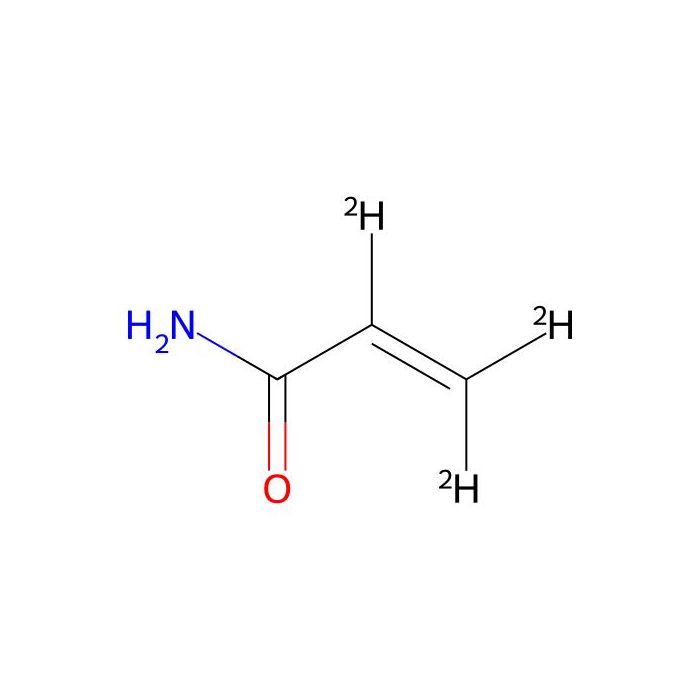
Acrylamide-d , CAS No.122775-19-3

CAS: 122775-19-3 Cat. No.: A1440959 Summenformel: D2C=CDCONH2 Molekulargewicht: 74.1 EG-Nummer: 685-248-3 PubChem CID: 12209671
Zu bestellen verfügbar
Storage
Store at -20°C
Shipped In
Ice chest + Ice pads
★
Größe
Deutschland (EU)
USA*
Preis
Menge
1mg
A1440959-1mg
Auf Bestellung · 8–12 Wochen
Enter a quantity for the sizes you want to add.

Übersicht

Acrylamide-d3 is the deuterium labeled Acrylamide.

Spezifikationen

Storage
Store at -20°C
Verschickt in
Ice chest + Ice pads
Dieses Produkt erfordert Kühlkettenversand. Grundversand und andere Economy-Optionen sind nicht verfügbar.
Namen und Kennungen
SMILES
C=CC(=O)N
IUPAC Name
2,3,3-trideuterioprop-2-enamide
InChIKey
HRPVXLWXLXDGHG-FUDHJZNOSA-N
InChI
1S/C3H5NO/c1-2-3(4)5/h2H,1H2,(H2,4,5)/i1D2,2D
Isomere SMILES
[2H]C(=C([2H])C(=O)N)[2H]
WGK Deutschland
3
PubChem CID
12209671
Molekulargewicht
74.1

Erweiterte Daten

Taxonomic Classification

Taxonomy Tree

KingdomOrganic compounds
SuperclassOrganic acids and derivatives
KlasseCarboxylic acids and derivatives
SubclassAcrylic acids and derivatives
Intermediate Tree Nodes Not available
Direct ParentAcrylic acids and derivatives
Alternative Parents Primary carboxylic acid amides  Organonitrogen compounds  Organic oxides  Hydrocarbon derivatives  Carbonyl compounds  
Molecular FrameworkAliphatic acyclic compounds
Substituents Acrylic acid or derivatives - Primary carboxylic acid amide - Carboxamide group - Organic nitrogen compound - Organic oxygen compound - Organic oxide - Hydrocarbon derivative - Organooxygen compound - Organonitrogen compound - Carbonyl group - Aliphatic acyclic compound
BeschreibungThis compound belongs to the class of organic compounds known as acrylic acids and derivatives. These are organic compounds containing acrylic acid CH2=CHCO2H or a derivative thereof.
External Descriptors Not available
3D-Struktur
Interaktives chemisches Strukturmodell


Zertifikate (CoA, COO, BSE/TSE und Analyse-Diagramm)
C of A & Other Certificates(BSE/TSE, COO):
Analytical Chart:
Chemische und physikalische Eigenschaften
Flammpunkt (°F)280.4 °F
Flammpunkt (°C)138 °C
Sicherheit und Gefahren (GHS)
Piktogramm(e)
GHS06,   GHS08,   GHS07
Signal
Danger
Gefahrenhinweise

H315:Causes skin irritation

H319:Causes serious eye irritation

H301:Toxic if swallowed

H317:May cause an allergic skin reaction

H312:Harmful in contact with skin

H332:Harmful if inhaled

H372:Causes damage to organs through prolonged or repeated exposure

H340:May cause genetic defects

H350:May cause cancer

H361:Suspected of damaging fertility or the unborn child

Sicherheitshinweise

P261:Avoid breathing dust/fume/gas/mist/vapors/spray.

P305+P351+P338:IF IN EYES: Rinse cautiously with water for several minutes. Remove contact lenses if present and easy to do - continue rinsing.

P280:Wear protective gloves/protective clothing/eye protection/face protection.

P302+P352:IF ON SKIN: wash with plenty of water.

P321:Specific treatment (see ... on this label).

P405:Store locked up.

P501:Dispose of contents/container to an approved waste disposal plant.

P264:Wash hands [and …] thoroughly after handling.

P260:Do not breathe dust/fume/gas/mist/vapors/spray.

P281:Use personal protective equipment as required.

P271:Use only outdoors or in a well-ventilated area.

P270:Do not eat, drink or smoke when using this product.

P304+P340:IF INHALED: Remove person to fresh air and keep comfortable for breathing.

P272:Contaminated work clothing should not be allowed out of the workplace.

P333+P313:IF SKIN irritation or rash occurs: Get medical advice/attention.

P362+P364:Take off contaminated clothing and wash it before reuse.

P330:Rinse mouth.

P203:Obtain, read and follow all safety instructions before use.

P264+P265:Wash hands [and …] thoroughly after handling. Do not touch eyes.

P301+P316:IF SWALLOWED: Get emergency medical help immediately.

P318:if exposed or concerned, get medical advice.

P317:Get emergency medical help.

P337+P317:If eye irritation persists: Get medical help.

P332+P317:If skin irritation occurs: Get medical help.

P319:Get medical help if you feel unwell.

WGK Deutschland
3
Lösungsrechner
Bewertungen

Kundenbewertungen

Application Protocols

No item-specific, validated application protocols are provided in the Product Data. The following general procedures illustrate typical uses; adapt and validate for your system.

Example: Casting a 10% polyacrylamide resolving gel (Laemmli system)

  • Prepare 10% T, 2.6% C gel solution using acrylamide/bis-acrylamide in degassed water with Tris–HCl pH 8.8. Optionally substitute a defined fraction of monomer with Acrylamide-d to achieve desired isotopic content.
  • Add APS (final 0.05–0.1% w/v) and TEMED (0.05–0.1% v/v), mix gently without introducing bubbles, pour between plates, overlay with isopropanol or water-saturated butanol, and allow to polymerize 20–30 min.
  • Cast stacking gel (e.g., 4% T, pH 6.8) similarly. Assemble gel and run with Tris–Glycine–SDS buffer at constant voltage.

Example: Preparing an LC–MS internal standard solution

  • Accurately weigh Acrylamide-d in a low-light environment. Dissolve in water (or water:MeOH) to prepare a 1–10 mM stock. Store aliquots at −20 °C in amber vials.
  • Spike analytical samples with a known concentration of Acrylamide-d; construct calibration curves by plotting analyte-to-IS response ratios vs. concentration.

Note: Control oxygen for polymerizations, verify isotopic enrichment and label position to ensure suitability for the analytical method, and validate any protocol changes with pilot tests.

Biological Roles

This product is a deuterium-labeled small molecule monomer intended for research use; it has no intrinsic biological role or function as supplied.

General biochemical context (literature):

  • Chemical reactivity: acrylamide is an electrophilic Michael acceptor that can react with nucleophilic residues (e.g., cysteine thiols) in proteins under suitable conditions, forming covalent adducts. Deuteration does not alter this qualitative behavior.
  • Metabolic fate (organismal, literature): in vivo, acrylamide can undergo conjugation (e.g., glutathione), epoxidation to glycidamide, and subsequent detoxification; these pathways are relevant to exposure science, not to routine laboratory use.
  • Analytical biology: deuterated acrylamide is useful as an internal standard for mass spectrometric quantification of acrylamide or its adducts in biological samples, enabling isotope-dilution accuracy.

Applications in life science workflows:

  • Structural biology and biophysics: incorporation into polyacrylamide gels for electrophoresis (PAGE) to resolve proteins/DNA. Deuterated variants may be employed for neutron scattering contrast or specialized NMR studies of gels and confined water.

Note: The above reflects general literature knowledge. This product is for research use only and is not intended for diagnostic, therapeutic, or other clinical purposes.

Buffer Applications

Acrylamide-d is not a buffering agent and is not used to control pH directly. However, it is a key monomer for preparing polyacrylamide gels, which are employed alongside defined buffer systems in electrophoresis.

Electrophoresis context (general/literature):

  • Common buffer systems with polyacrylamide gels:
    • Tris–Glycine (Laemmli) for SDS–PAGE of proteins (resolving gel pH ~8.8; stacking gel pH ~6.8).
    • Tris–Tricine for resolving low-molecular-weight proteins/peptides.
    • Tris–Borate–EDTA (TBE) or Tris–Acetate–EDTA (TAE) for DNA/RNA PAGE.
  • Practical notes:
    • Degas acrylamide/bis-acrylamide solutions and buffers before initiating polymerization to reduce oxygen inhibition.
    • Maintain ionic strength and pH of buffers precisely; polymerization rate and gel mechanical properties can vary with pH and salts.
    • If using deuterated acrylamide for neutron scattering or NMR-sensitive applications, consider D2O-based buffer systems to maintain overall deuteration of the gel matrix and reduce H/D exchange where relevant.

Recipes and concentrations should be selected according to the electrophoretic method; acrylamide concentration (%T) and crosslinker (%C) determine pore size, while the buffer determines separation mechanism and resolution.

Green Alternatives

Context: Acrylamide-based polymerizations are widespread in research; environmental and safety considerations often center on monomer toxicity, aqueous processing, and initiator choices. Deuteration does not materially change the EHS profile versus protiated acrylamide.

Options to improve greenness (general guidance):

  • Solvent choice: use water as the principal solvent where feasible; avoid dipolar aprotic solvents (DMF/DMSO) unless necessary for comonomer solubility.
  • Initiation systems: favor photoinitiated or enzyme-mediated radical generation (e.g., riboflavin/UV, horseradish peroxidase/H2O2) over heavy-metal catalysts; consider ascorbate/Fe(II)/persulfate redox at room temperature with minimal energy input.
  • Controlled radical methods: RAFT in water can reduce waste by improving polymer property predictability and lowering the need for iterative optimization.
  • Safer monomer handling: prepare dilute stock solutions to minimize dust/aerosol exposure; closed mixing to reduce emissions.

Comparison snapshot (literature/general):

  • Aqueous APS/TEMED vs. organic-solvent AIBN systems: water-based systems avoid VOCs and elevated temperatures at the cost of oxygen sensitivity.
  • Photopolymerization vs. thermal: photoinitiation offers on-demand curing at ambient temperature, reducing energy, but may require specialized equipment and photoinitiators with their own EHS profiles.
  • Alternative monomers (e.g., N-vinylpyrrolidone, bio-based acrylates): can lower toxicity but change material performance; not direct substitutes for acrylamide in PAGE.

Note: For regulated waste, unreacted acrylamide should be captured and disposed of as hazardous waste; complete polymerization to polyacrylamide prior to disposal reduces monomer release.

Pharmaceutical Uses

This product is supplied for research use only and is not intended for human or veterinary use.

Formulation/analytical roles (general, literature):

  • Isotope-dilution internal standard: deuterated acrylamide can be used in validated LC–MS/GC–MS analytical methods to quantify trace acrylamide in excipients, process streams, or packaging extracts by co-elution and defined mass shift.
  • Reference material: supports method development, calibration curves, spike-recovery studies, and inter-laboratory comparisons where matrix effects are significant.

Manufacturing/process analytical technology (PAT):

  • Monitoring acrylamide formation in high-temperature processing streams (e.g., polymer or carbohydrate-rich matrices) using deuterated internal standards can improve quantitation accuracy and detection limits.

Excipient status: acrylamide monomer itself is not used as a pharmaceutical excipient; its polymer, polyacrylamide, finds uses in non-pharmaceutical applications. Any use in regulated environments must be supported by appropriate reference standards, validated methods, and compliance with applicable pharmacopeial/ICH guidelines.

Note: No medical, therapeutic, or clinical claims are made or implied for this product.

Physical Properties

Item-specific numerical specifications are not provided in the Product Data for this SKU. Refer to CoA/Spec Sheet for verified values.

General/literature properties for unlabeled acrylamide (for context only; deuteration slightly increases molecular weight and can subtly shift thermal constants):

  • Appearance (literature): white crystalline solid.
  • Melting point: ~84–86 °C (literature, acrylamide).
  • Boiling point: ~125–126 °C at 25–30 mmHg (decomposes; literature, acrylamide).
  • Density: ~1.12 g/mL at 25 °C (literature, acrylamide solid bulk density approximations vary).
  • Solubility: very soluble in water; miscible with polar organics such as methanol and ethanol (literature, acrylamide). Poorly soluble in nonpolar hydrocarbons.
  • LogP (octanol/water): approximately −0.7 (literature, acrylamide), indicative of high hydrophilicity.
  • pKa: amide N–H is non-ionizing under neutral conditions; acrylamide behaves as a neutral polar compound (literature).
  • Refractive index: not typically reported for the solid; solutions show no unique refractive behavior beyond typical amide chromophore.

Notes on isotopic effects (general):

  • Deuteration increases molecular weight by ~1 per D and may produce small increases in boiling/melting points and decreases in vapor pressure relative to the protiated analogue. Such differences are usually modest and application-dependent.

For experimental planning with this product, use literature values only as qualitative guides and rely on the item’s CoA/SDS for quantitative specifications.

Quality and Grades
  • Grade/Purity: Not specified for this item; refer to CoA/Spec Sheet.
  • Appearance: Not specified for this item; refer to CoA/Spec Sheet.

Guidance on interpreting grades for acrylamide isotopologues (general):

  • Isotopic enrichment: For “-d” products, a key quality attribute is deuterium enrichment (%) and labeling pattern (positional vs. non-specific). These directly impact NMR/MS response and kinetic isotope effect studies. Confirm enrichment and positions on the CoA.
  • Polymerization grade: Acrylamide intended for electrophoresis typically emphasizes low ionic/metal content, low UV-absorbing impurities, and controlled inhibitor content to ensure reproducible gel polymerization and low background.
  • Analytical grade (reference standard/internal standard): Emphasizes chemical purity, isotopic purity, and identity confirmation (HRMS, NMR) to support quantitation.
  • Stabilizers/inhibitors: Some acrylamide monomer lots are supplied inhibitor-free to ensure rapid polymerization, others may contain trace polymerization inhibitors. The presence/absence and identity of any stabilizer are item-specific—verify on the CoA.

What to check on receipt (best practices):

  • Verify isotopic enrichment and labeling site(s) against your experimental needs.
  • Review residual solvent, water content, and inhibitor status on the spec sheet where available.
  • For electrophoresis, run a small test polymerization (e.g., 10% gel) to confirm gelation time and mechanical integrity under your conditions.
Reaction and Applications

This deuterated acrylamide is primarily used where isotopic labeling is advantageous:

Analytical/biophysical uses:

  • Internal standard for LC–MS/GC–MS quantification of acrylamide in complex matrices (deuterium label provides mass shift and co-elution behavior).
  • Isotopic tracer in polymerization kinetics and mechanism studies (e.g., determining propagation/termination pathways, chain-transfer events).
  • Contrast enhancement in neutron scattering/SANS of polyacrylamide networks via selective deuteration.

Polymer chemistry (general, acrylamide):

  • Radical polymerization to polyacrylamide using APS/TEMED (aqueous), redox systems (APS/NaHSO3), photoinitiators (e.g., Irgacure) or RAFT control agents for narrow dispersity.
  • Copolymerization with cationic (e.g., DADMAC), anionic (e.g., acrylic acid), or neutral monomers (e.g., N,N-dimethylacrylamide) to tune charge density and gel properties.
  • Crosslinking with N,N′-methylenebisacrylamide to form PAGE gels; deuterated monomer may be incorporated wholly or partially for isotopic contrast.

Organic reactivity (general, acrylamide):

  • Michael acceptor at the β-carbon: undergoes 1,4-addition with soft nucleophiles (thiols, amines) and catalyzed conjugate additions (e.g., Cu, organocatalysis).
  • Participation in Heck-type, aza-Michael, and radical addition reactions.

Practical tips:

  • Oxygen inhibition: thoroughly degas solutions (vacuum/nitrogen sparge) for reproducible polymerization rates.
  • Temperature control: polymerizations can be exothermic; scale and cooling matter.
  • Isotopic integrity: avoid conditions causing H/D exchange at labile positions (strong acid/base, protic solvents at elevated temperature) if label position is exchangeable.
Reaction Conditions

Guidance below is based on general literature for acrylamide polymerizations and conjugate additions; adapt to your scale and verify with small trials. These are not item-specific specifications.

Radical polymerization (aqueous PAGE-type gels):

  • Monomer: acrylamide (with optional fraction of deuterated acrylamide-d) and N,N′-methylenebisacrylamide (e.g., 29:1 or 37.5:1 acrylamide:bis by mass for standard gels).
  • Solvent: degassed deionized water or buffer; final pH typically ~8.8 for resolving gels (Tris–HCl).
  • Initiation: 0.05–0.1% (w/v) ammonium persulfate (APS) with 0.05–0.1% (v/v) TEMED at 20–25 °C; gelation in 10–30 min depending on oxygen level and concentrations.
  • Photopolymerization: riboflavin/UV or Type I photoinitiators enable room-temperature curing; adjust photoinitiator loadings (tens to hundreds of ppm) based on light intensity.

RAFT polymerization (controlled):

  • Solvent: water or water/MeOH.
  • CTA: trithiocarbonates/dithiobenzoates (e.g., CPADB) at [CTA]:[initiator]:[monomer] ratios tailored for target DP (e.g., 1:0.2:200–500).
  • Temperature: 25–70 °C depending on initiator (VA-044 for aqueous at 25–40 °C).
  • Oxygen control: deoxygenate thoroughly; consider enzyme-assisted deoxygenation (GOx) for convenience.

Conjugate additions (Michael):

  • Nucleophiles: thiols/amines.
  • Catalysis: base (triethylamine), organocatalysts, or Cu catalysts as appropriate.
  • Solvent: water, MeOH, or mixed aqueous systems; temperatures 0–50 °C.

Note on isotopic integrity: If the deuterium is at exchangeable sites (e.g., –ND2), avoid strong acid/base and protic solvents at elevated temperatures to minimize H/D exchange. Non-exchangeable vinyl deuterium labels are substantially more robust.

Safety and Handling

Hazard information fields in the Product Data are not populated for this SKU. Always consult the SDS for authoritative, item-specific safety and regulatory information.

General/literature safety profile (acrylamide and its isotopologues):

  • GHS classification (literature, acrylamide): often classified as Acute Toxicity (Oral, Dermal), Skin/Eye Irritant, Germ Cell Mutagenicity (Cat. 2), Carcinogenicity (Cat. 2), and Specific Target Organ Toxicity (repeated exposure). Actual classification for this item may differ; defer to SDS.
  • Exposure routes: dermal absorption, inhalation of dust/aerosols, ingestion. Acrylamide is readily absorbed through skin—avoid direct contact.
  • Special risks: spontaneous polymerization hazard upon heating or in the presence of radicals; exclude heat and radical initiators. Aqueous solutions can polymerize exothermically if contaminated with peroxides/persulfates.

Handling and PPE (good laboratory practice):

  • Use in fume hood or well-ventilated area.
  • Wear lab coat, nitrile gloves (double-gloving recommended for extended handling), and splash goggles/face shield.
  • Avoid skin contact; promptly wash exposed skin with soap and water. Remove contaminated clothing.
  • Avoid inhalation; minimize dust generation. Use HEPA-filtered capture for powder handling where possible.

Storage/incompatibilities:

  • Store at −20 °C (as specified for this item). Keep container tightly closed, protected from light and heat.
  • Segregate from strong oxidizers, strong acids/bases, and radical initiators (e.g., peroxides, persulfates) unless controlled for polymerization.

First aid (overview; consult SDS):

  • Skin: remove contaminated clothing; wash with soap/water ≥15 min; seek medical attention.
  • Eyes: rinse with water ≥15 min; seek medical attention.
  • Inhalation: move to fresh air; monitor respiration; seek medical attention.
  • Ingestion: rinse mouth; do not induce vomiting; seek medical attention.
Solvent Selection

Acrylamide-d is a small, highly polar monomer (amide + conjugated alkene), typically used in aqueous or polar organic media.

General solvent behavior (literature, acrylamide):

  • Polarity class: polar, protic-compatible; strong hydrogen-bond donor/acceptor functionality via the amide.
  • Miscibility: very soluble in water; highly soluble in methanol, ethanol; soluble in DMSO and DMF; limited solubility in nonpolar solvents (hexanes, toluene).
  • Dielectric constant context: prefers solvents with moderate-to-high dielectric constants to stabilize amide hydrogen bonding and permit controlled radical polymerization.

Selection guidance by application:

  • Electrophoresis gel casting: deionized water is standard. Degas solutions to minimize oxygen inhibition of radical polymerization.
  • Isotopic NMR studies: D2O, CD3OD, or DMSO-d6 are common choices, chosen to match analytical needs and avoid back-exchange of deuterium at labile positions (note: non-exchangeable D on vinylic positions is more stable; amide N–H is protiated unless specifically deuterated as –ND2).
  • Synthetic polymerization: aqueous or water/alcohol mixtures are routine with APS/TEMED initiation; aprotic polar solvents (DMF) can be used for specialty copolymerizations.

Comparison (general):

  • Water: best for PAGE and most radical polymerizations; oxygen must be minimized.
  • Methanol/ethanol: useful for solution processing and co-monomer dissolutions; flammable.
  • DMSO/DMF: maximize solubility for functional comonomers; ensure removal post-polymerization if material will contact biological systems.
Storage and Reconstitution

Storage conditions (item-specific):

  • Store at −20 °C (as specified). Shipments are on ice packs in an insulated container to maintain cold chain.

General storage guidance (small-molecule acrylamide isotopologues):

  • Keep container tightly closed, in a dry, well-ventilated place. Protect from light and heat to minimize undesired polymerization.
  • If supplied as a solid, minimize headspace and moisture ingress; consider desiccation. If supplied as a solution, store in amber, oxygen-impermeable containers; avoid metal ions and radical initiators.
  • Avoid repeated warming/cooling; aliquot upon receipt to reduce freeze–thaw cycles and headspace oxygen exposure.

Reconstitution/preparation (general):

  • For stock solutions, dissolve in degassed deionized water (or appropriate deuterated solvent if isotopic integrity is critical, e.g., D2O). Typical working concentrations range from 0.1 to 1.0 M for polymerization reagents and 1–10 mM for analytical standards; adjust to application needs.
  • Filter sterilization (0.22 µm) may be employed for biological workflows, performed quickly to limit premature polymerization.
  • For polymerization, prepare fresh solutions of initiators (APS) and accelerators (TEMED) immediately before use; oxygen-sparge monomer solutions if consistent gel times are required.

Shelf life: Not specified for this item; refer to CoA/Spec Sheet.

Always refer to the product’s CoA and SDS for definitive storage, handling, and stability information.

Structure and Identity

Acrylamide-d is a deuterium-labeled isotopologue of acrylamide intended for research and analytical applications (e.g., isotope tracing, internal standards, and specialized polymerizations).

  • SKU: A1440959
  • Product Name: Acrylamide-d
  • CAS: 122775-19-3 (literature indexing for a deuterated acrylamide isotopologue)
  • CID: 12209671 (literature)
  • InChIKey: 129186 (as provided; consult CoA/SDS for definitive identifier)
  • Molecular Formula: Not specified for this item; refer to CoA/Spec Sheet.
  • Molecular Weight: Not specified for this item; refer to CoA/Spec Sheet.
  • SMILES: Not specified for this item; refer to CoA/Spec Sheet.

Structural features (general/literature description):

  • Core scaffold: an acrylamide (propenamide) framework featuring a vinyl group conjugated to an amide (Michael acceptor: CH2=CH–C(=O)–NH2 in the protiated parent).
  • Isotopic labeling: replacement of one or more hydrogens with deuterium (D). The exact labeling pattern/degree for this SKU is not specified in the product data; consult the CoA for positions and enrichment.
  • Functional groups: α,β-unsaturated amide (conjugated alkene and amide carbonyl), nucleophile-reactive β-carbon, H-bond donor/acceptor amide.

2D structure in words (general acrylamide): a three-carbon chain with a terminal C=C double bond (C1–C2) conjugated to a carbonyl at C3; the carbonyl carbon is bound to –NH2. Deuterated variants maintain this topology with D substituting for selected H positions.

Synthetic Utility

Functional highlights (general, acrylamide framework):

  • Michael acceptor: the α,β-unsaturated amide undergoes conjugate additions with thiols, amines, and stabilized carbanions under base or catalysis (e.g., organocatalytic aza-Michael additions).
  • Radical polymerization: readily homopolymerizes to polyacrylamide; compatible with controlled radical techniques (RAFT, ATRP variants in water with appropriate catalysts/mediators) enabling block/graft architectures.
  • Crosslinking: co-polymerization with N,N′-methylenebisacrylamide yields 3D networks (gels) with tunable pore sizes for separations, immobilization, and soft-materials research.
  • Post-functionalization: amide moiety enables further chemistry (e.g., activation to form amide couplings, conversion to nitrile/acid derivatives under dehydrating/hydrolytic conditions) albeit the conjugated system can direct reactivity.

Isotopic utility (deuterated variant):

  • Mechanistic probes: kinetic isotope effects and position-specific labeling allow dissection of rate-determining steps in conjugate additions or polymerizations.
  • Spectroscopic handles: enhanced interpretability in NMR (e.g., reduced 1H background), neutron scattering contrast in hydrogels, and MS quantitation.

Retrosynthetic value:

  • Acrylamide serves as a modular handle for building β-functionalized amides via conjugate addition followed by elaboration at nitrogen or carbonyl. Deuterium incorporation enables isotopically labeled targets without altering electronic properties substantially.
Target Specificity

Not applicable. This product is a small-molecule monomer and does not possess antigen/epitope specificity, clone identity, isotype, or species reactivity. For application-relevant information, see Reaction & Applications and Application Protocols.

Dürfen wir Sie über Rabattaktionen informieren?

Später erinnern

Vielen Dank! Bitte überprüfen Sie Ihren E-Mail-Posteingang, um zu bestätigen.

Hoppla! Benachrichtigungen sind deaktiviert.