Determine the necessary mass, volume, or concentration for preparing a solution.
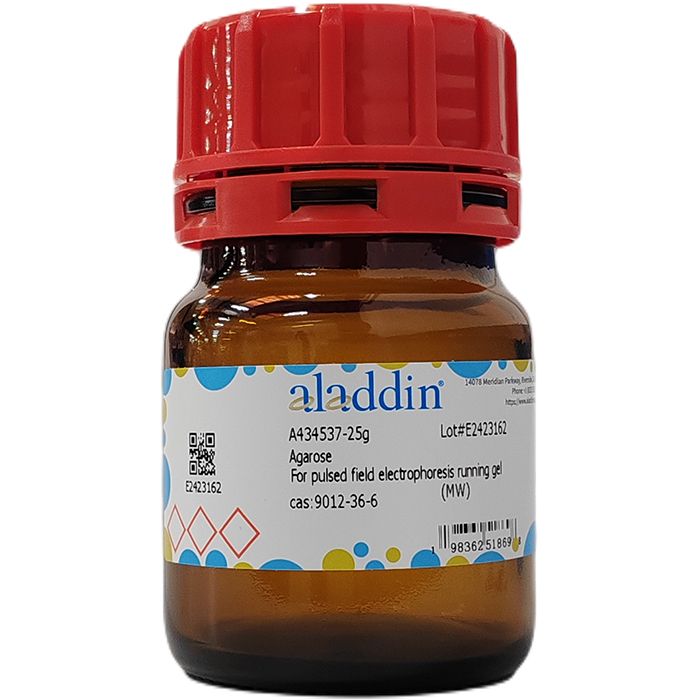
For pulsed field electrophoresis running gel for sensitive chromatographic and analytical workflows requiring minimal baseline interference.
Room temperature Ships Check lot-specific COA for exact specifications.
SDS, COA, datasheet, and spec sheet available for download. Lot-specific COA accessible via lot number lookup.
Cited in 264 peer-reviewed publications across chromatography, organic synthesis, and cross-coupling reactions.
Application
Especially formulated for fast resolution of large DNA (10-2000 ·kb) by pulsed-field gel electrophoresis (PFGE) or conventional electrophoresis. Pulsed-field gel electrophoresis was developed in 1984 to deal with "reptation" of large DNA′s whose size surpass the limit of resolution and all migrate at the same rate. Alternately pulsed, orthogonally oriented electric fields are applied across the gel. Every time the direction of the electric field changes, the large DNA′s can no longer migrate until they become reoriented along the new electric field. The time required for reorientation is dependent on the size of the DNA, therefore the DNA is fractionated by size.
Comprehensive hazard, handling, storage, and regulatory compliance document.
Download SDS →Lot-specific quality data. Enter your lot number to retrieve the exact COA.
Look up COA →Full quality attributes and acceptance criteria for this grade.
View spec sheet →Taxonomy Tree
| Kingdom | Organic compounds |
|---|---|
| Superclass | Organic oxygen compounds |
| Klasse | Organooxygen compounds |
| Subclass | Carbohydrates and carbohydrate conjugates |
| Intermediate Tree Nodes | Not available |
| Direct Parent | Oligosaccharides |
| Alternative Parents | O-glycosyl compounds 1,4-dioxepanes Oxanes Oxolanes Secondary alcohols Hemiacetals Polyols Oxacyclic compounds Dialkyl ethers Acetals Primary alcohols Hydrocarbon derivatives |
| Molecular Framework | Aliphatic heteropolycyclic compounds |
| Substituents | Oligosaccharide - Glycosyl compound - O-glycosyl compound - 1,4-dioxepane - Dioxepane - Oxane - Oxolane - Secondary alcohol - Hemiacetal - Acetal - Dialkyl ether - Oxacycle - Ether - Polyol - Organoheterocyclic compound - Hydrocarbon derivative - Primary alcohol - Alcohol - Aliphatic heteropolycyclic compound |
| Beschreibung | This compound belongs to the class of organic compounds known as oligosaccharides. These are carbohydrates made up of 3 to 10 monosaccharide units linked to each other through glycosidic bonds. |
| External Descriptors | Not available |
Find and download the COA for your product by matching the lot number on the packaging.
| Lot Number | Certificate Type | Datum | Artikel |
|---|---|---|---|
| Certificate of Analysis | May 20, 2024 | A434537 | |
| Certificate of Analysis | May 20, 2024 | A434537 | |
| Certificate of Analysis | May 20, 2024 | A434537 | |
| Certificate of Analysis | May 20, 2024 | A434537 | |
| Certificate of Analysis | May 20, 2024 | A434537 | |
| Certificate of Analysis | May 20, 2024 | A434537 |
| Schmelzpunkt (°C) | 62-68℃ |
|---|---|
| Molekulargewicht | 630.500 g/mol |
| XLogP3 | -6.500 |
| Hydrogen Bond Donor Count | 10 |
| Hydrogen Bond Acceptor Count | 19 |
| Rotatable Bond Count | 8 |
| Exact Mass | 630.201 Da |
| Monoisotopic Mass | 630.201 Da |
| Topological Polar Surface Area | 285.000 Ų |
| Heavy Atom Count | 43 |
| Formal Charge | 0 |
| Complexity | 946.000 |
| Isotope Atom Count | 0 |
| Defined Atom Stereocenter Count | 20 |
| Undefined Atom Stereocenter Count | 0 |
| Defined Bond Stereocenter Count | 0 |
| Undefined Bond Stereocenter Count | 0 |
| The total count of all stereochemical bonds | 0 |
| Covalently-Bonded Unit Count | 1 |