GRADE & PURITYAnimal Free?Animal-free — produced without animal-derived components to reduce contamination risk. Use in biomanufacturing and culture avoiding animal-origin material.Carrier Free?Carrier-free — supplied without added carrier protein/stabilizer. Use when carriers (e.g. BSA) would interfere with conjugation or sensitive assays.His Tag?His tag grade — recombinant protein bearing a His tag for affinity purification/detection. Use to purify, immobilize, or detect the tagged protein.≥95%(SDS-PAGE)expressed in E. coli, See COA
Animal Free,Carrier Free,His Tag,≥95%(SDS-PAGE),expressed in E. coli, See COA Animal Free,Carrier Free,His Tag for sensitive chromatographic and analytical workflows requiring minimal baseline interference.
🌡
Storage & shipping
Store at -20°C,Avoid repeated freezing and thawing Ships Ice chest + Ice pads Check lot-specific COA for exact specifications.
📋
Quality documents
SDS, COA, datasheet, and spec sheet available for download. Lot-specific COA accessible via lot number lookup.
📚
Literature proof
Cited in 0 peer-reviewed publications across chromatography, organic synthesis, and cross-coupling reactions.
Übersicht
PLAT, also known as tissue-type plasminogen activator (tPA), is a secreted serine protease synthesized by endothelial cells (1). The partially active single chain can be further processed to full activity by plasmin, tissue kallikrein or Factor Xa. Active PLAT converts plasminogen to plasmin, a fibrinolytic protease, by hydrolyzing an Arg-Val peptide bond in plasminogen. Unusually high levels of tPA activity can result in excessive bleeding, and low levels of tPA activity can result in thrombosis or embolism. Human PLAT contains 4 domains; the N-terminal fibronectin type-1 domain, an epidermal growth factor-like domain, two kringle domains and a serine protease catalytic domain.
Converts the abundant, but inactive, zymogen plasminogen to plasmin by hydrolyzing a single Arg-Val bond in plasminogen. By controlling plasmin-mediated proteolysis, it plays an important role in tissue remodeling and degradation, in cell migration and many other physiopathological events. Play a direct role in facilitating neuronal migration.
57.7-76.0 kDa, under reducing conditions; 57.1-76.3 kDa, under non-reducing conditions
Aktionsart
ACTIVATOR
CAS
105857-23-6
Molekültyp
Enzyme
Lagerung und Versand
Konzentration
expressed in E. coli, See COA
Storage
Store at -20°C,Avoid repeated freezing and thawing
Verschickt in
Ice chest + Ice pads
Stabilität und Lagerung
Store at -20°C for 1 year. Avoid freeze / thaw cycle.
Bilder
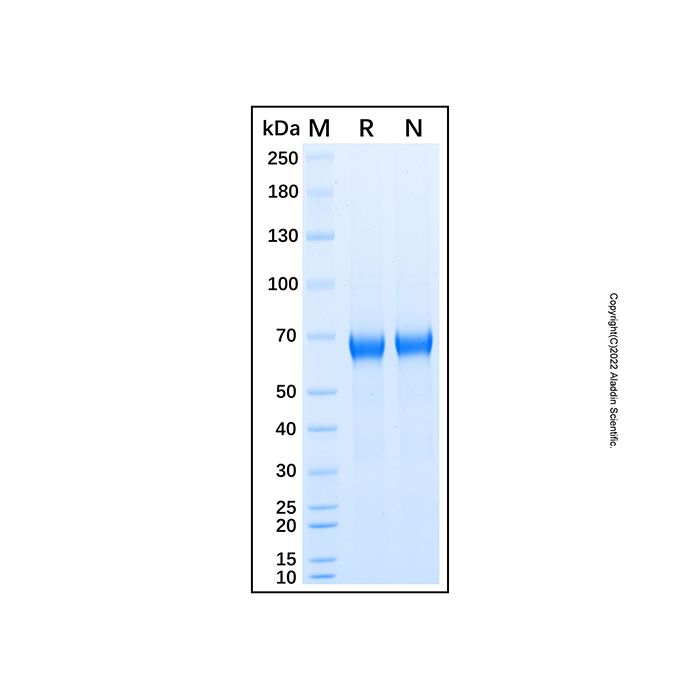
Alteplase (A1443673) - SDS-PAGE
3 μg/lane of Alteplase was resolved with SDS-PAGE under reducing (R) and non-reducing (N) conditions and visualized by Coomassie® Blue staining, showing a band at 60.2-71.9 kDa under reducing conditions and 61.5-73.1 kDa under non-reducing conditions.
Documentation
📋 Safety Data Sheet (SDS)
Comprehensive hazard, handling, storage, and regulatory compliance document.
Wir verwenden Cookies, um die ordnungsgemäße Funktion der Website sicherzustellen und, soweit zulässig, Ihr Nutzererlebnis zu verbessern. Sie können Ihre Einstellungen jederzeit unter „Einstellungen“ verwalten. Weitere Informationen finden Sie in unserer Cookie-Richtlinie.
Shall we send you a message when we have discounts available?
Remind me later
Thank you! Please check your email inbox to confirm.
Products are supplied to verified businesses, institutions, and qualified professionals for research and development use only. Not for use in humans, animals, diagnosis, or therapy.

 ZJ26F0737767