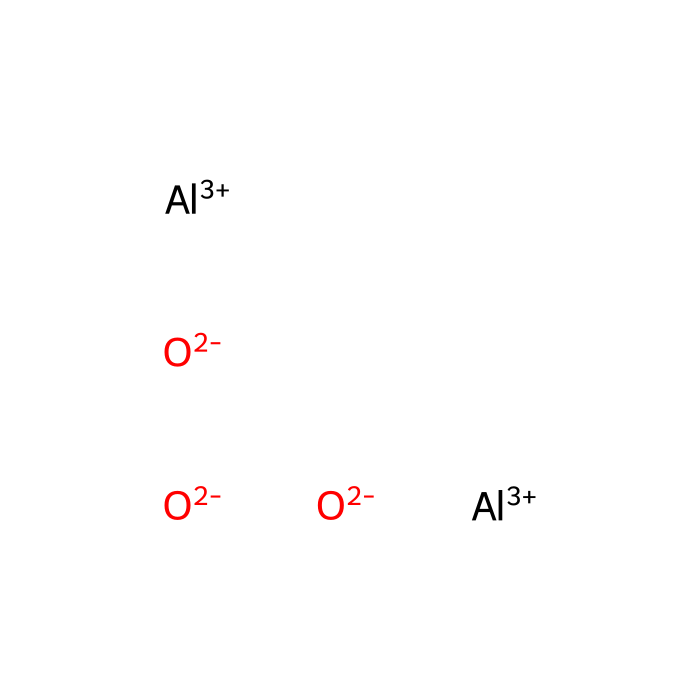
Aluminum oxide - 100-200mesh≥75%,Activated , CAS No.1344-28-1

CAS: 1344-28-1 Cat. No.: A359389 Summenformel: Al2O3 Molekulargewicht: 101.96 EG-Nummer: 215-691-6
Zu bestellen verfügbar
QUALITÄT & REINHEIT 100-200mesh≥75%,Activated
Storage
Room temperature,Desiccated
Shipped In
Normal
★
Größe
Deutschland (EU)
USA*
Preis
Menge
500g
A359389-500g
3 Auf Lager
9 Auf Lager

12,93€

15,53€
Speichern 2,60 € (16.76%)
12×500g
A359389-12×500g
Auf Bestellung · 8–12 Wochen
164,78€
20×500g
A359389-20×500g
Auf Bestellung · 8–12 Wochen

196,02€

260,23€
Speichern 64,21 € (24.67%)
Enter a quantity for the sizes you want to add.

Übersicht

Easy to absorb water, but not deliquescent. Soluble in concentrated sulfuric acid, insoluble in water

Spezifikationen

Spezifikationen & Reinheit
100-200mesh≥75%,Activated
Storage
Room temperature,Desiccated
Verschickt in
Normal
Namen und Kennungen
Pubchem Sid
Pubchem Sid Url
https://pubchem.ncbi.nlm.nih.gov/substance/508811737
Kanonisches Lächeln
O=[Al]O[Al]=O
IUPAC Name
dialuminum;oxygen(2-)
InChIKey
PNEYBMLMFCGWSK-UHFFFAOYSA-N
INCHI
1S/2Al.3O/q2*+3;3*-2
Isomere SMILES
[O-2].[O-2].[O-2].[Al+3].[Al+3]
RTECS
BD1200000
Molekulargewicht
101.96
Reaxy-Rn
11323344
Reaxys-RN_link_address
https://www.reaxys.com/reaxys/secured/hopinto.do?context=S&query=IDE.XRN=11323344&ln=

Erweiterte Daten

Taxonomic Classification

Taxonomy Tree

KingdomInorganic compounds
SuperclassMixed metal/non-metal compounds
KlassePost-transition metal salts
SubclassNot available
Intermediate Tree Nodes Not available
Direct ParentPost-transition metal salts
Alternative Parents Miscellaneous mixed metal/non-metals  Inorganic salts  
Molecular FrameworkNot available
Substituents Inorganic post-transition metal salt - Inorganic salt - Miscellaneous mixed metal/non-metal
BeschreibungThis compound belongs to the class of inorganic compounds known as post-transition metal salts. These are inorganic halogenic compounds in which the heaviest metal atom is a post-transition metal.
External Descriptors Not available
3D-Struktur
Interaktives chemisches Strukturmodell


Zertifikate (CoA, COO, BSE/TSE und Analyse-Diagramm)
C of A & Other Certificates(BSE/TSE, COO):
Analytical Chart:

Find and download the COA for your product by matching the lot number on the packaging.

33 results found

Lot NumberCertificate TypeDatumArtikel
F2624214F2624214Certificate of AnalysisJun 04, 2026 A359389
F2624211F2624211Certificate of AnalysisJun 04, 2026 A359389
F2624210F2624210Certificate of AnalysisJun 04, 2026 A359389
C2624227C2624227Certificate of AnalysisMar 17, 2026 A359389
C2624228C2624228Certificate of AnalysisMar 17, 2026 A359389
A2619278A2619278Certificate of AnalysisJan 04, 2026 A359389
A2619279A2619279Certificate of AnalysisJan 04, 2026 A359389
A2619280A2619280Certificate of AnalysisJan 04, 2026 A359389
L2517087L2517087Certificate of AnalysisSep 02, 2025 A359389
I2522171I2522171Certificate of AnalysisSep 02, 2025 A359389
I2522169I2522169Certificate of AnalysisSep 02, 2025 A359389
I2522148I2522148Certificate of AnalysisSep 02, 2025 A359389
A2619004A2619004Certificate of AnalysisSep 02, 2025 A359389
E2507252E2507252Certificate of AnalysisApr 17, 2025 A359389
H2508033H2508033Certificate of AnalysisApr 17, 2025 A359389
E2529019E2529019Certificate of AnalysisApr 17, 2025 A359389
E2507240E2507240Certificate of AnalysisApr 17, 2025 A359389
H2421101H2421101Certificate of AnalysisJun 24, 2024 A359389
J2417470J2417470Certificate of AnalysisJun 24, 2024 A359389
L2418778L2418778Certificate of AnalysisApr 27, 2024 A359389
J2326211J2326211Certificate of AnalysisOct 14, 2023 A359389
J2326212J2326212Certificate of AnalysisOct 14, 2023 A359389
A2303345A2303345Certificate of AnalysisJan 07, 2023 A359389
A2330482A2330482Certificate of AnalysisJun 10, 2022 A359389
L2208525L2208525Certificate of AnalysisJun 10, 2022 A359389
L2208474L2208474Certificate of AnalysisJun 10, 2022 A359389
L2208463L2208463Certificate of AnalysisJun 10, 2022 A359389
E2415031E2415031Certificate of AnalysisJun 10, 2022 A359389
A2403038A2403038Certificate of AnalysisJun 10, 2022 A359389
I2227315I2227315Certificate of AnalysisJun 10, 2022 A359389
G2207059G2207059Certificate of AnalysisJun 10, 2022 A359389
C2328171C2328171Certificate of AnalysisJun 10, 2022 A359389
E2322591E2322591Certificate of AnalysisJun 10, 2022 A359389
Chemische und physikalische Eigenschaften
Brechungsindex1.768
Siedepunkt (°C)2977°C
Schmelzpunkt (°C)2000°C
Molekulargewicht101.961 g/mol
XLogP3
Hydrogen Bond Donor Count0
Hydrogen Bond Acceptor Count3
Rotatable Bond Count0
Exact Mass101.948 Da
Monoisotopic Mass101.948 Da
Topological Polar Surface Area3.000 Ų
Heavy Atom Count5
Formal Charge0
Complexity0.000
Isotope Atom Count0
Defined Atom Stereocenter Count0
Undefined Atom Stereocenter Count0
Defined Bond Stereocenter Count0
Undefined Bond Stereocenter Count0
The total count of all stereochemical bonds0
Covalently-Bonded Unit Count5
FAQs und Artikel
Cerium Ammonium Nitrate, CAN
Activated Carbon and Adsorbent Essentials
Molybdenum: Understanding This Key Element
How to Choose Alumina Products? — A Practical Guide from Fundamental Concepts to Application Categories
Immobilized Enzyme Technology and Its Applications in Biocatalysis
Nanowires: Properties, Preparation Routes, and Process Selection (Comprehensive Analysis of Top-Down and Bottom-Up Approaches with Recommended Aladdin Reagents)
Cobalt Catalysts—From Fundamentals to Practice: Mechanistic Insights, Selection Logic, and a One-Stop Aladdin Selection List
Minute-Scale Construction of Fluorinated Nitrogen-Bridged Bicycles: Pd(II)/Pd(IV) Cascade Chemistry and a Pd(IV) “Dyotropic (Paired-Migration)” Rearrangement Driving Strain-Release Ring Expansion
High-Refractive-Index vs Low-Refractive-Index Coating Materials: From AR/Waveguide Principles to a Formulation & Material-Selection Map (Including Product Category Tables A/B/C)
SOFC Solid Oxide Fuel Cells: From “What It Is and How It Generates Power” to a Key Materials Map, Application Scenarios, and Selection Navigation (Electrolytes / Electrodes / Interconnects / Sealing)
Panorama Guide to Lithium-Ion Battery Electrode Materials: Working Principles, Materials Map, and Selection Navigation (incl. Tables 1–4)
Post-Transition Metals and Their Salts: A Classification Guide from Definitions to Value-Chain Applications (Including Product Lists in Tables 1–4)
Optical & Optoelectronic Materials Selection Guide:Positioning materials, key metrics, and validation paths along “Generation → Guiding → Control → Readout” (with product navigation and Tables 1–4)
Ceramic Materials Guide: Basic Definitions, Classification Framework, and Research-Task-Oriented Selection (with Product Navigation and Tables 1–4)
Why Metal Nanocatalysts Can “Save Energy Yet Lose Performance Easily”: Durability Logic from Active Sites to Support/Interface Engineering (Including Selection Guide and Product Tables A–D)
Applications of Self-Assembled Monolayers (SAMs), Microcontact Printing, and Soft Lithography in Surface Functionalization and Micro/Nanopatterning
Self-Assembled Nanodielectrics (SANDs): Self-Assembled Nanodielectric Layers for Low-Voltage Thin-Film Transistors (with Product Selection Guide)
Research Value of Polyelectrolyte Multilayers: Layer-by-Layer Design of Interfacial Composition, Mass Transport, and Function
Polyetherimide (PEI): Structural Features, Main Properties, and Typical Application Directions
Experimental Selection and Outcome Assessment of Heterogeneous Metal Catalysts in Organic Synthesis
Limitations and Future Development of Epoxy Resins: Safety, Environmental Protection, Recycling, Bio-Based Materials, and High-Performance Trends
Four Core Applications of Epoxy Resins: Bonding, Protection, Load-Bearing, and Insulation Protection
Guide to Epoxy Resin Performance Design: System Composition, Key Properties, Process Control, and Application Selection
Guide to Selecting Polyurethane Coating Systems: Application Analysis for Wood, Flooring, Plastics, Automotive, and Industrial Protection
Comprehensive Performance Analysis of Polyurethane Coating Films: Soft/Hard Segment Structure, Microphase Separation, Crosslinking and Curing, and Selection of Representative Chemicals
Structure–Property Relationship of Silicone Resins: Mechanisms of Heat Resistance, Weatherability, Hydrophobicity, and Coating Performance Analysis
Silicone Resin Coating Formulation Design: From Application Conditions to Matching Resins, Pigments and Fillers, Curing, and Substrates
How Should Montmorillonite Be Rationally Modified? Organic Modification, Inorganic Modification, and Application-Oriented Selection and Validation
What Is Silica Sol: Mechanism of Action, Application Scenarios, and Selection Criteria for Nanosilica Dispersions
Diagnosis of Coating Performance Issues and Selection of Resin Modification Routes
Structural Design Logic of Common Resin Modification Technologies: Molecular Chain Structure, Functional Groups, Phase Structure, Crosslinked Networks, and Hybrid/Functional Design
Resin Polarity in Coating Formulations: From Molecular Structure to Dissolution, Compatibility, Interfacial Interactions, and Formulation Design
Signal Transduction Mechanism of Graphene Biosensors: From Molecular Recognition to Electrical/Optical Signal Readout and Materials Selection
Color-Development Mechanisms, Formulation Forms, and Selection/Application Logic of Colorants in Personal Care Products
Vanadium-Aluminum Master Alloy: Vanadium Source Control and Quality Essentials in High-End Titanium Alloy Melting
Aladdin® Plant Research Related Products
UVA Absorption Mechanism of Avobenzone: Keto–Enol Tautomerism, Photochemical Instability, and Formulation Photostabilization Strategies
Solid Supports in Packed Gas Chromatography Columns: Definition, Mechanisms of Action, Classification, and Selection
Citations of This Product
Lösungsrechner
Bewertungen

Kundenbewertungen

Verwandte Produkte

Aluminum oxide - ≥99.8% metals basis, 13nm(TEM) , CAS No.1344-28-1
Tungstic oxide/Alumina - for elemental analysis, 0.85-1.7mm
Aluminum oxide - PureSpectra™, Spectrum pure, ≥99.999% metals basis , CAS No.1344-28-1
Aluminum oxide G - for TLC , CAS No.1344-28-1
Aluminum oxide - PrimorTrace™, ≥99.99% metals basis, α-phase,0.40μm , CAS No.1344-28-1
Aluminum oxide - nanoparticles, 30 nm particle size (TEM), 20 wt. % in H2O , CAS No.1344-28-1
Aluminum oxide - nanoparticles, α-phase,30 nm particle size, 20 wt. % in H2O , CAS No.1344-28-1
Alumina,activated - Φ4mm-6mm,for drier , CAS No.1302-74-5
Alumina,activated - UltraPureChrom™, for GC, 60-80 mesh , CAS No.1302-74-5
Alumina,activated - UltraPureChrom™, for GC, 20-40 mesh , CAS No.1302-74-5
Alumina,activated - UltraPureChrom™, for GC, 40-60 mesh , CAS No.1302-74-5
Aluminium hydroxide - ≥99.9% metals basis, 2~10μm , CAS No.21645-51-2
Aluminium oxide - 100-200 mesh≥75% , CAS No.1344-28-1
Aluminium hydroxide - PrimorTrace™, ≥99.99% metals basis, 2-10μm , CAS No.21645-51-2
Aluminium oxide,basic - 200-300 mesh≥70% , CAS No.1344-28-1
Aluminum hydroxide isophthalate MOF (CAU-10, Isophthalate:Al=0.9-1.0) - Particle size: 0.4-0.7 μm , CAS No.1416330-84-1
Aluminum oxide - ≥99.998% metals basis, Lumps , CAS No.1344-28-1
Aluminum oxide - PrimorTrace™, ≥99.99% metals basis, γ-phase,≤20nm , CAS No.1344-28-1
Aluminum oxide - Phosphotungstic acid modified alumina , CAS No.1344-28-1
Aluminum oxide - 200-300mesh≥70% ,activated , CAS No.1344-28-1
Aluminum oxide - ≥99.9% metals basis, powder,mixture of α-phase,30nm , CAS No.1344-28-1
Aluminum oxide - ≥99.9% metals basis, γ-phase,<50nm , CAS No.1344-28-1
Aluminum oxide - 60-100 mesh ≥75% , CAS No.1344-28-1
Aluminum oxide - PrimorTrace™, ≥99.99% metals basis, nanopowder,γ-phase,20nm , CAS No.1344-28-1
Aluminum oxide - ≥99.9% metals basis, powder,α-phase,150nm , CAS No.1344-28-1
Aluminum oxide - nanoparticles, 5-10 nm particle size (TEM), 20 wt. % in H2O , CAS No.1344-28-1
Aluminum oxide - nanoparticles, <30 nm particle size, 20 wt. % in isopropanol , CAS No.1344-28-1
Aluminum oxide - ≥99.9% metals basis, γ-phase,10nm , CAS No.1344-28-1
Aluminum oxide - PrimorTrace™, ≥99.99% metals basis, α-phase,0.20um , CAS No.1344-28-1
Palladium on alumina - Palladium alumina(dry base 10%)
Palladium on alumina - Palladium alumina(dry base 5%)
Aluminum oxide - PrimorTrace™, ≥99.99% metals basis, powder,5~6um, used for Used as an abrasive and in the production of crucibles, ceramics, refractory materials, and artificial gemstones. Used as a raw material for aluminum production and capable of for
Tonerde, aktiviert - Φ3mm-5mm, für Trockner , CAS No.1302-74-5
Alumina,activated - UltraPureChrom™, for GC, 80-100 mesh , CAS No.1302-74-5
Aluminum oxide - AR , CAS No.1344-28-1
Aluminum oxide - for elemental analysis, 2-4mm airball , CAS No.1344-28-1
Aluminum oxide - PrimorTrace™, ≥99.99% metals basis, for coating , CAS No.1344-28-1
Aluminum oxide - PrimorTrace™, ≥99.99% metals basis , CAS No.1344-28-1
Tungstic oxide/alumina - 0.85-1.7mm,for elemental analysis
alpha-Alumina - 200-300 mesh≥70% , CAS No.1344-28-1
alpha-Alumina trihydrate - 100-200 mesh≥75% , CAS No.1344-28-1
Aluminum oxide - ≥99.9% metals basis , CAS No.1344-28-1
Aluminum oxide - ≥99% metals basis , CAS No.1344-28-1
Platinum alumina catalyst - Platinum content(dry base 10%)
Aluminum oxide - PrimorTrace™, ≥99.99% metals basis, powder,6-7μm , CAS No.1344-28-1
Aluminum oxide - for elemental analysis, wool , CAS No.1344-28-1
Aluminum oxide - ≥99.9% metals basis, crystal form Y phase 15 (nm) , CAS No.1344-28-1
Aluminum Hydroxide Suspension, for Chloride Determination in Highly Colored Samples - for Chloride Determination in Highly Colored Samples
Cobalt aluminum oxide, Co 39-41% , CAS No.12672-27-4
Rhodium (On Alumina) - 5 wt. % loading labeling, matrix alumina support , CAS No.7440-16-6
Silicon dioxide, alumina doped - PrimorTrace™, ≥99.99% metals basis, nanoparticles,dispersion,<50nm particle size,20wt. % in H₂O
Ruthenium on alumina - 5 wt. % loading , CAS No.7440-18-8
Ruthenium on alumina - extent of labeling: 0.5wt. % loading,pellets,3.2mm
Rhodium on alumina - extent of labeling: 0.5wt. % loading,pellets,3.2mm
Palladium nanoparticles entrapped in aluminum hydroxide matrix - 0.5wt% loading
Palladium on alumina - extent of labeling: 1wt. % loading, Powder or beads
Palladium on alumina - extent of labeling: 5wt. % loading, powder
Palladium on alumina - extent of labeling: 0.5wt. % loading,dry,tablet
Palladium on alumina - extent of labeling: 0.5 wt. % loading,spheres
Palladium on alumina - Evonik Noblyst® P1159 5% Pd
Palladium on alumina - 10% load,powder,reduction,drying
Palladium on alumina - 0.5% load, particle size: 3-5 mm, particle size , CAS No.P476050
Palladium on alumina - 5 wt. % (dry basis), matrix activated alumina , CAS No.7440-05-3
Nickel on silica/alumina - extent of labeling: ~65 wt. % loading, powder
Aluminum oxide, mesoporous - MSU-X (wormhole), average pore size 3.8 nm , CAS No.1344-28-1
Aluminum oxide - Ultra dry , CAS No.1344-28-1
Aluminum oxide - single crystal substrate, <0001> , CAS No.1344-28-1
Aluminum oxide - nanopowder,<50 nm particle size (TEM) , CAS No.1344-28-1
Aluminum oxide - nanowires, diam. × L 2-6 nm × 200-400 nm , CAS No.1344-28-1
Aluminum hydroxide hydrate - 47-60% (Al2O3) , CAS No.1330-44-5
Aluminum oxide - PrimorTrace™, ≥99.99% metals basis, ≤10μm , CAS No.1344-28-1
Aluminum oxide - ≥99.9% metals basis, α Phase, 200-400nm , CAS No.1344-28-1
Alumina/Silica/Boria - fabric,Al2O3 62%/SiO2 24%/B2O3 14%,weight.m-2 -400g,length 1 m,coil width 25.4mm
Alumina/Silica/Boria - fabric,Al2O3 62%/SiO2 24%/B2O3 14%,weight.m-2 -400g,length 2 m,weight 400g,coil width 25.4mm
Alumina/Silica/Boria - fabric,Al2O3 62%/SiO2 24%/B2O3 14%,weight.m-2 -400g,length 5 m,coil width 25.4mm
Aluminum oxide - <30 nm particle size, 20 wt.% aqueous solution , CAS No.1344-28-1

Dürfen wir Sie über Rabattaktionen informieren?

Später erinnern

Vielen Dank! Bitte überprüfen Sie Ihren E-Mail-Posteingang, um zu bestätigen.

Hoppla! Benachrichtigungen sind deaktiviert.