Determine the necessary mass, volume, or concentration for preparing a solution.
| Activity Type | Activity Value -log(M) | Mechanism of Action | Activity Reference | Publications (PubMed IDs) |
|---|

Moligand™, 10mM in DMSO Moligand™ für empfindliche chromatographische und analytische Workflows, die minimale Basislinieninterferenzen erfordern.
Store at -80°C Versand Dry ice packs + Cold packs. Genaue Spezifikationen finden Sie im chargenspezifischen COA.
SDS, COA, Datenblatt und Spezifikationsblatt stehen zum Download bereit. Chargenspezifische COA über Chargennummernsuche abrufbar.
In 0 peer-reviewten Publikationen zu Chromatographie, organischer Synthese und Kreuzkupplungsreaktionen zitiert.
Information
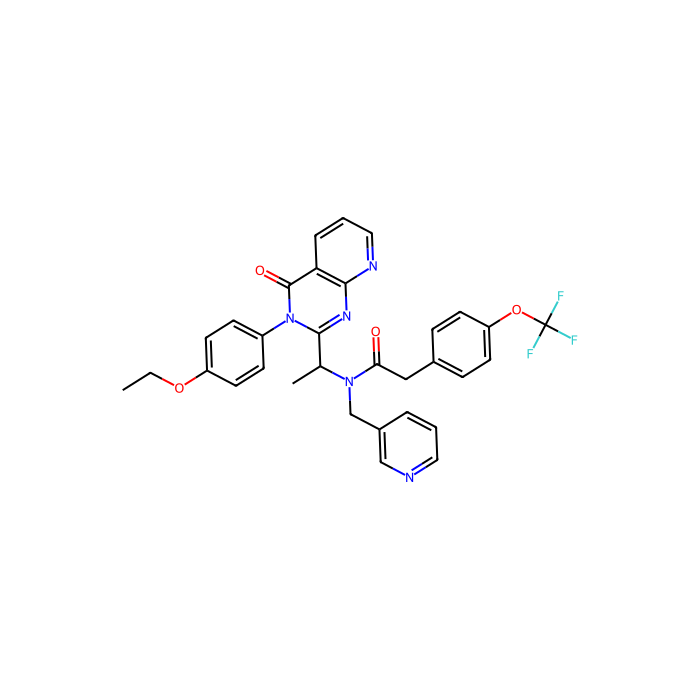
AMG 487 AMG 487 is an orally active and selective CXC chemokine receptor 3 (CXCR3) antagonist that inhibits the binding of IP-10 (CXCL10) and ITAC (CXCL11) to CXCR3 with IC50 of 8.0 nM and 8.2 nM, respectively.
Targets
CXCR3-CXCL10 (Cell-free assay); CXCR3-CXCL11 (Cell-free assay) 8.0 nM; 8.2 nM
In vitro
AMG487 is the targeted blocker of chemokine receptor CXCR3 and improves inflammatory symptoms by blocking the inflammatory cycle. AMG487 significantly affects DC maturity in vitro and function leading to impaired T cell activation, inducing DCs to have characteristics similar to tolerogenic DCs. AMG487 may directly play an immunomodulatory role during DC development and functional shaping.
In vivo
AMG487 exhibits the antiarthritic effects in DBA/1J mice bearing collageninduced arthritis (CIA).
Cell Research(from reference)
Cell lines:Murine bone marrow-derived DCs (BMDCs)
Concentrations:3 μM, 15 μM, 30 μM, 60 μM
Incubation Time:over 6 days
Umfassendes Dokument zu Gefahren, Handhabung, Lagerung und Einhaltung regulatorischer Vorschriften.
<<<<<<< HEAD SDS herunterladen → ======= SDS herunterladen → >>>>>>> release248-p3Chargenspezifische Qualitätsdaten. Geben Sie Ihre Chargennummer ein, um das genaue COA abzurufen.
COA nachschlagen →Vollständige Qualitätsmerkmale und Akzeptanzkriterien für diese Qualität.
Spezifikationsblatt ansehen →Taxonomy Tree
| Kingdom | Organic compounds |
|---|---|
| Superclass | Organoheterocyclic compounds |
| Klasse | Pyridopyrimidines |
| Subclass | Pyrido[2,3-d]pyrimidines |
| Intermediate Tree Nodes | Not available |
| Direct Parent | Pyrido[2,3-d]pyrimidines |
| Alternative Parents | Phenylacetamides Phenol ethers Phenoxy compounds Alkyl aryl ethers Pyrimidones Pyridines and derivatives Heteroaromatic compounds Tertiary carboxylic acid amides Lactams Trihalomethanes Azacyclic compounds Organofluorides Organic oxides Hydrocarbon derivatives Carbonyl compounds Organonitrogen compounds Alkyl fluorides |
| Molecular Framework | Aromatic heteropolycyclic compounds |
| Substituents | Pyrido[2,3-d]pyrimidine - Phenylacetamide - Phenoxy compound - Phenol ether - Alkyl aryl ether - Pyrimidone - Monocyclic benzene moiety - Pyridine - Pyrimidine - Benzenoid - Tertiary carboxylic acid amide - Heteroaromatic compound - Carboxamide group - Trihalomethane - Lactam - Azacycle - Carboxylic acid derivative - Ether - Organic nitrogen compound - Organonitrogen compound - Organofluoride - Organohalogen compound - Organooxygen compound - Organic oxide - Halomethane - Hydrocarbon derivative - Carbonyl group - Organic oxygen compound - Alkyl halide - Alkyl fluoride - Aromatic heteropolycyclic compound |
| Beschreibung | This compound belongs to the class of organic compounds known as pyrido[2,3-d]pyrimidines. These are compounds containing the pyrido[2,3-d]pyrimidine ring system, which is a pyridopyrimidine isomer with three ring nitrogen atoms at the 1-, 3-, and 8- position. |
| External Descriptors | Not available |
| Activity Type | Activity Value -log(M) | Mechanism of Action | Activity Reference | Publications (PubMed IDs) |
|---|
| Activity Type | Relation | Activity value | Units | Action Type | Journal | PubMed Id | doi | Assay Aladdin ID |
|---|
| Activity Type | Relation | Activity value | Units | Action Type | Journal | PubMed Id | doi | Assay Aladdin ID |
|---|
| Activity Type | Relation | Activity value | Units | Action Type | Journal | PubMed Id | doi | Assay Aladdin ID |
|---|
| Activity Type | Relation | Activity value | Units | Action Type | Journal | PubMed Id | doi | Assay Aladdin ID |
|---|
| Activity Type | Relation | Activity value | Units | Action Type | Journal | PubMed Id | doi | Assay Aladdin ID |
|---|
| Activity Type | Relation | Activity value | Units | Action Type | Journal | PubMed Id | doi | Assay Aladdin ID |
|---|
| Activity Type | Relation | Activity value | Units | Action Type | Journal | PubMed Id | doi | Assay Aladdin ID |
|---|
| Activity Type | Relation | Activity value | Units | Action Type | Journal | PubMed Id | doi | Assay Aladdin ID |
|---|
| Activity Type | Relation | Activity value | Units | Action Type | Journal | PubMed Id | doi | Assay Aladdin ID |
|---|
| Activity Type | Relation | Activity value | Units | Action Type | Journal | PubMed Id | doi | Assay Aladdin ID |
|---|
| Activity Type | Relation | Activity value | Units | Action Type | Journal | PubMed Id | doi | Assay Aladdin ID |
|---|
| Activity Type | Relation | Activity value | Units | Action Type | Journal | PubMed Id | doi | Assay Aladdin ID |
|---|
| DMSO (mg/ml) Maximale Löslichkeit | 100 |
|---|---|
| DMSO (mM) Maximale Löslichkeit | 165.675375668914 |
| Wasser (mg/ml) Maximale Löslichkeit | <1 |
| Molekulargewicht | 603.600 g/mol |
| XLogP3 | 5.200 |
| Hydrogen Bond Donor Count | 0 |
| Hydrogen Bond Acceptor Count | 10 |
| Rotatable Bond Count | 10 |
| Exact Mass | 603.209 Da |
| Monoisotopic Mass | 603.209 Da |
| Topological Polar Surface Area | 97.200 Ų |
| Heavy Atom Count | 44 |
| Formal Charge | 0 |
| Complexity | 997.000 |
| Isotope Atom Count | 0 |
| Defined Atom Stereocenter Count | 1 |
| Undefined Atom Stereocenter Count | 0 |
| Defined Bond Stereocenter Count | 0 |
| Undefined Bond Stereocenter Count | 0 |
| The total count of all stereochemical bonds | 0 |
| Covalently-Bonded Unit Count | 1 |
Unser Leitfaden zur Qualitätsauswahl behandelt Reinheit, Stabilisatorstatus und Anwendungseignung für alle Varianten in unserem Katalog.
Moligand™ Qualitätsleitfaden ansehen →