Determine the necessary mass, volume, or concentration for preparing a solution.
10mM in DMSO for sensitive chromatographic and analytical workflows requiring minimal baseline interference.
Store at -80°C Ships Dry ice packs + Cold packs Check lot-specific COA for exact specifications.
SDS, COA, datasheet, and spec sheet available for download. Lot-specific COA accessible via lot number lookup.
Cited in 2 peer-reviewed publications across chromatography, organic synthesis, and cross-coupling reactions.
Information
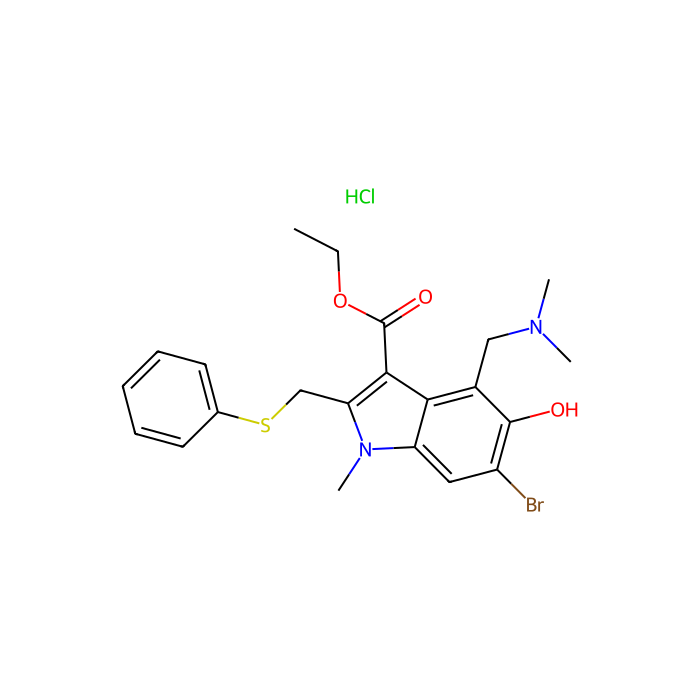
Arbidol HCl Arbidol HCl (Umifenovir) is a broad-spectrum antiviral compound that blocks viral fusion, used in treatment of influenza and other respiratory viral infections.
In vitro
Arbidol inhibits the cell entry of HCV pseudoparticles of genotypes 1a, 1b, and 2a in a dose-dependent fashion. Arbidol also displays a dose-dependent inhibition of HCV membrane fusion, as assayed by using HCV pseudoparticles (HCVpp) and fluorescent liposomes. Arbidol is found to present potent inhibitory activity against enveloped and non-enveloped RNA viruses, including FLU-A, RSV, HRV 14 and CVB3 when added before, during, or after viral infection, with IC50 ranging from 2.7 to 13.8 mg/mL. Arbidol shows selective antiviral activity against AdV-7, a DNA virus, only when added after infection (therapeutic index (TI) = 5.5). Arbidol induces changes to viral mRNA synthesis of the PB2, PA, NP, NA, and NS genes in MDCK cultures infected with influenza A/PR/8/34. Arbidol interacts and modifies the physicochemical properties of the phospholipids in the membrane, having a significant effect on negatively charged phospholipids but a minor one on zwitterionic phospholipids. Arbidol is located at the interface of the membrane, participates in hydrogen bonding either with water or the phospholipid or both, and decreases the hydrogen bonding network of the phospholipids giving place to a phospholipid phase similar to the dehydrated solid one. Arbidol is found to have potent inhibitory activity against HTNV when added in vitro before or after viral infection, with IC50 of 0.9 mg/mL and 1.2 mg/mL, respectively.
In vivo
Cell Data
cell lines:U87MG
Concentrations:
Incubation Time:
Powder Purity:≥98%
| Isomeric SMILES | CCOC(=O)C1=C(N(C2=CC(=C(C(=C21)CN(C)C)O)Br)C)CSC3=CC=CC=C3.Cl |
|---|---|
| WGK Germany | 3 |
| Molecular Weight | 513.88 |
| Reaxy-Rn | 5469513 |
| Reaxys-RN_link_address | https://www.reaxys.com/reaxys/secured/hopinto.do?context=S&query=IDE.XRN=5469513&ln= |
Comprehensive hazard, handling, storage, and regulatory compliance document.
Download SDS →Lot-specific quality data. Enter your lot number to retrieve the exact COA.
Look up COA →Full quality attributes and acceptance criteria for this grade.
View spec sheet →| Melt Point(°C) | 133-137°C |
|---|
| 1. Ziwei Guo, Huan He, Kunqian Liu, Shicheng Yang, Zihui Li, Chaochao Lai, Zhicheng Liao, Xiaomin Ren, Bin Huang, Xuejun Pan. (2023) Sunlight-induced degradation of COVID-19 antivirals arbidol in natural aquatic environments: Mechanisms, pathways and toxicity. JOURNAL OF ENVIRONMENTAL MANAGEMENT, [PMID:37769471] [10.1016/j.jenvman.2023.119113] |
| 2. Runhong Zhou, Jianan Hu, Jingnan Qiu, Shengsheng Lu, Haixing Lin, Ruifeng Huang, Shaofen Zhou, Guoqing Huang, Jian He. (2023) Phenolic compound SG-1 from Balanophora harlandii and its derivatives exert anti-influenza A virus activity via activation of the Nrf2/HO-1 pathway. BIOCHEMICAL PHARMACOLOGY, [PMID:36918045] [10.1016/j.bcp.2023.115495] |