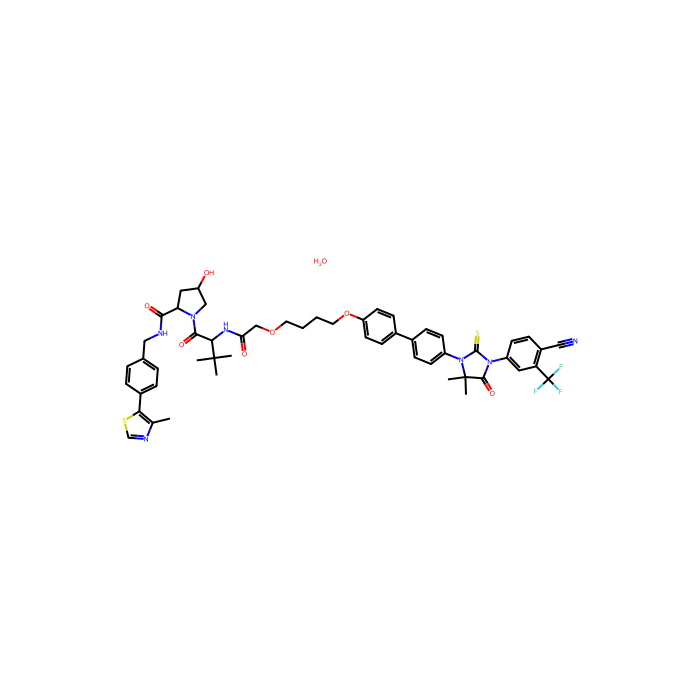
Potent and selective androgen receptor (AR) degrader (DC50= 5 nM). Comprises an androgen receptor antagonist, enzalutamide, joined by a linker to a VHL E3 ligase ligand. Brings about degradation of ARs in VCaP and LNCaP prostate cancer cell lines (Dmax= 98% at 12h) in a proteasome-dependent manner, and inhibits cell proliferation. Also degrades clinically relevant AR mutants expressed in HEK293T cells. Exhibits no significant effect on glucocorticoid, estrogen or progesterone receptors at concentrations inducing AR degradation.ARCC 4 negative control also available.
Storage
Store at -20°C
Verschickt in
Ice chest + Ice pads
Dieses Produkt erfordert Kühlkettenversand. Grundversand und andere Economy-Optionen sind nicht verfügbar.
Zertifikate (CoA, COO, BSE/TSE und Analyse-Diagramm)
C of A & Other Certificates(BSE/TSE, COO):
Analytical Chart:
Chemische und physikalische Eigenschaften
Löslichkeit
Solvent:DMSO, Max Conc. mg/mL: 102.42, Max Conc. mM: 100
Lösungsrechner
Molarity Calculator
Determine the necessary mass, volume, or concentration for preparing a solution.
Dilution Calculator
Determine the dilution needed to prepare a stock solution.
Reconstitution Calculator
Bewertungen
Kundenbewertungen
Application Protocols
No tested applications are specified for ARCC 4. The following generic procedures are provided as pragmatic starting points for small-molecule screening compounds; adjust based on your assay system.
A. Preparation of DMSO stock solutions (general)
Warm vial to room temperature in a desiccator. Briefly centrifuge to collect contents.
Add anhydrous DMSO to prepare a 10–50 mM stock (e.g., 10 mg into 2–4 mL for a 10–20 mM solution if MW ~500 Da; adjust when actual MW is known). Vortex until dissolved. If necessary, sonicate briefly.
Aliquot into low-binding microtubes under inert gas if moisture/oxidation sensitivity is suspected. Store at -20°C, protected from light.
B. Serial dilution for biochemical/cell assays (general)
Prepare a 10-point 3-fold dilution series in assay-compatible solvent to span 0.1 nM–100 μM final, keeping DMSO ≤0.1–1% v/v.
Include vehicle controls and, if relevant, positive control ligands.
Check for precipitation visually and by plate-reader light scattering (optional).
C. Analytical confirmation (general)
Verify identity/purity by LC–MS before first use and after long-term storage. Confirm concentration by UV (if chromophore known) or quantitative NMR.
Note: For research use only.
Biological Roles
Item-specific biological roles, targets, and pathways for ARCC 4 are not provided.
General considerations for small-molecule research probes
Mode of action: Without structure/function data, assume unknown MoA. Use unbiased screening and target deconvolution methods (chemoproteomics, CETSA, thermal profiling, CRISPR screens) to elucidate activity if needed.
ADME properties: Not specified for this item. For planning, estimate permeability, metabolic stability, and plasma protein binding only after structural data and in vitro assays are available.
Off-target/assay interference: Evaluate for aggregation, redox cycling, metal chelation, or fluorescence if structural flags are later identified. Include orthogonal readouts and counterscreens.
Experimental guidance
Begin with broad concentration ranges (e.g., 0.1–50 μM) to map activity windows, ensuring solvent vehicle controls.
Track cytotoxicity (e.g., CellTiter-Glo) in parallel with phenotypic assays to separate target-mediated effects from general toxicity.
Validate hits with fresh material and independent analytical confirmation (LC–MS).
Note: No clinical or therapeutic claims are made; for research use only.
Buffer Applications
ARCC 4 is a discrete small molecule, not a buffering agent. Therefore, it is not typically used to formulate buffers or maintain pH.
Practical notes for assay buffers (general guidance)
When dosing ARCC 4 into biochemical or cell-based assays, prepare in DMSO and dilute into your chosen buffer (e.g., PBS, HEPES, Tris) while keeping final DMSO ≤0.1–1% v/v.
To reduce nonspecific binding or aggregation, consider adding 0.01–0.05% nonionic surfactant (if compatible) and 0.1% BSA for biochemical assays.
Verify compound stability in the working buffer over the assay time course (LC–UV or LC–MS check after incubation).
No item-specific buffer systems, pKa, or pH recommendations are available for this product.
Green Alternatives
Without structural details for ARCC 4, green chemistry considerations focus on solvent and handling choices during preparation and use in assays.
Greener solvent choices (general guidance)
Primary stock solvent: DMSO is relatively low hazard compared with DMF/NMP and is often acceptable from a green-chemistry standpoint for small-scale stocks.
If alcoholic co-solvents are needed, prefer ethanol over methanol where assay-compatible.
Avoid chlorinated solvents (e.g., DCM, CHCl3) for routine handling unless required; if used, contain vapors and ensure proper waste segregation.
Comparison (general; not item-specific)
DMSO vs DMF/NMP: DMSO has lower reproductive toxicity concerns and better biodegradability; DMF/NMP offer higher solubilizing power but carry stricter regulatory profiles.
EtOH vs MeOH: Ethanol is less toxic; however, both can perturb biological assays—minimize final percentages.
Operational practices
Use microscale preparations to reduce solvent use.
Employ closed-vial dissolution and low-dead-volume filtration to minimize waste.
Document and recycle solvent where institutional programs exist.
Limitations
If ARCC 4 ultimately requires a specific solvent for stability or solubility (to be confirmed on CoA), that requirement takes precedence over generic green substitutions.
Pharmaceutical Uses
No pharmacopeial status, excipient role, or manufacturing use is specified for ARCC 4. This product is supplied strictly for research use only.
General context
Screening/lead discovery: Library members like ARCC 4 are commonly evaluated in discovery workflows but are not intended for human or veterinary use.
Formulation for research: For in vivo research in animals (if applicable under your approvals), compound-specific solubility and stability data are required. None are provided here; consult CoA and generate formulation data de novo.
Regulatory status: Not listed with any pharmacopeial monograph in the provided data. No GMP grade or clinical use claims are made.
Guidance
Do not use in drug products or diagnostic applications.
For any preclinical formulation experiments, develop composition based on measured solubility, stability, and pH sensitivity specific to ARCC 4 once structural data are confirmed.
Physical Properties
Only limited item-specific data are available. Do not treat any value as a product specification unless stated as such below.
Item-specific (from Product Data)
Appearance: Not specified for this item; refer to CoA/Spec Sheet.
Molecular weight: Not specified for this item; refer to CoA/Spec Sheet.
Computed/literature (general guidance for small molecules; not item-specific)
Melting point, boiling point, density, logP, pKa, refractive index: Not available for this specific compound due to missing structure. Typical library compounds are solids with MW 250–600 Da and varied polarity, but this is general context only (literature), not applicable as a spec here.
Solubility (general laboratory guidance)
Stock preparation: Many screening compounds are dissolved in anhydrous DMSO to 10–50 mM. For ARCC 4, confirm solubility empirically and consult CoA.
Aqueous media: If water solubility is poor, prepare DMSO stocks and dilute into buffer, maintaining final DMSO ≤0.1–1% v/v for biochemical assays. Add nonionic surfactant (e.g., 0.01–0.1% Tween 80) only if assay-compatible.
Stability
Storage guidance provided: Store at -20°C. Protect from moisture and light unless otherwise stated on the CoA/SDS.
Quality and Grades
Item-specific quality information is limited in the Product Data.
Grade/Purity: Not specified for this item; refer to CoA/Spec Sheet.
Stabilizers/additives: Not specified for this item; refer to CoA/Spec Sheet.
Context for library compounds (general information)
Screening-library compounds are commonly supplied at ≥90–95% purity by LC/GC with identity confirmed by MS and, often, 1H NMR (literature/general). UV/vis background, water content, and residual solvents may be reported on the CoA but are not specified here.
If the compound is optically active, enantiomeric excess may be included on the CoA; otherwise, racemates are common for early discovery.
Practical guidance
Verify identity and purity against the batch-specific CoA before critical assays.
If LC–MS purity is marginal for your application (e.g., biophysical binding or in-cell target engagement), consider repurification (prep HPLC) and orthogonal identity confirmation (HRMS, NMR).
For analytical work (e.g., HPLC method development), low-UV absorbance requirements and metal/peroxide limits are sometimes specified for solvents/reagents; such limits are not specified for this item.
Conclusion
Treat all unspecified quality attributes as unknown until confirmed by CoA/SDS. Contact Technical Support if you need a tighter specification window for screening or lead-optimization workflows.
Reaction and Applications
No structure or functional groups are provided for ARCC 4; therefore, specific synthetic reaction applications cannot be assigned.
Research applications (general for small-molecule library members)
Chemical biology and screening: Use as a discrete entity in biochemical or cell-based assays to probe phenotypes or target engagement. Validate identity/purity prior to screening.
SAR/analogue profiling: If ARCC 4 is part of a targeted sublibrary (e.g., a scaffold series), pair results with related analogues to establish structure–activity relationships.
Biophysical assays: Assess binding using DSF, SPR, MST, or ITC after confirming solubility and absence of aggregation (e.g., by DLS or detergent controls).
Orthogonal confirmation: Employ counter-screens to exclude assay interference (PAINS/RED flags) if structural information becomes available.
Practical guidance
Prepare DMSO stocks (see Solvent Selection) and use serial dilutions for dose–response curves.
Include vehicle controls and replicate wells; pre-screen for intrinsic fluorescence/absorbance that can interfere with readouts.
If covalent reactivity is suspected (based on later structural info), include glutathione or nucleophile scavenger controls.
Note: For use as a reagent in synthetic transformations, functional-group knowledge is essential; consult the full structural data (CoA) before planning chemistry.
Reaction Conditions
Reaction conditions specific to ARCC 4 cannot be recommended in the absence of structural and functional-group information.
General guidance (only if derivatization is later pursued)
Cross-coupling (literature/general): Pd-catalyzed couplings often run in polar aprotic solvents (DMF, DMAc, dioxane, toluene/water) at 60–120°C with bases such as K2CO3, Cs2CO3, or NaOtBu; air/moisture exclusion as required by catalyst.
Amide couplings (literature/general): HATU/DIPEA or EDC/HOBt in DMF/DCM at 0–25°C; monitor by LC–MS.
Hydrogenations (literature/general): Pd/C or Raney Ni in EtOH/EtOAc/THF under H2 (1–50 bar), 20–50°C, subject to reducible groups.
Assay-use conditions (general, non-synthetic)
Solubilize in DMSO, dilute into buffer at ambient temperature, and maintain final organic solvent content compatible with the biological system. Verify stability across the assay time frame by analytical methods.
Note: Treat all of the above as general literature guidance, not item-specific specifications.
Safety and Handling
Safety data for this specific item are not provided. Treat as a potentially hazardous research chemical and consult the SDS for definitive guidance.
GHS classification (item-specific)
Signal word: Not specified for this item; refer to SDS.
Hazard statements (H-phrases): Not specified for this item; refer to SDS.
Pictograms: Not specified for this item; refer to SDS.
General laboratory precautions (best practice)
PPE: Lab coat, safety glasses, and appropriate chemical-resistant gloves (e.g., nitrile). Use in a fume hood to avoid inhalation of dusts or vapors.
Avoid contact with skin, eyes, and clothing. Do not ingest or inhale. Wash thoroughly after handling.
Handling: Minimize exposure to air and moisture until you confirm hygroscopicity/hydrolytic stability. Open vials at ambient conditions only briefly; reseal promptly.
Incompatibilities: Unknown for this specific compound. As a precaution, segregate from strong oxidizers, strong acids/bases, and reducing agents until SDS review.
First aid (overview; defer to SDS)
Inhalation: Move to fresh air; seek medical attention if symptoms persist.
Skin/eye contact: Rinse with water for at least 15 minutes; remove contaminated clothing; obtain medical advice.
Ingestion: Rinse mouth; do not induce vomiting; get medical attention.
Waste disposal
Collect as organic chemical waste. Follow institutional and regulatory requirements.
Note: This product is for research use only.
Solvent Selection
Because the structure and polarity of ARCC 4 are not provided, solvent choice should be established empirically, starting with broadly compatible, high-purity solvents.
Recommended starting points (general for small molecules)
Stock solution: Anhydrous DMSO (analytical/anhydrous grade) at 10–50 mM is typical for screening compounds. Confirm solubility visually and by LC.
Alternative stock solvents: DMF or NMP can improve solubility for highly lipophilic or hydrogen-bonding compounds; verify assay compatibility and toxicity.
Co-solvent approaches: For aqueous assays, dilute DMSO stocks into buffer while keeping final DMSO ≤0.1–1% v/v. If precipitation occurs, add a minimal amount of co-solvent (MeOH, EtOH, PEG400) within assay limits.
Solvent properties (general/literature)
DMSO: Polar aprotic, high dielectric constant (~47), miscible with water and organics; often the safest first choice for chemical probes.
DMF/NMP: Polar aprotic, good for difficult solutes; higher toxicity/volatility concerns; use with appropriate controls.
MeOH/EtOH: Protic; may affect enzyme activity or cell health at modest % levels—validate in your system.
Practical tips
Warm (25–40°C) and vortex to assist dissolution; avoid prolonged heating of unstable compounds.
Filter 0.22 μm if particles persist and the compound is not prone to adsorption/degradation.
Record exact solvent composition in ELN to support reproducibility.
Storage and Reconstitution
Item-specific storage conditions are provided; reconstitution guidance is generalized for small-molecule library compounds.
Item-specific
Storage temperature: Store at -20°C (provided).
Shipping: Ice chest + ice pads (provided).
General best practices
Keep container tightly closed in a dry, inert atmosphere. Use desiccant. Protect from light until stability is confirmed.
Upon receipt, allow the sealed vial to equilibrate to room temperature before opening to prevent moisture condensation.
If supplied as a solid: Reseal promptly after dispensing. For hygroscopic or air-sensitive materials (unknown here), consider handling in a glovebox or with dry N2 purge.
Reconstitution (general)
Prepare concentrated stock solutions in anhydrous DMSO (typ. 10–50 mM). Filter through 0.22 μm if particulate persists and the compound is not adsorptive.
Aliquot stocks to avoid repeated freeze–thaw. Store at -20°C. Many small-molecule DMSO stocks are stable for months; verify by LC–MS before critical experiments.
For working solutions in aqueous buffers, prepare fresh on the day of use and discard remaining dilutions after the experiment unless stability has been demonstrated.
Unspecified parameters
Appearance, solubility, exact stability, and formulation details: Not specified for this item; refer to CoA/Spec Sheet and SDS.
Structure and Identity
Concise identity summary for a small-molecule screening library member. Item-specific identifiers are limited in the supplied data.
Product name: ARCC 4 (library compound)
CAS: 1973403-00-7 (provided)
PubChem CID: 154701569 (provided)
InChIKey: 234016 (provided; note: unusually short vs standard 27-character keys; verify on CoA/SDS)
SMILES: Not specified for this item; refer to CoA/Spec Sheet.
Molecular formula: Not specified for this item; refer to CoA/Spec Sheet.
Molecular weight: Not specified for this item; refer to CoA/Spec Sheet.
Structural features
2D/functional groups: Not specified for this item; refer to CoA/Spec Sheet.
Stereochemistry: Not specified for this item; refer to CoA/Spec Sheet.
Notes
ARCC 4 is listed under a small-molecule/compound library category, suggesting use as a research probe or screening hit. Without the structure (SMILES/InChI), specific functional group annotations and derived properties cannot be provided. Consult the Certificate of Analysis (CoA) and SDS for definitive identifiers before experimental use.
Synthetic Utility
The synthetic reactivity of ARCC 4 cannot be described without structural information (functional groups, oxidation state, and substitution pattern are not provided).
General notes (applicable to library compounds if structure becomes available)
If ARCC 4 contains handle(s) such as halides, boronates, or carboxylates, diversification via cross-coupling (e.g., Suzuki–Miyaura, Buchwald–Hartwig) or amide couplings (HATU/EDC) may be feasible (literature/general).
Heteroaromatic scaffolds commonly undergo SNAr or Minisci-type functionalization (literature/general) if appropriately activated.
Protecting-group strategies and late-stage C–H functionalization can enable analogue generation for SAR; suitability depends on the exact scaffold.
Actionable recommendation
Obtain the full structure (SMILES/InChI) from the CoA/SDS before planning any synthetic transformations or building-block derivatizations.
Target Specificity
No target, pathway, or selectivity profile is provided for ARCC 4 in the Product Data.
Antigen/epitope: Not applicable (small molecule, not an antibody or protein reagent).
Species reactivity/clone/isotype: Not applicable.
Guidance
If ARCC 4 is used as a putative probe, determine target specificity experimentally using orthogonal assays and, where feasible, unbiased methods (chemoproteomics, CETSA, genetic interaction mapping). Document any discovered specificity in your internal records.
Wir verwenden Cookies, um die ordnungsgemäße Funktion der Website sicherzustellen und, soweit zulässig, Ihr Nutzererlebnis zu verbessern. Sie können Ihre Einstellungen jederzeit unter „Einstellungen“ verwalten. Weitere Informationen finden Sie in unserer Cookie-Richtlinie.
Dürfen wir Sie über Rabattaktionen informieren?
Später erinnern
Vielen Dank! Bitte überprüfen Sie Ihren E-Mail-Posteingang, um zu bestätigen.
Products are supplied to verified businesses, institutions, and qualified professionals for research and development use only. Not for use in humans, animals, diagnosis, or therapy.