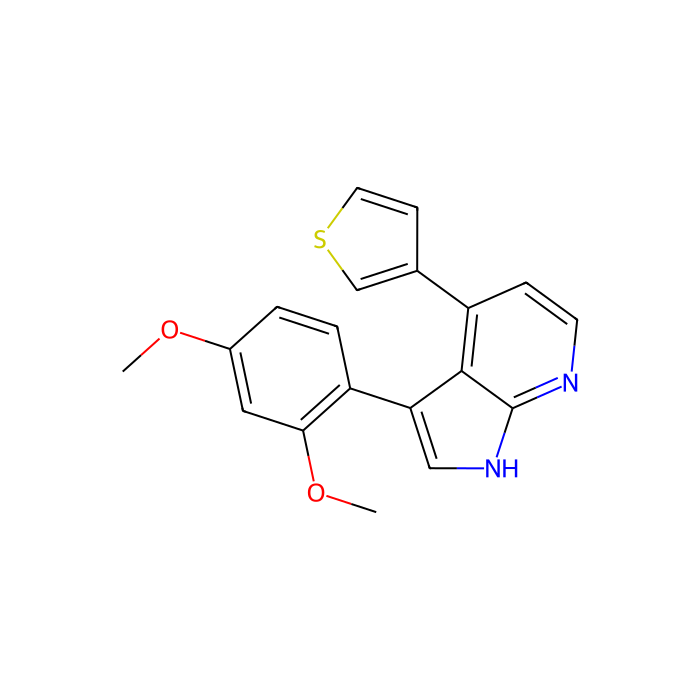
 I2208471
Determine the necessary mass, volume, or concentration for preparing a solution.
| Activity Type | Activity Value -log(M) | Mechanism of Action | Activity Reference | Publications (PubMed IDs) |
|---|

Information
ARN-3236 ARN-3236 is a potent, orally available and selective inhibitor of salt-inducible kinase 2 (SIK2) with IC50 of <1 nM, 21.63 nM and 6.63 nM for SIK2, SIK1 and SIK3, respectively. ARN-3236 induces apoptosis in cancer cells.
Targets
SIK2 (Cell-free assay); SIK3 (Cell-free assay); SIK1 (Cell-free assay) 1 nM; 6.63 nM; 21.63 nM
In vitro
SIK2 is overexpressed in approximately 30% of high grade serous ovarian cancers. ARN-3236 inhibits growth of 10 ovarian cancer cell lines at an IC50 of 0.8 to 2.6 μM, where the IC50 of ARN-3236 is inversely correlated with endogenous SIK2 expression (Pearson’s r = −0.642, P = 0.03). ARN-3236 enhances sensitivity to paclitaxel in 8 of 10 cell lines. In at least three cell lines a synergistic interaction is observed. ARN-3236 uncouples the centrosome from the nucleus in interphase, blocks centrosome separation in mitosis, causes prometaphase arrest and induces apoptotic cell death and tetraploidy. ARN-3236 also inhibits AKT phosphorylation and attenuates survivin expression.
In vivo
The antitumor activity of ARN-3236 is measured using ovarian cancer xenograft model in nu/nu mice. In SKOv3ip xenograft model, ARN-3236 plus paclitaxel produces greater inhibition of tumor growth than any other group and showed statistically significant difference compared to paclitaxel alone (P = 0.028). ARN-3236 also inhibits SIK2 activity and enhances paclitaxel sensitivity in OVCAR8 xenografts.
Cell Research(from reference)
Cell lines:HEY, A2780, UPN251, OVCAR3, OVCAR5, OVCAR8, ES-2, OC316, SKOv3 and IGROV1
Concentrations:1 μM, 2 μM, 3 μM, 5 μM
Incubation Time:16 h, 24 h, 32 h, 48 h
Taxonomy Tree
| Kingdom | Organic compounds |
|---|---|
| Superclass | Organoheterocyclic compounds |
| Klasse | Pyrroles |
| Subclass | Substituted pyrroles |
| Intermediate Tree Nodes | Not available |
| Direct Parent | Phenylpyrroles |
| Alternative Parents | Dimethoxybenzenes Pyrrolopyridines Phenoxy compounds Anisoles Alkyl aryl ethers Pyridines and derivatives Thiophenes Heteroaromatic compounds Azacyclic compounds Organonitrogen compounds Hydrocarbon derivatives |
| Molecular Framework | Aromatic heteropolycyclic compounds |
| Substituents | 3-phenylpyrrole - M-dimethoxybenzene - Dimethoxybenzene - Pyrrolopyridine - Phenoxy compound - Anisole - Phenol ether - Methoxybenzene - Alkyl aryl ether - Monocyclic benzene moiety - Benzenoid - Pyridine - Heteroaromatic compound - Thiophene - Ether - Azacycle - Organonitrogen compound - Organic nitrogen compound - Hydrocarbon derivative - Organooxygen compound - Organic oxygen compound - Aromatic heteropolycyclic compound |
| Beschreibung | This compound belongs to the class of organic compounds known as phenylpyrroles. These are polycyclic aromatic compounds containing a benzene ring linked to a pyrrole ring through a CC or CN bond. |
| External Descriptors | Not available |
| Activity Type | Activity Value -log(M) | Mechanism of Action | Activity Reference | Publications (PubMed IDs) |
|---|
| Activity Type | Activity Value -log(M) | Mechanism of Action | Activity Reference | Publications (PubMed IDs) |
|---|
| Activity Type | Activity Value -log(M) | Mechanism of Action | Activity Reference | Publications (PubMed IDs) |
|---|
| Activity Type | Relation | Activity value | Units | Action Type | Journal | PubMed Id | doi | Assay Aladdin ID |
|---|
| Activity Type | Relation | Activity value | Units | Action Type | Journal | PubMed Id | doi | Assay Aladdin ID |
|---|
| Activity Type | Relation | Activity value | Units | Action Type | Journal | PubMed Id | doi | Assay Aladdin ID |
|---|
| Activity Type | Relation | Activity value | Units | Action Type | Journal | PubMed Id | doi | Assay Aladdin ID |
|---|
| Activity Type | Relation | Activity value | Units | Action Type | Journal | PubMed Id | doi | Assay Aladdin ID |
|---|
| Activity Type | Relation | Activity value | Units | Action Type | Journal | PubMed Id | doi | Assay Aladdin ID |
|---|
| Activity Type | Relation | Activity value | Units | Action Type | Journal | PubMed Id | doi | Assay Aladdin ID |
|---|
| Activity Type | Relation | Activity value | Units | Action Type | Journal | PubMed Id | doi | Assay Aladdin ID |
|---|
| Activity Type | Relation | Activity value | Units | Action Type | Journal | PubMed Id | doi | Assay Aladdin ID |
|---|
| Activity Type | Relation | Activity value | Units | Action Type | Journal | PubMed Id | doi | Assay Aladdin ID |
|---|
| Activity Type | Relation | Activity value | Units | Action Type | Journal | PubMed Id | doi | Assay Aladdin ID |
|---|
| Löslichkeit | Solubility (25°C) In vitro DMSO: 67 mg/mL (199.16 mM); Ethanol: 2 mg/mL (5.94 mM); Water: Insoluble; |
|---|---|
| DMSO (mg/ml) Maximale Löslichkeit | 67 |
| DMSO (mM) Maximale Löslichkeit | 199.161737165958 |
| Wasser (mg/ml) Maximale Löslichkeit | <1 |
| Molekulargewicht | 336.400 g/mol |
| XLogP3 | 4.200 |
| Hydrogen Bond Donor Count | 1 |
| Hydrogen Bond Acceptor Count | 4 |
| Rotatable Bond Count | 4 |
| Exact Mass | 336.093 Da |
| Monoisotopic Mass | 336.093 Da |
| Topological Polar Surface Area | 75.400 Ų |
| Heavy Atom Count | 24 |
| Formal Charge | 0 |
| Complexity | 424.000 |
| Isotope Atom Count | 0 |
| Defined Atom Stereocenter Count | 0 |
| Undefined Atom Stereocenter Count | 0 |
| Defined Bond Stereocenter Count | 0 |
| Undefined Bond Stereocenter Count | 0 |
| The total count of all stereochemical bonds | 0 |
| Covalently-Bonded Unit Count | 1 |
No vendor-tested biological application protocols are provided for this item. The following general protocols are commonly used for small-molecule kinase inhibitors and should be adapted to your system.
A. Preparing DMSO stock and aliquots
B. Biochemical kinase assay (generic outline)
C. Cell-based assay (generic outline)
Note: Parameters above are general literature practices; optimize for your enzyme/cell line. No item-specific, vendor-validated conditions are claimed.
Scope: The following summarizes literature/general knowledge for ARN-3236-like SIK inhibitors. Item-specific bioactivity parameters (IC50, kinome selectivity) are not specified here and should be confirmed in your assays.
All statements above are for research context only. No therapeutic or diagnostic claims are made.
Applicability: ARN-3236 is not a buffering agent. This section provides practical guidance for preparing assay-compatible solutions of a hydrophobic bioactive small molecule.
General buffer practices for bioassays:
Note: No item-specific buffer compatibility, pKa, or solubility values are provided; verify empirically in your assay matrix.
Context: As a bioactive small molecule, ARN-3236 is not a process solvent or bulk reagent; “green” considerations focus on solvent vehicles, assay miniaturization, and waste minimization.
Greener handling strategies (general):
Illustrative comparison (vehicles; general):
Note: No item-specific green metrics (e.g., E-factor, solvent safety data) are specified for this product.
Scope and limitations:
Relevance to pharmaceutical research (general):
Regulatory/compendial status:
Any clinical, therapeutic, or diagnostic applications are outside the permitted scope of this product.
Item-specific properties:
Practical handling (general, literature/experience-based for kinase inhibitors):
What Moligand™ signifies (general description):
Implications for experimental use:
Recommended acceptance checks on receipt:
Documentation:
Primary application domain: ARN-3236 is supplied as a bioactive screening compound (Moligand™) rather than as a synthetic reagent or catalyst.
Research applications (literature/general for ARN-3236-like SIK inhibitors):
Not typically applicable:
Practical notes:
All use is for research only; no clinical or diagnostic use.
Not a reaction reagent: ARN-3236 is not generally employed to mediate or catalyze chemical reactions. Accordingly, conventional reaction parameters (temperature, catalysts, yields) are not applicable.
Assay preparation conditions (practical guidance for this compound class):
Stability during use:
Note: No item-specific kinetic parameters, solubility limits, or stability constants are provided. Validate conditions in pilot experiments.
GHS/SDS:
General laboratory precautions (good practice for bioactive small molecules):
Incompatibilities and stability (general):
First aid (overview; defer to SDS for authoritative instructions):
Note: Always consult the product-specific SDS for definitive hazard information and response procedures.
Use context: ARN-3236 is a bioactive small molecule typically handled as concentrated organic stock solutions for biochemical or cell-based assays rather than as a reaction solvent.
Practical solvent guidance (general for kinase-tool compounds):
Handling tips:
Note: Item-specific solubility and extinction coefficients are not specified; consult the CoA/Spec Sheet or measure empirically.
Storage conditions (as provided):
General handling:
Reconstitution guidance (general for hydrophobic bioactives):
Stability notes:
Research use only: Not for human or veterinary use.
Overview: ARN-3236 is a bioactive small-molecule tool compound listed in Aladdin’s Moligand™ collection. It is supplied for research use in chemical biology and screening.
Structural features (general, literature):
2D description (generic):
Applicability: ARN-3236 is a finished bioactive small molecule supplied for screening and chemical biology. It is not typically used as a synthetic building block or reagent.
If synthetic derivatization is desired (general considerations):
Bottom line: Use ARN-3236 primarily as a molecular probe. For preparative chemistry or scaffold modification, consult primary literature on ARN-3236’s structure and ensure appropriate IP/freedom-to-operate assessments.
Product data do not include target annotations. The following reflects general literature for ARN-3236-like tool compounds and should be verified experimentally for your system.
Caution: Item-specific binding constants, selectivity heatmaps, and confirmed targets are not provided here. Users should consult primary literature and perform in-house validation with this specific lot and assay format.
Unser Leitfaden zur Qualitätsauswahl behandelt Reinheit, Stabilisatorstatus und Anwendungseignung für alle Varianten in unserem Katalog.
Moligand™ Qualitätsleitfaden ansehen →