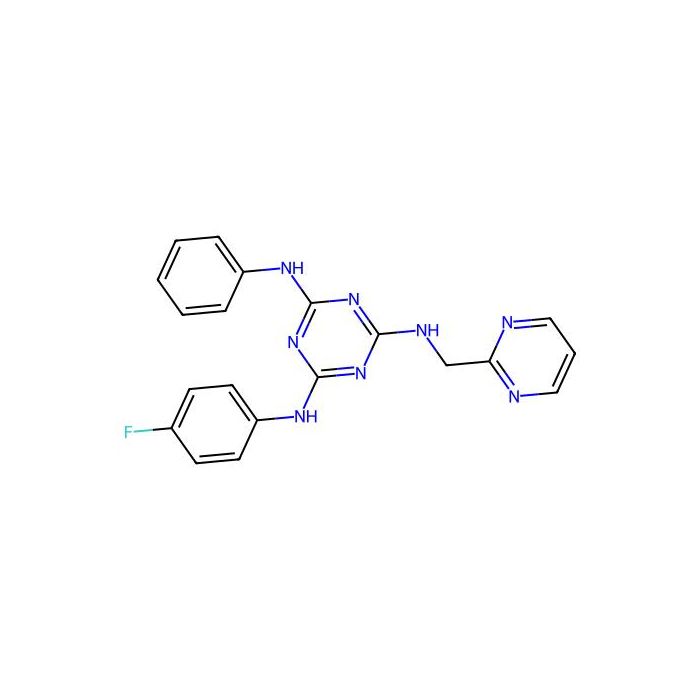
ASP2905 is a potent and selective potassium channel Kv12.2 inhibitor encoded by the Kcnh3/BEC1 gene. ASP2905 can cross the blood-brain barrier and has antipsychotic activities.
In Vitro
ASP2905 potently inhibits potassium currents in CHO cells expressing KCNH3 (IC 50 of 9.0 nM). ASP2905 (≤10 μM) minimally bound with low affinities to 55 transmembrane proteins. ASP2905 (0.1 µM, 1 µM) decreases the frequency of spontaneous inhibitory postsynaptic currents in cultured rat hippocampal neurons. MCE has not independently confirmed the accuracy of these methods. They are for reference only.
In Vivo
ASP2905 treatment inhibits hyperlocomotion induced by Phencyclidine. And significantly ameliorates Phencyclidine-induced prolongation of immobility time in mice subjected to the forced swimming test. MCE has not independently confirmed the accuracy of these methods. They are for reference only. Animal Model: Male ddY mice (aged 4-5 weeks) injected with Phencyclidine hydrochloride (PCP)Dosage: 0.01 mg/kg, 0.03 mg/kg, 0.1 mg/kg, 0.3 mg/kg Administration: Oral administration; once Result: Inhibited hyperlocomotion induced by Phencyclidine.
Spezifikationen
Spezifikationen & Reinheit
10mM in DMSO
Biochemische und physiologische Mechanismen
ASP2905 is a potent and selective potassium channel Kv12.2 inhibitor encoded by the Kcnh3/BEC1 gene. ASP2905 can cross the blood-brain barrier and has antipsychotic activities.
Storage
Store at -80°C
Verschickt in
Dry ice packs + Cold packs
Dieses Produkt erfordert Kühlkettenversand. Grundversand und andere Economy-Optionen sind nicht verfügbar.
Wir verwenden Cookies, um die ordnungsgemäße Funktion der Website sicherzustellen und, soweit zulässig, Ihr Nutzererlebnis zu verbessern. Sie können Ihre Einstellungen jederzeit unter „Einstellungen“ verwalten. Weitere Informationen finden Sie in unserer Cookie-Richtlinie.
Dürfen wir Sie über Rabattaktionen informieren?
Später erinnern
Vielen Dank! Bitte überprüfen Sie Ihren E-Mail-Posteingang, um zu bestätigen.
Products are supplied to verified businesses, institutions, and qualified professionals for research and development use only. Not for use in humans, animals, diagnosis, or therapy.

 J2610917