≥99% for sensitive chromatographic and analytical workflows requiring minimal baseline interference.
🌡
Storage & shipping
Protected from light,Desiccated,Store at -80°C Ships Dry ice packs + Cold packs Check lot-specific COA for exact specifications.
📋
Quality documents
SDS, COA, datasheet, and spec sheet available for download. Lot-specific COA accessible via lot number lookup.
📚
Literature proof
Cited in 0 peer-reviewed publications across chromatography, organic synthesis, and cross-coupling reactions.
Übersicht
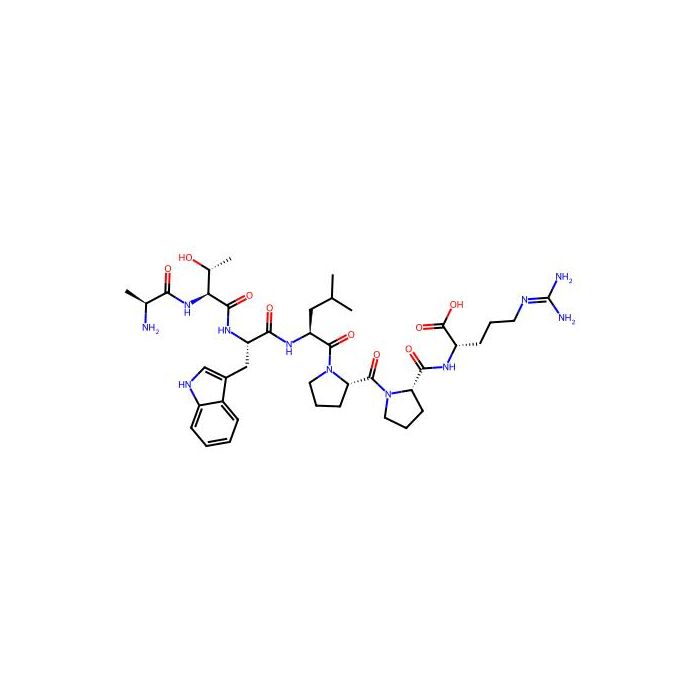
ATWLPPR Peptide is a biological active peptide. (This peptide is a specific VEGFR2/KDR heptapeptide antagonist, it binds VEGFR2 (KDR/flk), completely inhibiting VEGF binding to KDR and preventing VEGF-induced angiogenesis in-vivo. It specifically inhibits human endothelial cell proliferation in-vitro and totally abolishes VEGF-induced angiogenesis in-vivo.)
Specifications
Spezifikationen & Reinheit
≥99%
Storage
Protected from light,Desiccated,Store at -80°C
Verschickt in
Dry ice packs + Cold packs
Dieses Produkt erfordert Kühlkettenversand. Grundversand und andere Economy-Optionen sind nicht verfügbar.
Aktionsart
INHIBITOR
Reinheit
≥99%
Namen und Kennungen
Molekulargewicht
839.98
Documentation
📋 Safety Data Sheet (SDS)
Comprehensive hazard, handling, storage, and regulatory compliance document.
Zertifikate (CoA, COO, BSE/TSE und Analyse-Diagramm)
C of A & Other Certificates(BSE/TSE, COO):
Analytical Chart:
Lösungsrechner
Molarity Calculator
Determine the necessary mass, volume, or concentration for preparing a solution.
Dilution Calculator
Determine the dilution needed to prepare a stock solution.
Reconstitution Calculator
Bewertungen
Kundenbewertungen
Application Protocols
Tested applications and recommended conditions for this specific item are not provided. Not specified for this item; refer to CoA/Spec Sheet.
General, non-validated guidance (for planning only):
Receptor-binding assay (plate-based): Coat high-binding plates with immobilized receptor or heparin surrogate; block with 1% BSA; incubate with labeled ATWLPPR (1 nM–10 µM) in PBS + 0.05% Tween-20; wash and detect fluorescence/biotin readout. Include excess unlabeled peptide for competition controls.
Cell-binding assay: Incubate adherent cells with labeled peptide on ice (to minimize endocytosis) in HBSS + 1% BSA for 30–60 min; wash and analyze by flow cytometry or microscopy.
Surface immobilization: Activate carboxylated sensor chips or beads with EDC/NHS; couple peptide via N-terminus; block residual ester with ethanolamine; characterize density by label calibration.
Important: The above are generic starting points and are not validated for this product lot. Optimize concentrations, incubation times, and buffers empirically and verify performance in your specific system.
Biological Roles
Biological context (literature/general):
ATWLPPR is a short, sequence-defined peptide used as a molecular tool in angiogenesis-related research. It has been reported in the literature as a ligand that can interact with cell-surface receptors involved in vascular biology (notably neuropilin-1, NRP-1) and has been used to study the modulation of VEGF165–NRP-1 complex formation in vitro. Such studies focus on receptor binding/competition, signaling readouts, and cellular uptake routes under controlled laboratory conditions.
Biochemical features relevant to function:
The C-terminal Arg imparts a cationic guanidinium group capable of engaging acidic patches and heparan-sulfate motifs; the Trp residue contributes hydrophobic/aromatic interactions that can stabilize receptor contacts.
The Pro–Pro dipeptide segment can induce a turn-like conformation, potentially positioning the C-terminus for productive binding in receptor assays.
Use cases in model systems (non-clinical):
Employed to decorate surfaces or nanoparticles to investigate targeted adhesion/uptake of endothelial cells in culture.
Utilized as a competitor/control peptide in binding studies to dissect the role of specific receptor–ligand interactions.
Caveats:
Binding affinity and specificity can depend strongly on sequence context, concentration, buffer conditions, and presentation (soluble vs immobilized). Results from one system may not generalize; validate in your assay format.
Compliance note: For research use only. No medical or clinical applications are claimed or supported.
Buffer Applications
As a small peptide ligand, ATWLPPR is not a buffering agent. However, buffer choice is critical for its handling and use in assays.
Stock preparation: Dissolve in nuclease/protease-free water or low-ionic-strength buffer. If needed, acidify slightly with 1–10 mM HCl or 0.1% TFA to aid dissolution, then adjust to the target buffer upon dilution.
Working buffers: PBS (10 mM phosphate, 137 mM NaCl, 2.7 mM KCl, pH 7.2–7.4) or HEPES (10–25 mM, pH 7.2–7.5) are commonly used for cell-based and binding assays.
pH considerations: Maintain pH 6.5–7.5 to preserve Arg protonation state relevant to many binding interactions, while minimizing hydrolysis.
Additives: 0.1% BSA or 0.01–0.05% Tween-20 can reduce nonspecific adsorption to plastics during low-nanomolar assays. Avoid high detergent levels that may disrupt receptor interactions.
Sterile work: Filter sterilize solutions (0.22 µm) for cell culture work; prepare fresh working solutions to minimize degradation.
Incompatible conditions to avoid:
Strong oxidants or metal-catalyzed oxidation (Trp-sensitive); chelate trace metals with 0.1–1 mM EDTA if compatible with the assay.
Prolonged incubation above room temperature or at extreme pH (<3 or >9), which can promote backbone hydrolysis or side-chain modifications.
Specifications: No item-specific buffer composition is provided; consult your protocol and the item’s CoA for any recommended solvent/salt form details.
Green Alternatives
While ATWLPPR itself is a peptide reagent, greener choices pertain to the media and chemistries used to dissolve, process, and conjugate it.
Greener media and processes (general recommendations):
Prefer aqueous buffers over high percentages of organic solvents (e.g., choose PBS/HEPES with ≤10% DMSO rather than neat DMF/DMSO) when solubility permits.
Use water-soluble coupling systems (e.g., EDC/NHS in MES buffer) instead of organic-phase carbodiimide couplings.
Apply enzyme-mediated ligations (e.g., sortase A with a suitably engineered tag in variants; not applicable to this exact sequence without modification) to avoid hazardous reagents.
Reagent substitutions and trade-offs:
Replace DMF with greener peptide coupling solvents (e.g., NBP, Cyrene) when performing SPPS on sequence variants; ensure resin and coupling reagents are compatible.
Opt for less hazardous labels (e.g., sulfo-NHS dyes in water) rather than organic-soluble isothiocyanates when possible.
Comparison snapshot (general):
Conventional: NHS-ester fluorophore in anhydrous DMF → good reactivity, organic waste.
Prepare concentrated stocks to reduce packaging and solvent use, aliquot to avoid discard after freeze–thaw, and neutralize aqueous wastes before disposal per local regulations.
Note: These are process-level green improvements; the peptide’s intrinsic environmental profile is largely determined by its amino acid composition and does not afford “greener variants” without altering the sequence.
Pharmaceutical Uses
No pharmacopeial or excipient status is provided for this item. ATWLPPR is supplied strictly for research use only.
Formulation research contexts (literature/general, non-clinical):
Targeting ligand in preclinical formulation studies: Conjugation to liposomes, polymeric nanoparticles, or hydrogels to evaluate targeted delivery concepts in vitro or ex vivo.
Analytical standards: Sequence-defined reference for method development (LC–MS peptide mapping, HPLC retention benchmarking) in discovery settings.
Affinity components: Incorporation into experimental affinity matrices for capturing or enriching receptor candidates from lysates.
Manufacturing/quality considerations (general):
If used in formulation research, document the peptide’s salt form, terminal capping state (free vs acetylated/amidated), and purity profile, as these affect solubility, charge, and interaction with excipients.
Remove residual organic solvents and reagents after conjugation (e.g., through dialysis or SEC) to meet internal acceptance criteria for research materials.
Regulatory note:
This product is not approved as an API, excipient, or medical device component. No clinical, diagnostic, or therapeutic uses are claimed or supported. All work should remain within laboratory research and method-development frameworks.
Physical Properties
Appearance: Not specified for this item; refer to CoA/Spec Sheet.
Molecular weight: Not specified for this item; refer to CoA/Spec Sheet.
Molecular formula: Not specified for this item; refer to CoA/Spec Sheet.
Exact mass/Monoisotopic mass: Not specified for this item; refer to CoA/Spec Sheet.
Purity/Grade: Not specified for this item; refer to CoA/Spec Sheet.
pI/pKa: Not specified for this item; refer to CoA/Spec Sheet.
Solubility (general guidance for short peptides; literature):
Water, dilute aqueous acid (e.g., 0.1% TFA or 1–10 mM HCl): typically soluble for millimolar stocks depending on salt form.
PBS or physiological buffers: generally soluble; adjust pH 6–7 if needed to aid dissolution.
DMSO: useful co-solvent for hydrophobic sequences; minimize to ≤10% v/v in biological assays.
UV/Vis (literature/general): Strong absorbance at 280 nm due to Trp; typical ε280 ~5500 M⁻1·cm⁻1 per Trp (literature, for proteins/peptides in neutral buffer).
Stability (general peptide considerations): Stable when lyophilized, desiccated, protected from light, and stored at −80°C as recommended. In solution, avoid prolonged exposure to room temperature; store aliquots frozen to minimize degradation (e.g., deamidation, oxidation of Trp).
Notes:
No item-specific physical constants (mp, bp, density, RI) are applicable/reported for small peptides. For definitive specifications including counterion and terminal modifications, consult the item’s CoA/Spec Sheet.
Quality and Grades
Item-specific grade/purity: Not specified for this item; refer to CoA/Spec Sheet.
What peptide grades generally mean (general information):
Crude: Minimal post-synthesis purification; contains deletion sequences and protecting-group remnants—seldom suitable for quantitative biology.
Desalted: Gross impurities removed; still heterogeneous.
75–85%: Suitable for preliminary screening where minor impurities are tolerable.
90–95% (HPLC grade): Preferred for receptor-binding studies, conjugation, and quantitative assays.
98% (premium grade): Demanding applications (biophysics, standards) where low impurity background is essential.
Analytical characterization typically provided (consult CoA):
RP-HPLC chromatogram (purity), ESI/ MALDI MS (molecular mass), sometimes HRMS and elemental analysis for counterion/solvent content.
Identity confirmation by MS/MS or amino acid analysis may be supplied for critical applications.
Stabilizers/additives:
Not specified for this item; refer to CoA/Spec Sheet. Peptides are often shipped lyophilized without stabilizers; if present (e.g., TFA salt, volatile buffer), it will be indicated on the CoA.
Practical note:
For reproducibility across assays, record the lot number and verify purity/identity from the CoA before use. If conjugation or quantitative binding studies are intended, prefer lots with ≥95% purity and confirmed counterion content to minimize variability.
Reaction and Applications
This product is a functional peptide ligand used primarily as a biochemical tool rather than a synthetic reagent. Typical research applications include:
Ligand–receptor studies (literature/general): Employed as a sequence-defined probe to investigate receptor recognition on endothelial or other cell types. Binding/competition assays exploit its C-terminal Arg and hydrophobic/aromatic features.
Surface immobilization: The free N-terminus can be coupled to activated surfaces (NHS-esters, isothiocyanates) to present the peptide for cell-adhesion or capture assays. If side-selective immobilization is needed, a cysteine-tailed variant is often used (not part of this sequence) for thiol-specific coupling (maleimide, iodoacetamide, or Au–S on gold).
Bioconjugation and labeling: Reaction at the N-terminal amine with NHS esters (fluorophores, biotin) at pH 7.5–8.5; avoid over-alkylation of Arg’s guanidinium (less nucleophilic but reactive under harsh conditions). Trp enables UV quantitation at 280 nm; consider orthogonal labels (e.g., Alexa, FITC) for detection.
Nanoparticle and hydrogel functionalization: Peptide grafting onto liposomes, polymers, or inorganic surfaces to modulate cell interaction in vitro. Use EDC/NHS chemistry to couple carboxyl-bearing substrates to the peptide’s N-terminus.
Affinity enrichment: As a capture ligand in pull-downs when immobilized on beads; optimize spacer length to reduce steric hindrance.
Practical tips:
Maintain mild conditions (neutral pH, ambient temperature) during coupling to preserve sequence integrity. Protect from light to minimize photo-oxidation of Trp. Verify coupling efficiency by HPLC/MS and quantify active ligand density where applicable.
Reaction Conditions
General laboratory conditions relevant to ATWLPPR use involve conjugation and immobilization rather than classical organic reactions. Typical parameters (literature/general):
NHS-ester labeling at N-terminus:
Solvent: Aqueous bicarbonate or phosphate buffer, pH 7.5–8.5 (10–100 mM). Optionally 10–20% DMF/DMSO to solubilize hydrophobic labels.
Temperature/time: 20–25°C, 0.5–2 h.
Stoichiometry: 2–5 eq label per peptide; quench with Tris or ethanolamine.
Expected outcomes: Near-quantitative conversion under clean conditions; monitor by LC–MS.
EDC/NHS coupling to carboxylated surfaces (immobilization):
Buffer: MES, pH 5.5–6.0 (25–100 mM) for activation; couple peptide in pH 7.2–7.4 buffer.
Temperature/time: Ambient, 15–60 min activation; 1–2 h coupling.
Notes: Control for hydrolysis; include salt (0.15 M NaCl) to reduce nonspecific electrostatics.
Photo/oxidation avoidance:
Work under subdued light; include 0.1–1 mM antioxidant (e.g., methionine) if compatible to protect Trp during prolonged processing.
Analytical verification:
Use HPLC (C18, water–acetonitrile with 0.1% formic acid/TFA) to assess purity and conversion; detect at 214 nm (peptide bond) and 280 nm (Trp).
These conditions are provided as general guidance derived from standard peptide chemistry practices. Optimize for your substrate, label, and desired presentation; consult primary literature for specific receptor-binding assay conditions.
Safety and Handling
GHS classification: Not specified for this item; refer to SDS.
Signal word / H-statements / Pictograms: Not specified for this item; refer to SDS.
General hazard profile (peptide, research use): Typically considered of low acute toxicity; handle as a laboratory chemical. Avoid inhalation of powders/aerosols and contact with skin/eyes.
PPE and engineering controls:
Wear lab coat, safety glasses, and appropriate disposable gloves (e.g., nitrile). Handle powders in a fume hood or ventilated enclosure to minimize dust/aerosols.
Use clean, low-particulate practices to preserve material quality.
First aid overview (general):
Inhalation: Move to fresh air; seek medical attention if symptoms occur.
Skin/eye contact: Rinse with water for at least 15 minutes; remove contaminated clothing; seek medical advice if irritation persists.
Ingestion: Rinse mouth; do not induce vomiting; seek medical attention.
Chemical incompatibilities and special risks:
Avoid strong oxidizers (Trp and other residues can oxidize), strong acids/bases for prolonged periods (may hydrolyze amide bonds), and repeated freeze–thaw (can promote degradation/aggregation).
Protect from light per product instructions to minimize photo-oxidation of aromatic residues (e.g., Trp).
Spill/cleanup and waste:
Collect solids by gentle sweeping with damp disposable wipes; avoid creating dust. Dispose according to institutional and local regulations for laboratory chemical waste.
Authoritative source: Always defer to the product-specific SDS for definitive hazard, exposure limits, and emergency measures.
Solvent Selection
ATWLPPR is a short peptide with mixed polarity (Trp, Leu hydrophobic; Arg cationic; Pro–Pro conformationally constraining). Solubility is strongly influenced by terminal groups and salt form.
Start small: Add 10–50 µL of high-purity water to the lyophilized peptide and gently vortex/sonicate. If insoluble, incrementally add dilute acid (e.g., 0.1% TFA or 1–10 mM HCl) to protonate basic sites and enhance solubility.
Buffers: For biological use, prepare stocks in water and then dilute into PBS (pH 7.2–7.4) or HEPES buffer. Adjust final pH to 6.5–7.4.
Co-solvents: If hydrophobicity from Trp/Leu impedes dissolution, pre-wet with a minimal volume of DMSO (e.g., 5–10% of final volume), then bring to volume with aqueous buffer. Keep DMSO ≤10% v/v in assays when possible.
Polarity/miscibility (general):
Fully miscible with water once dissolved; limited solubility in neat nonpolar solvents. DMSO and DMF are effective for preparing high-concentration stock solutions, followed by aqueous dilution.
When to choose alternatives:
If aggregation or slow dissolution occurs, use slightly acidic buffers (pH 5–6) or add 0.01–0.1% non-ionic surfactant (e.g., Tween-20) for surface-coating applications.
For conjugation chemistry in organic phase, use an appropriate protected precursor or perform conjugation in mixed aqueous–organic media compatible with the chosen coupling method.
Quality tips:
Filter sterilize (0.22 µm) after dissolution when sterile applications are required; avoid protein-binding filters if peptide loss is observed.
Storage and Reconstitution
Storage conditions (item-specific):
Store at −80°C, desiccated, protected from light.
Shipped on dry ice packs + cold packs to maintain low temperature.
For research use only.
General reconstitution guidance for peptides:
Equilibrate vial to room temperature before opening to prevent condensation. Briefly centrifuge to collect material.
Initial dissolution: Add sterile water to achieve a convenient stock (e.g., 1–10 mM based on the peptide’s molecular weight—Not specified for this item; refer to CoA/Spec Sheet). If solubility is limited, add 1–10 mM HCl or 0.1% TFA dropwise, or pre-wet with minimal DMSO then dilute with buffer.
Filtration: If sterility is required, filter through a 0.22 µm low-protein-binding membrane.
Aliquoting: Divide into single-use aliquots to avoid repeated freeze–thaw. Use low-bind tubes to minimize adsorption.
Storage of solutions: Store aliquots at −80°C protected from light. For short-term use, −20°C may be acceptable for a few days; avoid multiple thaw cycles.
Stability notes: Avoid prolonged exposure to room temperature and light to minimize Trp oxidation and backbone hydrolysis. Consider adding inert gas headspace (N2/Ar) for sensitive long-term stocks.
Documentation:
Record the reconstitution solvent, concentration, pH, and date. Consult the CoA/Spec Sheet for any item-specific instructions on salt form, terminal capping, and recommended solvents.
Structure and Identity
Product: ATWLPPR Peptide (SKU: A1451419)
CAS: 272121-15-0
Sequence: ATWLPPR (N-terminus A; C-terminus R)
Molecular formula: Not specified for this item; refer to CoA/Spec Sheet.
Molecular weight: Not specified for this item; refer to CoA/Spec Sheet.
SMILES: Not specified for this item; refer to CoA/Spec Sheet.
InChIKey: Not specified for this item; refer to CoA/Spec Sheet.
Structural features (general description):
Composition: Heptapeptide containing one basic residue (Arg, C-terminal), one aromatic residue (Trp), two prolines (Pro, Pro), and aliphatic residues (Ala, Thr, Leu).
Functional groups: terminal amine (if free N-terminus), C-terminal carboxylate or amide (item-specific status not provided), side-chain guanidinium (Arg), indole (Trp), secondary amide bonds along the backbone, secondary alcohol (Thr), cyclic imino acids (Pro) introducing conformational constraint.
Charge/microenvironment (literature/general): At neutral pH, a free C-terminus contributes −1 and Arg contributes +1, giving an overall near-neutral to mildly cationic peptide depending on termini protection and salt form.
2D topology in words: A linear seven-residue chain with alternating backbone carbonyl and amide nitrogens; a bulky indole side chain at position 3 (Trp) provides hydrophobic/aromatic character, consecutive Pro–Pro at positions 5–6 imposes a conformational turn/kink, and a C-terminal Arg furnishes a cationic guanidinium handle for electrostatic interactions.
Identity notes:
Category: Small molecule/compound library – peptide ligand.
Any stereochemistry is the canonical L-configuration for standard amino acids unless otherwise specified (not specified for this item; confirm on CoA).
Synthetic Utility
ATWLPPR serves as a defined ligand and conjugation handle in chemical biology rather than as a general synthetic reagent. Its utility centers on selective functionalization and presentation.
Key reactive sites (general):
N-terminal amine (if free): Primary site for acylation/labeling (NHS esters, isothiocyanates, succinimidyl carbonates).
Side chains: Arg guanidinium is poor nucleophile; typically avoided in selective labeling. Trp can undergo electrophilic substitution/oxidation (undesired in most cases). There are no Lys/Cys residues; for site-specific conjugation, a C-terminal modification or auxiliary tag (e.g., Cys-addition) is commonly introduced in designed variants (not part of this item’s stated sequence).
Named methods and strategies:
EDC/NHS coupling to attach the peptide to carboxyl-bearing surfaces/polymers via its N-terminus.
Click strategies when azido/alkyne handles are introduced synthetically on variants; copper-free SPAAC preferred for biological contexts.
Solid-phase peptide synthesis (SPPS) of sequence variants: Fmoc/tBu chemistry on Rink amide or Wang resin; HBTU/HATU/DIC–Oxyma couplings; Pro–Pro coupling may benefit from double-coupling or longer times due to sterics.
Analytical characterization:
RP-HPLC for purity; LC–MS or MALDI–TOF for identity; UV at 280 nm enables convenient tracking due to Trp.
Use in materials assembly:
Immobilization density and spacer length are critical; employ PEG linkers to reduce steric hindrance and nonspecific adsorption in surface-based assays.
Target Specificity
Item-specific target/antigen, clone, or species reactivity data: Not specified for this item; refer to CoA/Spec Sheet.
Note on literature (not item-specific): Although ATWLPPR has been reported as a targeting peptide in vascular biology studies, no validated target specificity is provided with this product listing. Users should establish specificity in their own assay system using appropriate positive/negative controls and, where possible, sequence variants or scrambled controls.
Wir verwenden Cookies, um die ordnungsgemäße Funktion der Website sicherzustellen und, soweit zulässig, Ihr Nutzererlebnis zu verbessern. Sie können Ihre Einstellungen jederzeit unter „Einstellungen“ verwalten. Weitere Informationen finden Sie in unserer Cookie-Richtlinie.
Shall we send you a message when we have discounts available?
Remind me later
Thank you! Please check your email inbox to confirm.
Products are supplied to verified businesses, institutions, and qualified professionals for research and development use only. Not for use in humans, animals, diagnosis, or therapy.