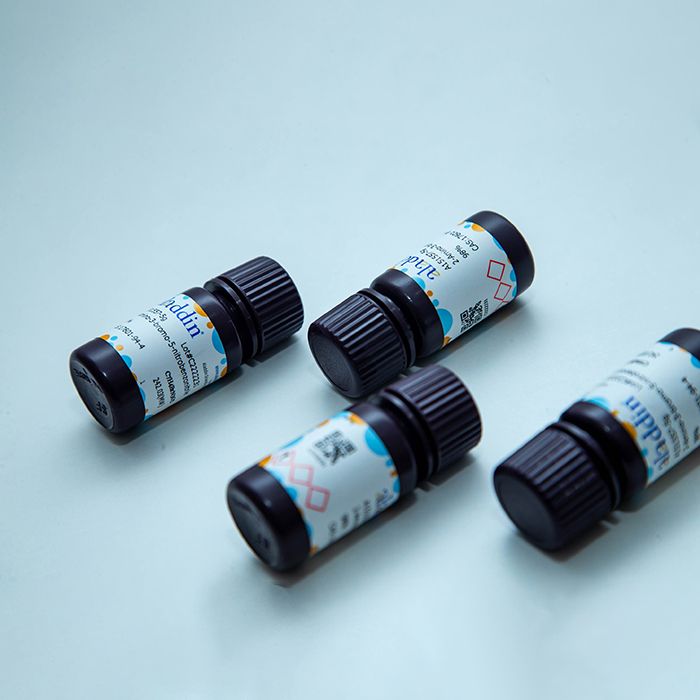
ATWLPPR Peptide TFA, a heptapeptide, acts as a selective neuropilin-1 inhibitor, inhibits VEGF 165 binding to NRP-1, used in the research of angiogenesis. ATWLPPR Peptide TFA has potential in reducing the early retinal damage caused by diabetes .
Appearance:Solid
IC50& Target:Neuropilin-1
In Vitro:ATWLPPR Peptide TFA is a selective neuropilin-1 inhibitor, inhibits VEGF 165 binding to NRP-1 by 82% at 100 μM. MCE has not independently confirmed the accuracy of these methods. They are for reference only.
In Vivo:ATWLPPR (400 μg/kg, s.c.) preserves vascular integrity and decreases the oxidative stress level, possibly reduces the early retinal damage caused by diabetes. ATWLPPR prevents the increase of inflammation-associated proteins (GFAP, VEGF and ICAM-1) i
Biological Activity:ATWLPPR Peptide TFA, a heptapeptide, acts as a selective neuropilin-1 inhibitor, inhibits VEGF 165 binding to NRP-1, used in the research of angiogenesis. ATWLPPR Peptide TFA has potential in reducing the early retinal damage caused by diabetes.
Spezifikationen
Product Name
ATWLPPR Peptide TFA, CAS No.A658822
Spezifikationen & Reinheit
≥99%
Aktionsart
INHIBITOR
CAS
A658822
Molekültyp
Peptide
Lagerung und Versand
Storage
Protected from light,Desiccated,Store at -80°C
Verschickt in
Dry ice packs + Cold packs
Erweiterte Daten
Zertifikate (CoA, COO, BSE/TSE und Analyse-Diagramm)
C of A & Other Certificates(BSE/TSE, COO):
Analytical Chart:
Lösungsrechner
Molarity Calculator
Determine the necessary mass, volume, or concentration for preparing a solution.
Dilution Calculator
Determine the dilution needed to prepare a stock solution.
Reconstitution Calculator
Bewertungen
Kundenbewertungen
Application Protocols
No tested applications or recommended dilutions are provided in the Product Data for this item. Because performance is assay- and system-dependent, users should develop and optimize protocols (e.g., binding assays, bioconjugations, analytical LC–MS) based on their specific requirements and consult the literature for comparable sequences.
Biological Roles
General context (literature): ATWLPPR (often referenced as A7R) is described in the literature as a sequence used to interrogate protein–ligand interactions, including those involving cell-surface receptors. Such peptides are commonly employed as tools in receptor-binding studies, competition assays, and as targeting motifs in delivery research. Specific binding behavior can be system- and context-dependent and must be validated experimentally.
Biochemical features of the sequence:
The Arg guanidinium contributes strong basicity and potential electrostatic interactions with acidic protein surfaces.
Trp provides an intrinsic fluorophore, enabling label-free fluorescence readout in some assays (e.g., monitoring environment-sensitive Trp emission), though quenching and inner-filter effects should be considered.
Two Pro residues can influence backbone conformation and receptor recognition by constraining local structure.
Practical considerations:
If used as a probe, consider N- or C-terminal tagging strategies that preserve the core epitope; test multiple labeling sites to avoid perturbing function.
Validate affinity and specificity under your assay conditions (buffer composition, ionic strength, temperature, and co-factors can significantly affect results).
Note: No target specificity or validated biological activity is provided in the Product Data for SKU A658822; users should consult the primary literature and perform in-house confirmation for their system.
Buffer Applications
This item is a peptide rather than a buffering agent; it is not typically used to establish buffer capacity. However, appropriate buffer selection is critical for its dissolution, stability, and activity measurements.
Working buffers (general guidance):
PBS or HEPES (pH 7.2–7.5): common for biochemical assays; may reduce solubility for some basic peptides—pre-dissolve in water or diluted acid, then dilute into buffer.
Acetate buffer (pH 4.5–5.5): enhances solubility of basic peptides by maintaining protonation.
Ammonium acetate/formate (pH ~5–6.5): MS-friendly for LC–MS applications; volatile and greener than TFA.
Preparation hints:
If peptide resists dissolution, acidify slightly (e.g., 0.1% acetic acid), dissolve, then adjust to final buffer composition.
Avoid strong bases; high pH can compromise stability (Trp oxidation, backbone cleavage in extreme cases).
Filter sterilize only after complete dissolution to minimize filter binding; use low-protein-binding membranes.
Ionic strength and additives:
Moderate salt (50–150 mM) can reduce nonspecific interactions in binding assays.
Include carrier proteins (e.g., 0.1% BSA) cautiously; they may alter apparent affinity by nonspecific adsorption.
Item-specific buffer recommendations are not provided; optimize empirically for the target assay.
Green Alternatives
For peptide handling, the main sustainability levers are solvent choice and counterion selection rather than reaction replacement.
Greener counterions vs TFA:
TFA salts are common from RP-HPLC but can introduce persistent, corrosive fluorinated waste and may affect bioassays.
Greener alternatives: acetate, formate, or chloride salts typically offer reduced environmental burden and improved biocompatibility.
Practical counterion exchange (general guidance):
Dissolve peptide in water or aqueous methanol and pass through a short anion-exchange or desalting cartridge equilibrated with the desired counterion (e.g., 0.1–0.5 M ammonium acetate), then lyophilize.
Alternatively, repeated dissolution/lyophilization from volatile acid solutions (acetic/formic acid) can lower TFA content.
Solvent comparison for dissolution and analytics (general):
| Option | Environmental aspect | Performance notes |
|---|---|---|
| Water/Acetate buffer | Preferred green medium | Good for most assays; compatible with cells/enzymes |
| Water/HEPES or PBS | Aqueous, low hazard | Stable buffering; minimal VOCs |
| MeOH/Water (≤30%) | Lower toxicity vs ACN | Useful for LC; watch protein compatibility |
| ACN/Water | VOC, petrochemical | Excellent for RP-HPLC but less green |
| DMSO | Recyclable but persistence concerns | Powerful solubilizer; keep % low in bioassays |
Select the mildest, most aqueous system that still meets assay/solubility needs. No item-specific green certifications are provided.
Pharmaceutical Uses
No pharmacopeial status or excipient role is specified for this item. This peptide is supplied strictly for research use only.
Research formulation context (general, non-clinical):
Peptide ligands like ATWLPPR are used in preclinical research as targeting moieties for delivery systems (e.g., nanoparticles, liposomes) and surface functionalization, aiding mechanistic studies. Such uses remain research-stage and require extensive validation.
For in vitro assays, peptides may be formulated in sterile, isotonic buffers (e.g., PBS) at working concentrations determined by assay sensitivity and binding affinity.
Considerations for translational research (informational only, not a claim of suitability):
Counterion exchange (TFA → acetate/chloride), endotoxin control, and sequence verification are typical steps before in vivo method development. None of these specifications are provided for this product and must be established by the researcher if needed.
Regulatory note:
This product is not intended for therapeutic, diagnostic, or clinical use. No GMP status, compendial monographs, or clinical-grade specifications are provided in the Product Data.
Physical Properties
Appearance: Not specified for this item; refer to CoA/Spec Sheet.
Molecular weight: Not specified for this item (salt form). For reference, the neutral peptide ATWLPPR has a computed monoisotopic mass of ~839.47 Da (literature/computed; excludes TFA counterions).
Molecular formula: Not specified for this item; refer to CoA/Spec Sheet.
SMILES / InChIKey: Not specified for this item; refer to CoA/Spec Sheet.
Solubility (general guidance for peptides; literature):
Often soluble in water, aqueous buffers, or dilute aqueous acid (e.g., 0.1% TFA or HCl) due to the basic Arg side chain.
Co-solvents such as acetonitrile (10–30%) or DMSO can assist dissolution for hydrophobic sequences; ATWLPPR contains Trp/Leu which may modestly reduce solubility in pure water at neutral pH.
Adjusting pH to ≤6 typically increases solubility for basic peptides (protonation of N-terminus/Arg).
pI/logP/pKa: Not specified for this item. Typical basic pKa for Arg guanidinium ~12.5 (literature), N-terminus ~8–9 (literature).
Melting/boiling points, density, refractive index: Not applicable/Not specified for this solid peptide material.
All item-specific specifications (water content, residual solvents, counterion content) are Not specified for this item; refer to CoA/Spec Sheet.
Quality and Grades
Item-specific grade/purity: Not specified for this item; refer to CoA/Spec Sheet.
Peptides are commonly supplied as lyophilized TFA salts following RP-HPLC purification. Purity is typically reported by HPLC area % and identity confirmed by MS/HRMS; counterion content and residual water/solvent may also be reported.
TFA salt implications: TFA counterions can influence solubility, chromatographic behavior, and bioassay outcomes (e.g., cell sensitivity to residual TFA). If needed, counterion exchange to acetate, chloride, or formate can be performed post-purchase.
Residual protecting groups or synthesis-related impurities are minimized by rigorous purification, but the exact specification (e.g., ≥95% HPLC) must be confirmed on the lot-specific CoA.
Recommendations:
Review the CoA for: purity (%), identity (MS), counterion content, residual solvents/water, and peptide content.
For quantitative studies, normalize by peptide content (correcting for counterions/water) if reported on the CoA.
Note: No item-specific grade or stabilizer information is provided in the Product Data for SKU A658822.
Reaction and Applications
This product is a functional peptide tool rather than a classical small-molecule reagent. Typical laboratory applications focus on biochemical assays and bioconjugation rather than bulk synthetic transformations.
Use cases (general, research):
Ligand/receptor binding studies, competition assays, and surface plasmon resonance (SPR) using ATWLPPR as a sequence-defined probe.
Analytical method development: peptide mapping, LC–MS method controls, or retention time markers for indole-containing sequences.
Materials/bioconjugation: immobilization on activated surfaces for affinity capture or sensor development.
Available chemical handles for derivatization (sequence-specific):
N-terminus: primary amine amenable to acylation (NHS-esters), isothiocyanates, or aldehyde/ketone tagging via reductive amination after transamination chemistry.
C-terminus (if free acid; not specified here): coupling via EDC/NHS to amines on surfaces or carrier proteins; formation of amide linkages.
Thr side chain: hydroxyl can be selectively modified (e.g., periodate oxidation–oxime ligation routes after appropriate derivatization), though conditions must preserve peptide integrity.
Trp: electrophilic substitutions or photo-induced modifications are possible but can affect biological activity; typically avoided unless intended.
Practical tips:
Verify salt form and peptide content before stoichiometric conjugations; TFA counterions contribute mass but not peptide equivalents.
Use freshly prepared, oxygen- and light-minimized solutions to protect Trp from oxidation/photobleaching.
For surface coupling, maintain pH windows appropriate to the chemistry (e.g., pH 7.5–8.5 for NHS-ester amine acylation; pH 4.5–6 for EDC-mediated acid–amine coupling).
All activity-related uses should be validated empirically in the intended system.
Reaction Conditions
Because this is a peptide tool, “reaction conditions” primarily refer to bioconjugation and immobilization chemistries. The following are general literature conditions to guide method selection; optimize for your system.
Amine acylation with NHS esters (labeling the N-terminus):
Solvent: Aqueous buffer (50 mM HEPES or PBS), pH 7.5–8.5.
Temperature/time: RT, 15–60 min.
Stoichiometry: 2–10 eq NHS-ester vs peptide.
Notes: Minimize hydrolysis by preparing reagent immediately before use; quench with Tris or ethanolamine.
EDC/NHS coupling of C-terminal carboxyl to amines (if C-terminus is free acid; not specified):
Solvent: MES buffer, pH 4.5–6.0 (activation), then add amine partner near neutral pH.
Temperature/time: 0–25°C, 30–120 min.
Additives: NHS or sulfo-NHS improves coupling efficiency and solubility.
UV 350–365 nm (diazirines) or 254–312 nm (aryl azides); short exposures on ice to limit side reactions.
Yields and kinetics vary with sequence, solvent, and partners; monitor by LC–MS. Item-specific reactivity data are not provided.
Safety and Handling
Research use restriction: For research use only (Product Data). Not for human or veterinary use.
GHS classification, signal word, pictograms, H-statements: Not specified for this item; refer to SDS for authoritative information.
General safe handling for peptides/powders:
Avoid inhalation and dust generation; handle in a fume hood or ventilated enclosure.
Use appropriate PPE: lab coat, nitrile gloves, safety glasses. For lyophilized material, consider antistatic measures to control flyaway powder.
Prevent light exposure as specified (protect from light) to minimize photodegradation, particularly of Trp-containing peptides.
Avoid moisture; store and handle under desiccation to prevent hydrolysis or aggregation.
Incompatibilities and stability considerations (general):
Strong oxidizers may degrade Trp (indole) and other residues.
Repeated freeze–thaw can promote aggregation; use aliquots.
Extreme pH can cause backbone or side-chain modifications (e.g., deamidation, racemization at very high pH).
First-aid overview (general guidance; defer to SDS):
Skin contact: Wash with soap and water. Remove contaminated clothing.
Eye contact: Rinse cautiously with water for several minutes.
Inhalation: Move to fresh air; seek medical attention if symptoms persist.
Ingestion: Rinse mouth; seek medical attention if unwell.
Always consult the SDS for this specific SKU prior to use.
Solvent Selection
ATWLPPR is an amphipathic/basic 7-mer. Solubility behavior is governed by its Arg (basic), Trp/Leu (hydrophobic), and two Pro residues.
Primary choices (general peptide practice):
Water or aqueous buffers (pH 4–6) often provide good solubility due to protonation of N-terminus and Arg.
Dilute aqueous acid (e.g., 0.1% HCl or 0.1% TFA in water) can assist initial dissolution of stubborn pellets; subsequently dilute into the working buffer.
DMSO (up to 10–20% v/v in final solution) can be used to pre-wet/dissolve hydrophobic peptides; follow with gradual aqueous addition to avoid precipitation.
Water/Acetonitrile mixtures (10–30% ACN) are useful for preparing stock solutions for analytical assays (HPLC/MS) or when DMSO is undesirable.
Practical workflow:
Start with small volume of water or 0.1% aqueous acid and gentle vortex/sonication.
If insoluble, add minimal DMSO to achieve a clear concentrate; then titrate with buffer of choice while monitoring for precipitation.
Filter (0.22 µm) only if necessary; avoid adsorption losses by using low-bind plastics.
When to choose alternatives:
Highly sensitive biological assays: prefer acetate- or chloride-salt peptides dissolved in PBS/HEPES to minimize TFA carryover (perform counterion exchange if required).
Spectroscopic studies involving Trp fluorescence: avoid high TFA or strongly absorbing solvents; use neutral buffers and low organic content.
Note: Exact solubility values are not specified for this item; empirical optimization is recommended.
Storage and Reconstitution
Item-specific storage (from Product Data):
Protect from light.
Store desiccated.
Store at −80°C.
Shipped on dry ice packs + cold packs.
General reconstitution guidance for peptides (informational; align with your assay and CoA):
Allow the sealed vial to equilibrate to room temperature in a desiccator before opening to avoid moisture condensation.
For initial dissolution, use sterile water or slightly acidic aqueous solution (e.g., 0.1% acetic acid). If needed, add a small volume of DMSO to aid solubilization, then dilute with buffer.
Prepare concentrated stocks (e.g., 1–10 mM if solubility allows), aliquot into low-bind tubes, and refreeze at −80°C. Avoid repeated freeze–thaw cycles.
For long-term stability, maintain under inert atmosphere (optional) and minimize exposure to light to protect Trp.
Thawing and use:
Thaw aliquots on ice or at room temperature, mix gently, and use promptly. Discard aliquots showing precipitation or discoloration.
Note: No item-specific stability data (shelf life, peptide content, counterion equivalents) are provided; refer to the lot-specific CoA and SDS for authoritative guidance.
Structure and Identity
Short description: ATWLPPR Peptide TFA is a synthetic linear heptapeptide (sequence: Ala–Thr–Trp–Leu–Pro–Pro–Arg) provided as a trifluoroacetate (TFA) salt from HPLC isolation. No stereochemical modifications are specified; by convention L-amino acids are typically used in research peptides unless noted.
Item-specific identifiers (from Product Data)
SKU: A658822
Product name: ATWLPPR Peptide TFA
CAS: A658822 (catalog placeholder; not a canonical CAS Registry number)
InChIKey: Not specified for this item; refer to CoA/Spec Sheet.
SMILES: Not specified for this item; refer to CoA/Spec Sheet.
Structural features (general description for this sequence)
Sequence: ATWLPPR (7 residues)
Functional groups: primary α-amine (N-terminus), carboxyl group (C-terminus; exact C-terminal modification not specified), guanidinium (Arg), secondary alcohol (Thr), indole (Trp), two cyclic imino acids (Pro) that introduce backbone rigidity, aliphatic side chains (Ala, Leu).
Overall character: amphipathic/basic (due to Arg), with one aromatic residue (Trp) and two prolines.
Counterion: TFA present from purification (number of TFA equivalents not specified; varies by salt form).
Composition & masses (computed/literature, free peptide without counterions)
Monoisotopic neutral mass (free acid): ~839.47 Da (literature/computed)
Average neutral mass: ~840.0 Da (literature/computed)
Note: Actual molecular formula/weight of the supplied TFA salt depends on counterion stoichiometry and is not specified for this item.
Synthetic Utility
While not a conventional building block for small-molecule synthesis, ATWLPPR is useful in bioconjugation and materials chemistry due to its defined sequence and available functional groups.
Functional handles and transformations (general):
N-terminal amine: coupling with NHS esters, isocyanates/isothiocyanates, aldehydes (via reductive amination), or activated carbonates for labeling and immobilization.
C-terminal carboxyl (if present; not specified): carbodiimide-mediated coupling (EDC/NHS or DIC/HOBt) to primary amines on polymers, proteins, or surfaces.
Thr hydroxyl: can be derivatized after selective activation (e.g., carbonate formation) though less common due to selectivity concerns.
Introduction of click handles: install azido/alkynyl tags by using modified amino acids or by N-terminal acylation with azido/alkynoic acids.
Retrosynthetic value:
Sequence-defined ligands allow modular assembly of multifunctional constructs (ligand–spacer–reporter). The peptide can serve as the ligand component, with orthogonal chemistry at the termini to assemble conjugates under mild, aqueous conditions.
Analytical support:
Identity/purity verification via LC–MS, HRMS, and analytical RP-HPLC; Trp UV absorbance (280 nm) offers convenient quantitation but requires extinction coefficient calibration in the chosen buffer.
Note: Item-specific terminal modifications and purity grades are not provided; confirm on the CoA to choose optimal conjugation strategies.
Target Specificity
No target, antigen, receptor, or binding specificity is provided in the Product Data for SKU A658822. This section intentionally contains no inferred targets. Users should consult the primary literature and validate specificity in their own assay system.
Wir verwenden Cookies, um die ordnungsgemäße Funktion der Website sicherzustellen und, soweit zulässig, Ihr Nutzererlebnis zu verbessern. Sie können Ihre Einstellungen jederzeit unter „Einstellungen“ verwalten. Weitere Informationen finden Sie in unserer Cookie-Richtlinie.
Dürfen wir Sie über Rabattaktionen informieren?
Später erinnern
Vielen Dank! Bitte überprüfen Sie Ihren E-Mail-Posteingang, um zu bestätigen.
Products are supplied to verified businesses, institutions, and qualified professionals for research and development use only. Not for use in humans, animals, diagnosis, or therapy.