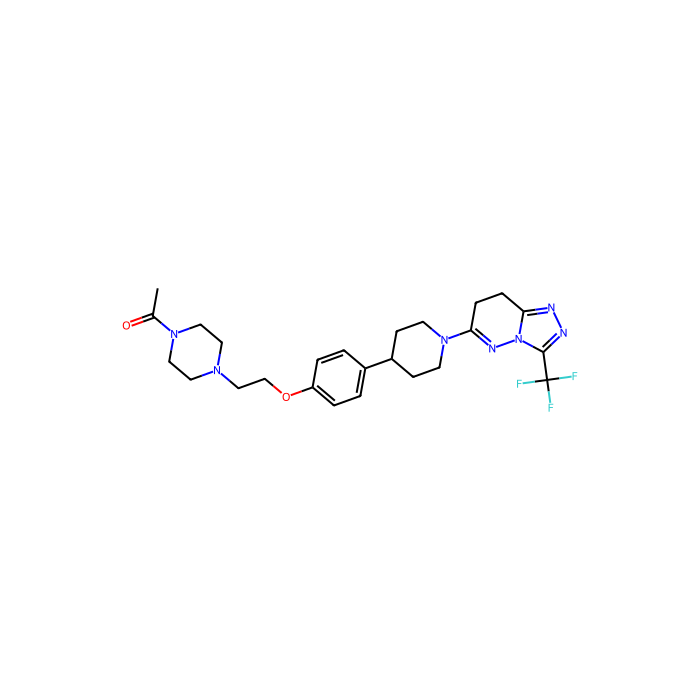
AZD3514 is a potent and oral androgen receptor downregulator with Ki of 2.2 μM and has ability of reducing AR protein expression.
Spezifikationen
Synonyme
1-[4-[2-[4-[1-[3-(trifluoromethyl)-7,8-dihydro-[1,2,4]triazolo[4,3-b]pyridazin-6-yl]piperidin-4-yl]phenoxy]ethyl]piperazin-1-yl]ethanone | AZD 3514 | AZD3514 | AZD-3514 | 1-(4-(2-(4-(1-(3-(Trifluoromethyl)-7,8-dihydro-[1,2,4]triazolo[4,3-b]pyridazin-6-yl)piperidin-4-yl)phenoxy)ethyl)piperazin-1-yl)ethanone | 6-(4-{4-[2-(4-acetylpiperazin- Show more
Spezifikationen & Reinheit
≥98%
Biochemische und physiologische Mechanismen
Description: IC50 Value: N/A AZD3514 is a small-molecule androgen receptor downregulator for treatment of advanced prostate cancer [1]. AZD3514 binds to the AR ligand binding domain and has selectivity for binding to AR over other nuclear hormone receptors. in vitro: AZD3514 inhibits cell growth in prostate cancer cells expressing wild-type (VCaP) and mutated (T877A) AR (LNCaP), but is inactive in AR-negative prostate cancer cells, indicating a dependency on AR for efficacy [2]. in vivo: We assessed activity initially in the Hershberger castrated rat assay in which oral dosing of AZD3514 (100mg/kg once-daily for 7 days) significantly inhibited testosterone-induced growth of sexual accessory organs [2]. Clinical trial: Open-label Prostate Cancer Study. Phase 1
Storage
Store at -20°C
Verschickt in
Ice chest + Ice pads
Dieses Produkt erfordert Kühlkettenversand. Grundversand und andere Economy-Optionen sind nicht verfügbar.
This compound belongs to the class of organic compounds known as phenylpiperidines. These are compounds containing a phenylpiperidine skeleton, which consists of a piperidine bound to a phenyl group.
External Descriptors
Not available
1. Djoumbou Feunang Y, Eisner R, Knox C, Chepelev L, Hastings J, Owen G, Fahy E, Steinbeck C, Subramanian S, Bolton E, Greiner R, and Wishart DS. ClassyFire: Automated Chemical Classification With A Comprehensive, Computable Taxonomy. Journal of Cheminformatics, 2016, 8:61.
Determine the necessary mass, volume, or concentration for preparing a solution.
Dilution Calculator
Determine the dilution needed to prepare a stock solution.
Reconstitution Calculator
Bewertungen
Kundenbewertungen
Application Protocols
No item-specific, validated application protocols are provided in the Product Data.
General research-use guidance (non-spec):
Stock preparation: Common practice is to dissolve small molecules in dry DMSO to prepare concentrated stocks (e.g., 10–50 mM), then aliquot and store at −20°C to avoid freeze–thaw cycles. Confirm actual solubility and stability experimentally for AZD3514 before adopting this practice.
Cell-based assays: Establish a vehicle control (matching DMSO %), perform a concentration–response (e.g., 8–12 points), and monitor both target readouts and cell health.
Biochemical assays: Titrate detergent, salt, and cofactor conditions to minimize nonspecific effects; verify compound integrity by LC–MS before and after incubation.
These are general practices and do not constitute specifications or validated protocols for this specific item.
Biological Roles
Literature context (no clinical claims):
AZD3514 is described in the scientific literature as a small-molecule modulator of the androgen receptor (AR) pathway. Reports indicate it can reduce AR protein levels and suppress AR signaling, consistent with use as a research tool to interrogate AR-dependent transcription and proliferation in model systems.
Proposed mechanisms from published studies include interference with AR nuclear translocation and/or promotion of AR turnover, leading to diminished AR-driven gene expression. Exact molecular interactions and degradation pathways should be confirmed in the primary literature for your specific cell model.
Research utility:
Commonly used to benchmark AR pathway inhibition alongside antagonists and PROTAC-style degraders, enabling comparative potency and mechanistic profiling (e.g., reporter assays, qPCR of AR targets, western blotting for AR abundance).
Facilitates target-validation experiments in oncology-relevant cell lines where AR signaling is implicated, bridging biochemical, cellular, and transcriptomic readouts.
Caveats:
Off-target effects and context-dependent responses may occur; conduct counter-screens and measure cytotoxicity/viability.
Batch-to-batch reproducibility should be verified by identity and purity testing and by reproducing key pharmacologic phenotypes under standardized assay conditions.
Note: The above reflects general literature knowledge and is not an item-specific performance guarantee.
Buffer Applications
Not typically applicable. AZD3514 is not a buffering agent and is not used to prepare classical buffer systems. For biological assays, it may be diluted into existing buffers or media from a DMSO stock; select buffers based on your assay target and detection modality, and validate compound stability in the chosen matrix.
Green Alternatives
This product is a bioactive small molecule, not a process solvent or auxiliary reagent typically targeted for green-replacement strategies. Accordingly, the concept of “green alternatives” is not directly applicable.
Minimize DMSO volume by preparing higher-concentration master stocks when solubility permits and aliquoting to reduce waste.
Use microplate formats and automated dispensing to limit overuse and improve reproducibility.
If analytical method development allows, choose greener mobile phases (e.g., ethanol or water-rich eluents) and reduce buffer salt loads, while ensuring compound stability and detection sensitivity.
Dispose of DMSO- and acetonitrile-containing wastes via appropriate hazardous-waste streams to prevent environmental release.
Pharmaceutical Uses
No excipient or formulation-grade use is specified for this item. This product is supplied for research use only.
Professional context (general, non-therapeutic):
In discovery and preclinical research labs, compounds like AZD3514 may be employed as reference standards for analytical method development, stability-indicating assays, and as positive controls in target-engagement or pathway-reporter assays.
If used to support formulation research (e.g., enabling studies), ensure compatibility with the intended vehicle, assess chemical/physical stability, and document impurity profiles. This listing does not provide pharmacopeial compliance or GMP status.
Physical Properties
Item-specific physicochemical specifications are not supplied in the Product Data.
Appearance: Not specified for this item; refer to CoA/Spec Sheet.
Melting point (MP): Not specified for this item; refer to CoA/Spec Sheet.
Boiling point (BP): Not applicable/unknown for a high-MW bioactive solid; not specified for this item.
Density: Not specified for this item; refer to CoA/Spec Sheet.
LogP/logD: Not specified for this item; refer to CoA/Spec Sheet.
pKa: Not specified for this item; refer to CoA/Spec Sheet.
Refractive index: Not applicable to solids; not specified for this item.
Solubility: Not specified for this item; refer to CoA/Spec Sheet.
Literature/practical notes (non-spec):
Bioactive screening compounds like AZD3514 are commonly handled as DMSO stocks for in vitro studies; exact solubility limits are compound- and lot-dependent and must be experimentally verified.
For quantitative work (e.g., LC–MS reference standard), determine solubility and stability empirically in your assay-relevant matrices (buffer, serum, cell media) and document with chromatographic purity checks.
Always treat the above as general guidance only. For method validation or GMP-adjacent use, rely on the item-specific CoA and SDS.
Quality and Grades
Grade/Purity: Not specified for this item; refer to CoA/Spec Sheet.
Professional guidance on interpretation:
For bioactive small molecules, suppliers may report purity by HPLC/UPLC (area %), supported by orthogonal techniques (NMR, MS). Verify which assay is used and whether residual solvents, inorganics, and water content are controlled.
If a stabilizer or counter-ion is present, it should be declared on the CoA; none is specified in the Product Data for this item.
For screening libraries, consistency of identity and purity across lots is critical. Confirm lot-specific purity threshold (e.g., ≥95% HPLC) and whether the value excludes volatile components.
If you require low-UV background for analytical assays or certified residual-metal limits, request an expanded specification and analytical package.
What is specific here:
This listing provides storage and shipping conditions but does not define a grade label (e.g., “Screening grade”, “Analytical standard”). Users should consult the CoA for assay details (chromatographic method, detection wavelength, and reference standard).
Reaction and Applications
This item is intended as a bioactive small-molecule research tool rather than a synthetic reagent.
Research applications (literature/general):
Used as a chemical probe candidate in studies of androgen receptor (AR) signaling. Typical use cases include target engagement assays, reporter assays, transcriptional readouts, and degradation/turnover studies in cell lines expressing AR.
Employed as a reference compound for assay development and screening benchmarking in AR-focused discovery campaigns.
Analytical applications:
Can serve as a system-suitability or positive-control analyte in LC–MS or HPLC method development for AR-modulator panels, provided an authenticated reference is available.
Note: No item-specific application data are provided in the Product Data. Users should validate concentration ranges, exposure times, and assay formats empirically for their specific biological system. Avoid inferring therapeutic properties; this product is for research use only.
Reaction Conditions
Not applicable. AZD3514 is supplied as a bioactive small molecule for research use rather than as a reagent for chemical reactions. No catalytic or stoichiometric reaction conditions are associated with this product in the provided data.
Analytical handling (general guidance):
For LC–MS analysis, develop conditions empirically (e.g., water–acetonitrile gradients with 0.1% formic acid or ammonium formate). Optimize source parameters for sensitivity while monitoring for in-source fragmentation.
For stability studies, assess degradation across pH, temperature, light exposure, and oxidative stress per ICH-like screening, but tailor to research needs. These are not product specifications.
Safety and Handling
GHS Classification: Not specified for this item; refer to SDS.
Signal word / H-statements / Pictograms: Not specified for this item; refer to SDS.
Research use: For research use only (per Product Data). Not for human or animal therapeutic use.
General laboratory precautions (professional guidance):
Handle in a chemical fume hood. Avoid inhalation of dust and contact with skin/eyes. Wear appropriate PPE: lab coat, safety glasses, and chemically resistant gloves.
Storage: Store at −20°C (per Product Data). Protect from moisture and light; keep container tightly closed. Allow to equilibrate to room temperature in a desiccator before opening to minimize condensation.
Incompatibilities: Unknown for this item; as a precaution, segregate from strong oxidizers and acids/bases until compatibility is established.
First aid (overview; defer to SDS): In case of skin/eye contact, rinse with water for at least 15 minutes; remove contaminated clothing. If inhaled, move to fresh air. If swallowed, rinse mouth and seek medical attention. Provide the SDS to responders.
Spills and disposal: Avoid dust generation. Collect with inert absorbent and dispose of in accordance with institutional and local regulations. Decontaminate surfaces with suitable solvent compatible with your laboratory’s waste streams.
Always consult the product-specific SDS for authoritative hazard and response information.
Solvent Selection
This product is a bioactive small molecule, not a laboratory solvent. Solvent-selection considerations here focus on dissolution for biological assays and analytical methods.
General guidance (non-spec):
Primary vehicles: DMSO is commonly used to prepare concentrated stocks for bioassays. Confirm actual solubility and stability before preparing master plates.
Aqueous use: For cell-based or biochemical assays, dilute DMSO stocks into buffered media, keeping final DMSO typically ≤0.1–0.5% v/v to minimize vehicle effects; verify tolerability in your system.
Analytical methods: For LC–MS, water–acetonitrile or water–methanol systems with formic acid or ammonium formate are typical; choose based on ionization and retention behavior established during method development.
Solid dispensing: If using acoustic or powder dispensing, confirm flowability and hygroscopicity; use desiccation and inert gas backfill as needed.
Comparison (general):
DMSO vs DMF: DMSO offers wider biocompatibility at low percentages; DMF may improve solubility for certain scaffolds but is less favored in live-cell contexts.
MeOH/EtOH cosolvents: Useful for rapid dissolution but may affect protein targets or cells; validate carefully.
Storage and Reconstitution
Storage temperature: Store at −20°C (per Product Data). Keep tightly sealed, protected from light and moisture. Allow the container to warm to room temperature in a desiccator before opening to prevent condensation ingress.
Shipping: Shipped in an ice chest with ice pads (per Product Data) to maintain a cool chain.
Stability: Not specified for this item; refer to CoA/Spec Sheet.
Reconstitution: Not specified for this item; refer to CoA/Spec Sheet.
General handling guidance (non-spec):
If preparing solution stocks, use anhydrous solvent (commonly DMSO for bioactives) and sterile-filter if solutions will be used in cell culture. Record concentration gravimetrically or by quantitative NMR where possible.
Aliquot solutions to single-use vials to minimize freeze–thaw and headspace oxygen. For long-term storage, consider −20°C or −80°C depending on demonstrated stability.
Before critical experiments, verify integrity by analytical HPLC/LC–MS and check for precipitation upon dilution into assay media.
For authoritative stability and reconstitution instructions specific to this lot, consult the product CoA and SDS.
Structure and Identity
Product name: AZD3514 (bioactive small-molecule research compound)
CAS: 1240299-33-5 (literature)
PubChem CID: 46893585 (literature)
InChIKey: 164136 (provided; note: this does not conform to standard InChIKey length/format)
SMILES: Not specified for this item; refer to CoA/Spec Sheet.
Molecular formula: Not specified for this item; refer to CoA/Spec Sheet.
Molecular weight: Not specified for this item; refer to CoA/Spec Sheet.
Structural features (general/literature context):
AZD3514 is reported in the literature as a small-molecule modulator of the androgen receptor (AR) pathway. Detailed atom connectivity, stereochemistry, and functional-group composition should be confirmed from an authenticated reference (CoA/SDS or primary literature). Without a verified structure string for this specific lot, Aladdin does not assert an item-specific structure depiction here.
2D description (general):
Literature reports describe an aromatic heterocycle–rich scaffold consistent with AR pathway modulators; however, precise ring systems and substituent patterns are not specified in the item data. Users should consult the product CoA or trusted databases for an authoritative structure before method development or analytical qualification.
Synthetic Utility
Not a typical synthetic building block. This item is generally used as a bioactive reference compound rather than as a substrate, reagent, or intermediate in organic synthesis.
If derivatization is desired (research context only):
Researchers sometimes generate analytical surrogates (e.g., stable-isotope–labeled analogs) or tagged derivatives for mechanistic studies. Such work requires a confirmed structure, suitable functional handles, and validated purification/characterization methods. No such handles or schemes are specified for this item.
For routine organic synthesis needs, consider dedicated building blocks or reagents listed under the appropriate categories in the Aladdin catalog.
Target Specificity
This section is typically applicable to biological macromolecules such as antibodies or peptides with defined binding targets. As AZD3514 is a small-molecule research compound, no antibody-like specificity parameters (antigen, clone, isotype, species reactivity) apply. Item-specific target-binding data are not provided in the Product Data.
Wir verwenden Cookies, um die ordnungsgemäße Funktion der Website sicherzustellen und, soweit zulässig, Ihr Nutzererlebnis zu verbessern. Sie können Ihre Einstellungen jederzeit unter „Einstellungen“ verwalten. Weitere Informationen finden Sie in unserer Cookie-Richtlinie.
Dürfen wir Sie über Rabattaktionen informieren?
Später erinnern
Vielen Dank! Bitte überprüfen Sie Ihren E-Mail-Posteingang, um zu bestätigen.
Products are supplied to verified businesses, institutions, and qualified professionals for research and development use only. Not for use in humans, animals, diagnosis, or therapy.

 I2221085