QUALITÄT & REINHEITMoligand™?Moligand™ — Aladdin's line of ligands and bioactive small molecules. Use for receptor, pathway, and binding studies needing defined small-molecule tools.≥99%
In H3255 (L858R) cells, AZD3759 inhibits EGFR phosphorylation with IC50 of 7.2 nM. AZD3759 demonstrates inhibitory effects on both the pEGFR pathway and cell proliferation of EGFR mutation-derived cells PC-9 and H3255 with IC50 of 7.7 nM and 7 nM, respectively, showing mo activity on cell proliferation of H838 cells.
In vivo
AZD3759 shows good oral bioavailability in dogs, and penetrates extensively into monkey brain. In a brain metastasis PC-9 (Exon19Del) model, AZD3759 (15 mg/kg) causes significant dose-dependent antitumor efficacy.
Cell Research(from reference)
Cell lines:PC-9 (exon 19Del), H3255 (L858R) and H838 (wt) cells
Concentrations:~30 mM
Incubation Time:72 h
Spezifikationen
Synonyme
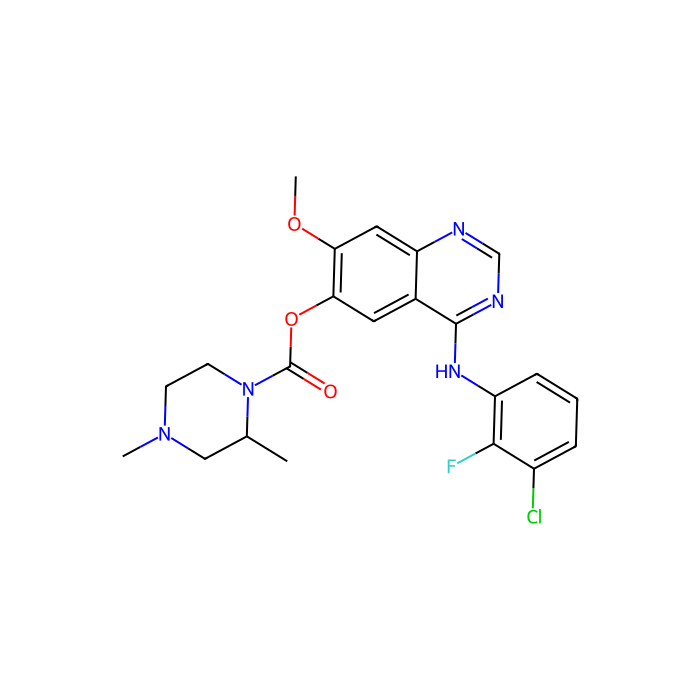
(R)-4-(3-chloro-2-fluorophenylamino)-7-methoxyquinazolin-6-yl 2,4-dimethylpiperazine-1-carboxylate | zorifertinib | (9S,10R)-3,4,5,14,15,16-hexamethoxy-9,10-dimethyltricyclo[10.4.0.0^{2,7}]hexadeca-1(16),2,4,6,12,14-hexaene | 4-((3-Chloro-2-fluorophenyl)amino)-7-methoxyquinazolin-6-yl (2R)-2,4-dimethylpiperazine-1-carboxylate | (+/-)-N-[2 Show more
Spezifikationen & Reinheit
Moligand™, ≥99%
Biochemische und physiologische Mechanismen
AZD3759 is a potent, oral active, CNS-penetrant EGFR inhibitor with IC50 of 0.3 nM, 0.2 nM, and 0.2 nM for EGFR (WT), EGFR (L858R), and EGFR (exon 19Del), respectively. Phase 1.
Storage
Store at -20°C
Verschickt in
Ice chest + Ice pads
Dieses Produkt erfordert Kühlkettenversand. Grundversand und andere Economy-Optionen sind nicht verfügbar.
This compound belongs to the class of organic compounds known as quinazolinamines. These are heterocyclic aromatic compounds containing a quianazoline moiety substituted by one or more amine groups.
External Descriptors
Not available
1. Djoumbou Feunang Y, Eisner R, Knox C, Chepelev L, Hastings J, Owen G, Fahy E, Steinbeck C, Subramanian S, Bolton E, Greiner R, and Wishart DS. ClassyFire: Automated Chemical Classification With A Comprehensive, Computable Taxonomy. Journal of Cheminformatics, 2016, 8:61.
Determine the necessary mass, volume, or concentration for preparing a solution.
Dilution Calculator
Determine the dilution needed to prepare a stock solution.
Reconstitution Calculator
Bewertungen
Kundenbewertungen
Application Protocols
No tested application protocols are provided in the product data for this item.
Validated applications, recommended concentrations/dilutions, and positive controls: Not specified for this item; refer to CoA/Spec Sheet.
General recommendations (non-item-specific):
Prepare single-use aliquots of DMSO stock to avoid freeze–thaw cycles.
Include vehicle-only controls in all assays. Confirm absence of compound precipitation after dilution by visual inspection and, if needed, light scattering or filtration (0.2 µm).
Verify compound integrity during the assay by spot-check LC–MS/UPLC at start and end points.
Please consult your internal SOPs and the lot-specific documentation for any validated procedures.
Biological Roles
Item-specific biological characterization is not provided in the product data.
General/literature context:
AZD3759 is described in the open literature as a small-molecule ligand designed for protein kinase engagement. Public sources often position it as a selective ATP-site binder for receptor tyrosine kinases. Users should consult primary references for definitive target profiling, potency, and selectivity panels.
Practical research uses (non-clinical):
Chemical probe for target engagement assays (e.g., thermal shift, cellular target occupancy) in biochemical and cell-based systems.
Benchmark control in screening funnels to calibrate assay sensitivity and dynamic range.
Analytical standard for exposure assessments and exploratory ADME method development in laboratory settings.
Caveats:
Do not infer therapeutic efficacy or safety from research-grade material. Biological outcomes can be highly context-dependent (cell line, expression, media, vehicle concentration).
Confirm off-target liabilities and aggregation/fluorescence interference through orthogonal assays and counterscreens.
For rigorous use, pair this compound with lot-specific analytical data (purity/identity), confirm solubility under assay conditions, and document vehicle effects. Always adhere to the “Research Use Only” notice and avoid any clinical or diagnostic application.
Buffer Applications
This product is not a buffering agent and is not typically used to set or control pH.
Practical guidance for assay buffers (general):
Prepare compound stocks in DMSO, then dilute into assay buffers such as HEPES, PBS, or Tris at the lowest feasible DMSO percentage (often ≤0.5–1% v/v). Validate vehicle tolerance for your biological system.
Include detergents (e.g., 0.01–0.05% Tween-20) only if required to mitigate nonspecific binding or aggregation and after verifying no impact on the assay signal.
Maintain constant ionic strength and pH across samples and controls to avoid confounding target engagement data. Filter buffers (0.22 µm) to remove particulates.
If buffer-related specifications (pH stability range, salt compatibility) are critical for your workflow, determine them empirically for your lot or consult relevant literature; item-specific data are not provided here.
Green Alternatives
Because AZD3759 is a research ligand rather than a bulk solvent or reagent, “green alternatives” are best considered in terms of formulation and handling practices.
Greener choices (general considerations):
Stock solvent optimization: Use the minimum effective DMSO percentage in assays. Where feasible, evaluate bio-friendly co-solvents (glycerol, PEG-400) or aqueous solubilization aids that are validated and compatible with your assay.
Minimize waste: Prepare aliquots at use-ready concentrations to reduce repeated thawing and disposal of expired solutions. Consolidate dilutions to avoid leftover high-DMSO mixtures.
Avoid halogenated wash solvents: For vial and equipment cleaning, substitute MeOH/EtOH/IPA or aqueous detergents in place of chlorinated solvents when compatible.
Energy footprint: Store only as cold as required (here: −20°C per item data) and avoid unnecessary shipments by coordinating orders.
Illustrative comparison (formulation focus):
DMSO vs ethanol: DMSO offers broader solubility but has higher environmental persistence and worker-exposure concerns; ethanol is greener but may not solubilize complex heteroaromatics sufficiently.
DMF/NMP vs aqueous systems: DMF/NMP have higher EHS burdens; where possible, transition to buffered aqueous vehicles after a minimal DMSO seed.
Always validate alternative solvents for chemical stability and assay performance before scale-up.
Pharmaceutical Uses
No clinical or therapeutic claims are made for this product. It is supplied strictly for research use only.
Reference standard for analytical method development and validation (e.g., LC–MS/MS quantitation) in discovery or preformulation laboratories.
Tool compound for in vitro permeability/efflux assessments, plasma protein binding experiments, and stability studies under controlled lab conditions.
Control article in formulation screening (solubilization strategies, co-solvents, enabling excipients) without any implication of suitability for human use.
Regulatory/quality notes:
Pharmacopeial monograph: Not specified for this item; refer to CoA/Spec Sheet and applicable databases.
Residual solvents, elemental impurities, and release criteria: Not specified for this item; consult the lot-specific CoA.
Use constraints:
For research use only; not for human or veterinary use, not for diagnostic procedures, and not for ex vivo or in vivo applications in humans. Ensure internal governance and EHS approvals are in place before use.
Physical Properties
Item-specific physicochemical constants have not been provided in the product data.
Molecular weight: Not specified for this item; refer to CoA/Spec Sheet.
Molecular formula: Not specified for this item; refer to CoA/Spec Sheet.
Appearance: Not specified for this item; refer to CoA/Spec Sheet.
Melting point (literature/general): Not specified here; consult primary literature or CoA for the exact solid-state transition(s) of the supplied form (free base vs. salt, solvate, or polymorph).
Boiling point: Generally not applicable for high-MW, solid research ligands; item-specific data not provided.
Density/refractive index: Not applicable/Not specified for this item; refer to CoA/Spec Sheet.
Aqueous solubility: Not specified for this item; refer to CoA/Spec Sheet.
LogP/logD, pKa(s) (literature/computed): Not provided here. Values may vary with protonation state and counterions; confirm with experimentally determined data for your lot.
Practical notes (general guidance, not item-specific specifications):
Many heteroaromatic research ligands are prepared as DMSO stock solutions (e.g., 10–50 mM) and subsequently diluted into aqueous assay buffers containing low percentages of DMSO. Actual solubility and stability must be verified empirically for your batch/assay conditions.
Hygroscopicity and polymorphism, if relevant, should be assessed from the CoA and by pre-use characterization (DSC/TGA, PXRD, or Karl Fischer for moisture if needed).
Quality and Grades
Grade/Purity: Moligand™ (as provided). This denotes a research-use small-molecule ligand product intended for discovery chemistry, screening, and assay development. It emphasizes identity and performance suitable for laboratory research.
What Moligand™ generally implies (contextual explanation; not item-specific specs):
Focus on small-molecule ligands/probes commonly used for biochemical, cellular, or biophysical assays.
Typically accompanied by identity confirmation (e.g., NMR/MS/HRMS) and purity determination (e.g., HPLC/UPLC); exact tests, thresholds, and acceptance criteria are lot-specific.
Critical notes for this specific listing:
Numerical purity, residual solvents, counterion content, water/peroxide levels, metal traces, and UV cutoff are Not specified for this item; refer to CoA/Spec Sheet.
If your application is sensitive (e.g., quantitative bioassays, crystallography), request and verify the full analytical package for the delivered lot (chromatographic purity trace, spectroscopic data, and salt/form information).
Quality assurance in practice (recommendations):
Upon receipt, record the lot and immediately archive the CoA/SDS.
For reproducibility across campaigns, reserve a primary reference vial for characterization and prepare working aliquots to minimize variability from freeze–thaw or ambient exposure.
If low-UV or trace-metal specifications are required (e.g., analytical or catalysis contexts), contact technical support for a specification-controlled batch.
Reaction and Applications
This product is supplied as a research-use small-molecule ligand (not primarily as a synthetic reagent). Consequently, its core value is in discovery and analytical contexts rather than as a building block.
Research applications (general, non-clinical):
Reference chemical control for biochemical target engagement studies and orthogonal assay validation.
Tool compound for screening cascades, hit confirmation, and establishing structure–response relationships when used alongside analogs.
Analytical reference standard for LC–MS method development, retention-time locking, and quantitation in ADME-like lab studies.
Probe candidate for biophysical characterization (e.g., thermal shift, SPR, NMR binding) when solubility and stability permit.
Practical considerations:
Prepare concentrated DMSO stocks (e.g., 10–50 mM as allowed by solubility) and verify by analytical HPLC/UPLC.
Assess stability under assay conditions (temperature, pH, light) and track potential degradation or aggregation.
Include vehicle controls and, where relevant, orthogonal readouts to de-risk assay interference (e.g., fluorescence quenching/inner-filter effects).
Note: If you intend to derivatize or immobilize the molecule for chemoproteomics or affinity enrichment, consult structural disclosures and ensure functional handles are compatible with your coupling chemistry. Item-specific reactivity is not provided here.
Reaction Conditions
Conventional synthetic reaction conditions are not directly applicable because this product is supplied as a final small-molecule ligand, not a reagent. Nonetheless, users frequently need handling conditions for biophysical/biochemical experimentation.
General assay handling conditions (non-item-specific):
Stock preparation: Dissolve in anhydrous DMSO to a convenient concentration (e.g., 10–50 mM as permitted by solubility). Warm gently to room temperature and vortex/sonicate briefly to aid dissolution; avoid prolonged heating.
Working solutions: Dilute stocks into assay buffer immediately before use to minimize precipitation and degradation. Maintain consistent vehicle percentage across samples and controls.
Temperature: Many assays are performed at ambient to 37°C; verify chemical stability over the assay timeframe under your specific pH and buffer composition.
Light/oxidation: Protect solutions from light; consider inert atmosphere for long incubations if the compound is air-sensitive (status not specified here).
Analytical confirmation: Use LC–MS or UPLC-UV to confirm concentration and integrity after dilution, especially for long incubations.
Item-specific parameters such as pKa-dependent solubility, exact stability windows, and incompatibilities are not provided; determine empirically for your use case.
Safety and Handling
Hazard classification details have not been supplied for this item in the product data.
GHS classification: Not specified for this item; refer to SDS.
Signal word / H-statements / Pictograms: Not specified for this item; refer to SDS.
General laboratory safety guidance (defer to SDS for authoritative instructions):
Handle in a chemical fume hood while wearing appropriate PPE: lab coat, safety glasses, and suitable chemical-resistant gloves.
Avoid inhalation of dust or aerosols. Prevent skin and eye contact. Do not ingest. Wash thoroughly after handling.
Storage incompatibilities: Keep separate from strong oxidizers, strong acids/bases, and reactive reducing agents unless compatibility is confirmed.
Spills: For small dry spills, avoid dust generation; sweep up with minimal disturbance and dispose of per institutional hazardous waste procedures. For solutions, absorb with inert material and clean area with appropriate solvent while maintaining ventilation.
First aid (overview; follow SDS): If on skin/eyes, rinse with water for several minutes; remove contaminated clothing. If inhaled, move to fresh air. If swallowed, rinse mouth; seek medical advice in all cases of exposure.
Thermal/photolysis considerations: Many research ligands are light- and/or heat-sensitive. Protect from light, avoid prolonged elevated temperatures, and minimize freeze–thaw.
Always consult the lot-specific SDS delivered with the product for definitive hazard, toxicological, and disposal guidance.
Solvent Selection
Item-specific solubility data are not provided. The following is general guidance for small-molecule heteroaromatic ligands used in discovery assays.
Primary stock solvent (typical): DMSO due to broad solubilizing power and compatibility with biochemical/cell-based assays at low final percentages (commonly ≤0.5–1% v/v). Verify your assay tolerance.
Alternative solvents: DMF, NMP, ethanol, or methanol can be considered for formulation or intermediate dilutions. For purely synthetic manipulations or stability studies, anhydrous acetonitrile or acetone may also be useful.
Aqueous media: Direct water solubility varies with ionization state and salt form. Use co-solvent strategies (DMSO → buffer dilution) and surfactants or cyclodextrins only if validated for the assay.
pH modulation: If an ionizable functionality is present (amine/azole/acid), mild acid or base can modulate solubility; ensure chemical stability is maintained and avoid conditions that induce hydrolysis or oxidation.
Selection tips (general):
For biophysics (SPR/ITC/DSF): Favor high-purity DMSO stocks, verify absence of particulates by 0.2 µm filtration, and match vehicle in samples/controls.
For LC–MS quantification: Choose solvents compatible with the mobile phase. Minimize nonvolatile buffers.
For long incubations in aqueous buffers: Confirm stability by LC or UV profiling at assay-relevant temperature and time.
Always confirm solvent choice with small-scale tests and the lot-specific CoA.
Storage and Reconstitution
Storage conditions (item-specific): Store at −20°C (per product data). Protect from light and moisture.
Reconstitution and handling (general guidance; not item-specific specifications):
Allow the container to equilibrate to room temperature in a desiccator before opening to minimize moisture condensation.
Prepare a concentrated stock solution in high-quality, anhydrous DMSO. Typical working stocks for small-molecule ligands are 10–50 mM, limited by solubility. Filter through 0.2 µm PTFE if particulates are present.
Aliquot stocks into amber vials or microtubes to avoid repeated freeze–thaw events and light exposure. Store aliquots at −20°C or below.
For short-term use, refrigerated storage (2–8°C) of working dilutions may be acceptable if stability is verified; otherwise prepare fresh before use.
Avoid multiple freeze–thaw cycles; thaw on ice or at room temperature, mix gently, and promptly return unused aliquots to storage.
Item-specific attributes such as exact solubility, solution stability, and form (free base vs. salt) are Not specified for this item; refer to the lot CoA/Spec Sheet and confirm empirically under your assay conditions.
Structure and Identity
Product name: AZD3759 (SKU: A413895)
CAS: 1626387-80-1
PubChem CID: 78209992
InChIKey: 230869 (as provided in product data)
Molecular formula: Not specified for this item; refer to CoA/Spec Sheet.
Molecular weight: Not specified for this item; refer to CoA/Spec Sheet.
SMILES: Not specified for this item; refer to CoA/Spec Sheet.
Structural features (general/literature context):
AZD3759 is widely described in the literature as a small-molecule kinase-targeted chemical probe candidate; detailed functional groups and ring systems vary by disclosed structure and are not item-specified here. Consult the CoA/SDS or primary literature for the definitive structural diagram.
2D structure description:
A precise 2D structural description is not item-specified. For accurate depiction and atom-level identity (including any heteroaromatic ring systems, alkynes, amines, or other features), please refer to the product CoA or peer-reviewed structural disclosures. This listing intentionally avoids asserting a structural diagram without the manufacturer’s specification.
Notes:
When preparing regulatory or publication materials, cite the CAS and your lot-specific CoA/SDS for definitive identifiers. If structural identifiers (SMILES/InChI) are required for cheminformatics, extract them from the lot CoA or trusted databases and verify against the supplied CAS.
Synthetic Utility
This listing is for a finished research ligand rather than a synthetic building block. As such, it is not commonly employed as a reagent or intermediate in standard organic transformations.
How it may still support synthetic/medchem workflows (general):
SAR benchmarking: Use as a comparator compound to contextualize activity changes from designed analogs.
Analytical control: Serve as a retention-time and response-factor standard during purification and quantitation of structural analogs.
Derivatization (if structure allows): With appropriate knowledge of the exact structure and functional handles, it may be possible to append linkers or reporter groups for affinity capture or imaging; this requires consultation of primary structural data and compatibility with chosen coupling chemistry.
Notably, without item-specific functional group disclosure (e.g., free amines, phenols, alkynes), we cannot recommend reaction classes or named transformations. If you intend to modify the molecule, obtain definitive structural identifiers (SMILES/InChI) and confirm reactivity through small-scale scouting and analytical verification.
Target Specificity
Target specificity data are not provided in the product listing and should not be inferred from the product name alone.
Verified molecular target(s): Not specified for this item; refer to CoA/Spec Sheet and primary literature.
Selectivity panel results, binding constants (Kd, Ki, IC50), and off-target profiles: Not specified for this item; consult peer-reviewed sources and validate under your laboratory conditions.
For rigorous research, determine target engagement in your system using orthogonal assays (e.g., biochemical enzyme assays, cellular target-occupancy measurements, CETSA/thermal shift) and include appropriate positive/negative controls.
Benötigen Sie Hilfe bei der Auswahl der Qualität?
Unser Leitfaden zur Qualitätsauswahl behandelt Reinheit, Stabilisatorstatus und Anwendungseignung für alle Varianten in unserem Katalog.
Wir verwenden Cookies, um die ordnungsgemäße Funktion der Website sicherzustellen und, soweit zulässig, Ihr Nutzererlebnis zu verbessern. Sie können Ihre Einstellungen jederzeit unter „Einstellungen“ verwalten. Weitere Informationen finden Sie in unserer Cookie-Richtlinie.
Dürfen wir Sie über Rabattaktionen informieren?
Später erinnern
Vielen Dank! Bitte überprüfen Sie Ihren E-Mail-Posteingang, um zu bestätigen.
Products are supplied to verified businesses, institutions, and qualified professionals for research and development use only. Not for use in humans, animals, diagnosis, or therapy.

 F2224252