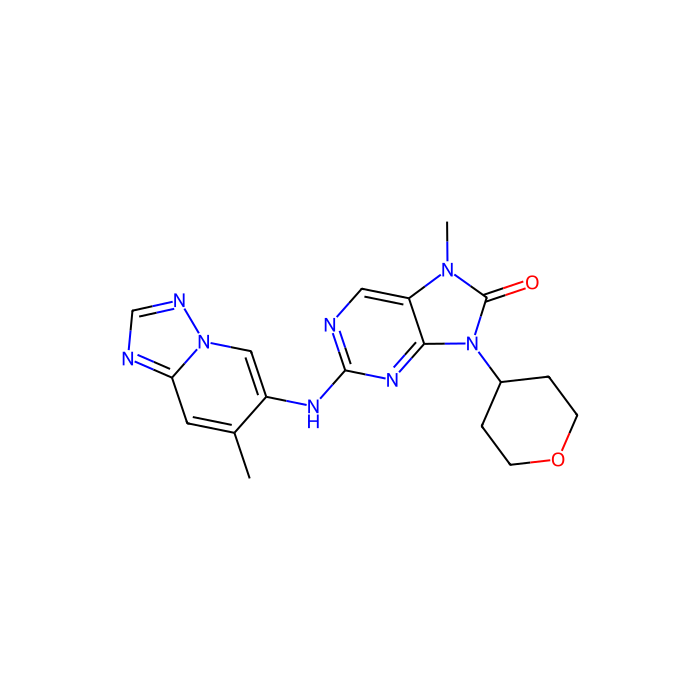
AZD7648 - Moligand™, ≥98% , Inhibitor of phosphatidylinositol-4;5-bisphosphate 3-kinase catalytic subunit alpha;Inhibitor of phosphatidylinositol-4;5-bisphosphate 3-kinase catalytic subunit gamma;Inhibitor of protein kinase; DNA-activated; catalytic subun, Inhibitor of phosphatidylinositol-4;5-bisphosphate 3-kinase catalytic subunit alpha;Inhibitor of phosphatidylinositol-4;5-bisphosphate 3-kinase catalytic subunit gamma;Inhibitor of protein kinase; DNA-activated; catalytic subunit

CAS: 2230820-11-6 Cat. No.: A414215 Summenformel: C18H20N8O2 Molekulargewicht: 380.4 EG-Nummer: 964-328-4
Zu bestellen verfügbar
GRADE & PURITY Moligand™ ? Moligand™ — Aladdin's line of ligands and bioactive small molecules. Use for receptor, pathway, and binding studies needing defined small-molecule tools. ≥98%
Synonyms
7-methyl-2-[(7-methyl-[1,2,4]triazolo[1,5-a]pyridin-6-yl)amino]-9-(oxan-4-yl)purin-8-one | SB23233 | A930641 | BCP30676 | AC-31586 | 7,9-Dihydro-7-methyl-2-[(7-methyl[1,2,4]triazolo[1,5-a]pyridin-6-yl)amino]-9-(tetrahydro-2H-pyran-4-yl)-8H-purin-8-one | S
Storage
Store at -20°C
Shipped In
Ice chest + Ice pads
★
Size
Deutschland (EU)
USA*
Price
Qty
5mg
A414215-5mg
—
1 Auf Lager

73,67€

110,98€
Speichern 37,31 € (33.62%)
10mg
A414215-10mg
—
2 Auf Lager

108,38€

163,05€
Speichern 54,67 € (33.53%)
25mg
A414215-25mg
—
2 Auf Lager

183,87€

275,85€
Speichern 91,98 € (33.34%)
50mg
A414215-50mg
—
2 Auf Lager

280,19€

420,77€
Speichern 140,57 € (33.41%)
100mg
A414215-100mg
—
2 Auf Lager

473,70€

710,59€
Speichern 236,89 € (33.34%)
250mg
A414215-250mg
—
2 Auf Lager

801,70€

1.202,60€
Speichern 400,90 € (33.34%)
Enter a quantity for the sizes you want to add.
🧪

Why this grade

Moligand™, ≥98% Moligand™ for sensitive chromatographic and analytical workflows requiring minimal baseline interference.

🌡

Storage & shipping

Store at -20°C Ships Ice chest + Ice pads Check lot-specific COA for exact specifications.

📋

Quality documents

SDS, COA, datasheet, and spec sheet available for download. Lot-specific COA accessible via lot number lookup.

📚

Literature proof

Cited in 0 peer-reviewed publications across chromatography, organic synthesis, and cross-coupling reactions.

Specifications

Synonyme
7-methyl-2-[(7-methyl-[1,2,4]triazolo[1,5-a]pyridin-6-yl)amino]-9-(oxan-4-yl)purin-8-one | SB23233 | A930641 | BCP30676 | AC-31586 | 7,9-Dihydro-7-methyl-2-[(7-methyl[1,2,4]triazolo[1,5-a]pyridin-6-yl)amino]-9-(tetrahydro-2H-pyran-4-yl)-8H-purin-8-one | S
Spezifikationen & Reinheit
Moligand™, ≥98%
Biochemische und physiologische Mechanismen
AZD7648 is a potent inhibitor of DNA-PK with an IC50 of 0.6 nM in biochemical assay and more than 100-fold selective against 396 other kinases.
Storage
Store at -20°C
Verschickt in
Ice chest + Ice pads
Dieses Produkt erfordert Kühlkettenversand. Grundversand und andere Economy-Optionen sind nicht verfügbar.
Note
Moligand™
Aktionsart
INHIBITOR
Mechanismus der Wirkung
Inhibitor of phosphatidylinositol-4;5-bisphosphate 3-kinase catalytic subunit alpha;Inhibitor of phosphatidylinositol-4;5-bisphosphate 3-kinase catalytic subunit gamma;Inhibitor of protein kinase; DNA-activated; catalytic subunit
Reinheit
≥98%
Produkteigenschaften
ALogP1.059
hba_count6
HBD-Zahl1
Rotationsfähige Bindung3
Namen und Kennungen
Pubchem Sid504773199
Pubchem Sid Urlhttps://pubchem.ncbi.nlm.nih.gov/substance/504773199
Kanonisches LächelnCC1=CC2=NC=NN2C=C1NC3=NC=C4C(=N3)N(C(=O)N4C)C5CCOCC5
IUPAC Name7-methyl-2-[(7-methyl-[1,2,4]triazolo[1,5-a]pyridin-6-yl)amino]-9-(oxan-4-yl)purin-8-one
InChIKeyXISVSTPEXYIKJL-UHFFFAOYSA-N
INCHI1S/C18H20N8O2/c1-11-7-15-20-10-21-25(15)9-13(11)22-17-19-8-14-16(23-17)26(18(27)24(14)2)12-3-5-28-6-4-12/h7-10,12H,3-6H2,1-2H3,(H,19,22,23)
Isomere SMILES CC1=CC2=NC=NN2C=C1NC3=NC=C4C(=N3)N(C(=O)N4C)C5CCOCC5
Molekulargewicht 380.4
Reaxy-Rn 33031239
Reaxys-RN_link_address https://www.reaxys.com/reaxys/secured/hopinto.do?context=S&query=IDE.XRN=33031239&ln=

Documentation

📋 Safety Data Sheet (SDS)

Comprehensive hazard, handling, storage, and regulatory compliance document.

Download SDS →

✅ Certificate of Analysis (COA)

Lot-specific quality data. Enter your lot number to retrieve the exact COA.

Look up COA →

📊 Datasheet

Quick-reference summary of product specifications and applications.

View datasheet →

🔬 Specification Sheet

Full quality attributes and acceptance criteria for this grade.

View spec sheet →

Advanced Data

Taxonomic Classification

Taxonomy Tree

KingdomOrganic compounds
SuperclassOrganoheterocyclic compounds
KlasseImidazopyrimidines
SubclassPurines and purine derivatives
Intermediate Tree Nodes Not available
Direct ParentPurinones
Alternative Parents Triazolopyridines  Methylpyridines  Aminopyrimidines and derivatives  Aminopyridines and derivatives  Oxanes  N-substituted imidazoles  Triazoles  Heteroaromatic compounds  Ureas  Secondary amines  Oxacyclic compounds  Dialkyl ethers  Azacyclic compounds  Organopnictogen compounds  Organic oxides  Hydrocarbon derivatives  
Molecular FrameworkAromatic heteropolycyclic compounds
Substituents Purinone - Triazolopyridine - Methylpyridine - Aminopyrimidine - Aminopyridine - Pyrimidine - Pyridine - Oxane - N-substituted imidazole - Heteroaromatic compound - 1,2,4-triazole - Imidazole - Azole - Urea - Oxacycle - Azacycle - Secondary amine - Ether - Dialkyl ether - Organic nitrogen compound - Organic oxygen compound - Organopnictogen compound - Organic oxide - Hydrocarbon derivative - Organooxygen compound - Organonitrogen compound - Amine - Aromatic heteropolycyclic compound
BeschreibungThis compound belongs to the class of organic compounds known as purinones. These are purines in which the purine moiety bears a C=O group. Purine is a bicyclic aromatic compound made up of a pyrimidine ring fused to an imidazole ring.
External Descriptors Not available
3D-Struktur
Interaktives chemisches Strukturmodell


Zugehörige Ziele (menschlich)
PRKDC Tchem DNA-dependent protein kinase catalytic subunit (3 Activities)
Activity TypeActivity Value -log(M)Mechanism of ActionActivity ReferencePublications (PubMed IDs)
PIK3CG Tclin Phosphatidylinositol 4,5-bisphosphate 3-kinase catalytic subunit gamma isoform (0 Activities)
Activity TypeActivity Value -log(M)Mechanism of ActionActivity ReferencePublications (PubMed IDs)
PIK3CA Tclin Phosphatidylinositol 4,5-bisphosphate 3-kinase catalytic subunit alpha isoform (0 Activities)
Activity TypeActivity Value -log(M)Mechanism of ActionActivity ReferencePublications (PubMed IDs)
ABL1 Tclin Tyrosine-protein kinase ABL (18331 Activities)
Activity TypeRelationActivity valueUnitsAction TypeJournalPubMed IddoiAssay Aladdin ID
KCNH2 Tclin HERG (29587 Activities)
Activity TypeRelationActivity valueUnitsAction TypeJournalPubMed IddoiAssay Aladdin ID
PRKDC Tchem DNA-dependent protein kinase (1929 Activities)
Activity TypeRelationActivity valueUnitsAction TypeJournalPubMed IddoiAssay Aladdin ID
GSK3B Tclin Glycogen synthase kinase-3 beta (11785 Activities)
Activity TypeRelationActivity valueUnitsAction TypeJournalPubMed IddoiAssay Aladdin ID
CSNK1D Tchem Casein kinase I delta (4546 Activities)
Activity TypeRelationActivity valueUnitsAction TypeJournalPubMed IddoiAssay Aladdin ID
PDPK1 Tchem 3-phosphoinositide dependent protein kinase-1 (3758 Activities)
Activity TypeRelationActivity valueUnitsAction TypeJournalPubMed IddoiAssay Aladdin ID
PIK3CD Tclin PI3-kinase p110-delta subunit (6699 Activities)
Activity TypeRelationActivity valueUnitsAction TypeJournalPubMed IddoiAssay Aladdin ID
CDK2 Tchem Cyclin-dependent kinase 2 (9050 Activities)
Activity TypeRelationActivity valueUnitsAction TypeJournalPubMed IddoiAssay Aladdin ID
PIK3CG Tclin PI3-kinase p110-gamma subunit (5411 Activities)
Activity TypeRelationActivity valueUnitsAction TypeJournalPubMed IddoiAssay Aladdin ID
AOX1 Tchem Aldehyde oxidase (429 Activities)
Activity TypeRelationActivity valueUnitsAction TypeJournalPubMed IddoiAssay Aladdin ID
PIK3CB Tchem PI3-kinase p110-beta subunit (4044 Activities)
Activity TypeRelationActivity valueUnitsAction TypeJournalPubMed IddoiAssay Aladdin ID
CYP3A5 Tclin Cytochrome P450 3A5 (525 Activities)
Activity TypeRelationActivity valueUnitsAction TypeJournalPubMed IddoiAssay Aladdin ID
CSF1R Tclin Macrophage colony stimulating factor receptor (5179 Activities)
Activity TypeRelationActivity valueUnitsAction TypeJournalPubMed IddoiAssay Aladdin ID
CYP3A4 Tclin Cytochrome P450 3A4 (53859 Activities)
Activity TypeRelationActivity valueUnitsAction TypeJournalPubMed IddoiAssay Aladdin ID
AURKA Tchem Serine/threonine-protein kinase Aurora-A (10240 Activities)
Activity TypeRelationActivity valueUnitsAction TypeJournalPubMed IddoiAssay Aladdin ID
ATM Tchem Serine-protein kinase ATM (4198 Activities)
Activity TypeRelationActivity valueUnitsAction TypeJournalPubMed IddoiAssay Aladdin ID
ATR Tchem Serine-protein kinase ATR (986 Activities)
Activity TypeRelationActivity valueUnitsAction TypeJournalPubMed IddoiAssay Aladdin ID
TTK Tchem Dual specificity protein kinase TTK (2978 Activities)
Activity TypeRelationActivity valueUnitsAction TypeJournalPubMed IddoiAssay Aladdin ID
HL-60 (67320 Activities)
Activity TypeRelationActivity valueUnitsAction TypeJournalPubMed IddoiAssay Aladdin ID
U2OS (164939 Activities)
Activity TypeRelationActivity valueUnitsAction TypeJournalPubMed IddoiAssay Aladdin ID
FaDu (1726 Activities)
Activity TypeRelationActivity valueUnitsAction TypeJournalPubMed IddoiAssay Aladdin ID
HCT-116 (91556 Activities)
Activity TypeRelationActivity valueUnitsAction TypeJournalPubMed IddoiAssay Aladdin ID
BRD4 Tchem Bromodomain-containing protein 4 (13122 Activities)
Activity TypeRelationActivity valueUnitsAction TypeJournalPubMed IddoiAssay Aladdin ID
PIK3R1 Tchem PI3-kinase p110-delta/p85-alpha (1508 Activities)
Activity TypeRelationActivity valueUnitsAction TypeJournalPubMed IddoiAssay Aladdin ID
PIK3R1 Tchem PI3-kinase p110-alpha/p85-alpha (2589 Activities)
Activity TypeRelationActivity valueUnitsAction TypeJournalPubMed IddoiAssay Aladdin ID
PIK3R1 Tchem PI3K p110 beta/p85 alpha (919 Activities)
Activity TypeRelationActivity valueUnitsAction TypeJournalPubMed IddoiAssay Aladdin ID
TRIM24 Tchem Transcription intermediary factor 1-alpha (2087 Activities)
Activity TypeRelationActivity valueUnitsAction TypeJournalPubMed IddoiAssay Aladdin ID
BRPF1 Tchem Peregrin (2217 Activities)
Activity TypeRelationActivity valueUnitsAction TypeJournalPubMed IddoiAssay Aladdin ID
Zugehörige Ziele (nicht menschlich)
PIK3CA PI3-kinase p110-alpha subunit (51 Activities)
Activity TypeRelationActivity valueUnitsAction TypeJournalPubMed IddoiAssay Aladdin ID
Mapk1 MAP kinase ERK2 (650 Activities)
Activity TypeRelationActivity valueUnitsAction TypeJournalPubMed IddoiAssay Aladdin ID
Fgfr3 Fibroblast growth factor receptor 3 (21 Activities)
Activity TypeRelationActivity valueUnitsAction TypeJournalPubMed IddoiAssay Aladdin ID
Mus musculus (284745 Activities)
Activity TypeRelationActivity valueUnitsAction TypeJournalPubMed IddoiAssay Aladdin ID
C2C12 (756 Activities)
Activity TypeRelationActivity valueUnitsAction TypeJournalPubMed IddoiAssay Aladdin ID
Pik3cg Phosphatidylinositol 4,5-bisphosphate 3-kinase catalytic subunit gamma isoform (160 Activities)
Activity TypeRelationActivity valueUnitsAction TypeJournalPubMed IddoiAssay Aladdin ID
8238086 Cytochrome P450 (0 Activities)
Activity TypeRelationActivity valueUnitsAction TypeJournalPubMed IddoiAssay Aladdin ID
Wirkungsmechanismen
Zertifikate (CoA, COO, BSE/TSE und Analyse-Diagramm)
C of A & Other Certificates(BSE/TSE, COO):
Analytical Chart:

Find and download the COA for your product by matching the lot number on the packaging.

8 results found

Lot NumberCertificate TypeDatumArtikel
G2629039Certificate of AnalysisAug 04, 2026 A414215
I2410055Certificate of AnalysisOct 13, 2022 A414215
K2229245Certificate of AnalysisOct 13, 2022 A414215
K2229254Certificate of AnalysisOct 13, 2022 A414215
K2229267Certificate of AnalysisOct 13, 2022 A414215
K2229269Certificate of AnalysisOct 13, 2022 A414215
K2229270Certificate of AnalysisOct 13, 2022 A414215
K2229271Certificate of AnalysisOct 13, 2022 A414215
Chemische und physikalische Eigenschaften
LöslichkeitSolubility (25°C) In vitro DMSO: 6 mg/mL (15.77 mM); Water: Insoluble; Ethanol: Insoluble;
DMSO (mg/ml) Maximale Löslichkeit6
DMSO (mM) Maximale Löslichkeit15.7728706624606
Wasser (mg/ml) Maximale Löslichkeit<1
Molekulargewicht380.400 g/mol
XLogP31.000
Hydrogen Bond Donor Count1
Hydrogen Bond Acceptor Count7
Rotatable Bond Count3
Exact Mass380.171 Da
Monoisotopic Mass380.171 Da
Topological Polar Surface Area101.000 Ų
Heavy Atom Count28
Formal Charge0
Complexity588.000
Isotope Atom Count0
Defined Atom Stereocenter Count0
Undefined Atom Stereocenter Count0
Defined Bond Stereocenter Count0
Undefined Bond Stereocenter Count0
The total count of all stereochemical bonds0
Covalently-Bonded Unit Count1
Lösungsrechner
Bewertungen

Kundenbewertungen

Application Protocols

No validated application protocols are provided in the Product Data for AZD7648. The notes below summarize common practices for handling small-molecule tool compounds in biochemical and cell-based assays; they are general and not specific to this SKU.

General small-molecule assay workflow (not item-specific):

  • Stock preparation: Prepare a DMSO stock at a known concentration (e.g., 10–50 mM). Record exact mass and final volume; verify by UV or LC–MS if needed.
  • Plate setup: Generate serial dilutions (e.g., 1:3 or 1:2) in assay-compatible diluent; maintain constant vehicle concentration across all wells.
  • Incubation: Preincubate with target/biosystem per your assay design; typical times range from 10 to 60 minutes for enzyme assays and 1–24 hours for cellular readouts. Optimize per system.
  • Controls: Include vehicle-only, positive control (if known), and, where appropriate, counter-screens for fluorescence interference or aggregation.
  • Data quality: Monitor Z′-factor, signal-to-background, and assess compound carryover/adsorption by using low-binding plastics and appropriate wash steps.

Documentation:

  • Record lot number, storage history, and any observations (color, precipitation). Retain CoA/Spec Sheet with experimental records for traceability.
Biological Roles

Item-specific biological targets, pathways, or mechanisms are not provided in the Product Data for AZD7648. The following remarks are general to small-molecule research ligands and should not be interpreted as confirmed properties of this SKU.

General context (not item-specific):

  • Research ligands are frequently used as chemical tools to interrogate enzyme function, signaling cascades, or DNA/protein interaction networks in cell-free and cell-based systems.
  • Such compounds are not endogenous metabolites; any observed biological effects arise from their interaction with biomacromolecules under experimental conditions.
  • Selectivity and potency can be context-dependent (assay format, species orthologs, expression levels). Users should consult peer-reviewed literature or internal profiling data for target-specific information.

Good practices:

  • Confirm identity/purity prior to biological testing; impurities may confound assays.
  • Establish concentration–response curves and vehicle controls. Assess solubility and aggregation risk (e.g., detergent controls, light scattering) to avoid false positives.
  • Evaluate stability in the intended biological matrix (buffer, media, microsomes) if relevant; monitor by LC–MS.

Regulatory note:

  • This material is provided strictly for research use only. It is not intended for diagnostic, therapeutic, or in vivo use in humans or animals.
Buffer Applications

AZD7648 is a small-molecule ligand, not a buffering agent. No item-specific buffer formulations are provided. However, practical guidance is offered for incorporating hydrophobic ligands into aqueous assay buffers.

General buffer handling (not item-specific):

  • Prepare concentrated DMSO stock (e.g., 10–50 mM). Dilute into assay buffer with vigorous mixing to a low final DMSO percentage compatible with your system (commonly 0.05–1% v/v).
  • To mitigate precipitation upon dilution, pre-mix the stock into an intermediate solution (e.g., buffer containing 10–30% DMSO), then stepwise dilute to final conditions.
  • Include a non-ionic surfactant (e.g., 0.01–0.05% Tween-20 or Pluronic F-68) if aggregation or adsorption losses are suspected; verify that surfactant does not interfere with the assay.
  • Protein-containing buffers (e.g., with BSA) can improve apparent solubility for hydrophobic ligands via binding; confirm the impact on free concentration in activity studies.

Common assay buffers (examples; literature/general):

  • Enzyme assays: HEPES or Tris (pH 7.0–7.5) with 100–300 mM NaCl and Mg2+/Mn2+ as required by the enzyme system; exact formulations depend on your target and are not specified for this item.

Always verify clarity after dilution and, if needed, filter through 0.22–0.45 µm PTFE/PVDF filters.

Green Alternatives

While AZD7648 itself is a fixed structure, greener choices can be made around its handling, dissolution, and analytical workflows. Item-specific solvent needs are not provided, so consider the trade-offs below when selecting media.

Greener solvent considerations (general):

  • Prefer high-boiling, low-volatility, and lower-toxicity solvents where compatible with your assay (e.g., water-based systems with minimal co-solvent). Reduce DMSO content when feasible without compromising solubility.
  • For preparative dissolutions, ethanol or isopropanol can sometimes substitute a fraction of DMSO to reduce environmental impact; validate assay tolerance.
  • Replace DMF/NMP with bio-based or lower-hazard options (e.g., propylene carbonate, PEG 200/400 blends) where solubility and assay performance allow.

Comparison snapshot (general, literature-based; not item-specific):

  • DMSO: excellent solvency, miscible with water; moderate environmental footprint; widely accepted in bioassays.
  • Ethanol: renewable routes available; good EHS profile; lower solvency for bulky heteroaromatics.
  • Isopropanol: similar to ethanol; slower evaporation; moderate solvency.
  • Propylene carbonate: greener profile; high polarity; viscosity can affect dosing and mixing.

Operational green tips:

  • Prepare higher-concentration master stocks to minimize solvent volume carried into assays.
  • Use miniaturized assays (e.g., 384/1536-well) to reduce chemical consumption.
  • Implement solvent recovery where applicable and segregate halogenated vs non-halogenated waste streams.

Always re-verify compound stability when changing solvents.

Pharmaceutical Uses

No pharmacopeial status, excipient role, or formulation use is provided for AZD7648 in the Product Data. The material is supplied strictly for research use only.

General, non-clinical R&D contexts where such compounds are employed (not item-specific claims):

  • Analytical reference in method development (LC–MS/MS, HPLC-UV) to assess retention behavior, ionization efficiency, and stability-indicating methods.
  • Pre-formulation research to explore solubility enhancement techniques (co-solvents, pH adjustments, cyclodextrins, lipid-based systems) for small molecules—results are case-specific and must be validated empirically.
  • Compatibility checks with packaging/consumables (adsorption to plastics, glass) and diluent screening for in vitro studies.

Explicit limitations:

  • Not intended as an active pharmaceutical ingredient (API), excipient, or for use in humans/animals.
  • No compendial monograph information is provided. Any GMP-related use would require separate qualification and is outside the scope of this listing.

Documentation:

  • For lot-specific identity and purity confirmation, consult the CoA/Spec Sheet. Additional characterization data may be available upon request subject to availability.
Physical Properties

Authoritative item-specific physicochemical values are not included in the Product Data for this SKU. Always consult the CoA/Spec Sheet for values used in method development or regulatory documentation.

Item-specific (from Product Data):

  • Appearance: Not specified for this item; refer to CoA/Spec Sheet.
  • Molecular weight: Not specified for this item; refer to CoA/Spec Sheet.

Commonly referenced physical properties (literature/general for “drug-like” small molecules; not product specifications):

  • Solubility practice: Many kinase-targeted research ligands are prepared as DMSO stocks (e.g., 10–50 mM) and subsequently diluted into aqueous assay buffers containing carrier proteins or surfactants to minimize precipitation; actual solubility for this item is unknown.
  • LogP/cLogP, pKa, and refractive index: Not specified for this item; refer to CoA/Spec Sheet.
  • Melting point (solid research ligands typically exhibit a defined MP): Not specified for this item; refer to CoA/Spec Sheet.
  • Boiling point/density (not typically reported for high-MW solids): Not specified for this item; refer to CoA/Spec Sheet.

Practical notes (general, not item-specific):

  • Stock preparation frequently benefits from gentle warming (≤40 °C) and brief sonication when using high-concentration DMSO; filter sterilization through PTFE or PVDF may be used for assay compatibility.
  • Avoid repeated freeze–thaw of concentrated stocks; aliquot to preserve integrity.
Quality and Grades

Grade/Purity: Moligand™ (as provided).

What Moligand™ typically signifies (general Aladdin usage; not a guarantee of unstated specs):

  • Intended for discovery chemistry, screening collections, and chemical biology. Emphasis on identity confirmation and suitability for research assays rather than analytical reference monograph grade.
  • May accompany documentation such as CoA/Spec Sheet confirming identity (e.g., NMR/HRMS/LC). Exact tests and acceptance criteria for this SKU are provided on the CoA and are product/lot-specific.

Implications for users:

  • For high-sensitivity applications (e.g., quantitative bioanalysis, impurity profiling), verify assay compatibility (UV background, LC peak shape, residual solvents) from the CoA/Spec Sheet before use.
  • If your workflow demands pharmacopeial alignment or certified reference material (CRM) attributes, consider qualifying the lot in-house or contacting Aladdin Technical Support for available higher documentation levels.

Stabilizers/inhibitors:

  • None are listed in the Product Data. If stabilizers or form-specific excipients are present, they will be declared on the CoA/Spec Sheet.

Lot-specifics not provided in Product Data:

  • Water content, residual solvents, metal content, peroxides, and chromatographic purity thresholds are Not specified for this item; refer to CoA/Spec Sheet.
Reaction and Applications

This product is offered as a finished small-molecule research ligand rather than a general-purpose synthetic reagent. No manufacturer application notes were provided beyond research use. The points below reflect typical applications for screening compounds; they are general and not item-specific specifications.

Common laboratory applications (research use only):

  • Tool compound in biochemical assays to study enzyme-mediated pathways or validate targets in chemical biology. Concentration–response studies often employ serial dilutions from DMSO stocks.
  • Reference material in analytical method development (LC–MS, HPLC) for retention, fragmentation, and stability studies; assists in validating sample prep and instrument parameters.
  • Control compound in phenotypic screens to benchmark assay windows, provided its activity profile is known to the user from literature or internal data.

Not typical uses:

  • It is not commonly used as a coupling partner, reagent, or catalyst in standard organic transformations.

Practical notes:

  • Verify identity and purity against the CoA before inclusion in screening plates.
  • Assess stability under assay conditions (temperature, pH, light). Aliquot concentrated stocks to avoid freeze–thaw.
  • For plate-based screening, pre-dilute in intermediate solvent to improve pipetting accuracy and minimize precipitation upon aqueous dilution.

For specific mechanistic or target-related uses of AZD7648, consult peer-reviewed literature or internal validation data; such details are not provided in the Product Data and are outside the scope of this listing.

Reaction Conditions

This product is not supplied as a reagent for chemical synthesis; thus, there are no recommended chemical reaction conditions specific to AZD7648 in the Product Data.

General guidance for preparing solutions and conducting biochemical/analytical experiments (not item-specific specifications):

  • Stock solutions: Dissolve in an appropriate solvent (commonly DMSO) to 10–50 mM. If dissolution is slow, gently warm (≤40 °C) and/or sonicate briefly.
  • Dilution into aqueous media: Add stock slowly to vigorously stirred buffer to minimize local supersaturation; maintain final DMSO as low as assay permits (often ≤0.5% v/v).
  • Light/temperature: Protect from strong light and avoid prolonged exposure to elevated temperatures during experiments to preserve integrity.
  • Analytical methods: LC–MS-friendly mobile phases (e.g., water/acetonitrile with 0.1% formic acid or ammonium formate) are commonly used for small molecules; optimize gradients and ion source settings empirically.

Expected yields, catalysts, or temperatures for chemical reactions are not applicable to this product listing.

Safety and Handling

Safety information specific to this item is not provided in the Product Data. For authoritative guidance, consult the SDS for AZD7648 (SKU A414215).

GHS and hazard information (item-specific):

  • Signal word: Not specified for this item; refer to SDS.
  • H-statements: Not specified for this item; refer to SDS.
  • GHS classification/pictograms: Not specified for this item; refer to SDS.

General laboratory handling guidance (not item-specific):

  • Use appropriate PPE: lab coat, safety glasses, and compatible chemical-resistant gloves (e.g., nitrile). Handle powders in a fume hood or ventilated enclosure to minimize inhalation and dust exposure.
  • Avoid contact with skin/eyes and avoid ingestion/inhalation. Wash thoroughly after handling.
  • Incompatibilities: Strong oxidizers and strong acids/bases may degrade heteroaromatic small molecules; avoid contact unless purposefully reacting under controlled conditions.
  • First aid (general): In case of contact, rinse affected area with water for ≥15 minutes; seek medical attention as needed. If inhaled, move to fresh air. If ingested, rinse mouth and seek medical advice. Always follow SDS instructions.
  • Spill response: Avoid dust, collect mechanically or with damp disposable towels/HEPA vacuum, and dispose of according to institutional and local regulations.
  • Waste: Dispose of as organic laboratory chemical waste. Do not release to the environment.

Special risks: No item-specific reactivity hazards are provided. As with many research ligands, protect from light and moisture during handling to preserve integrity.

Solvent Selection

Item-specific solubility data are not provided. The following guidance reflects common practices for heteroaromatic small-molecule ligands and should be verified empirically for AZD7648.

  • Primary stock solvent: DMSO is typically preferred for hydrophobic discovery ligands owing to broad solvating power and biological assay compatibility at ≤1% v/v final concentration. Start with 10–50 mM stocks and adjust per observed solubility.
  • Alternate solvents (general, assay dependent): DMF, NMP (high solvency; assess cytotoxicity/background); ethanol or isopropanol (lower solvency but easier volatility/removal); aqueous buffers with co-solvent and surfactant (e.g., 10–30% DMSO + 0.01–0.1% Tween-20) for direct dosing.
  • Miscibility profile (general): DMSO is miscible with water and most organic media; stepwise dilution into buffered systems reduces precipitation risk.
  • Polarity/dielectric (general references): DMSO ε ≈ 47 (literature), ethanol ε ≈ 25, DMF ε ≈ 37 at 20–25 °C; choose higher dielectric media to aid dissolution of polar heteroaromatics.

When to choose one solvent over another:

  • Cell-free enzyme assays: DMSO stocks with careful vehicle matching across wells.
  • Cell-based assays: Minimize final DMSO (≤0.1–0.5% v/v if possible); consider ethanol or PEG400 co-solvent systems if DMSO sensitivity is observed.
  • Preparative handling: For weigh–dissolve steps, wet the powder with a few drops of DMSO, then bring to volume; brief sonication can help. Filter with PTFE or PVDF if clarity is required.

Always confirm actual solubility and stability for this SKU experimentally.

Storage and Reconstitution

Item-specific conditions (from Product Data):

  • Storage: Store at −20 °C.
  • Shipping: Ice chest + Ice pads.

General best practices for small-molecule research ligands (not item-specific specifications):

  • Protect from moisture and light. Store in tightly closed containers under inert atmosphere if practical, especially for long-term storage.
  • Upon receipt, allow containers to equilibrate to room temperature in a desiccator before opening to prevent condensation on the solid.

Reconstitution guidance (verify empirically for this SKU):

  • Solvent: Begin with DMSO to prepare a concentrated stock (e.g., 10–50 mM). If insoluble, consider gentle warming (≤40 °C) and brief sonication.
  • Aliquoting: Dispense single-use aliquots in amber vials or plates to minimize freeze–thaw cycles. Label with compound name, lot, concentration, and date.
  • Aqueous dilution: Add DMSO stock slowly to buffered media with vigorous mixing to avoid precipitation. Keep final DMSO as low as assay allows.

Stability and retest:

  • Long-term stability, hygroscopicity, and light sensitivity are Not specified for this item; refer to CoA/Spec Sheet. Periodically re-check by LC–MS/HPLC for critical studies.

Research Use Note:

  • For research use only. Not for human or animal use.
Structure and Identity

Brief overview: AZD7648 is supplied as a research-use small molecule in Aladdin’s Moligand™ portfolio. Structural identifiers in the Product Data are incomplete; consult the CoA/Spec Sheet for definitive structural information.

  • Product name: AZD7648 (SKU: A414215)
  • CAS: 2230820-11-6
  • PubChem CID: 135151360 (catalog reference)
  • InChIKey: 418977 (as provided; note that a standard InChIKey is typically 27 characters—please refer to the CoA for the authoritative identifier)
  • SMILES: Not specified for this item; refer to CoA/Spec Sheet.
  • Molecular formula: Not specified for this item; refer to CoA/Spec Sheet.
  • Molecular weight: Not specified for this item; refer to CoA/Spec Sheet.

Structural features (general, not item-specific):

  • AZD7648 is known in the literature as a drug-like, heteroaromatic small molecule inhibitor scaffold. Typical features for compounds in this class include multiple aromatic/heteroaromatic rings, ring-bound heteroatoms (e.g., N), and H-bond donor/acceptor motifs. These notes are general literature context and are not a specification for this lot.

2D structure description (general guidance):

  • Literature depictions show a planar poly(hetero)aromatic core with appended substituents imparting polarity balance for cell-permeant chemical biology. For exact atom connectivity and stereochemistry (if any), please use the CoA/Spec Sheet or vendor-provided structure files.
Synthetic Utility

AZD7648 is offered as a finished small-molecule research ligand, not a general-purpose synthetic building block. Consequently, its direct synthetic utility in routine transformations is limited. Nevertheless, medicinal chemists may consider the scaffold as a starting point for analogue design; the following are general, literature-style considerations and not item-specific specifications.

General scaffold considerations (not item-specific):

  • Heteroaromatic cores with multiple nitrogen atoms can be diversified via SNAr, Buchwald–Hartwig amination, or palladium-catalyzed cross-coupling at halogenated positions if such handles are present in a designed precursor.
  • Peripheral amines, amides, or sulfonamides (if present in an analogue) enable rapid SAR development through acylation, sulfonylation, and urea/carbamate formation.
  • Late-stage functionalization strategies (C–H activation, Minisci-type additions) may be applicable to electron-deficient heteroaromatics in related scaffolds.

Applications in discovery chemistry:

  • Use as a reference comparator for new analogues in potency/selectivity panels, metabolic stability assessments, and permeability studies.

Note:

  • The actual functional groups and substitution pattern of AZD7648 for this SKU are not specified in the Product Data; consult the CoA/Spec Sheet or primary literature for structure-specific synthetic opportunities.
Target Specificity

No target, binding partner, or specificity information is provided in the Product Data for AZD7648 (SKU A414215).

  • Verified target(s): Not specified for this item; refer to CoA/Spec Sheet and primary literature.
  • Off-target profile: Not specified for this item; refer to internal profiling data if available.
  • Species reactivity/ortholog considerations: Not specified for this item.

If you intend to use AZD7648 as a tool compound for a defined biological target, please consult peer-reviewed literature and perform internal confirmation under your assay conditions. Reported selectivity/potency values in the literature can vary with assay format and should be cross-validated.

Shall we send you a message when we have discounts available?

Remind me later

Thank you! Please check your email inbox to confirm.

Oops! Notifications are disabled.