QUALITÄT & REINHEITAR?Analytical Reagent grade — high-purity chemicals meeting strict assay limits for lab analysis. Use when accuracy matters and trace impurities could skew results.
Zertifikate (CoA, COO, BSE/TSE und Analyse-Diagramm)
C of A & Other Certificates(BSE/TSE, COO):
Analytical Chart:
Lösungsrechner
Molarity Calculator
Determine the necessary mass, volume, or concentration for preparing a solution.
Dilution Calculator
Determine the dilution needed to prepare a stock solution.
Reconstitution Calculator
Bewertungen
Kundenbewertungen
Application Protocols
No biological assay protocols (e.g., WB, IHC, IF, FC) apply to this inorganic salt.
General laboratory protocol examples (non-biological):
Preparation of a 0.1 M BaI2 solution: Rapidly weigh the required amount in a low-humidity environment; dissolve in CO2-free deionized water to volume; store in tightly sealed polypropylene under desiccation; standardize if needed.
Sulfate precipitation test (qualitative): To a portion of the BaI2 solution, add a few drops of an aqueous sulfate source; observe immediate formation of dense white BaSO4 precipitate; confirm by insolubility in acids (except hot conc. H2SO4). Handle precipitates and filtrates as hazardous waste containing Ba2+/I−.
For application-specific procedures (materials synthesis, precipitation kinetics, particle engineering), consult primary literature and adapt to the scale, solvent system, and desired solid-state phase.
Biological Roles
This product is an inorganic salt intended for laboratory research; it is not designed for biological or clinical applications.
General biochemical context (literature; not item-specific):
Barium ion (Ba2+) has no essential biological role and is generally considered toxic, interfering with potassium channels and muscle function when bioavailable.
Iodide (I−) is an essential micronutrient for thyroid hormone biosynthesis in biological systems; however, delivery as barium iodide is inappropriate due to Ba2+ toxicity.
In vitro, Ba2+ is occasionally used as a tool ion to probe ion channel function (e.g., blocking inwardly rectifying K+ channels), but safer counterions and rigorously controlled conditions are typically employed.
Practical implications for lab work:
Avoid using barium iodide in cell culture or biochemical assays unless specifically justified and supported by risk assessment. More biocompatible iodide sources (e.g., NaI, KI) are strongly preferred for biological systems.
Any exposure of biological samples to Ba2+ may cause confounding toxic effects; treat such experiments as toxicology studies rather than routine biochemical manipulations.
For any life-science use cases, consult institutional biosafety guidelines and consider alternative reagents that separate iodide delivery from barium exposure.
Buffer Applications
Barium iodide dihydrate is not a buffering agent and is not typically used to prepare pH buffer systems.
Practical note:
In aqueous solutions it dissociates to Ba2+ and I− and does not provide acid/base conjugate pairs necessary for buffering.
If ionic strength adjustment is needed, consider inert salts compatible with your system (e.g., NaCl, KCl). For iodide-containing buffers, use NaI or KI to avoid Ba2+-induced precipitation with common anions (e.g., phosphate, sulfate, carbonate).
Refer to dedicated buffering agents (HEPES, Tris, phosphate, acetate) for buffer preparation and capacity across desired pH ranges.
Green Alternatives
Choosing greener alternatives depends on whether you need Ba2+, I−, or both.
Environmental/health considerations (general):
Soluble barium salts are toxic; minimizing Ba2+ use reduces hazard and waste-treatment burdens. Iodide itself is less problematic, but iodide-containing waste can form iodine/iodates under oxidative conditions.
Greener substitutions by function (literature/general):
If only iodide is required: Prefer KI or NaI (lower acute toxicity, widely available, often higher solubility in mixed organic solvents).
If only Ba2+ is required: Use BaCl2·2H2O or Ba(NO3)2 when compatible; note each has its own environmental profile, but chloride/nitrate counterions may be easier to manage than iodide in some waste streams.
For sulfate testing (gravimetry): BaCl2 is more standard and may simplify redox/waste handling relative to iodide.
Process design improvements:
Employ microscale/quantitative addition to minimize excess Ba2+ and I−.
Implement closed-loop water usage and ion-exchange treatment to capture Ba2+ from effluents.
Consider solvent systems with lower VOC impact (water, water/alcohol blends) when feasible; BaI2·2H2O is readily water-soluble.
Brief comparison (qualitative):
BaI2·2H2O: High water solubility; provides Ba2+ and I−; higher toxicity profile (Ba2+), iodide waste considerations.
KI/NaI: Lower toxicity; no divalent cation effects; may offer better solubility in some organics.
BaCl2: Maintains Ba2+ functionality; chloride is less redox-active than iodide but still requires controlled disposal.
Select alternatives based on required ions, reactivity, and waste minimization goals.
Pharmaceutical Uses
No direct pharmaceutical excipient or formulation uses are recommended for barium iodide due to the toxicity of soluble barium salts. This product is supplied strictly for research and laboratory use.
General formulation context (literature/general):
Barium sulfate (insoluble) is used clinically as a contrast agent; this does not translate to soluble barium salts like BaI2, which are toxic and not employed in drug products.
Iodide can serve functional roles (e.g., iodination reactions) in chemical manufacturing, but process intermediates are typically converted and thoroughly removed before any pharmaceutical context.
Potential roles in process development (non-clinical):
As an iodide and Ba2+ source in research-scale synthesis of inorganic materials (e.g., exploratory scintillators or optical materials) that may have downstream technology applications.
As a laboratory reagent in analytical method development where iodide is required but pharmaceutical contact is absent.
Compliance note: Not intended for human or animal use. No pharmacopeial monograph applicability is claimed for this item; refer to CoA/Spec Sheet for quality attributes if evaluating for non-clinical process steps.
Physical Properties
Item-specific (Product Data):
Appearance: Not specified for this item; refer to CoA/Spec Sheet.
Molecular Formula: Not specified for this item; refer to CoA/Spec Sheet.
Molecular Weight: Not specified for this item; refer to CoA/Spec Sheet.
Literature/General (for reference only; not item specifications):
Common form: Colorless to white, highly hygroscopic/deliquescent crystals (dihydrate).
Formula (dihydrate): BaI2·2H2O.
Formula weight (dihydrate): ~427.17 g/mol.
Solubility: Very soluble in water; soluble in polar protic solvents such as methanol and ethanol; negligible solubility in nonpolar solvents (literature). The aqueous solutions are strongly conducting due to full ionization.
Volatility: Non-volatile inorganic salt; no meaningful vapor pressure under ambient conditions.
Partitioning: LogP not applicable to inorganic salts; species exist as hydrated ions in water.
Optical: No defined UV cutoff; solutions may show high ionic background but minimal intrinsic absorbance away from iodide charge-transfer bands (qualitative).
Thermal behavior: Hydrate waters are lost on heating; anhydrous BaI2 melts at elevated temperature (literature for anhydrous). Exact transition temperatures depend on heating rate and atmosphere.
Practical notes (general):
Strongly deliquescent; samples readily absorb moisture to form concentrated solutions on exposure to humid air.
Solutions are typically neutral to slightly acidic depending on dissolved CO2 and impurities; iodide is a weakly basic/soft nucleophile.
For quantitative property needs (mp, density, hydrate confirmation), consult the item’s CoA/SDS and primary literature.
Quality and Grades
Item-specific (Product Data):
Grade: AR (Analytical Reagent)
What AR grade generally implies (general guidance; confirm on CoA for this lot):
Purity and impurity control suitable for analytical laboratory applications, including gravimetric/volumetric analyses and preparation of standard solutions.
Typically features low levels of common inorganic contaminants (alkali/alkaline earth metals, transition metals, sulfate, carbonate), but exact impurity limits are not specified for this item; refer to CoA/Spec Sheet.
Particulate cleanliness and consistent hydrate stoichiometry are important for reproducibility in titrations and standards. Verify hydrate content by mass loss or certificate values if your application is stoichiometry-sensitive.
Stabilizers and additives:
No stabilizer or anti-caking agent is specified for this item; refer to CoA/Spec Sheet.
Practical guidance for AR-grade BaI2·2H2O usage:
Because the salt is deliquescent, weighings should be performed quickly in a controlled humidity environment. Consider standardizing solutions against a primary standard if exact normality is critical.
For trace analysis or materials synthesis sensitive to alkali metals, review the CoA for Na/K contamination. If necessary, re-precipitation (e.g., via insoluble barium salts) followed by redissolution can further purify.
For optical/electronic materials, confirm limits for color-forming impurities (Fe/Cu) when transparency or photonic properties are important; specific limits are not specified for this item.
Reaction and Applications
Materials science (aligned with catalog category):
Precursor to barium-containing halide materials via solution processing (e.g., converting to other BaX2 salts by halide exchange, or to mixed-metal halides). BaI2·2H2O offers a convenient iodide-rich medium for preparing Ba-based lattices.
Useful in metathesis routes to insoluble barium salts (BaSO4, BaCO3, Ba3(PO4)2) by precipitation from aqueous solutions, enabling fabrication of functional fillers, ceramics precursors, and pigments.
Analytical chemistry (literature/general):
Source of Ba2+ for gravimetric sulfate determination (precipitation of BaSO4). Although BaCl2 is more common, BaI2 can be employed when chloride interference must be avoided and iodide is acceptable.
Iodometric contexts where iodide background is tolerable, with Ba2+ providing unique precipitation/selectivity profiles.
Organic and inorganic synthesis (general):
Halide metathesis: Provides iodide for halide exchange with organohalides or metal halides where a divalent counterion is advantageous.
Phase-transfer/ion pairing effects: Ba2+ can influence reactivity/selectivity in certain ionic reactions (e.g., crown ether-complexed Ba2+ aiding nucleophilicity of I− in specific media), though NaI/KI are more common.
Practical tips (general):
Hygroscopicity necessitates rapid handling; prepare solutions gravimetrically and standardize if concentration accuracy is critical.
For metathesis precipitations, maintain adequate ionic strength and stirring; introduce the anion (e.g., sulfate) slowly to control particle size.
Avoid oxidants that could convert I− to I2; if oxidation is a concern, conduct under inert atmosphere or add reducing agents appropriately.
Reaction Conditions
The following are general literature-guided conditions for reactions involving BaI2·2H2O; they are not item-specific specifications.
Aqueous metathesis/precipitation:
Solvent: Deionized water (optionally mixed with ethanol/methanol to tune kinetics).
Concentrations: 0.05–1.0 M Ba2+ typical for lab-scale precipitations; stoichiometric or slight excess depending on target anion.
Temperature: Ambient to 60 °C to adjust solubility and nucleation rate.
Procedure: Add the counter-anion solution (e.g., sulfate, carbonate, phosphate) slowly under vigorous stirring; age the suspension to allow Ostwald ripening if larger crystallites are desired; filter, wash with solvent to remove Na+/I− residues.
Halide exchange with metal/organic halides (where applicable):
Solvent: Polar protic media (MeOH, EtOH, H2O/MeOH) favor BaI2 dissolution; strictly anhydrous conditions may require anhydrous BaI2 and dry alcohols.
Temperature: Ambient to reflux of chosen solvent.
Notes: Competing precipitation (e.g., BaCO3, Ba3(PO4)2) can occur if basic or carbonate-containing media are present. Monitor for iodine formation if oxidants or air-sensitive substrates are involved.
Drying/dehydration (material prep step):
Gentle vacuum drying at moderate temperature can reduce surface moisture; full conversion to anhydrous BaI2 requires controlled thermal treatment and verification by TGA/XRD (literature practice). Avoid overheating in air to prevent iodide oxidation.
Always verify solubility and compatibility experimentally; adjust ionic strength and pH to control particle size and phase purity.
Safety and Handling
Item-specific (Product Data):
GHS signal word, hazard statements, pictograms, and classification: Not specified for this item; refer to SDS.
General safety information (literature/typical for barium/iodide salts; not a substitute for the SDS):
Hazards: Soluble barium salts are acutely toxic if ingested due to Ba2+ interference with potassium channels and muscle function. Iodide salts can cause thyroid-related effects at high doses. Avoid ingestion, inhalation of dust, and skin/eye contact.
Deliquescence: Highly hygroscopic; containers may accumulate liquid if exposed to humid air. Open only in low-humidity environments (desiccator or glovebox) and reseal promptly.
PPE: Laboratory coat, nitrile gloves, splash goggles; use a dust mask or work in a fume hood when handling powders.
Incompatibilities: Strong oxidizers (risk of iodine formation), strong acids releasing HI, and sulfate solutions (precipitates BaSO4) when barium ion is undesired. Avoid contact with carbonates if BaCO3 formation is problematic.
First aid (overview): If inhaled—move to fresh air; seek medical attention if symptoms persist. If on skin—wash with soap and water. If in eyes—rinse cautiously with water for several minutes and seek medical advice. If swallowed—rinse mouth, do not induce vomiting; obtain immediate medical attention.
Spillage: Avoid dust generation; collect with minimal water to prevent spreading deliquescent residue; dispose per institutional and local regulations.
Always consult the product SDS for authoritative hazard classification, exposure limits, and emergency procedures.
Solvent Selection
This product is an inorganic, highly polar salt; “solvent selection” pertains mainly to dissolving or processing it rather than using it as a solvent.
Polarity and miscibility (literature/general):
Dissolves readily in water due to full ionization of Ba2+ and I−.
Soluble in polar protic organic solvents (e.g., methanol, ethanol) to varying extents; limited solubility in aprotic polar solvents (e.g., acetonitrile) and negligible in nonpolar media (e.g., hydrocarbons, ethers).
Aqueous solutions are compatible with many water-miscible organics (MeOH, EtOH, acetone), enabling mixed-solvent processing.
Practical selection guidance:
For analytical work (e.g., sulfate determinations via BaSO4 precipitation), use deionized water to minimize background ions.
For materials synthesis where water is undesirable, methanol or ethanol can serve as carriers for iodide/barium, but verify solubility and avoid moisture-sensitive downstream steps.
Avoid carbonate-containing or high-pH media if BaCO3 precipitation is problematic.
Comparison (literature/general):
vs KI/NaI: KI/NaI are more soluble in many organic media and lack Ba2+-specific hazards; choose BaI2 when a Ba2+ source is required or when divalent cation effects are desired.
vs CaI2: CaI2 is also highly hygroscopic and often more soluble in alcohols; select BaI2 when barium incorporation or specific lattice/precipitation behavior is needed.
Note: Solubility and conductivity of solutions depend on temperature and cosolvents; verify experimentally for your composition.
Storage and Reconstitution
Item-specific (Product Data):
Storage conditions: Room temperature, desiccated.
Shipped: Normal conditions.
General handling guidance for BaI2·2H2O (literature/practice):
Hygroscopic/deliquescent: Store tightly sealed in a desiccator (low RH) or under inert gas. Minimize headspace humidity; use desiccants (silica gel, molecular sieves) in secondary containment.
Container: Use chemically resistant, airtight containers (e.g., HDPE or glass with PTFE-lined caps). Wipe threads before closing to prevent crusting and cap seizure.
After opening: Record opening date; if caking/liquefaction occurs, gently break up in a dry box or transfer to a clean, dry container. Avoid prolonged exposure to air.
Reconstitution/solution preparation:
Water or alcohols (MeOH/EtOH) are typical solvents. Prepare solutions with CO2-free water when carbonate precipitation would be problematic.
Filter solutions (0.2–0.45 µm) to remove particulates prior to sensitive applications.
Storage of solutions: Use amber or opaque containers if iodine formation is a risk in oxidative environments; prefer freshly prepared solutions. Refrigeration is generally not necessary but can slow decomposition; prevent crystallization at low temperatures by adjusting concentration.
Stability checks:
Inspect for discoloration (yellow/brown tinge indicates iodine formation) and insoluble residues (possible BaCO3/BaSO4); prepare fresh if observed.
For lot-specific shelf life and stability, consult the CoA and SDS.
Structure and Identity
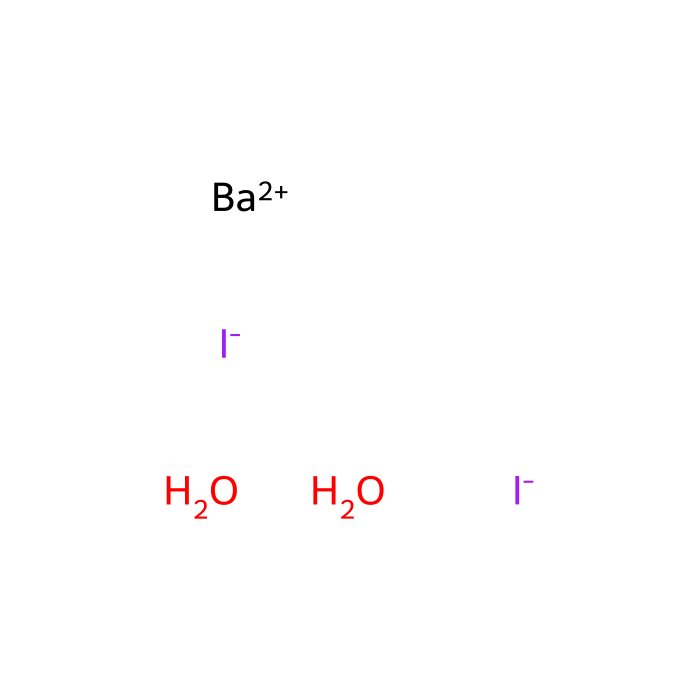
Barium iodide dihydrate is an inorganic, ionic salt consisting of a divalent barium cation coordinated by iodide anions and waters of crystallization.
Item-specific (Product Data):
SKU: B304626
CAS: 7787-33-9
Grade: AR (Analytical Reagent)
InChIKey (as provided): 207460
Storage: Room temperature, desiccated; shipped under normal conditions
Research use: For research use only
Literature/Computed (general reference, not item-specific specifications):
Preferred name: Barium iodide dihydrate
Molecular formula: BaI2·2H2O (literature)
Molecular weight: ~427.17 g/mol for BaI2·2H2O (literature; Ba 137.33, I 126.90×2, H2O×2)
InChI (BaI2, hydrate omitted in most line notations): InChI=1S/Ba.2HI/h;2*1H/q+2;;/p-2 (literature, for anhydrous salt representation)
Ion pair: Ba2+ with two I− counterions; in the crystalline dihydrate, Ba2+ typically exhibits higher coordination (e.g., octahedral/extended) involving water and iodide ligands.
Hydrate state: Two waters of crystallization per formula unit; hydrogen bonding networks contribute to lattice stability and deliquescent behavior.
2D description in words: Central Ba2+ cation electrostatically associated with two iodide anions; two neutral water molecules are incorporated in the crystal lattice and coordinate to Ba2+ via oxygen lone pairs. No stereocenters or covalent heterocycles are present.
Notes: Structural depictions for hydrates in line notations are often simplified to the anhydrous ionic pair plus explicit waters (dot-notation). Always confirm hydrate state by CoA for stoichiometry-sensitive applications.
Synthetic Utility
Dual-ion precursor:
Provides both Ba2+ and I−, enabling one-step introduction of barium and iodide into solution syntheses. Useful for preparing other barium salts via anion exchange (e.g., BaI2 + Na2SO4 → BaSO4↓ + 2 NaI), facilitating controlled precipitation and particle engineering.
Halide chemistry (general):
Iodide is a soft, nucleophilic anion capable of halide exchange with activated organohalides (Finkelstein-type equilibria). While NaI/KI are preferred in organic solvents, BaI2 can be leveraged in polar protic systems or where Ba2+ coordination influences outcome.
I− can catalyze certain substitutions (e.g., SN1/SN2 acceleration via in situ RI formation). When using BaI2, consider solvent choice (water/alcohols) and potential side precipitations with buffer anions.
Materials synthesis:
Starting material for barium-containing halides and oxo-salts via aqueous or alcohol routes; BaI2’s high solubility enables homogeneous mixing prior to thermal conversion to oxides/carbonates/other salts.
Potential utility in flux growth or ion-exchange pathways for creating iodide-rich lattices or doping studies (with caution regarding redox of iodide to iodine).
Practical considerations:
Avoid oxidants; maintain inert atmosphere when iodide oxidation would compromise product purity.
Control water content: the dihydrate introduces defined water; for strictly anhydrous conditions, dehydrate under controlled vacuum/heat or start from anhydrous BaI2 (verify by TGA/CoA).
Target Specificity
Not applicable. This product is an inorganic salt and is not an antibody, protein, or targeted biological reagent. No antigen, epitope, species reactivity, clone, or isotype information applies.
Benötigen Sie Hilfe bei der Auswahl der Qualität?
Unser Leitfaden zur Qualitätsauswahl behandelt Reinheit, Stabilisatorstatus und Anwendungseignung für alle Varianten in unserem Katalog.
Wir verwenden Cookies, um die ordnungsgemäße Funktion der Website sicherzustellen und, soweit zulässig, Ihr Nutzererlebnis zu verbessern. Sie können Ihre Einstellungen jederzeit unter „Einstellungen“ verwalten. Weitere Informationen finden Sie in unserer Cookie-Richtlinie.
Dürfen wir Sie über Rabattaktionen informieren?
Später erinnern
Vielen Dank! Bitte überprüfen Sie Ihren E-Mail-Posteingang, um zu bestätigen.
Products are supplied to verified businesses, institutions, and qualified professionals for research and development use only. Not for use in humans, animals, diagnosis, or therapy.