≥98% for sensitive chromatographic and analytical workflows requiring minimal baseline interference.
🌡
Storage & shipping
Store at -20°C Ships Ice chest + Ice pads Check lot-specific COA for exact specifications.
📋
Quality documents
SDS, COA, datasheet, and spec sheet available for download. Lot-specific COA accessible via lot number lookup.
📚
Literature proof
Cited in 0 peer-reviewed publications across chromatography, organic synthesis, and cross-coupling reactions.
Übersicht
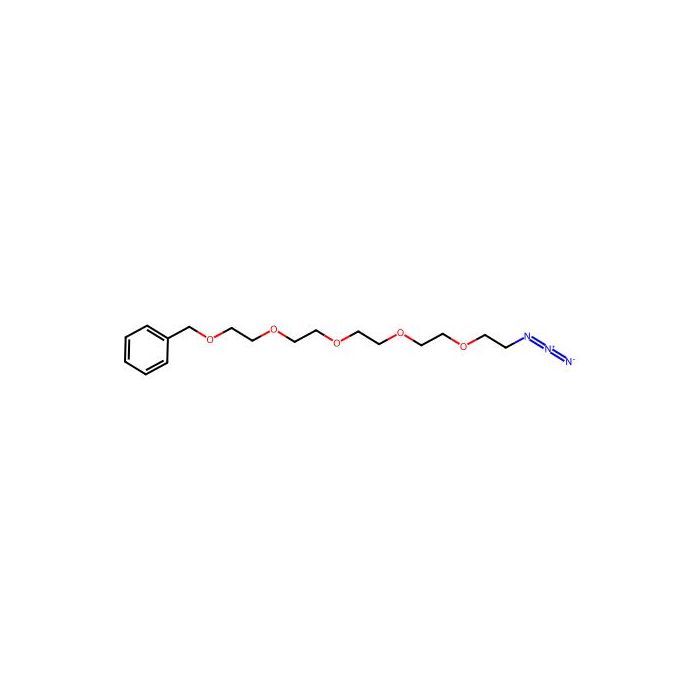
Benzyl-PEG5-azide is a PEG derivative containing a benzyl protecting group and an azide moiety. Benzyl is an alcohol protecting group which can be removed via hydrogenolysis. The azide moiety can participate in copper-catalyzed Click Chemistry reactions with alkynes, DBCO and BCN. The hydrophilic PEG spacer increases the water solubility of compounds in aqueous media.
Molecular Formula:C17H27N3O5
MW:353.4
Specifications
Spezifikationen & Reinheit
≥98%
Storage
Store at -20°C
Verschickt in
Ice chest + Ice pads
Dieses Produkt erfordert Kühlkettenversand. Grundversand und andere Economy-Optionen sind nicht verfügbar.
Reinheit
≥98%
Documentation
📋 Safety Data Sheet (SDS)
Comprehensive hazard, handling, storage, and regulatory compliance document.
Zertifikate (CoA, COO, BSE/TSE und Analyse-Diagramm)
C of A & Other Certificates(BSE/TSE, COO):
Analytical Chart:
Chemische und physikalische Eigenschaften
Löslichkeit
Solubility in Water, DMSO, DCM, DMF
Lösungsrechner
Molarity Calculator
Determine the necessary mass, volume, or concentration for preparing a solution.
Dilution Calculator
Determine the dilution needed to prepare a stock solution.
Reconstitution Calculator
Bewertungen
Kundenbewertungen
Application Protocols
No vendor-validated biological assay protocols are provided for this SKU. For general synthetic applications, see Reaction Conditions.
Suggested workflow outlines (literature/general):
CuAAC coupling:
Dissolve Benzyl-PEG5-azide and alkyne partner at 10–50 mM in t-BuOH/H2O (1:1).
Add CuSO4 (1–5 mol%) and sodium ascorbate (5–20 mol%); optionally add THPTA (1 equiv vs Cu).
Stir at RT until complete by LC–MS/TLC; quench with EDTA; extract or purify by RP-HPLC/flash.
Staudinger reduction to amine:
Dissolve azide in THF/H2O; add PPh3 (1.2–1.5 equiv) at RT.
Stir until azide band disappears; work up by aqueous extraction; purify as needed.
Benzyl deprotection:
Suspend in MeOH with Pd/C; apply H2 (1–3 bar) at RT.
Filter catalyst, concentrate, and purify.
These outlines are general guidance only; adapt stoichiometry, solvent, and purification to your specific substrates and scale.
Biological Roles
This product is a synthetic linker and does not have inherent biological function. However, in research contexts it is frequently used to spatially separate functional groups from biomolecular surfaces.
General notes (literature/general information):
PEG spacers are widely employed to reduce nonspecific protein adsorption and to improve aqueous compatibility of conjugates. A PEG5 chain provides approximately 2–3 nm of end-to-end contour length in extended conformations, though actual effective spacing depends on solvent and environment.
The azide group is bioorthogonal under most physiological conditions, enabling selective ligation to alkyne/strained-alkyne partners in complex media with minimal off-target reactivity.
The benzyl terminus can serve as a removable protecting group or hydrophobic anchor; after hydrogenolysis, the liberated hydroxyl can be further functionalized (e.g., carbonate/carbamate formation) for bioconjugation strategies.
No clinical or therapeutic claims are made or implied. For cell or protein work, assess potential effects of residual copper (if CuAAC was used) and thoroughly purify conjugates. Endotoxin content, metal residues, and residual solvent levels—if relevant to your application—must be verified on the supplied CoA/Spec Sheet for this SKU.
Buffer Applications
Not a buffering reagent. Benzyl-PEG5-azide does not establish defined pH ranges or buffer capacity.
Practical guidance:
When used in aqueous bioconjugation, select a buffer compatible with your chemistry:
CuAAC: Phosphate-buffered saline (PBS), HEPES, or Tris buffers (avoid excess amines with certain Cu-ligands) at pH ~7–8 are commonly employed (literature, general guidance). Ensure oxygen management and ligand choice for copper stabilization.
SPAAC: Broadly compatible with most biological buffers at neutral pH since no metal catalyst is required.
Filter buffers (0.22 µm) and degas as needed to minimize copper oxidation and to maintain reproducibility.
Item-specific buffer formulations are not applicable; refer instead to Reaction Conditions for setup details.
Green Alternatives
While Benzyl-PEG5-azide itself is a specialized linker, greener choices primarily concern solvent systems and copper management for click chemistry.
Greener practice options (literature/general):
Solvent selection for CuAAC:
Prefer ethanol/water or t-butanol/water mixtures over DMF/DMSO when substrate solubility allows—these are lower-toxicity, more biodegradable solvents.
For very hydrophobic partners, consider ethyl acetate or 2-MeTHF with small water fractions as more sustainable alternatives to DMF.
Copper source and ligand:
Use catalytic amounts of CuSO4 with in situ reduction by sodium ascorbate; employ water-soluble ligands (e.g., THPTA) to minimize copper loading and facilitate removal.
Explore polymer-supported copper catalysts for easier recovery.
Copper-free ligation:
SPAAC with DBCO/BCN eliminates copper waste; balance against cost and potential side reactions with nucleophiles.
Compact comparison (general guidance):
t-BuOH/H2O vs DMF/H2O: t-BuOH/H2O is greener and easier to handle; DMF/H2O offers broader solubility but higher environmental burden.
CuAAC vs SPAAC: CuAAC is economical and fastest with broad scope; SPAAC is greener (no copper) but requires strained alkynes and can be slower.
Waste minimization:
Exploit the PEG handle to enable aqueous extractions or phase-switch purification, reducing silica usage. Recycle solvent where feasible.
Pharmaceutical Uses
No pharmacopoeial monograph or excipient status is provided for this item. This product is offered strictly for research and laboratory use.
General R&D context (non-clinical):
Linker/scaffold in discovery chemistry: PEGylated azides are frequently used to assemble libraries via CuAAC, allowing SAR exploration while maintaining aqueous compatibility.
Bioconjugation process development: Acts as a hydrophilic spacer between small molecules/labels and biomacromolecules, aiding solubility and reducing aggregation in analytical assays.
Materials and surface science: Tailoring of surface properties (antifouling layers, sensor interfaces) through click grafting.
If use in regulated manufacturing is contemplated, detailed specifications (purity profile, residual solvents, metal content, endotoxin/bioburden) and change-control documentation must be obtained. For SKU-specific acceptance criteria, consult the CoA/Spec Sheet.
Physical Properties
Item-specific physical constants are not provided in the Product Data. The following are general expectations for PEGylated benzyl azides (literature/general information; not item specifications):
Appearance: Not specified for this item; refer to CoA/Spec Sheet.
Melting/boiling point: Not specified for this item; refer to CoA/Spec Sheet. PEG oligomers often present as low-melting waxy solids or viscous liquids depending on chain length (literature, general behavior).
Density/refractive index: Not specified for this item; refer to CoA/Spec Sheet. Values typically resemble short PEG oligomers (literature, general behavior).
Solubility (literature, general behavior):
High solubility in polar aprotic solvents (DMF, DMSO, NMP, acetonitrile) and good solubility in alcohols (MeOH, EtOH, i-PrOH).
Limited solubility in nonpolar hydrocarbons; partial solubility in dichloromethane/ethyl acetate.
Aqueous solubility can be moderate due to PEG5; the benzyl end imparts some hydrophobicity.
Partitioning: PEG chains reduce logP relative to purely hydrophobic azides; exact logP not specified for this item.
pKa: Not applicable (no ionizable acidic/basic centers under neutral conditions; azide is not protonated under typical conditions).
Always confirm operational properties (solubility, phase behavior) on a small scale with your intended solvent system, as impurity profile and microstructure can affect behavior.
Quality and Grades
Grade/Purity: Not specified for this item; refer to CoA/Spec Sheet.
Guidance on typical grading for this class of reagent (general information):
Research grade PEG-azides are commonly specified by HPLC purity or NMR purity and may include limits on residual solvents, di-/polymer content, and inorganic residues. Lower UV-absorbing grades may be preferred for photometric applications.
For bioconjugation, suppliers often offer low-endotoxin or metal-lean variants. If metal content is critical for downstream catalysis or bioassays, request the corresponding specification limits and CoA.
Stabilizers: Not commonly required for PEG-azides; product is typically supplied neat. If present, stabilizers or inhibitors would be disclosed on the label/CoA. None are specified for this item.
Verification and release testing considerations (general best practice):
Identity by 1H/13C NMR and HRMS; azide IR band typically ~2100 cm⁻¹ (literature).
Purity by HPLC/GC where applicable; water content by Karl Fischer if formulation sensitivity warrants it.
For regulatory or QA documentation (endotoxin, residual metals, solvent content), please consult the specific CoA/Spec Sheet for SKU B595301.
Reaction and Applications
This reagent is a versatile bifunctional linker combining a benzylic protecting/capping group with a terminal azide for modular coupling.
Click chemistry (CuAAC): Rapid, high-yield coupling to terminal or internal alkynes to form 1,4-disubstituted triazoles. Ideal for installing a benzyl–PEG5 spacer onto small molecules, polymers, or surfaces bearing alkyne handles. The PEG5 chain improves aqueous compatibility and reduces nonspecific binding in bioassays.
Copper-free click (SPAAC): Reaction with strained alkynes (DBCO, BCN) enables metal-free ligation on sensitive biomolecules.
Azide-to-amine conversion: Staudinger reduction (PPh3/H2O) or catalytic hydrogenation affords the corresponding benzyl-PEG5-amine, enabling amide coupling, urea formation, or reductive amination.
Protecting group strategy: The benzyl ether can be cleaved by hydrogenolysis (H2, Pd/C) to unveil HO–PEG5–azide, offering orthogonal deprotection relative to the azide handle.
Surface/polymer modification: Grafting to alkyne-functional polymers, nanoparticles, or surfaces to introduce a hydrophilic spacer that diminishes protein fouling and tunes interfacial properties.
Practical tips:
Maintain metal cleanliness when targeting CuAAC; residual thiols/amines can chelate Cu(I)—use appropriate ligands (TBTA, THPTA) to accelerate and stabilize.
For sensitive substrates, consider SPAAC to avoid copper exposure.
Following click, PEGylated products often purify efficiently by reverse-phase chromatography; monitor by LC–MS and IR (loss of azide band ~2100 cm⁻¹, literature).
Reaction Conditions
The following are typical literature conditions for the key transformations of Benzyl-PEG5-azide (general guidance; optimize for your substrates):
CuAAC (azide–alkyne cycloaddition):
Solvent: t-BuOH/H2O (1:1), EtOH/H2O, or DMF/H2O for hydrophobic partners.
Catalyst: 1–10 mol% CuSO4·5H2O with 2–20 mol% sodium ascorbate (in situ Cu(I) generation).
Ligand: TBTA or THPTA (1–2 equiv relative to Cu) to accelerate and protect biomolecules.
Temperature/time: RT to 40 °C; 0.5–12 h typically affords high conversion.
Notes: Degas solutions if needed; monitor loss of azide IR (~2100 cm⁻¹) and appearance of triazole signals.
SPAAC (copper-free):
Partner: DBCO/BCN-functionalized alkyne.
Solvent: Aqueous buffer or mixed organic/aqueous; RT.
Time: 1–24 h depending on concentration and ring strain.
Azide reduction to amine:
Staudinger: PPh3 (1.2–1.5 equiv) in THF/H2O or dioxane/H2O, RT to 50 °C; hydrolysis to liberate amine, then standard aqueous workup.
Hydrogenation: H2 (1–3 bar), Pd/C (5–10 wt%), MeOH/EtOH, RT to 40 °C; monitor to avoid premature benzyl cleavage if not desired.
Benzyl ether hydrogenolysis (to unmask PEG–OH):
H2 (1–3 bar), Pd/C, MeOH/EtOAc, RT–40 °C; several hours. Protect azide if necessary or verify compatibility—aliphatic azides often survive mild hydrogenolysis but may reduce under more forcing conditions (literature caution).
Always perform small-scale trials to balance selectivity between azide and benzyl functionalities.
Safety and Handling
GHS classification, signal word, pictograms, and H-statements: Not specified for this item; refer to the SDS for authoritative safety information.
General hazards (general chemistry guidance for organic azides and PEGylated organics):
Organic azides can be sensitive to heat and strong shock; however, aliphatic/benzylic azides with high molecular weight and without metal salts are typically of low explosive potential. Avoid heating to dryness and avoid contact with heavy metal salts (e.g., Cu(II), Pb(II)) that can form sensitive metal azides.
May cause irritation to skin/eyes/respiratory tract upon contact or inhalation of dust/aerosols.
PPE: Laboratory coat, safety glasses or face shield, and appropriate chemical-resistant gloves (e.g., nitrile). Handle in a fume hood to avoid inhalation of vapors/aerosols.
Incompatibilities: Strong oxidizers, strong acids capable of generating hydrazoic acid, and heavy metal salts (risk of forming metal azides). Avoid sodium azide cross-contamination.
First aid (overview; consult SDS):
Skin/eye contact: Rinse with water for at least 15 minutes; remove contaminated clothing; seek medical attention if irritation persists.
Inhalation: Move to fresh air; monitor breathing; seek medical attention if symptoms occur.
Ingestion: Rinse mouth; do not induce vomiting; seek medical attention.
Fire safety: Use CO2, dry chemical, or foam. Combustion may produce CO/CO2 and nitrogen oxides.
Waste: Collect organic azide residues in compatible, clearly labeled containers. Do not allow contact with metal drain pipes; follow institutional hazardous waste procedures.
Solvent Selection
Benzyl-PEG5-azide behaves as an amphiphilic PEGylated small molecule: the PEG chain favors polar media while the benzyl cap adds mild hydrophobicity.
Polarity/miscibility (literature, general behavior):
Freely miscible or highly soluble in polar aprotic solvents (DMF, DMSO, NMP, acetonitrile).
Soluble in alcohols (methanol, ethanol, isopropanol) and often in acetone/ethyl acetate; moderate in dichloromethane.
Limited in alkanes and other nonpolar solvents.
Aqueous co-solvent systems (t-BuOH/H2O, MeOH/H2O) commonly used for CuAAC due to PEG compatibility.
Selection tips:
For CuAAC: t-BuOH/H2O (1:1) or EtOH/H2O mixtures balance solubility for both partners; DMF/H2O works well for hydrophobic alkynes.
For azide reductions (Staudinger): THF/H2O or THF/MeOH supports PPh3 solubility and phase transfer of PEG.
For hydrogenolysis of the benzyl ether: MeOH, EtOH, or EtOAc under H2/Pd.
For purification: Reverse-phase methods or normal-phase with MeOH/DCM or EtOAc/hexanes gradients leveraging PEG polarity.
Comparison (general):
DMF vs DMSO: DMF is easier to remove and often preferred for work-up; DMSO offers broader solubility but is more challenging to dry/remove.
Alcohol/H2O vs DMF/H2O in click: Alcoholic systems are greener and often sufficient; switch to DMF/H2O when alkyne partner is poorly soluble.
Storage and Reconstitution
Storage: Store at −20 °C (per Product Data). Protect from light and moisture. Minimize freeze–thaw cycles by aliquoting upon initial receipt.
Shipping: Shipped in an ice chest with ice pads (per Product Data) to maintain cold-chain integrity.
Stability (general guidance): Organic azides are typically stable at low temperature under inert atmosphere. Avoid prolonged exposure to heat. Keep away from heavy metal salts and strong acids.
Containers: Use amber vials with PTFE-lined caps. For long-term storage, consider an inert gas blanket (N2 or Ar) and desiccation.
Reconstitution/solubilization (general):
Readily dissolves in anhydrous DMF, DMSO, acetonitrile, methanol, ethanol, and isopropanol. For aqueous applications, prepare stock in a miscible organic solvent and dilute into buffer immediately before use.
For bioconjugation, prepare fresh solutions to limit hydrolysis/oxidation and to ensure accurate concentration.
Handling tips: Warm gently to room temperature before opening to avoid moisture condensation. If solid or semi-solid, allow to equilibrate in a desiccator.
Item-specific limits such as water content, residual solvents, and metal content are not specified for this item; refer to the CoA/Spec Sheet. Research use only (per Product Data).
Structure and Identity
Benzyl-PEG5-azide is a bifunctional PEGylated linker bearing a benzyl ether cap on one terminus and an azide on the other, separated by five ethylene glycol repeat units (–O–CH2–CH2–)5–.
Molecular formula: Not specified for this item; refer to CoA/Spec Sheet.
Molecular weight: Not specified for this item; refer to CoA/Spec Sheet.
SMILES: Not specified for this item; refer to CoA/Spec Sheet.
InChIKey: Not specified for this item; refer to CoA/Spec Sheet.
CAS: 86770-72-1
Structural features (general description):
One terminal benzyl ether (Ph–CH2–O–) providing a hydrophobic, removable protecting/capping group.
A flexible, hydrophilic PEG5 spacer (five –CH2–CH2–O– units) that imparts water compatibility and distance from surfaces or biomacromolecules.
A terminal organic azide (–N3) suitable for Cu(I)-catalyzed azide–alkyne cycloaddition (CuAAC, “click chemistry”) or reduction to the corresponding primary amine.
2D depiction in words: Phenyl ring attached to –CH2–O–, followed by five repeats of –CH2–CH2–O–, terminating in –CH2–CH2–N3. No stereocenters are present.
Notes:
Item-specific identifiers (MF/MW/SMILES/InChIKey) are not provided in the Product Data; consult the Certificate of Analysis for definitive identity parameters.
Synthetic Utility
Functional group set and value in synthesis (literature/general):
Terminal azide:
Platform for CuAAC/SPAAC to form robust 1,2,3-triazoles with terminal/internal or strained alkynes—chemoselective, tolerant of water and many functional groups.
Convertible handle: Reduction to primary amine (Staudinger, catalytic hydrogenation, or borohydride–Ni/Co systems) enabling amide coupling, sulfonamide formation, or urea linkages.
Participation in traceless Staudinger ligations with electrophilic partners.
Benzyl ether terminus:
Orthogonal protecting/capping group for the PEG hydroxyl; removable under mild hydrogenolysis (H2, Pd/C) to reveal HO–PEG5–N3 for further elaboration (e.g., carbonate/carboxylate activation).
Hydrophobic anchor to influence phase behavior or adsorption during separations.
PEG5 spacer:
Provides conformational flexibility and aqueous compatibility; useful in linking recognition elements to reporters without steric occlusion.
Retrosynthetic perspective:
Serves as a modular “spacer block” between two diverse fragments: triazole-connected partner on the azide side, and either retained benzyl cap or unmasked alcohol for downstream coupling. This orthogonality enables stepwise, high-yield assembly of complex architectures (polymers, dendrons, probes).
Target Specificity
Not applicable. This product is a small-molecule linker and does not possess biological target specificity (no antigen/epitope/isotype information). No antibody or protein-binding data are associated with this SKU.
Häufig gestellte Fragen
What is the purity of this product?
This product is supplied at ≥98% purity (chemical assay). Lot-specific values are stated on the Certificate of Analysis.
How should this product be stored?
Store at ?20 °C. Freezer storage is required to maintain the specified shelf life.
How is this product shipped?
This product ships in an insulated container with ice pads. Unpack on arrival and transfer it to the storage condition stated above.
Wir verwenden Cookies, um die ordnungsgemäße Funktion der Website sicherzustellen und, soweit zulässig, Ihr Nutzererlebnis zu verbessern. Sie können Ihre Einstellungen jederzeit unter „Einstellungen“ verwalten. Weitere Informationen finden Sie in unserer Cookie-Richtlinie.
Shall we send you a message when we have discounts available?
Remind me later
Thank you! Please check your email inbox to confirm.
Products are supplied to verified businesses, institutions, and qualified professionals for research and development use only. Not for use in humans, animals, diagnosis, or therapy.