GRADE & PURITYMoligand™?Moligand™ — Aladdin's line of ligands and bioactive small molecules. Use for receptor, pathway, and binding studies needing defined small-molecule tools.10mM in DMSO
Moligand™, 10mM in DMSO Moligand™ for sensitive chromatographic and analytical workflows requiring minimal baseline interference.
🌡
Storage & shipping
Store at -80°C Ships Dry ice packs + Cold packs Check lot-specific COA for exact specifications.
📋
Quality documents
SDS, COA, datasheet, and spec sheet available for download. Lot-specific COA accessible via lot number lookup.
📚
Literature proof
Cited in 0 peer-reviewed publications across chromatography, organic synthesis, and cross-coupling reactions.
Übersicht
Information
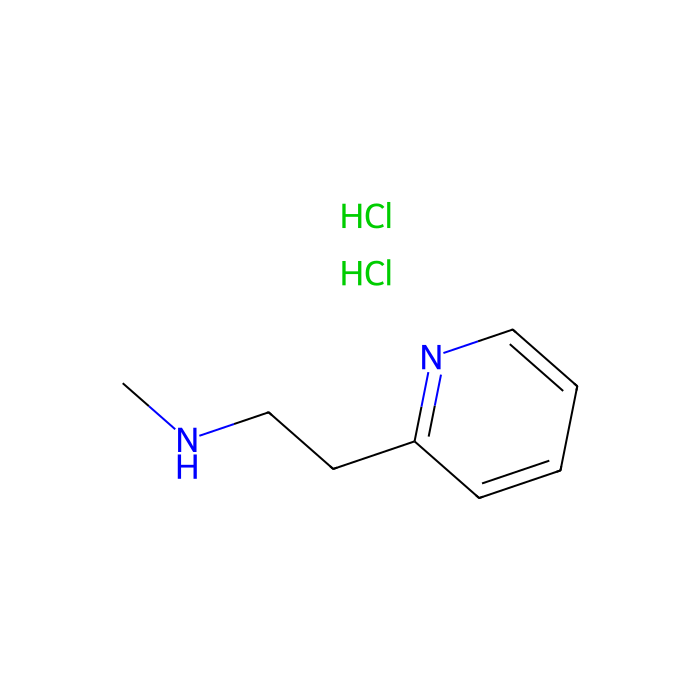
Betahistine (PT-9) is ahistamine H3receptor inhibitor withIC50of 1.9 μM. In vitro
Betahistine progressively enhances cAMP formation with a maximal effect, observed up to 10 nM, in CHO(H3R) cells incubated with 3 μM forskolin. In contrast, at concentrations higher than 10 nM betahistine progressively inhibits cAMP formation in CHO(H3R) cells incubated with 3 μM forskolin. Betahistine progressively reduces A23187-evoked [3H]arachidonic acid release (EC50=0.1 nM) with a maximal effect, observed up to 30 nM A23187-evoked [3H]arachidonic acid release from CHO(H3R) cells. Betahistine progressively enhanced the release of A23187-evoked [3H]arachidonic acid from CHO(H3R) cells at concentrations higher than 30 nM.
In vivo
Betahistine (< 30 mg/kg) increases t-MeHA levels in a dose-dependent manner with an ED50 of 2 mg/kg and a maximal effect of ∼35% reached at 30 mg/kg in mouse brain. Betahistine (16 mg twice per day for 3 months) has a significant effect on the frequency, intensity and duration of vertigo attacks, associated symptoms and the quality of life also are significantly improved in patients with Meniere\'s disease. Betahistine-dihydrochloride (16 mg tid and 48 mg tid) shows that the number of attacks per month decreased in both doses over time in Meni鑢e\'s disease. Betahistine (50 mg/kg) treatment induces symmetrical changes with up-regulation of histidine decarboxylase mRNA in the tuberomammillary nucleus and reduction of [3H]N-alpha-methylhistamine labeling in both the tuberomammillary nucleus, the vestibular nuclei complex and nuclei of the inferior olive in brain sections of cats. Cell Data
Wir verwenden Cookies, um die ordnungsgemäße Funktion der Website sicherzustellen und, soweit zulässig, Ihr Nutzererlebnis zu verbessern. Sie können Ihre Einstellungen jederzeit unter „Einstellungen“ verwalten. Weitere Informationen finden Sie in unserer Cookie-Richtlinie.
Shall we send you a message when we have discounts available?
Remind me later
Thank you! Please check your email inbox to confirm.
Products are supplied to verified businesses, institutions, and qualified professionals for research and development use only. Not for use in humans, animals, diagnosis, or therapy.